


Accessories 101: The Rules

Here's a number that might catch you off guard: according to The NPD Group, Americans spend over $90 billion a year on fashion accessories [1]. That's more than the GDP of some countries. All of it going toward bags, belts, hats, jewelry, and scarves. And yet most of us still stand in front of the mirror wondering whether our earrings work with our necklace, or if that belt is actually doing anything at all.
If you've ever pulled on a pair of leggings and a tunic and thought, "this looks fine but not quite finished," accessories are the missing piece. Legging apparel has become the backbone of modern wardrobes, and for good reason. It's comfortable, versatile, and goes with almost anything. But without the right accessories, it can also look incomplete.
The good news? Accessorizing isn't some mysterious art reserved for people with fashion degrees. There are actual rules. Not rigid, suffocating ones. More like guidelines that keep you from looking like you got dressed in the dark or raided a costume shop.
I've spent years figuring out what works, what doesn't, and what's worth spending real money on. So let's get into the actual rules of accessorizing, from proportion and color to knowing when less really is more.

The best outfits don't come from piling on more accessories. They come from choosing the right ones and having the confidence to leave the rest in the drawer. One intentional piece beats five random ones, every time.
Why Do Accessories Matter More Than You Think?
There's a reason stylists call accessories "the finishing layer." Fashion psychologist Carolyn Mair, who teaches at the London College of Fashion, has noted that people form first impressions within about 7 seconds. Your accessories are often the first things someone notices because they catch light, add color, or create movement. A plain black outfit with a bold watch and structured bag reads completely differently than the same outfit with nothing added.
Think about it this way. Two people walk into a coffee shop wearing identical black leggings and a white tee. One has a pendant necklace, clean white sneakers, and a crossbody bag. The other has no jewelry, scuffed shoes, and carries their phone in hand. Same base outfit. Wildly different impressions. That's what accessory styling actually does.
Accessories also do practical work. A belt defines your waist. Sunglasses protect your eyes and add attitude. A good bag carries your stuff without making you look like you're heading to the gym when you're actually meeting friends for dinner. When you're wearing legging apparel especially, accessories are what bridge the gap between "I just rolled out of bed" and "I planned this look."
Quick Q&A
Q: Do accessories really change how people perceive your outfit?
A: Yes. Research in fashion psychology consistently shows that accessories influence snap judgments about competence, style, and social status within seconds of a first impression.
If you've been treating accessories as an afterthought, you're leaving a lot of style on the table. And honestly? Getting them right is easier than picking out the perfect pair of jeans.
What Is the One-Statement-Piece Rule?
This is the single most reliable accessorizing rule out there. It's been echoed by everyone from Coco Chanel ("before you leave the house, look in the mirror and take one thing off") to modern stylists working with the Council of Fashion Designers of America (CFDA). The rule is simple: pick one standout accessory per outfit and let everything else play a supporting role.
If your statement piece is a chunky gold necklace, keep your earrings small or skip them entirely. Wearing bold, oversized sunglasses? Tone down the jewelry. The goal is a focal point, not a competition between six different loud pieces fighting for attention. This matters even more when your clothing is already streamlined, as it tends to be with athleisure styling. Legging apparel creates a sleek silhouette, so one strong accessory sits beautifully against that clean canvas.
Here's a concrete example I come back to often. Throw on a pair of high-waisted leggings, an oversized knit sweater, and then add a structured leather tote. The bag is your statement. Now add simple stud earrings and a thin bracelet. Done. The outfit looks intentional, balanced, and put together without any piece screaming louder than the rest.
Browse the Women's Proteck'd Collection and you'll see how clean, well-designed clothing naturally invites this kind of one-piece accessorizing. When your base layer already has thoughtful design elements, you don't need to pile on extras to look polished.
How Do You Accessorize Leggings Without Looking Sloppy?
Let's address the elephant in the room. Leggings have a reputation problem. Some people still think of them as glorified pajamas, which is absurd given that the global athleisure market hit $330 billion in 2023 according to Statista [2]. Leggings are a legitimate wardrobe staple. The trick is accessorizing them with enough structure to signal that you got dressed on purpose.
The first move is footwear. Swap your house slippers for ankle boots, loafers, or even pointed-toe flats. Your legging outfit instantly shifts from casual to polished. Footwear is arguably the most impactful accessory you can pair with fitted legwear because it anchors the entire look from the bottom up.
Next, think about bags. A slouchy backpack keeps the vibe casual (sometimes too casual). A structured crossbody or a mini bucket bag, on the other hand, adds a layer of sophistication. If you're heading out in legging apparel and want to look like you have somewhere to be, choose a bag with clean lines and minimal hardware.
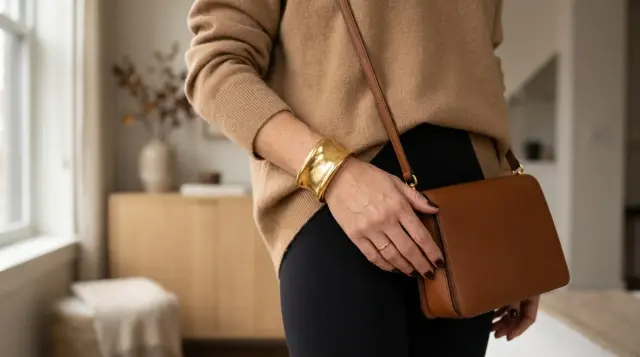
Jewelry layering plays a big role too. A stack of thin gold bracelets or a layered necklace setup adds texture and visual interest to an otherwise minimal outfit. And if you're looking for pieces that serve double duty as both fashion-forward and functional, the Faraday Fashion Collection offers options that blend real technology with wearable style. We covered more outfit coordination rules in our guide on Accessories That Elevate Any Outfit: What to Actually Buy.
What Are the Proportion Rules for Accessories?
Proportion sounds intimidating until you break it down. It's really just about balance. If your clothing is fitted and streamlined (think leggings with a tucked-in tee), your accessories can afford to be bigger and bolder. Oversized hoop earrings, a chunky watch, a wide belt over a long cardigan. These work because they contrast with the slim base.
Flip it around, though. If you're wearing an oversized sweatshirt or a billowy dress, go smaller and more delicate with your accessories. A dainty chain. Thin rings. A compact clutch. This prevents the outfit from looking like everything is competing for real estate. Fashion editor and author Tim Gunn has talked about this concept extensively, framing it as "visual weight distribution" across an outfit.
Here's a real-world test I use. Stand in front of a full-length mirror and squint. Seriously. When you blur the details, you can see the overall shape of your outfit as blocks of visual weight. If everything looks heavy on top and nothing on the bottom, add a statement shoe or an ankle bracelet. If the bottom half is doing all the work (say, patterned leggings with bold sneakers), keep the top half simple.
Quick Q&A
Q: Should accessories match the size of your body frame?
A: Not necessarily. Accessories should balance the proportions of your outfit, not your body. A petite person in a streamlined outfit can absolutely rock oversized earrings if the rest of the look is minimal.
The Men's Proteck'd Collection is a great example of how proportion-aware design works in practice. The clean cuts give you a solid foundation, so your accessories can do the talking without everything looking cluttered.
Should You Match Your Metals or Mix Them?
This question starts more debates than pineapple on pizza. For decades, the rule was strict: gold with gold, silver with silver, never the two shall meet. But fashion has loosened up considerably since the early 2000s, and mixing metals is now widely accepted. The key is doing it with intention, not by accident.
If you want to mix metals, the easiest approach is to pick one dominant metal (say, gold) and use the other as an accent. So your necklace, watch, and rings might be gold, but you throw in one silver bracelet. This creates a deliberate mixed-metal look rather than a "grabbed whatever was on the nightstand" situation.
According to a 2022 consumer trends analysis by the Jewelry Industry Summit in New York, mixed-metal jewelry saw a 28% increase in sales compared to the previous year. That suggests consumers are very much embracing this once-taboo combination. The shift reflects a broader move toward personal expression over rigid matching rules.
That said, if you're just starting to build your accessory collection, sticking with one metal family is the safer bet. It simplifies decision-making and ensures everything coordinates without much effort. If you're curious about building a more intentional wardrobe overall, our post on How to Build a Sustainable Wardrobe From Scratch: Where to Start covers the philosophy behind buying fewer, better pieces.
How Do You Choose Accessories for Different Occasions?
Context matters. A lot. The accessories you'd wear to brunch on a Saturday are not the ones you'd choose for a Monday morning client meeting. This seems obvious, but I see people get it wrong constantly, usually by either overdressing or underdressing for the setting.
For professional settings, the general guideline from image consultants at organizations like the Association of Image Consultants International (AICI) is to keep accessories minimal, high-quality, and understated. A classic watch, small earrings, a leather bag. Nothing that jingles, nothing that distracts. If you need a deeper breakdown, check out our guide on What to Wear to a Business Meeting: The Complete Guide.
For casual outings, that's where you can experiment. Stack those bracelets. Wear the hat. Try a belt bag instead of a traditional purse. Legging apparel shines in casual contexts because it gives you a relaxed foundation to build on with bolder accessory choices. A pair of black leggings with an oversized flannel, combat boots, and a beanie? That's a whole mood, and it works because every accessory adds character without formality.
For evening events, think about shine and texture. A metallic clutch, drop earrings, or a silk scarf can take even simple fitted pants and a blouse into cocktail territory. The trick is elevation through detail, not a complete wardrobe overhaul. We ranked the best accessories for this exact purpose in Accessories That Elevate Any Outfit: Ranked.
What Accessories Are Worth Investing In?
Not all accessories are created equal. Some you should splurge on because they'll last for years and get daily use. Others you can grab affordably because they're trend-driven and won't stick around long. The 2020 ThredUp Resale Report found that 64% of women are now open to buying secondhand accessories, which is smart for trendy pieces but less ideal for everyday staples [3].
Worth investing in: a quality leather bag (it'll outlast five cheap ones), a versatile watch, a pair of classic sunglasses from a reputable brand with UV protection (the American Academy of Ophthalmology recommends 100% UV-blocking lenses), and a set of simple gold or silver jewelry you can wear daily [4]. These are your workhorses.
Save money on: seasonal scarves, trendy hair accessories, costume jewelry in bold colors, and novelty items like themed socks or pins. These are fun to rotate but not worth a big financial commitment since trends cycle fast.
When it comes to functional fashion that's actually worth the investment, legging apparel with built-in technology or performance features falls into the "buy once, buy right" category. Brands like Proteck'd are doing interesting work here, creating pieces that look good and serve a genuine purpose beyond aesthetics. That crossover between style and substance is where smart accessorizing really pays off.
Can You Over-Accessorize? How Do You Know When to Stop?
Yes. You absolutely can over-accessorize, and it happens more often than under-accessorizing. The telltale sign? When someone looks at your outfit and can't identify a focal point. If their eyes are bouncing from your hat to your scarf to your necklace to your belt to your bangles without landing anywhere, you've gone too far.
A good litmus test comes from stylist Stacy London, who co-hosted "What Not to Wear" on TLC for a decade. Her advice was to check yourself in three zones: head/neck, wrists/hands, and waist/feet. Pick two of those three zones to accessorize and leave the third quiet. This creates visual breathing room.
For instance, if you're wearing earrings and a necklace (head/neck zone) plus a statement belt (waist zone), keep your wrists bare or minimal. If you're rocking stacked bracelets and rings (wrists/hands) with ankle boots and a chain belt (waist/feet), skip the necklace. It sounds simple because it is. And it works every single time.
The best outfits, whether they're built around fitted legwear, tailored suits, or flowing dresses, have a sense of intention. That intention comes not from adding more, but from editing well. Every accessory should answer the question: "Does this add something, or is it just noise?"
- Follow the one-statement-piece rule: choose one bold accessory and keep everything else supporting.
- Proportion matters. Pair fitted legging apparel with bolder accessories, and oversized clothing with delicate ones.
- Invest in daily-use accessories like quality bags, watches, and UV-blocking sunglasses, and save money on trend-driven pieces.
- Match accessories to the occasion. Professional settings call for restraint; casual outings invite experimentation.
- Use the three-zone check (head/neck, wrists/hands, waist/feet) to avoid over-accessorizing.
Frequently Asked Questions
A good rule of thumb is two to four accessories per outfit, with one being a standout piece. Use Stacy London's three-zone approach: accessorize two of three zones (head/neck, wrists/hands, waist/feet) and leave the third minimal. This prevents visual overload while still looking polished.
Absolutely. Accessories are what transform leggings from loungewear into a real outfit. Structured bags, layered jewelry, quality footwear, and belts worn over longer tops all work beautifully with legging apparel. The key is choosing accessories with enough structure to balance the casual vibe of the leggings.
Yes, mixing metals is widely accepted now. The easiest method is to pick one dominant metal and use the other sparingly as an accent. Sales data from the 2022 Jewelry Industry Summit showed mixed-metal jewelry rising 28%, confirming the trend is here to stay.
Footwear and bags tend to have the highest impact because they're the largest accessories and the most visible from a distance. After that, a good watch or a layered necklace adds noticeable polish. These four items account for most of the "finishing" effect that accessories provide.
No. Matching too precisely can look dated and overly coordinated. Instead, aim for accessories that complement your outfit through tone, texture, or mood. A warm-toned bag with a warm-toned outfit works, but they don't need to be the exact same shade.
Start with clean, quality footwear like white sneakers or ankle boots. Add a structured bag instead of a gym tote. Layer one or two pieces of simple jewelry, and consider a hat or sunglasses for visual interest. These swaps take athleisure from workout-ready to brunch-appropriate.
Spend more on items you'll use daily that also age well: a quality leather bag, a versatile watch, classic sunglasses with full UV protection, and a set of real-metal jewelry in gold or silver. These pieces pay for themselves through years of daily wear. Save your budget for trend items that won't last more than a season.
Belts remain highly useful, but their role has shifted from purely functional to largely aesthetic. A belt worn over a cardigan or blazer with leggings creates waist definition and adds a structural element to a soft outfit. Even in 2024, a quality belt is one of the most versatile accessories you can own.
Keep it minimal and high-quality. A classic watch, small earrings, and a structured bag are the standard recommendations from image consultants at organizations like the AICI. Avoid anything that jingles, oversized statement pieces, or overly casual items like beanies or novelty jewelry.
Yes, absolutely. Hats are one of the most impactful accessories because they frame your face and set the tone for the entire outfit. A baseball cap reads sporty and casual. A wide-brim felt hat reads polished and editorial. Choose based on the mood you're going for.
About the Author
Proteck'd EMF Apparel
Health & EMF Specialists
The Proteck'd team covers EMF protection, silver-fiber apparel, and practical ways to reduce everyday radiation exposure. Every piece Proteck'd ships is designed, tested, and worn by the people who build it.
Protect Yourself Today
Proteck'd Faraday and silver fiber apparel is engineered to shield your body from everyday EMF exposure. Built for real life, tested for real results.
Shop EMF Protection →✓30-day returns✓Free shipping✓Free returns✓Silver fiber shielding


Leave a comment