


How Reliable Are Smartwatches?: What to Trust and What to Ignore

Your smartwatch just told you that you slept 7 hours and 42 minutes, burned 2,300 calories, and your stress level is "elevated." Cool. But how much of that should you actually believe?
I've spent the better part of two years testing wearables from Apple, Samsung, Garmin, and Google. The honest answer: some of it is remarkably good, and some of it is basically a guess dressed up in a nice graph.
If you've ever searched for how does smartwatch comparison guide work, you've probably landed on sites that line up spec sheets side by side and call it a day. Screen size, battery claims, sensor lists. That format is useful for a quick glance, but it tells you almost nothing about whether the data on your wrist is worth trusting with actual health decisions.
The real work of a smartwatch comparison happens underneath all that. It's about figuring out which sensors have been validated against clinical-grade equipment, which software ecosystems quietly lock you in, and which marketing claims fall apart once you read the fine print. That's what we're covering here.
I'm not here to tell you which watch to buy. I want to help you understand what the numbers on your wrist actually mean, where smartwatch technology delivers genuine value, and where you're better off ignoring the notification entirely. Let's get into it.
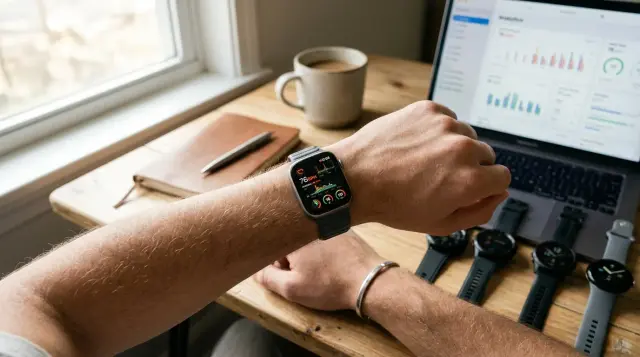
A spec without validation is a promise without evidence. The most important thing a smartwatch comparison can tell you isn't which watch has the most features. It's which features have actually been proven to work.
How Does a Smartwatch Comparison Guide Actually Work?
Most smartwatch comparison guides follow a predictable formula. They pull manufacturer specs, line them up in columns, and let you sort by price, battery life, screen resolution, or feature count. Sites like PCMag go further by running lab-tested benchmarks, measuring actual battery drain during GPS tracking, and scoring display brightness with a lux meter. Versus.com takes a more data-driven approach, letting you filter by hundreds of granular specs. Both methods answer part of the question. Neither tells the whole story.
Understanding how does smartwatch comparison guide work means recognizing that the best guides test real-world performance, not just what's printed on a box. A watch might claim 48-hour battery life. But if you're running always-on display plus continuous heart rate monitoring plus GPS for a daily run, you might get 18 hours. That gap between claimed specs and lived experience is where good comparison guides earn their keep.
Then there's the deeper layer: sensor validation. A 2022 review published in npj Digital Medicine found that consumer-grade wrist-worn heart rate sensors are generally accurate within 3 to 5 beats per minute at rest, but accuracy drops off during vigorous movement [1]. A comparison guide that doesn't mention this nuance is really just a shopping catalog with a prettier layout.
Quick Q&A
Q: Do smartwatch comparison guides test devices in real-world conditions?
A: The best ones do. PCMag and independent reviewers run multi-day wear tests, but many comparison sites only reprint manufacturer-provided specifications without independent verification.
There's also the question of what gets compared at all. Most guides skip over things like EMF output, data privacy practices, and long-term software support. If you're wearing something on your body 16 hours a day, those factors matter. For a closer look at how wearable categories stack up beyond spec sheets, check out our Smartwatch vs Fitness Tracker: An Honest Comparison.
Which Smartwatch Health Metrics Can You Actually Trust?
Not all health data from your wrist is created equal. Heart rate monitoring is the most reliable metric on most modern smartwatches, and it's not particularly close. The optical photoplethysmography (PPG) sensors used by Apple Watch, Samsung Galaxy Watch, and Google Pixel Watch have been tested extensively. A Stanford Medicine study from 2019 involving over 400,000 participants showed the Apple Watch could detect irregular heart rhythms with reasonable accuracy, which led to its FDA 510(k) clearance for atrial fibrillation screening [2].
Step counting? Decent, but far from perfect. Research published in the Journal of Sports Sciences found that wrist-worn accelerometers can overcount or undercount steps by 15 to 20 percent depending on walking speed and arm swing patterns. If you're using step count as a rough motivational tool, fine. If you're trying to precisely calibrate calorie expenditure from those steps, you're building on shaky ground.
Blood oxygen (SpO2) is where things get murkier. The FDA has not cleared most consumer smartwatch SpO2 sensors for medical-grade diagnosis. Samsung and Apple both include disclaimers stating their readings are "not intended for medical use." During the COVID-19 pandemic, many people relied on smartwatch SpO2 readings for peace of mind. The Cleveland Clinic has cautioned that fingertip pulse oximeters are significantly more reliable than wrist-based sensors for clinical decisions [3].
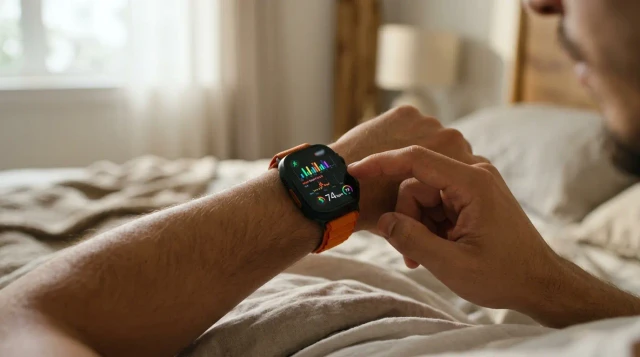
Sleep tracking is another mixed bag. Most watches use a combination of movement data and heart rate variability to estimate sleep stages. The problem? A 2020 study in the journal Sleep found that consumer wearables frequently misclassify light sleep as deep sleep and struggle to accurately detect REM phases. Your watch might say you got great sleep when you actually didn't. And vice versa. Use the trends, not the individual night's score.
What Should You Ignore on Your Smartwatch?
"Stress scores" are probably the most overhyped metric in wearable tech right now. Watches like the Samsung Galaxy Watch 7 and Fitbit Sense 2 claim to measure your stress level throughout the day. What they're actually measuring is heart rate variability (HRV), which can be influenced by caffeine intake, hydration, posture changes, and even ambient temperature. Calling it a "stress score" implies a psychological insight that the hardware simply can't deliver.
Body composition measurements deserve skepticism too. Samsung introduced bioelectrical impedance analysis (BIA) on the Galaxy Watch 4 series, claiming it could estimate body fat percentage. Independent testing by outlets like The Verge and Tom's Guide found wildly inconsistent results compared to DEXA scans, which are the gold standard. Off by 5 to 8 percentage points in some cases. That's not a rounding error. That's a completely different body composition category.
Then there are the proprietary wellness scores with no clinical basis at all. "Body Battery" from Garmin, "Readiness Score" from Oura, "Energy Score" from Fitbit. These are algorithmic mashups of sleep data, HRV, and activity levels. They can be fun to glance at, but treating them as medical advice is a mistake. No peer-reviewed study has validated these composite scores against actual clinical outcomes.
The bottom line: if a metric on your smartwatch doesn't come with a clear explanation of what sensor is collecting what data and how it's being interpreted, treat it as entertainment rather than healthcare information.
Does Smartwatch Sensor Quality Vary Between Brands?
Yes. A lot. And this is one of the things a smartwatch feature comparison rarely makes clear. Apple and Samsung invest heavily in custom sensor arrays and have pursued FDA clearances for specific health features. Apple's Series 10 includes a third-generation optical heart sensor, an electrical heart sensor for ECG, and a skin temperature sensor. Samsung's Galaxy Watch 8 uses Samsung BioActive Sensor technology that combines optical heart rate, electrical heart signal, and bioelectrical impedance in a single chip.
Google's Pixel Watch 4, by contrast, relies on Fitbit's sensor heritage but hasn't pursued as many regulatory clearances. Garmin takes a different approach entirely, optimizing for GPS accuracy and athletic performance metrics rather than medical-grade health monitoring. Their multi-band GPS systems are considered among the best for outdoor sports, which is why ultra-runners and triathletes tend to gravitate toward Garmin over Apple or Samsung.
Chipsets matter more than most people realize. The Qualcomm Snapdragon W5+ Gen 1 powers many Wear OS watches and brought meaningful improvements in power efficiency over its predecessor. Apple's S10 chip is purpose-built for the Watch and delivers consistently smooth performance. A watch that stutters when you swipe through menus isn't just annoying. Laggy software can delay health alerts and make the device frustrating enough that you stop wearing it. And a watch you don't wear tracks nothing.
Display technology also plays into daily reliability. AMOLED screens with 2,000+ nit peak brightness, like those found on the Apple Watch Ultra 3 and Samsung Galaxy Watch Ultra, remain readable in direct sunlight. Cheaper watches with 500-nit displays become nearly invisible outdoors, which matters if you're checking heart rate zones mid-run. When evaluating how does smartwatch comparison guide work in practice, these real-world usability details often get buried under headline features.
How Does Operating System Lock-In Affect Your Choice?
Here's something that rarely gets enough attention in wearable device comparisons: your phone determines your watch. Apple Watch only works with iPhones. Full stop. Samsung Galaxy Watch technically works with any Android phone, but you lose features like ECG and blood pressure monitoring unless you're using a Samsung Galaxy phone. Google's Pixel Watch works across Android but is optimized for Pixel devices. This isn't a minor inconvenience. It's a fundamental constraint that shapes your entire experience.
The ecosystem question extends beyond compatibility. If you're already deep in Apple Health, switching to a Wear OS watch means losing years of historical health data, or at best, dealing with clunky third-party sync tools. Samsung Health and Google Fit have their own walled gardens too. Your health data becomes a loyalty program you didn't sign up for.
Privacy is the other side of this coin. Your wearable collects intimate biometric data, and where that data goes depends on the platform. Apple has positioned itself as the privacy-first option, processing most health data on-device. Google and Samsung route more data through cloud services, raising questions about long-term data use and sharing. For more on protecting your digital footprint, our Digital Security: The Complete Guide is worth a read, along with our guide on Taking Back Your Online Life.
Should You Worry About EMF Exposure from Smartwatches?
I hear this question more and more, and it's a fair one. Smartwatches emit low-level radiofrequency electromagnetic fields (RF-EMF) whenever Bluetooth, Wi-Fi, or cellular connections are active. That's basically all day if you're wearing one. The World Health Organization classifies RF radiation as "possibly carcinogenic to humans" (Group 2B), the same category as pickled vegetables and talcum powder [4]. That classification reflects limited evidence rather than confirmed danger, but it also means the question isn't settled.
The FCC requires all wearable devices sold in the U.S. to meet specific absorption rate (SAR) limits of 1.6 W/kg averaged over 1 gram of tissue. Every major smartwatch on the market passes this threshold. But SAR testing is done under controlled lab conditions, not during 16-hour daily wear combined with a phone in your pocket, a laptop on your desk, AirPods in your ears, and a smart home router in every room. Cumulative exposure is the concern that regulatory frameworks haven't fully addressed.
Quick Q&A
Q: Do smartwatches emit enough EMF radiation to be a health concern?
A: Each device individually meets FCC safety limits, but cumulative exposure from multiple wearables and wireless devices throughout the day is an area where long-term research is still ongoing.
If you're someone who wears a smartwatch all day and sleeps with it on for sleep tracking, the total hours of skin-contact RF exposure add up. That's why some people are looking into shielding options. Proteck'd offers an entire Faraday Protection Collection designed specifically for people who want to reduce their exposure to electromagnetic radiation without ditching their devices entirely. You can also learn more about the science behind these products on our EMF Protection Benefits page.
For men who want wearable-friendly clothing that also incorporates EMF shielding, the Men's Faraday Tech Wear line is designed to integrate protection into everyday outfits. It's a practical middle ground between ignoring EMF entirely and going full tinfoil hat.
How Do AI Features Change What Smartwatches Can Do in 2026?
AI in wearable technology isn't just a buzzword on a slide deck anymore. It's actively reshaping what smartwatches deliver. The Samsung Galaxy Watch 8 uses on-device machine learning to refine heart rate accuracy over time by learning your specific wrist physiology. Apple's watchOS 12 introduced predictive health alerts that use longitudinal data patterns to flag potential issues before they become obvious in raw numbers.
Google's Gemini Nano integration into Wear OS 5 lets the Pixel Watch 4 process natural language queries on-device, meaning you can ask your watch health questions without sending data to the cloud. That's a meaningful privacy improvement and a genuine use case for AI at the edge. Not a gimmick. It's the beginning of wearables that actually adapt to you rather than presenting a one-size-fits-all dashboard.
But AI also introduces new concerns. Algorithmic recommendations are only as good as the data they're trained on. If your watch's AI model was primarily trained on data from 25 to 35 year old male athletes (which historically has been the dominant demographic in wearable studies), its recommendations might be less accurate for a 60 year old woman or a teenager. Bias in AI health models is an active area of research, and it's something consumers should keep in mind.
Smart home integration is another area where AI wearables are expanding their reach. Your watch can now trigger automations, control lighting, and interact with connected devices throughout your home. If you're exploring that world, our Home Automation: The Honest Guide and The Connected Home: The Beginner's Guide cover the practical realities of building a connected ecosystem.
What's the Smartest Way to Use a Smartwatch Comparison Guide?
After testing more wearables than I can count, here's what I'd tell a friend. Start with your phone, then pick your watch. OS compatibility eliminates half your options instantly, and that's actually a good thing. It narrows the field so you can focus on what matters within your ecosystem.
Next, decide what you actually need the watch to do. If you're a runner who cares about GPS accuracy and training load metrics, Garmin is probably your best bet. If you want the broadest health sensor suite with FDA-cleared features, Apple Watch leads. If you want an Android-friendly option with strong display quality and the best integration with Samsung phones, the Galaxy Watch 8 is hard to beat. Knowing your priority removes the paralysis of comparing 47 features you'll never use.
Then verify claims independently. When a brand says "all-day battery life," look for a reviewer who tested that specific model with your intended settings. When a watch advertises a new health sensor, check whether it has any regulatory clearance or clinical validation. A spec without validation is a promise without evidence.
Finally, think about what you're putting on your body. A smartwatch is the most intimate piece of technology most people own, sitting against your skin and collecting biometric data around the clock. Understanding how does smartwatch comparison guide work is the first step, but the real question is whether the device you choose respects your health, your privacy, and your body. That's the comparison that matters most.
- Heart rate monitoring is the most reliably accurate health metric on consumer smartwatches, typically within 3-5 BPM at rest.
- Stress scores, body composition readings, and proprietary wellness scores lack clinical validation and should be treated as estimates, not diagnoses.
- Operating system lock-in is a major factor that most comparison guides underemphasize; your phone brand largely determines your watch options.
- AI features in 2026 smartwatches are genuinely improving on-device accuracy and privacy, but algorithmic bias in health models remains an issue.
- Cumulative EMF exposure from always-on wearables is an emerging concern worth considering, even though individual devices meet FCC safety limits.
Frequently Asked Questions
A smartwatch comparison guide evaluates wearables across standardized criteria like sensor accuracy, battery life, display quality, OS compatibility, and health feature validation. The best ones combine manufacturer specs with independent lab testing and multi-day real-world wear tests. Look for guides that draw a clear line between FDA-cleared features and unvalidated marketing claims.
For most everyday purposes, yes. Research shows consumer PPG sensors are accurate within 3 to 5 beats per minute at rest. Accuracy drops during intense exercise or if the watch fits loosely. They're great for tracking trends but shouldn't replace a medical-grade chest strap or clinical monitor for diagnosing heart conditions.
Use it as a general indicator, not a medical measurement. The FDA hasn't cleared most consumer smartwatch SpO2 sensors for clinical diagnosis. Wrist-based readings are less reliable than fingertip pulse oximeters because of sensor positioning and skin contact variability. If you have respiratory concerns, use a dedicated medical-grade pulse oximeter.
All smartwatches emit low-level radiofrequency EMF from Bluetooth, Wi-Fi, and sometimes cellular radios. Individual devices meet FCC SAR safety limits. However, cumulative exposure from wearing a transmitting device on your skin for 16+ hours daily is an area where long-term research is still limited. The WHO classifies RF radiation as "possibly carcinogenic" (Group 2B).
Both are among the most accurate consumer smartwatches, but they excel in different areas. Apple Watch has more FDA-cleared health features, including ECG for atrial fibrillation detection. Samsung offers unique features like BIA body composition, though its accuracy has been questioned. Your phone ecosystem should be the primary deciding factor since Apple Watch only works with iPhones.
Use the trends, not the nightly details. A 2020 study in the journal Sleep found consumer wearables frequently misclassify sleep stages, particularly confusing light sleep with deep sleep. Week-over-week and month-over-month patterns are more useful than obsessing over one night's report. For clinical sleep concerns, a polysomnography test remains the gold standard.
OS compatibility. If you have an iPhone, the Apple Watch is your only fully functional option. If you have a Samsung phone, you'll get the most features from a Galaxy Watch. After compatibility, prioritize the health sensors you'll actually use daily rather than chasing the longest spec sheet.
Not really. Stress scores are derived from heart rate variability, which can be influenced by caffeine, hydration, posture, and temperature. No consumer smartwatch stress algorithm has been validated against clinical psychological assessments. Think of it as a rough snapshot of your autonomic nervous system state, not a diagnosis of your mental health.
It varies a lot by brand. Apple typically supports Apple Watch models with software updates for 5 to 6 years. Samsung promises 4 years of OS updates for Galaxy Watch models starting with the Watch 4 series. Google's Pixel Watch update commitment is 3 years. Longer update support means better long-term security and feature access.
No. Even FDA-cleared features like Apple Watch ECG are screening tools, not diagnostic instruments. They're designed to flag potential issues that warrant a doctor's visit, not to replace professional medical evaluation. Always consult a healthcare provider for medical concerns, regardless of what your wrist says.
References
- npj Digital Medicine (Nature) – Consumer wrist-worn heart rate sensors are generally accurate within 3 to 5 beats per minute at rest but accuracy degrades during vigorous movement.
- Stanford Medicine / Apple Heart Study – The Apple Watch could detect irregular heart rhythms with reasonable accuracy in a study involving over 400,000 participants, supporting its FDA 510(k) clearance for atrial fibrillation detection.
- Cleveland Clinic – Fingertip pulse oximeters are significantly more reliable than wrist-based sensors for clinical blood oxygen measurements.
- World Health Organization / IARC – The WHO classifies radiofrequency electromagnetic fields as possibly carcinogenic to humans (Group 2B).
About the Author
Proteck'd EMF Apparel
Health & EMF Specialists
The Proteck'd team covers EMF protection, silver-fiber apparel, and practical ways to reduce everyday radiation exposure. Every piece Proteck'd ships is designed, tested, and worn by the people who build it.
Protect Yourself Today
Proteck'd Faraday and silver fiber apparel is engineered to shield your body from everyday EMF exposure. Built for real life, tested for real results.
Shop EMF Protection →✓30-day returns✓Free shipping✓Free returns✓Silver fiber shielding


