


Meditation: What It Actually Is

Here's a number that caught me off guard: according to the CDC's 2017 National Health Interview Survey, the percentage of American adults who meditate tripled in just five years, jumping from 4.1% to 14.2% [1]. That's millions of people who went from never sitting quietly on purpose to doing it regularly. And yet, when most people hear the word "meditation," they still picture something they can't relate to. Incense. Chanting. An impossibly blank mind.
So what does how to start meditating mean, really? It sounds like a simple question, but it trips people up because they assume meditation is something exotic or difficult. It's not. Meditation is attention training. That's the whole thing. You pick something to focus on, your attention drifts (it will), and you bring it back. Over and over.
I've watched friends agonize over this for months. They research apps, buy cushions, read three books, and never actually sit down for five minutes. The irony is thick. The whole point of the practice is to stop overthinking, and people overthink their way out of ever trying it.
This article lays out what meditation actually is, what it isn't, what the research says about its effects on your brain and body, the different types you can try, and how to set yourself up so you'll stick with it. If you want the step-by-step walkthrough, check out How to Start Meditating: The Practical Guide. But first, let's get clear on what you're actually doing when you meditate.
What Is Meditation, and What Isn't It?
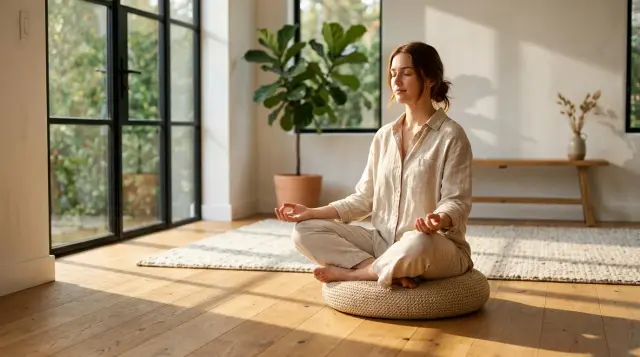
Meditation is the deliberate practice of directing your attention to a chosen focal point, like your breath, a sound, or a physical sensation, and returning to that anchor every time your mind wanders. That's the working definition used by researchers at the National Center for Complementary and Integrative Health (NCCIH), a branch of NIH [2]. Notice what's not in that definition: religion, emptiness, perfection, or sitting cross-legged on a floor.
The biggest misconception? That meditation means clearing your mind completely. It doesn't. Your mind will produce thoughts. That's what minds do, the same way lungs breathe and hearts pump. The practice isn't about stopping thoughts. It's about noticing them without getting swept away. Neuroscientist Amishi Jha at the University of Miami describes it as "push-ups for your attention." You don't get stronger by never struggling. You get stronger by catching the moment your focus slips and pulling it back.
Here's a concrete way to think about it. Imagine you're at a busy café trying to listen to a friend. Cars honk outside, someone drops a plate, a kid screams. You don't try to eliminate all those sounds. You just keep redirecting your attention to your friend's voice. Meditation works the same way, except the noisy café is your own mind.
Quick Q&A
Q: Do I need to stop thinking to meditate successfully?
A: No. Meditation isn't about stopping thoughts. It's about noticing them and gently returning your focus to your anchor, like your breath or a sound.
It also isn't relaxation, at least not primarily. Relaxation is often a side effect, but plenty of meditation sessions feel restless or boring. That's normal. You wouldn't call a tough gym workout "relaxation" just because you feel good afterward. A mindfulness session might be uncomfortable in the moment and still be doing exactly what it's supposed to do: strengthening your ability to direct attention on purpose.
Does Meditation Actually Change Your Brain?
Yes. And this is where meditation stops being woo-woo and starts being measurable.
A landmark 2011 study from Harvard Medical School, led by researcher Sara Lazar, put participants through an 8-week Mindfulness-Based Stress Reduction (MBSR) program. MRI scans taken before and after showed increased grey matter density in the hippocampus, which governs learning and memory, and decreased grey matter in the amygdala, the brain's alarm center for stress and fear [3]. The control group showed no such changes.
A separate 2014 meta-analysis published in JAMA Internal Medicine reviewed 47 clinical trials with a combined 3,515 participants. The conclusion: meditation programs showed moderate evidence for reducing anxiety, depression, and pain [4]. The effect sizes were comparable to those seen with antidepressant medications. That's remarkable for something that costs nothing and has no side effects.
What about focus? A 2019 study published in Behavioural Brain Research found that just 13 minutes of daily meditation practice over 8 weeks significantly improved participants' attention span and working memory. Thirteen minutes. That's less time than most people spend scrolling Instagram before breakfast.
There's also growing evidence linking regular contemplative practice to better sleep and improved gut function, two areas that feed into each other more than people realize. If you're curious about those connections, our guides on How to Sleep Better Tonight: The Complete Checklist and Gut Health: The Complete Guide go deep on both.
Meditation isn't about clearing your mind. It's about noticing that your mind has wandered and choosing to bring it back. That moment of noticing is the whole practice. Every time you do it, you get a little stronger.
What Are the Main Types of Meditation for Beginners?
There's no single right way to meditate. Different techniques suit different people, and the best mindfulness practice for you is whichever one you'll actually do tomorrow. Here are five types that have real research behind them and are genuinely accessible to someone who's never sat still on purpose.
Breath awareness meditation is the simplest starting point. You sit, close your eyes, and focus on the sensation of air entering and leaving your nostrils. When you notice you're thinking about dinner or a work email, you come back to the breath. Dr. Jon Kabat-Zinn, the founder of MBSR at the University of Massachusetts Medical School, built his entire stress-reduction program around this technique. It's been studied in hundreds of clinical trials.
Body scan meditation asks you to move your attention slowly from the top of your head to the tips of your toes, noticing tension, warmth, tingling, or nothing at all. It's especially helpful for people who feel "stuck in their heads" because it pulls attention into the physical body. A 2019 study from the University of Waterloo found that body scan practice significantly reduced mind-wandering during subsequent tasks.
Guided meditation uses a teacher's voice, live or recorded, to walk you through a session. Apps like Headspace (founded by former Buddhist monk Andy Puddicombe) and Insight Timer offer thousands of free guided sessions. This is often the easiest entry point because you don't have to figure out what to do. Someone tells you.
Loving-kindness meditation (Metta) involves silently repeating phrases of goodwill toward yourself and others. Something like: "May I be happy. May I be healthy. May you be happy. May you be healthy." Research from Stanford University's Center for Compassion and Altruism Research and Education (CCARE) found that Metta practice increased positive emotions and social connectedness after just seven weeks.
Mindfulness meditation is a broader category that encompasses breath awareness but extends to observing any present-moment experience without judgment. You might notice sounds, body sensations, or the feeling of sitting in a chair. The American Psychological Association recognizes it as an evidence-based approach for stress reduction and emotional regulation. For a deeper look at putting these techniques into action, see How to Build a Meditation Practice: The Practical Guide.

Why Does Everyone Say "Just Focus on Your Breath"?
Because it works. And because your breath is always with you. You don't need to download anything, charge anything, or buy anything. Your breath is happening right now, whether you pay attention to it or not. That makes it the most portable meditation anchor in existence.
But there's a deeper reason. Your breathing pattern directly reflects your nervous system state. When you're stressed, your breath gets shallow and fast. When you're calm, it slows. The relationship runs both directions: research from the Stanford University School of Medicine, published in Science in 2017 by researchers Kevin Yackle and Mark Bhatt, identified a small cluster of neurons in the brainstem that connects breathing rhythm to arousal and attention centers. Deliberately slowing your breath actually shifts your brain's arousal state.
So when someone asks what does how to start meditating mean, the most honest answer might be: sit down and pay attention to your breathing for three minutes. That's a complete meditation session. Not a warm-up. Not a shortcut. The real thing.
Try it right now if you want. Set a timer on your phone for three minutes. Sit in whatever chair you're in. Close your eyes. Breathe normally and notice where you feel the breath most clearly: your nostrils, your chest, your belly. When you realize you've been thinking about something else (and you will, probably within 10 seconds), just come back. No judgment. That moment of noticing and returning is the entire exercise.
How Do You Set Up a Space for Meditation?
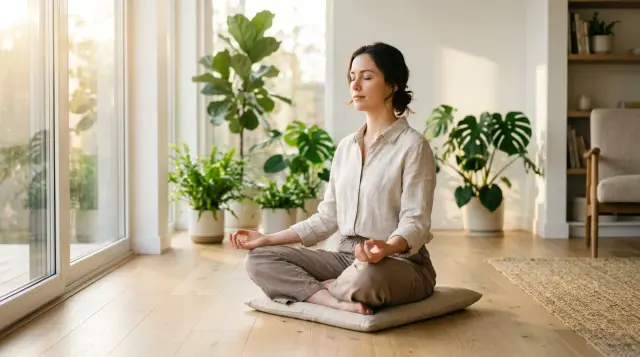
You don't need a meditation room. You don't need a cushion, a candle, or a singing bowl. You need a spot where you can sit without being interrupted for a few minutes. That's the bar.
That said, environment matters more than people think. A 2016 study in the journal Environment and Behavior found that environmental distractions significantly impaired participants' ability to sustain attention during contemplative exercises. So closing a door, putting your phone in another room, or even just turning it face down helps more than you'd expect.
I meditate in my living room corner most mornings. Nothing fancy. A regular chair, feet flat on the floor, hands on my thighs. Some people prefer sitting on the floor with a cushion. Others lie down (though you risk falling asleep, which is fine sometimes but isn't meditation). The point is to be comfortable enough that your body doesn't distract you, but alert enough that you don't drift off.
One thing that gets overlooked is what you're wearing. If your clothes are tight, scratchy, or pulling at you, that becomes another distraction your attention has to manage. Loose, comfortable clothing makes a real difference. If you're someone who also thinks about reducing environmental stressors during your practice, the Faraday Health Collection from Proteck'd offers EMF-shielding apparel that's also genuinely comfortable for sitting still. It's a small thing, but small things compound in a practice built on subtlety. You can learn more about how EMF shielding works on the EMF Health Benefits page.
Can You Meditate If Your Mind Won't Stop Racing?
Yes. Absolutely. In fact, you might need meditation more than anyone.
This is the most common objection I hear: "I can't meditate because my mind is too busy." That's like saying you can't go to the gym because you're too out of shape. The busy mind is the reason to practice, not a disqualification from it.
According to a widely cited study from Harvard psychologists Matthew Killingsworth and Daniel Gilbert, published in Science in 2010, people's minds wander about 47% of the time during waking hours. Nearly half. And that wandering was correlated with lower reported happiness, regardless of what activity people were doing. Meditation doesn't eliminate wandering. It gives you the ability to notice it faster and choose where to put your attention instead.
Quick Q&A
Q: Is meditation still working if my mind keeps wandering the whole time?
A: Yes. Every time you notice your mind has wandered and bring it back, that's one repetition of the exercise. More wandering means more reps, which means more training.
Think of it this way. You sit down for five minutes of breath-focused meditation. Your mind wanders 30 times. That's not a failed session. That's 30 moments where you caught yourself and redirected your attention. Thirty mental reps. Tomorrow, maybe it's 25. The trend matters more than any single session.
If you're exploring ways to improve your mental and physical health at the same time, you might find our piece on Self-Optimization: What It Is, What Works, What Doesn't useful. It covers how practices like meditation fit into a broader framework of evidence-based self-improvement.
How Long Should a Beginner Meditate Each Day?
Start with three to five minutes. Seriously. That's it.
The biggest mistake beginners make is setting the bar at 20 or 30 minutes, hating every second, and never sitting again. The research supports short sessions: that 2019 Behavioural Brain Research study I mentioned earlier showed meaningful cognitive improvements from 13 minutes a day. You don't need an hour.
Dr. Judson Brewer, a psychiatrist and neuroscientist at Brown University's Mindfulness Center, has argued that even informal moments of mindfulness during the day count as genuine contemplative practice. Noticing three breaths while waiting in line. Paying full attention while drinking your morning coffee. These build the same neural pathways.
The key insight about what does how to start meditating mean is that consistency matters infinitely more than duration. Five minutes every day for a month will change your brain more than one 90-minute session followed by three weeks of nothing. Treat it like brushing your teeth. Short, daily, non-negotiable.
A good rule of thumb for the first month: sit for three minutes daily during week one, five minutes during week two, eight minutes during week three, and ten minutes during week four. By the end of the month, you'll have a genuine daily mindfulness habit, and ten minutes won't feel like a burden anymore.
What Does Meditation Have to Do With Physical Health?
More than you'd guess. Meditation isn't just a mental exercise. The physiological effects are measurable and well documented.
A 2017 review published by the American Heart Association in the Journal of the American Heart Association found that meditation practice was associated with reduced blood pressure, lower heart rate, and decreased cortisol levels. The researchers noted it could be a reasonable adjunct to standard cardiovascular care.
Chronic stress, which meditation directly targets, is implicated in everything from poor sleep to weakened immune function to digestive problems. The gut-brain axis, the bidirectional communication pathway between your digestive system and your central nervous system, is particularly sensitive to stress hormones. When cortisol stays elevated, gut motility, barrier function, and microbiome diversity all suffer. Regular contemplative practice helps keep cortisol in check, which supports the whole system.
This is also why what you expose your body to environmentally matters alongside your mental health practices. If you're spending time reducing internal stress through meditation, it makes sense to think about reducing external stressors, too. Proteck'd's Women's Wellness Collection is designed with exactly this philosophy: comfortable, everyday clothing with built-in EMF shielding, so you can address both sides of the equation.
The connection between mental practice and physical outcomes isn't mystical. It's neurobiological. Your brain controls your body. Train the brain, and the body responds. It's not magic. It's just how the nervous system works.
Key Takeaways
Frequently Asked Questions
What does how to start meditating mean?
It means learning to sit still and direct your attention on purpose, usually to your breath, for a set period of time. You don't need any special equipment, beliefs, or experience. The practice is simply noticing when your mind wanders and gently bringing your focus back to your chosen anchor.
How long should I meditate as a beginner?
Start with three to five minutes. A 2019 Behavioural Brain Research study showed cognitive benefits from just 13 minutes daily, so you really don't need long sessions. Consistency matters far more than duration. Pick a length you'll actually stick with every day.
Can I meditate if I can't stop thinking?
Yes, and having a busy mind doesn't mean you're doing it wrong. Meditation isn't about stopping thoughts. It's about noticing them and returning to your focus point. Each time you catch yourself thinking and redirect, that's one successful rep of the exercise.
Is meditation religious or spiritual?
Not necessarily. While meditation has roots in various spiritual traditions, the form studied in most clinical research is secular. Programs like MBSR, developed at UMass Medical School, are entirely non-religious and used in hospitals and clinics worldwide.
What is the easiest type of meditation for beginners?
Breath awareness meditation is the simplest because it requires nothing except your own breathing. You focus on the sensation of air moving in and out of your nostrils. Guided meditation is another easy option since a teacher's voice walks you through each step.
Do I need to sit on the floor to meditate?
No. You can meditate in a regular chair, on a couch, or even lying down. The key is being comfortable enough that your body doesn't distract you, but alert enough that you don't fall asleep. A chair with your feet flat on the floor works perfectly.
Does meditation actually reduce anxiety?
A 2014 meta-analysis in JAMA Internal Medicine reviewed 47 trials and found moderate evidence that meditation programs reduce anxiety. The effect sizes were comparable to antidepressant medications. It's not a cure-all, but the evidence for anxiety reduction specifically is strong.
Can meditation help with sleep?
Yes. By lowering cortisol and calming the nervous system, regular meditation practice can improve sleep quality. A 2015 JAMA Internal Medicine study found that mindfulness meditation significantly improved sleep quality in older adults with moderate sleep disturbances compared to a sleep hygiene education control group.
What time of day is best for meditation?
Morning is often recommended because it sets a calm tone for the day and is easier to do before distractions pile up. But honestly, the best time is whichever time you'll actually do it consistently. Some people prefer meditating before bed to wind down.
How do I know if meditation is working?
You probably won't notice changes during a single session. Over weeks, most people report catching distracting thoughts faster, feeling less reactive to stress, and sleeping better. The Harvard grey matter study showed measurable brain changes after just 8 weeks of regular practice.
Is there anyone who shouldn't meditate?
Most people can meditate safely, but individuals with certain psychiatric conditions like PTSD, psychosis, or severe dissociative disorders should consult a healthcare provider first. Some people find that extended silent meditation can surface difficult emotions. Starting with short guided sessions is a safer entry point for those with trauma histories.
Do meditation apps actually work?
They can. Apps like Headspace have been studied in randomized controlled trials. A 2019 study published in PLOS ONE found that using Headspace for 10 days reduced stress by 14%. Apps work best as training wheels to build the habit, but many people eventually meditate without them.
References
- Centers for Disease Control and Prevention (CDC) – The percentage of U.S. adults who meditated tripled from 4.1% in 2012 to 14.2% in 2017, based on the National Health Interview Survey.
- National Center for Complementary and Integrative Health (NCCIH/NIH) – Meditation is a practice of training attention and awareness, and the NCCIH defines it as a mind-body practice used to increase calmness, improve psychological balance, and enhance overall well-being.
- Harvard Gazette / Harvard Medical School – An 8-week MBSR program led to measurable increases in grey matter density in the hippocampus and decreases in the amygdala, as shown by MRI scans.
- JAMA Internal Medicine – A 2014 meta-analysis of 47 trials with 3,515 participants found moderate evidence that meditation programs reduce anxiety, depression, and pain.
About the Author
Proteck'd EMF Apparel
Health & EMF Specialists
The Proteck'd team covers EMF protection, silver-fiber apparel, and practical ways to reduce everyday radiation exposure. Every piece Proteck'd ships is designed, tested, and worn by the people who build it.
Get the Free EMF Home Audit Checklist
A room-by-room PDF that walks you through the biggest EMF sources in your house and what to do about each one. No cost, no fluff.
Download the Checklist →✓30-day returns✓Free shipping✓Free returns✓Silver fiber shielding


Leave a comment