


The Future of Computing: A Realistic Look Ahead

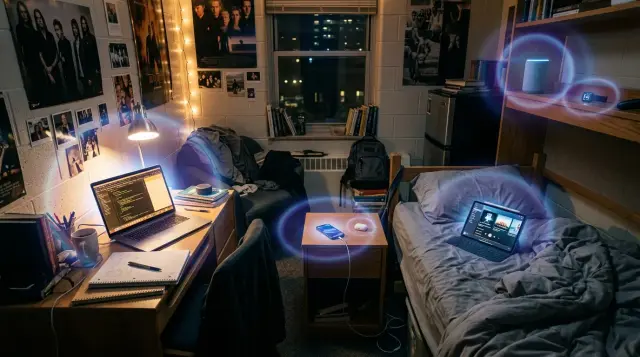
Here's a number worth sitting with: the average college student now carries or uses between five and eight wireless devices every single day. Phones, laptops, tablets, wireless earbuds, smart speakers, maybe a smartwatch. Now cram all those devices into a room that's barely 12 feet by 15 feet, add a roommate with their own collection, and toss in a communal Wi-Fi router mounted somewhere in the hallway. That's a lot of electromagnetic radiation bouncing around a very small space.
Dorm room EMF protection isn't something most freshmen think about while packing their bags. They're worried about mini-fridges and shower caddies. Not the invisible radio frequency signals pulsing through their living space 24 hours a day. But as someone who's spent years following the intersection of technology and health, I think this conversation deserves way more attention than it gets. Especially right now.
Why right now? Because the future of computing is about to make things more intense, not less. AI assistants are becoming always-on companions. Smart devices keep multiplying. And campuses are rolling out denser Wi-Fi networks to handle the load. The electromagnetic environment inside a dorm room in 2025 looks nothing like it did even five years ago.
This piece is going to cover the real science behind EMF exposure, break down what actually works for shielding, and look at how AI-driven computing trends are reshaping the conversation around college student EMF exposure. No fear-mongering, no snake oil. Just a clear look at what's happening and what you can do about it.
The students entering college this fall will carry more wireless devices, use more AI-powered tools, and be surrounded by denser wireless infrastructure than any generation before them. Thinking about dorm room EMF protection now isn't paranoia. It's just good planning for a world that's only going to get more connected.
- Dorm rooms concentrate multiple EMF sources in 100 to 200 square feet, creating unusually high exposure levels compared to typical homes.
- The inverse square law means even moving your phone a few feet farther from your pillow can reduce exposure by 90% or more.
- The WHO classifies RF electromagnetic fields as Group 2B, a possible carcinogen, and the NTP found tumor evidence in rats at high exposure levels.
- AI-driven computing is adding more always-on, always-transmitting devices to campus environments, compounding EMF exposure.
- Effective dorm room EMF protection combines distance, device management habits, and lab-tested shielding materials like Faraday fabrics.
Why Are Dorm Rooms Such Intense EMF Environments?
Think about the last apartment or house you lived in. You probably had a router in one room, your phone in another, your laptop on a desk somewhere else. There was breathing room between you and those signals. A dorm room obliterates that buffer. You're sleeping, studying, eating, and hanging out within a few feet of every wireless device you own, plus your roommate's devices, plus the institutional Wi-Fi access points that universities install every 30 to 50 feet along corridors.
Electromagnetic radiation follows the inverse square law. That means its intensity drops dramatically with distance. At six feet from a Wi-Fi router, exposure is roughly 36 times lower than at one foot. But in a 100-to-200-square-foot dorm room, you might never be more than eight feet from any given source. According to the WHO's International Agency for Research on Cancer, RF electromagnetic fields are classified as Group 2B, a possible carcinogen [1]. That classification alone doesn't prove harm. But it means the question isn't settled, and proximity matters.
The density issue gets worse at night. Most students sleep with their phone on the nightstand or even under the pillow. The laptop sits on the desk, often in sleep mode but still connected to Wi-Fi and transmitting. Meanwhile, every other student on the floor has their devices doing the same thing. It creates an electromagnetic environment that's genuinely unusual compared to how most people live. Sheer concentration of sources in a tiny space.
Quick Q&A
Q: Why is EMF exposure higher in a dorm room than in a typical home?
A: Dorm rooms pack multiple wireless devices from multiple people into 100 to 200 square feet with institutional-grade Wi-Fi routers nearby, dramatically reducing the distance buffer that normally limits exposure.
I've seen some campus plans where the access points are literally mounted on the other side of a dorm room wall. That means while you sleep, you're within a few feet of a commercial-grade transmitter that never turns off. If you're interested in understanding the broader health questions around this kind of exposure, Proteck'd's EMF Protection Benefits page is a solid starting point for making sense of the research.
How Is AI Changing EMF Exposure on College Campuses?
AI isn't just changing how we search the internet or write term papers. It's changing the physical infrastructure of campus computing, and that has direct implications for electromagnetic radiation levels in dorms. Universities like Stanford and MIT have begun deploying edge computing nodes closer to student living spaces to reduce latency for AI-heavy applications. More compute hardware nearby means more wireless communication signals in the air.
Consider what a typical student's tech stack looks like in 2025 compared to 2015. A decade ago, it was a laptop and a phone. That's it. Today it might include a phone, laptop, tablet, wireless earbuds, a smart speaker with a built-in AI assistant, a smartwatch, and maybe an AI-powered study tool that syncs across all of them. Each device maintains its own wireless connection. Some use Bluetooth, some use Wi-Fi, and newer devices are starting to tap into Wi-Fi 6E and Wi-Fi 7, which operate on the 6 GHz band, a higher frequency range than what older routers used.
The trend points in one direction: more devices, more connections, more RF radiation. If you want to understand where artificial intelligence is heading, I wrote about that in The Future of AI: What to Expect. The short version? AI is becoming ambient. It won't just live on your phone. It'll be in your thermostat, your lighting, your door lock. For students living in smart dorms, that means an even denser web of wireless signals surrounding them around the clock.
There's also the data dimension. AI tools constantly upload and download data to cloud servers, which means your devices aren't just passively connected. They're actively transmitting more often and for longer stretches. A 2023 report from Cisco estimated that the average North American internet user generates about 50 GB of data per month. For college students using AI tools heavily, that figure is likely higher. More data transfer equals more radio frequency emissions from the device in your hand or on your lap.

What Does the Science Actually Say About EMF Health Effects?
Let's be honest about the state of the research, because this topic attracts a lot of overstatement from both sides. The most significant government study to date is the National Toxicology Program (NTP) study, completed in 2018. It found "clear evidence" of heart tumors (malignant schwannomas) in male rats exposed to high levels of RF radiation similar to 2G and 3G cell phone emissions [2]. That's a real finding from a $30 million, decade-long study. It shouldn't be dismissed.
But context matters. The exposure levels in the NTP study were significantly higher than what most humans experience from normal device use. The rats were exposed to whole-body RF radiation for nine hours a day over two years. No college student is experiencing that level of exposure, even in the most device-packed dorm room. The FCC's current safety limit for cell phones is a specific absorption rate (SAR) of 1.6 W/kg averaged over 1 gram of tissue [3], and most consumer devices stay below that threshold.
On the other hand, the NTP study didn't look at the cumulative effect of multiple simultaneous sources. That's exactly the scenario in a dorm room. And it used older 2G/3G frequencies, not the newer bands that modern devices use. Research from the Ramazzini Institute in Italy found similar tumor types in rats exposed to much lower RF levels, closer to what cell towers emit [2]. So the question of low-level, chronic, multi-source exposure remains genuinely open.
The WHO's official position, updated in its fact sheet on electromagnetic fields and public health, is that current evidence doesn't confirm health effects below existing guidelines but that more research is needed, particularly on long-term exposure [1]. If you're curious about how AI itself is being used to analyze health data and predict outcomes, take a look at Is AI Able to Predict Health Problems?: The Honest Answer. The irony of AI both increasing our EMF exposure and potentially helping us understand its effects isn't lost on me.
What Are the Most Effective Strategies for Dorm Room EMF Protection?
Alright, let's get practical. If you're a student reading this, or a parent helping a kid set up their dorm, here are the strategies that actually move the needle on electromagnetic radiation shielding. I'll rank them roughly by effectiveness and ease of implementation.
Distance is your single best tool. The inverse square law is your friend here. Simply moving your phone to the other side of the room while you sleep, rather than keeping it on your nightstand, can reduce exposure by 90% or more. If your desk is right next to the wall where an access point is mounted, move the desk. If you can keep your router (assuming you have your own) at least six feet from your bed, do it. A study published by the Environmental Health Trust found that even moving a laptop from your lap to a desk reduced RF exposure to the torso by orders of magnitude.
Next, reduce the number of always-on wireless connections. Put your phone in airplane mode while you sleep. Turn off Bluetooth on devices you're not actively using. If your laptop is close enough to hardwire with an Ethernet cable, do it and disable the Wi-Fi radio. These aren't radical steps. They're basic signal hygiene that most people just never think about.
Then there's physical shielding. This is where products designed with EMF-blocking materials come in. Faraday fabrics, woven with conductive metals like silver or copper, can block a significant percentage of RF radiation. Proteck'd's Faraday Protection Collection includes items designed specifically for this purpose. For guys who want something they can actually wear on campus without looking like they're wrapped in tinfoil, the Men's Faraday Tech Wear line integrates shielding into normal-looking apparel. That's a meaningful upgrade over taping aluminum foil to your wall, which, yes, I've seen people do.
Quick Q&A
Q: What's the single most effective way to reduce EMF exposure in a dorm room?
A: Increasing distance from emitting devices, especially while sleeping, because RF intensity drops with the square of the distance, making even a few extra feet highly impactful.
Can EMF Blocking Fabric Really Make a Difference in a Small Room?
This is the skeptic's question, and it's a fair one. Does a piece of fabric actually block electromagnetic fields? The answer depends entirely on what the fabric is made of and how it's tested. Legitimate EMF blocking fabric uses conductive metals, typically silver threads or nickel-copper coatings, woven into the textile. When properly constructed, these fabrics can attenuate (reduce) RF signals by 30 dB or more, which translates to blocking 99.9% of the signal.
The key phrase there is "properly constructed." Not all products claiming EMF protection actually deliver. Look for lab-tested results from independent facilities, ideally showing attenuation across multiple frequency bands (including the 2.4 GHz and 5 GHz ranges used by Wi-Fi). If a company can't show you test data, walk away.
In a dorm room, shielding fabric has a few practical uses. You can hang it as a canopy or curtain between your bed and a known EMF source, like a wall-mounted access point. You can place a shielding pad between your laptop and your body. Or you can wear clothing with integrated Faraday fabric, which gives you a personal buffer that moves with you. That last option is especially useful because your dorm room isn't the only high-EMF environment on campus. Think about lecture halls with 200 students, each with a phone and laptop running, or the library during finals week.
For broader context on protecting your digital life alongside your physical health, Proteck'd's guides on Cybersecurity in 2026: The Threats and the Solutions and Digital Security: The Complete Guide are worth reading. Because honestly, the wireless signals you're shielding against are the same ones carrying your personal data. The conversation about EMF protection and digital privacy overlap more than most people realize.
How Should Students Think About EMF Protection as AI Computing Grows?
Let's zoom out and talk about the trajectory. AI is not slowing down. The computing power required to run large language models doubles roughly every six months, according to research from Epoch AI. That compute has to live somewhere, and increasingly, it's being pushed closer to the user through edge computing and on-device AI chips. Apple's M-series chips, Qualcomm's Snapdragon processors, and Google's Tensor chips all now include dedicated neural processing units that handle AI tasks locally on your device.
What does that mean for your dorm room? More processing means more power consumption, which means more EM radiation from the device itself, on top of the RF emissions from wireless connectivity. It compounds. Your phone in 2025 does more computing locally than a 2015 desktop, and that additional processing generates electromagnetic fields at frequencies that aren't just RF but also include extremely low frequency (ELF) emissions from the circuitry itself.
The smart approach is to think about dorm room EMF protection as part of your overall technology hygiene. Not a one-time purchase but a set of habits. Use wired connections when you can. Keep devices at a distance when they're transmitting heavily. Choose shielding products that are tested and verified. And stay informed about what new technologies are being deployed on your campus. For a broader look at how data flows and privacy intersect with all this, Data Protection: The Complete Guide provides useful background.
The students entering college this fall will graduate into a world where AI is everywhere and EM radiation is more pervasive than ever. Building good habits now, both in terms of digital security and physical shielding, is something your future self will thank you for. That's not alarmism. It's just paying attention to the direction things are clearly heading.
A Step-by-Step Approach to EMF-Proofing Your Dorm Room
I want to give you something concrete you can act on this weekend. Here's how I'd approach setting up a lower-EMF dorm room if I were heading back to school right now.
First, audit your devices. Write down every single thing that emits a wireless signal. Phone, laptop, tablet, smart speaker, wireless earbuds, gaming console, Bluetooth keyboard, smart TV. You'll probably be surprised by the count. My last count in a friend's kid's dorm room came to 11 devices for two students. Then figure out which ones you can hardwire. A USB-C to Ethernet adapter costs about $15, and most campus networks have Ethernet jacks in dorm rooms that nobody uses anymore.
Second, map your room layout with EMF in mind. Put your bed as far from the door and exterior hallway wall as possible, since that's often where institutional access points live. Keep your phone's charging station across the room from your pillow. If you use a laptop on your bed (be honest, you do), put a shielding pad between the laptop and your body.
Third, establish a nightly routine. Airplane mode on your phone. Laptop fully shut down, not just in sleep mode. Smart speaker unplugged. Wireless earbuds in their case, not on the charger next to your head. These three minutes of device management before bed can reduce your nighttime electromagnetic radiation exposure dramatically.
Fourth, invest in shielding that actually works. Whether it's a laptop pad, a phone pouch, or EMF-blocking apparel from a company like Proteck'd that uses Faraday fabric with verified testing, physical barriers between you and your devices are the last piece of the puzzle. Dorm room EMF protection doesn't require a complete lifestyle overhaul. It just requires a bit of awareness and a few smart choices.
Frequently Asked Questions
Dorm room EMF protection refers to strategies and products that reduce exposure to electromagnetic radiation from wireless devices concentrated in small college living spaces. Students need it because dorms pack more wireless devices per square foot than almost any other living environment. With phones, laptops, routers, and smart devices all within a few feet, cumulative exposure can be significantly higher than in a typical home.
Yes. Airplane mode effectively stops your phone from emitting RF radiation by disabling cellular, Wi-Fi, and Bluetooth transmitters. It's one of the simplest and most effective steps you can take, especially while sleeping. Keep in mind that some phones still emit low-level ELF fields from the processor, so distance is still a good idea.
At least three to six feet is a good general guideline. Because of the inverse square law, moving your phone from your nightstand (about one foot away) to across the room (six feet away) reduces RF exposure by roughly 36 times. Putting it in airplane mode and placing it across the room is the best combination.
Absolutely. Commercial-grade access points used in university buildings transmit at higher power levels than home routers, and they operate 24/7. If one is mounted on the other side of your wall, you could be sleeping within two to three feet of a continuous RF source. Positioning your bed away from that wall is a practical first step.
The evidence is mixed but not something to brush off. The National Toxicology Program's 2018 study found clear evidence of tumors in rats exposed to high RF radiation levels. The WHO classifies RF-EMF as a Group 2B possible carcinogen. Most health agencies say current exposure limits are safe but acknowledge that long-term, multi-source exposure needs more research.
They can, if they use genuine conductive shielding materials and have been independently lab-tested. Look for products that show attenuation data across relevant frequency bands like 2.4 GHz and 5 GHz. A properly designed laptop pad, for example, can block the majority of RF and ELF emissions between the device and your body.
Yes, likely. Wi-Fi 6E operates on the 6 GHz band, a higher frequency range that requires more access points to maintain coverage because higher frequencies don't penetrate walls as well. This means more transmitters installed closer together in dorm buildings. 5G small cells operate on similar principles. More access points means more sources of RF radiation in close proximity.
Faraday fabric is textile woven with conductive metals like silver or copper that blocks electromagnetic radiation. You can use it in a dorm room as a curtain, canopy, or device pad. It's also woven into wearable apparel. When properly constructed, it can attenuate RF signals by 30 dB or more, blocking over 99% of the signal.
Yes. When you connect via Ethernet and disable your laptop's Wi-Fi radio, you eliminate one of the primary RF sources at your desk. A USB-C to Ethernet adapter costs around $15, and most dorm rooms still have Ethernet jacks available. It's one of the cheapest and most effective dorm room EMF protection strategies out there.
AI tools require more data transfer, more always-on connections, and more processing power, all of which increase electromagnetic emissions from devices. AI-powered smart speakers, study tools, and assistants maintain constant wireless connections. On top of that, universities are deploying edge computing nodes closer to dorms to support AI workloads, adding more sources of RF radiation to the campus environment.
References
- World Health Organization – IARC – The WHO's International Agency for Research on Cancer classified RF electromagnetic fields as Group 2B, a possible carcinogen, in 2011.
- National Institute of Environmental Health Sciences – National Toxicology Program – The NTP study found clear evidence of heart tumors (malignant schwannomas) in male rats exposed to high levels of RF radiation.
- U.S. Food and Drug Administration – The FCC limits cell phone SAR to 1.6 W/kg averaged over 1 gram of tissue.
About the Author
Proteck'd EMF Apparel
Health & EMF Specialists
The Proteck'd team covers EMF protection, silver-fiber apparel, and practical ways to reduce everyday radiation exposure. Every piece Proteck'd ships is designed, tested, and worn by the people who build it.
Get the Free EMF Home Audit Checklist
A room-by-room PDF that walks you through the biggest EMF sources in your house and what to do about each one. No cost, no fluff.
Download the Checklist →✓30-day returns✓Free shipping✓Free returns✓Silver fiber shielding


