


How Reliable Are Smartwatches?: What the Research Shows

Here's a number that caught me off guard: over 30 percent of Americans now wear a smartwatch or fitness tracker on any given day. That's tens of millions of people trusting a tiny sensor on their wrist to tell them something meaningful about their health. But if you've ever searched for "is smartwatch comparison guide safe" before buying one, you've probably noticed something. Most guides obsess over screen brightness and battery life. They rarely ask whether the health data is actually reliable, or whether wearing a transmitting device all day raises concerns worth thinking about.
I get it. You want to know if you can trust what your wearable tells you. You also want to know if those big comparison roundups are steering you in the right direction. Fair questions, both of them. And the answers are more nuanced than a star rating can capture.
So I spent weeks pulling apart peer-reviewed research, FDA clearance documents, and independent lab tests to figure out where smartwatches genuinely deliver and where they fall short. The short version? They're impressive but imperfect. Most comparison guides leave out some stuff that actually matters.
Let's get into what the science says, what the comparison sites skip, and how to make a smarter decision about the tech you strap to your body every single day.
Your smartwatch is probably accurate enough to show you useful health trends over time. But no wrist sensor should replace clinical-grade monitoring, and no comparison guide should be your only source for safety questions.
- Smartwatch heart rate sensors are generally accurate within 3 to 8 percent at rest, but accuracy drops significantly during vigorous exercise.
- Sleep tracking overestimates total sleep time by 20 to 60 minutes compared to clinical polysomnography.
- Only specific features like Apple Watch ECG have received FDA 510(k) clearance, and only for limited use cases like AFib detection.
- Most smartwatch comparison guides don't address EMF exposure, sensor bias across skin tones, or biometric data privacy.
- Practical steps like removing your watch periodically and using EMF-shielding clothing can reduce long-term exposure concerns.
How Accurate Are Smartwatch Heart Rate Sensors, Really?
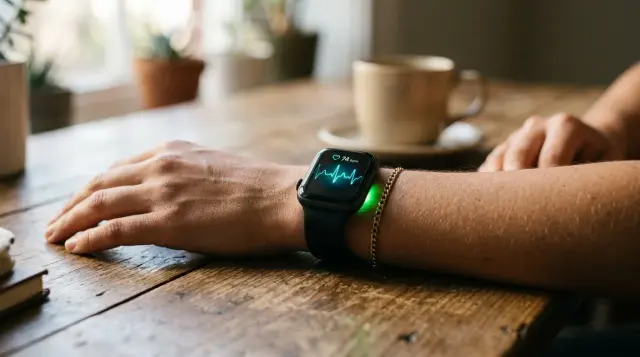
Heart rate tracking is the flagship feature of every smartwatch on the market. Apple, Samsung, Google, Garmin, Fitbit. They all use photoplethysmography (PPG), which shines green LED light into your skin and measures blood flow changes. Sounds high-tech. And honestly, it works pretty well. Most of the time.
A 2022 systematic review published in the BMJ found that wrist-worn optical heart rate sensors typically achieve mean absolute errors between 3 and 8 percent, depending on the activity [1]. At rest or during a casual walk, your Apple Watch or Galaxy Watch is probably within a few beats per minute of a medical-grade chest strap. That's genuinely useful.
But here's where it gets tricky. During high-intensity interval training, running, or cycling with lots of wrist movement, accuracy drops. Noticeably. The same BMJ review noted error rates exceeding 10 percent in some vigorous exercise scenarios [1]. If you're an athlete relying on precise heart rate zones, that margin matters.
Quick Q&A
Q: Are smartwatch heart rate readings accurate enough for medical decisions?
A: No. While consumer wearables provide useful trends, no major health organization recommends using them as a substitute for clinical-grade heart rate monitoring.
There's another wrinkle most smartwatch comparison guides don't mention. Research from Johns Hopkins and other institutions has shown that PPG sensors perform less accurately on darker skin tones, because melanin absorbs more green light [1]. If a comparison guide doesn't flag this limitation, it's not giving you the full picture. That alone should make you wonder whether any is smartwatch comparison guide safe for every reader.

What Do Smartwatch Comparison Guides Usually Get Wrong?
I've read dozens of these guides. PCMag, Consumer Reports, Wareable, Tom's Guide. They do a solid job comparing screen resolution, GPS accuracy, app ecosystems, and price. Consumer Reports' 2026 testing even uses standardized protocols to evaluate durability and interface responsiveness. That kind of lab-tested methodology is genuinely valuable.
What they consistently skip is the stuff that health-conscious buyers care about most. Long-term EMF exposure from a device that's literally touching your skin 16 hours a day. What happens to your biometric data once it leaves your wrist. For a deep look at the data privacy angle, our Digital Security: The Complete Guide covers the risks most people overlook.
The FCC requires all wearable devices to meet a specific absorption rate (SAR) limit of 1.6 W/kg, averaged over 1 gram of tissue. Every smartwatch sold in the U.S. passes that threshold. But SAR testing measures short-term exposure at a single point. It doesn't model what happens when you wear a Bluetooth and Wi-Fi transmitter against your skin around the clock for years. That gap in the research is real, and no mainstream comparison guide I've found addresses it honestly.
If you're wondering whether your wearable comparison guide covers all the bases, try a quick test. Does it mention sensor bias across skin tones? Does it talk about radiofrequency exposure? Does it explain what the company does with your sleep and heart data? If the answer is no to all three, you're only getting half the story. For more on the differences between device categories, check out our Smartwatch vs Fitness Tracker: An Honest Comparison.
Can You Trust Smartwatch Sleep Tracking Data?
Sleep tracking has become a major selling point. The Oura Ring, Apple Watch, Samsung Galaxy Watch 8, and Google Pixel Watch 4 all claim to break your night into light sleep, deep sleep, and REM stages. Some even give you a daily "sleep score." But how do those numbers stack up against the gold standard, polysomnography (PSG), which uses electrodes attached to your scalp in a clinical sleep lab?
Not as well as the marketing suggests. A 2021 study published in Nature and Science of Sleep found that consumer wearables tend to overestimate total sleep time by 20 to 60 minutes compared to PSG [2]. They're particularly bad at detecting brief awakenings during the night. So if your watch says you slept 7.5 hours, the real number might be closer to 7. Maybe less.
Sleep stage classification is even shakier. According to research from Stanford University's sleep lab, most wrist-based accelerometer and PPG combos correctly identify sleep stages roughly 60 to 70 percent of the time [2]. Better than a coin flip, sure. But it means your "deep sleep" number could be off by a meaningful amount on any given night.
Does that make sleep tracking useless? Not at all. The trend data, seeing your sleep patterns over weeks and months, can still be genuinely informative. You just shouldn't treat last night's exact REM minutes as gospel. Think of it like a weather forecast: directionally useful, not precise to the minute.
Are There Legitimate Safety Concerns with Wearing a Smartwatch All Day?
This is the question most people are really asking when they search "is smartwatch comparison guide safe." They want to know if the device itself is safe. The honest answer: we don't have perfect long-term data, but there are reasonable precautions you can take.
Smartwatches emit low-level radiofrequency (RF) radiation via Bluetooth and Wi-Fi. The World Health Organization's International Agency for Research on Cancer (IARC) classified RF electromagnetic fields as "possibly carcinogenic to humans" (Group 2B) back in 2011 [3]. That classification was primarily about cell phones held against the head, not wrist-worn devices with much lower output power. But the classification hasn't been updated since, and wearable usage patterns have changed dramatically.
If you want to reduce your exposure while still using a smartwatch, there are practical steps. Turn off Wi-Fi on the watch when you don't need it. Use airplane mode during sleep if your watch allows offline sleep tracking. And consider what you're wearing alongside your tech. Proteck'd's Faraday Protection Collection is designed for people who want a buffer between their body and their devices, using silver-infused fabric that provides EMF shielding. You can learn more about how that works on the EMF Protection Benefits page.
Skin irritation is another underreported issue. A 2023 study in Contact Dermatitis found that nickel and acrylate compounds in some watch casings and bands cause allergic contact dermatitis in roughly 2 to 5 percent of wearers. If you've noticed a rash under your watch band, that's not sweat. It might be a genuine allergic reaction worth investigating with a dermatologist.
Which Health Features Actually Have FDA Backing?
There's a big difference between a feature that's FDA-cleared and one that's just... there. The Apple Watch ECG app received FDA 510(k) clearance in 2018 specifically for detecting atrial fibrillation (AFib) [4]. That's meaningful. The landmark Apple Heart Study, conducted with Stanford Medicine and enrolling over 400,000 participants, found a 0.52 percent irregular pulse notification rate. Among those flagged, 84 percent were confirmed to have AFib [4].
Samsung's Galaxy Watch line has also received FDA clearance for its ECG and blood pressure monitoring features in certain markets. The blood pressure feature uses a calibration method that requires periodic check-ins with a traditional cuff. Responsible approach, honestly. But one that most users probably skip after the first week.
Quick Q&A
Q: Does FDA clearance mean a smartwatch feature is as good as a medical device?
A: No. FDA 510(k) clearance means the feature is substantially equivalent to an existing approved device for a specific, limited use case, not that it replaces clinical equipment.
Blood oxygen (SpO2) sensors, on the other hand, are in murkier territory. Most smartwatches include them, but few have gone through formal regulatory clearance for that specific measurement. The readings can be influenced by motion, cold fingers, nail polish, and poor fit. During the COVID-19 pandemic, the FDA specifically warned consumers against relying on non-cleared pulse oximeters for medical decisions. That warning applies to smartwatches too.
So when you're reading a wearable health tracker comparison, pay attention to which features have regulatory backing and which are basically wellness estimates. The distinction matters more than most guides let on.
How Should You Protect Your Data and Your Body?
Your smartwatch knows your heart rate, sleep schedule, location history, exercise patterns, and potentially your blood oxygen levels. That's an incredibly intimate dataset. And depending on the brand, that data might be stored on servers with varying levels of security, subject to privacy policies that can change without much notice.
Google's acquisition of Fitbit raised exactly these concerns. In 2024, the European Commission required Google to maintain data separation commitments as a condition of the merger. But commitments expire. If you care about what happens to your biometric data, our guide on Taking Back Your Online Life walks through the practical steps you can take right now.
On the physical side, there are straightforward things you can do. Give your wrist a break. Seriously. Wearing any device 24/7 without removing it leads to skin breakdown, moisture buildup, and continuous low-level RF exposure. Take it off while you shower. Take it off while you're just sitting on the couch reading. Your body will appreciate the break.
For those who want an extra layer of physical protection, Proteck'd's Men's Faraday Tech Wear line incorporates silver-fiber EMF shielding directly into everyday clothing. It's not tinfoil-hat territory. It's a practical response to the reality that we're now surrounded by more wireless transmitters than at any point in human history, and the long-term research simply hasn't caught up yet.
Is a Smartwatch Comparison Guide Safe to Rely On for Health Decisions?
Let me put it this way. A smartwatch comparison guide is great for figuring out whether you want a round screen or a square one, whether you prefer Wear OS or watchOS, and whether a $250 model tracks GPS well enough for your weekend runs. For those practical consumer questions, sites like PCMag, Wareable, and Consumer Reports do excellent work with standardized testing methods.
But if you're making a health-related decision, like whether a smartwatch can replace your doctor's cardiac monitoring or whether it's safe to wear one during pregnancy, a buyer's guide isn't the right resource. No wearable device comparison guide is designed to answer clinical questions. Treating them as medical references is where people get into trouble.
The smartest approach? Use comparison guides for what they're built for: helping you choose between products. Then supplement that with peer-reviewed research for health questions and with resources like Proteck'd's EMF Protection Benefits page for safety-related concerns. Layer your sources the same way you'd layer your protection.
Because the real answer to "is smartwatch comparison guide safe" isn't yes or no. It's: safe for some questions, incomplete for others. Knowing which questions to ask elsewhere is what separates a savvy consumer from someone just following star ratings.
Frequently Asked Questions
No, they're not. Smartwatch sensors give you useful wellness trends, but they lack the precision and regulatory clearance needed for clinical decision-making. The FDA has cleared only specific features like the Apple Watch ECG for detecting atrial fibrillation, and even that is meant as a screening tool, not a diagnostic replacement.
It's generally considered safe based on current FCC SAR limits, but there are good reasons to take breaks. Continuous wear can cause skin irritation or allergic contact dermatitis in about 2 to 5 percent of users, and it means constant low-level RF exposure. Most dermatologists recommend removing your watch for at least a few hours daily.
Smartwatches emit low-level radiofrequency radiation through Bluetooth and Wi-Fi. These levels fall within FCC safety limits. The WHO's IARC has classified RF fields as possibly carcinogenic (Group 2B), though that classification is based primarily on cell phone studies. Long-term studies specific to wrist-worn exposure are still lacking.
Smartwatch sleep tracking tends to overestimate total sleep time by 20 to 60 minutes compared to clinical polysomnography. Sleep stage classification accuracy ranges from about 60 to 70 percent. The trend data over weeks is more useful than any single night's breakdown.
As of 2025, the Apple Watch leads with FDA 510(k) clearance for its ECG app (atrial fibrillation detection) and irregular rhythm notifications. Samsung's Galaxy Watch also has ECG clearance and blood pressure monitoring approval in select markets. Most other health features on any smartwatch lack formal regulatory clearance.
Yes, for product comparisons involving features, battery life, price, and usability, guides from outlets like PCMag and Consumer Reports are well-researched and reliable. Where they fall short is in covering health data accuracy limitations, EMF safety, and data privacy. Supplement them with peer-reviewed sources for health-related questions.
No. Research has shown that optical PPG sensors perform less accurately on darker skin tones because melanin absorbs more of the green LED light used for heart rate measurement. This bias is well-documented in peer-reviewed literature but rarely mentioned in mainstream smartwatch comparison guides.
It depends on the manufacturer. Apple stores health data locally and encrypts it end-to-end with iCloud. Google and Samsung store data on cloud servers under privacy policies that can change. Fitbit's data practices shifted after Google's acquisition. Always read the privacy policy and understand where your biometric data is stored and who can access it.
No. The Apple Watch uses a single-lead ECG, while a standard hospital ECG uses 12 leads to capture a comprehensive view of heart activity. The Apple Watch ECG is cleared only for detecting atrial fibrillation and cannot identify heart attacks, structural abnormalities, or many other cardiac conditions.
You can turn off Wi-Fi on the watch when you don't need it, use airplane mode during sleep, and remove the watch for a few hours each day. EMF-shielding clothing made with silver-infused fabric, like those from Proteck'd, can also provide an additional barrier between wireless devices and your body.
References
- BMJ (British Medical Journal) – Wrist-worn optical heart rate sensors have mean absolute errors between 3 and 8 percent, with reduced accuracy on darker skin tones and during vigorous exercise.
- National Institutes of Health (Nature and Science of Sleep) – Consumer wearables overestimate total sleep time by 20 to 60 minutes compared to polysomnography and correctly classify sleep stages 60 to 70 percent of the time.
- International Agency for Research on Cancer (IARC), World Health Organization – The IARC classified radiofrequency electromagnetic fields as possibly carcinogenic to humans (Group 2B) in 2011.
- Stanford Medicine (Apple Heart Study) – The Apple Heart Study enrolled over 400,000 participants and found a 0.52 percent irregular pulse notification rate, with 84 percent of flagged participants confirmed to have atrial fibrillation.
About the Author
Proteck'd EMF Apparel
Health & EMF Specialists
The Proteck'd team covers EMF protection, silver-fiber apparel, and practical ways to reduce everyday radiation exposure. Every piece Proteck'd ships is designed, tested, and worn by the people who build it.
Get the Free EMF Home Audit Checklist
A room-by-room PDF that walks you through the biggest EMF sources in your house and what to do about each one. No cost, no fluff.
Download the Checklist →✓30-day returns✓Free shipping✓Free returns✓Silver fiber shielding


