


The Future of Technology: The Trends Shaping Tomorrow

Here's a number worth sitting with: the global market for generative AI alone is on track to hit $1.3 trillion by 2032. That's not some far-off fantasy. It's a projection based on growth already underway, in products you probably used before breakfast. The speed of change is real, and the future technology trends taking shape right now will define how we work, heal, commute, and even get dressed over the next decade.
But here's the part most trend roundups gloss over. Every new wave of technology doesn't just bring convenience. It brings exposure. More devices, more wireless signals, more data flying through the air around us at all hours. As we build a world saturated with connectivity, the question of how to protect ourselves from the very tech we depend on gets harder and harder to brush aside.
I've spent months reading market forecasts, research papers, and engineering roadmaps to pull together what's actually worth your attention. Not the hype. The trends with real money, real research, and real timelines behind them.
So what's actually coming? And how do you prepare for a future where technology is everywhere, including on your body and embedded in your walls? Let's get into it.
Key Takeaways
What Are the Biggest Future Technology Trends Through 2035?
If you want to map out the next decade, start with a handful of technologies that have already left the prototype phase and entered serious commercial deployment. Generative AI and large language models (think ChatGPT, Claude, Gemini) are the most visible. But they're just the tip of a much larger iceberg. According to McKinsey, generative AI could add $2.6 to $4.4 trillion annually to the global economy across industries [1].
Quantum computing is another one to watch closely. The quantum computing market surpassed $1 billion in revenue last year. Companies like IBM, Google, and IonQ are racing to build machines that can solve optimization, materials science, and cryptography problems classical computers simply can't handle. IBM's 1,121-qubit Condor processor, unveiled in late 2023, signaled that we've entered a new computational era.
Then there are agentic AI systems, which go well beyond chatbots. These are artificial intelligence programs that can plan, execute, and adjust multi-step tasks without constant human input. Picture an AI that doesn't just draft your email but also schedules the meeting, preps the agenda, and follows up afterward. Salesforce, Microsoft, and Google are all building agentic AI into their platforms right now.
Solid-state batteries, digital twins, neuromorphic computing, and edge AI round out the list. Each of these emerging tech innovations is backed by billions in investment and, more importantly, by clear use cases that industries are already adopting. These aren't hypotheticals. They're budgeted line items at Fortune 500 companies.
Quick Q&A
Q: Which future technology trend has the largest projected market size by 2032?
A: AI agents and generative AI, projected to reach a $1.3 trillion global market by 2032, making it the largest among emerging tech sectors.
How Will AI and Automation Reshape Daily Life by 2030?
Let's get specific, because "AI will change everything" doesn't actually help anyone plan for anything. Here's what's really happening. Hyperautomation, the combination of AI, robotic process automation, and machine learning to automate complex business workflows, is already transforming industries like insurance, logistics, and healthcare administration. Gartner estimated that organizations using hyperautomation would lower operational costs by 30% by 2025.
In your home, this plays out through smart automation that goes far beyond voice-controlled lights. We're talking about systems that learn your routines, adjust your thermostat before you realize you're cold, and manage your energy consumption based on real-time grid pricing. If you're curious about where this is heading, our guide on Home Automation Trends: Future Smart Home Setup breaks down the near-term trajectory. For a broader overview, check out our Home Automation: The Complete Guide.
Healthcare is where machine intelligence gets genuinely fascinating. AI models are already detecting diabetic retinopathy, predicting sepsis onset, and flagging early-stage cancers in medical imaging with accuracy rates that rival or exceed human specialists. A 2023 review published in Nature found AI diagnostic tools showing sensitivity rates above 90% for certain cancers when combined with physician review [2]. We explored this topic in depth in our piece on Can AI Predict Health Problems?: What the Research Shows.
Autonomous vehicles are another area where the abstract is becoming very concrete. Waymo now operates commercial robotaxi services in San Francisco, Phoenix, and Los Angeles, completing over 100,000 paid trips per week as of early 2025. The freight automation sector, led by companies like Aurora Innovation and TuSimple, is targeting long-haul trucking routes with Level 4 autonomy by 2027.
What Is Edge AI and Why Does It Matter for Personal Devices?
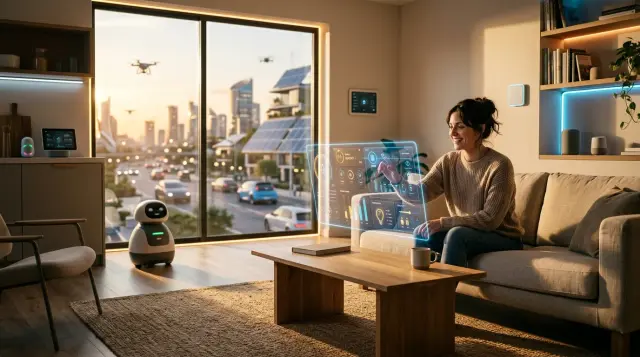
Most people interact with AI through the cloud. You ask Siri a question, it pings a server farm, processes your request, and sends back the answer. Edge AI flips that model. It puts artificial intelligence processing directly on your device, whether that's your phone, your car, or a sensor on a factory floor. The result? Faster responses, better privacy, and less dependence on internet connectivity.
Apple's Neural Engine, Qualcomm's AI Engine, and Google's Tensor chips are all examples of edge AI hardware already in millions of consumer devices. When your phone identifies a face in a photo without sending that image to the cloud, that's edge AI at work. Latency drops to under 10 milliseconds in some applications, which is why it's becoming so important for autonomous vehicles and industrial robotics.
But here's the trade-off nobody talks about enough. More processing power on your device means more electromagnetic radiation being generated right next to your body. Your phone isn't just a communication device anymore. It's a miniature AI workstation. And it's pressed against your head or sitting in your pocket for hours every day. This is where the conversation about future technology trends intersects with personal health in a very real way.
The World Health Organization's International Agency for Research on Cancer (IARC) classified radiofrequency electromagnetic fields as "possibly carcinogenic to humans" (Group 2B) back in 2011 [3]. As devices get more powerful and run more local AI processes, the amount of EM radiation they generate deserves more attention than it's getting. Understanding the EMF Protection Benefits of shielding fabrics is becoming a practical concern, not just a niche interest.
Every new wave of technology brings convenience and exposure in equal measure. The smartest approach isn't to resist innovation. It's to adopt it thoughtfully, with your health and security protected alongside your productivity.
How Does Quantum Computing Change Cybersecurity?
Quantum computing is often described in abstract, physics-heavy terms. But its most immediate real-world impact is surprisingly easy to understand: it threatens to break the encryption that protects almost everything online. RSA encryption, the backbone of internet security for decades, relies on the fact that classical computers can't efficiently factor very large numbers. A sufficiently powerful quantum computer could do it in hours.
This isn't theoretical panic. The National Institute of Standards and Technology (NIST) finalized its first set of post-quantum cryptography standards in August 2024, specifically because the threat is considered close enough to require preparation now. Companies like Google and IBM are already integrating these new standards into their infrastructure.
For everyday people, this means the cybersecurity rules you've relied on are about to change. Dramatically. Passwords, two-factor authentication, VPNs... the entire security stack needs upgrading for a quantum future. We covered the broader cybersecurity picture in our Cybersecurity in 2026: The Complete Guide, which is worth reading alongside this.
There's also a concept called "harvest now, decrypt later" that should concern anyone who handles sensitive data. Nation-state actors are already collecting encrypted data with the intention of decrypting it once quantum computers become powerful enough. The data you send today could be readable tomorrow. That's not science fiction. That's a documented intelligence strategy.
Why Is EMF Protection Becoming Part of the Tech Conversation?
Let me connect some dots. We've talked about edge AI putting more processing power in your pocket. We've discussed smart homes blanketing your living space in Wi-Fi, Bluetooth, and Zigbee signals. We've covered the explosion of connected devices, autonomous vehicles with radar arrays, and wearable health monitors. Every single one of these technologies generates electromagnetic radiation.
According to the WHO, human exposure to electromagnetic fields has been steadily increasing with advances in technology and changes in social behavior [3]. The average person in 2025 is exposed to significantly more RF radiation than someone in 2005, simply because of the sheer number of wireless devices surrounding them. 5G small cells, Wi-Fi 6E routers, Bluetooth earbuds, smart watches, smart refrigerators. The list keeps growing.
This is exactly why companies like Proteck'd have developed clothing that incorporates Faraday cage principles into everyday wear. Their Faraday Protection Collection uses silver-infused fabrics to attenuate electromagnetic radiation, giving you a layer of shielding you can actually wear. The Men's Faraday Tech Wear line, for example, looks like normal streetwear but incorporates EMF-blocking technology into the fabric itself.
I think this is where future tech trends and personal wellness genuinely meet. You don't have to be a conspiracy theorist to acknowledge that more wireless signals in your environment means more exposure, and that having options to reduce it is just smart planning. Same logic as wearing sunscreen. You don't need to fear the sun to take reasonable precautions.
Quick Q&A
Q: Can clothing actually block EMF radiation from devices?
A: Yes. Fabrics woven with silver or copper threads can attenuate electromagnetic radiation by creating a Faraday cage effect, and several independent labs have verified attenuation rates above 99% for certain frequency ranges.
What Technologies Are Transforming Energy and Transportation?
Solid-state batteries are about to reshape everything about electric vehicles. Unlike traditional lithium-ion cells, solid-state batteries replace the liquid electrolyte with a solid material. That means higher energy density, faster charging, and dramatically reduced fire risk. Toyota has announced plans to mass-produce solid-state batteries for EVs by 2027, claiming they could provide a range of roughly 745 miles on a single charge.
Fast-charging technology is advancing in parallel. Companies like StoreDot and QuantumScape are developing batteries that can reach 80% charge in under 10 minutes. Combine that with solid-state chemistry, and the biggest barrier to EV adoption (range anxiety and long charging times) starts to disappear.
Digital twin technology is another advancement reshaping transportation and energy infrastructure. A digital twin is a virtual replica of a physical system that updates in real time using sensor data. Siemens uses digital twins to model entire power grids, predicting failures before they happen. In transportation, companies like NVIDIA are building digital twins of entire cities to simulate autonomous vehicle routing.
The convergence of these technologies matters because they don't exist in isolation. A smart city with digital twin infrastructure, AI-optimized traffic, autonomous vehicles running on solid-state batteries, and edge AI processing at every intersection. That's not 2050 thinking. Major elements of that vision are being piloted in cities like Singapore, Helsinki, and Columbus, Ohio right now.
How Should You Prepare for These Emerging Tech Innovations?
Preparation doesn't mean you need to become an engineer or pour money into quantum computing startups. It means staying informed, making smart choices about the technology you adopt, and thinking ahead about the side effects of a more connected life.
Start with cybersecurity basics. As quantum computing threatens current encryption, make sure your digital habits are sound. Use a password manager. Enable hardware security keys for your most important accounts. Pay attention to which services are adopting post-quantum encryption standards. Our Cybersecurity in 2026: The Complete Guide has a practical checklist.
Think about your physical environment, too. How many wireless devices are in your home right now? Count them. Most people are genuinely surprised by the number. If you're concerned about cumulative electromagnetic field exposure, consider investing in EMF-shielding clothing or accessories from Proteck'd's Faraday Protection Collection. It's a simple, wearable way to reduce your daily exposure without giving up the tech you rely on.
Finally, stay curious. The people who thrive during periods of rapid technological change aren't the ones who predict every trend correctly. They're the ones who keep learning, stay flexible, and make informed decisions. Future technology trends will keep accelerating. The question is whether you'll ride the wave or get caught watching from shore.
Frequently Asked Questions
Q: What are the most important future technology trends to watch through 2035?
The biggest trends are generative AI and agentic systems, quantum computing, solid-state batteries, edge AI, digital twins, and neuromorphic computing. Each has significant investment backing and clear commercial timelines. Together, they'll reshape industries from healthcare and transportation to cybersecurity and energy.
Q: How will generative AI change the workplace by 2030?
Generative AI will automate content creation, coding, data analysis, and customer service at scale. McKinsey estimates it could add $2.6 to $4.4 trillion annually to the global economy. Rather than replacing all jobs, it's expected to work alongside human employees, handling routine tasks so people can focus on strategy and creativity.
Q: Is quantum computing a threat to current cybersecurity?
Yes, and it's a near-term concern. Quantum computers could break RSA and ECC encryption, which protects most internet communications. NIST finalized post-quantum cryptography standards in August 2024, and major tech companies are already migrating to quantum-resistant encryption.
Q: What is edge AI and why does it matter for everyday devices?
Edge AI runs artificial intelligence processes directly on your device instead of in the cloud. That means faster responses (under 10ms latency), better privacy, and functionality even without internet access. Apple's Neural Engine and Qualcomm's AI Engine are examples already built into millions of smartphones.
Q: Does EMF exposure increase as we use more wireless technology?
Yes. The WHO has documented a steady increase in human electromagnetic field exposure tied to the spread of wireless devices and infrastructure. More smart home gadgets, 5G small cells, and wearables all add to a higher cumulative RF environment. That's one reason EMF-shielding products are gaining popularity.
Q: Can clothing actually block electromagnetic radiation?
It can. Fabrics woven with silver or copper fibers create a Faraday cage effect that attenuates electromagnetic radiation. Independent testing has shown attenuation rates above 99% for certain frequency ranges. Proteck'd's Faraday Protection Collection uses this technology in everyday wearable garments.
Q: How will solid-state batteries change electric vehicles?
Solid-state batteries replace liquid electrolytes with solid materials, allowing for higher energy density, faster charging, and lower fire risk. Toyota plans mass production by 2027, targeting roughly 745 miles of range per charge. Paired with fast-charging tech from companies like StoreDot, this could make EV refueling as quick as filling a gas tank.
Q: What are digital twins and how are they used in real life?
A digital twin is a real-time virtual model of a physical system, updated continuously with sensor data. Siemens uses digital twins to model entire power grids. NVIDIA builds city-scale twins for autonomous vehicle simulation. They're used to predict equipment failures, optimize energy use, and test scenarios before deploying changes in the real world.
Q: What is agentic AI and how is it different from chatbots?
Agentic AI systems can autonomously plan, execute, and adjust multi-step tasks, while chatbots only respond to individual prompts. For example, an agentic AI could research a topic, draft a report, schedule a meeting to discuss it, and send follow-up emails, all from a single instruction. Salesforce, Microsoft, and Google are all building agentic AI into their platforms.
Q: How can I personally prepare for these technology changes?
Start by strengthening your cybersecurity habits, since quantum computing will eventually break current encryption. Audit the wireless devices in your home and consider EMF-shielding options like Faraday clothing. Stay informed about AI tools in your industry, and focus on building skills that complement automation rather than compete with it.
References
- McKinsey & Company via Nature – Generative AI could add $2.6 to $4.4 trillion annually to the global economy across industries
- Nature Reviews – AI diagnostic tools showed sensitivity rates above 90% for certain cancers when combined with physician review
- World Health Organization / IARC – IARC classified radiofrequency electromagnetic fields as possibly carcinogenic to humans (Group 2B) and the WHO has documented steadily increasing human EMF exposure
About the Author
Proteck'd EMF Apparel
Health & EMF Specialists
The Proteck'd team covers EMF protection, silver-fiber apparel, and practical ways to reduce everyday radiation exposure. Every piece Proteck'd ships is designed, tested, and worn by the people who build it.
Get the Free EMF Home Audit Checklist
A room-by-room PDF that walks you through the biggest EMF sources in your house and what to do about each one. No cost, no fluff.
Download the Checklist →✓30-day returns✓Free shipping✓Free returns✓Silver fiber shielding


