


The Connected Home: Is It Worth It?

Here's a stat that stopped me mid-scroll: the average American household now has over 22 connected devices. Smart speakers, Wi-Fi thermostats, video doorbells, robot vacuums, smart light bulbs. Every single one of them is sending and receiving wireless signals through your walls, around the clock. And if you've started wondering what all that invisible traffic might be doing to your body, you're asking a question that sits right at the heart of tech and electromagnetic health.
I'm not here to scare you into tossing your Alexa out the window. I genuinely love my smart thermostat. And I'd be lying if I said I wanted to give up streaming music to my kitchen speaker. But I think it's fair to ask honest questions about what we're trading for that convenience.
The science on electromagnetic radiation and health isn't as settled as either side wants you to believe. Government agencies, researchers, and industry groups have been arguing about radiofrequency safety for decades. Some studies raise genuine red flags. Others show no significant risk. The truth, as usual, lives somewhere in the messy middle.
So let's talk about it. What does your connected home actually emit? What does the latest research say? And what can you realistically do if you want to keep your smart home running without ignoring the growing body of evidence on wireless radiation health effects? Let's get into it.
What Does a Smart Home Actually Emit?
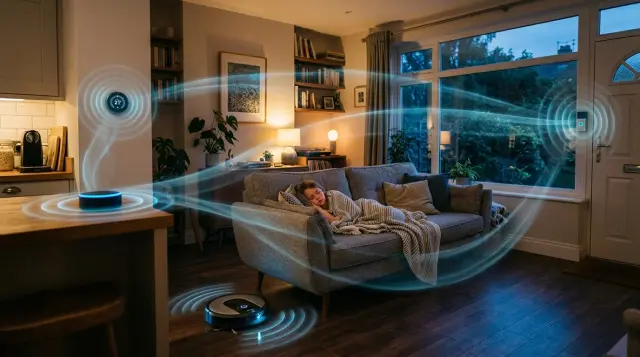
Every connected device in your home communicates using some flavor of radiofrequency (RF) radiation. Your Wi-Fi router runs at 2.4 GHz or 5 GHz. Your Bluetooth earbuds use 2.4 GHz. Smart home hubs, baby monitors, and Zigbee devices each add their own signals to the mix. Individually, the power output of each device is low. But collectively? That's a lot of electromagnetic fields stacked on top of each other in a confined space.
Think of it this way. You're sitting in your living room. Within range, there might be a Wi-Fi router, a smart TV, two phones, a smart speaker, a mesh network node, and a wireless security camera. According to the FCC, each device must stay below specific absorption rate (SAR) limits of 1.6 W/kg averaged over 1 gram of tissue [1]. But those limits were designed for single-device exposure and were last updated in 1996. Nobody was thinking about a home with 22 simultaneous emitters.
The real variables here are proximity and duration. A smart plug across the room produces trivial exposure. A smart speaker on your nightstand running all night is a different story entirely. A Wi-Fi router mounted on the wall three feet from where your toddler sleeps? That's the kind of scenario worth thinking carefully about. If you want a deeper look at how specific devices compare, I covered that in The Connected Home: The Honest Guide.
Quick Q&A
Q: Do smart home devices emit enough EMF to matter?
A: Individually, most emit low-power RF signals, but 20+ devices running constantly in close proximity create cumulative exposure that exceeds the single-device scenarios regulators originally tested for.
What Does the Research Say About EMF and Health?
Let's start with what the major agencies actually say. The World Health Organization's International Agency for Research on Cancer (IARC) classified radiofrequency electromagnetic fields as Group 2B in 2011, meaning "possibly carcinogenic to humans" [2]. That's the same category as pickled vegetables and talcum powder. It doesn't mean RF definitely causes cancer. It means the evidence was strong enough that the world's top cancer researchers couldn't rule it out.
Then came the big one. In 2018, the U.S. National Toxicology Program (NTP) published results from a $30 million study. It was the most comprehensive animal study on cell phone radiation ever conducted. The findings? Clear evidence of malignant heart schwannomas in male rats exposed to RF radiation at levels comparable to what humans experience [3]. The NTP also found some evidence of brain tumors. These weren't ambiguous results. The study's own peer review panel actually upgraded the findings from "some evidence" to "clear evidence" during the review process.
On the other side, large epidemiological studies like the Danish Cohort Study and parts of the INTERPHONE study found no consistent link between cell phone use and brain tumors in humans. The FDA has stated that the current body of evidence does not definitively connect RF exposure to health problems at levels below existing limits [4]. So you've got credible institutions landing on opposite sides.
Here's what I think gets lost in the headlines: the disagreement isn't really about whether electromagnetic radiation can affect biology. It can. The disagreement is about the threshold. At what exposure level, and over what duration, do effects become clinically meaningful? That's where the science is still catching up to our technology. For a broader look at how wearable tech factors in, check out The Best Health Wearables: The Honest Guide.
The disagreement isn't about whether electromagnetic radiation can affect biology. It can. The real question is at what exposure level, and over what duration, those effects become clinically meaningful. That's where the science is still racing to catch up with our technology.
Are Children More Vulnerable to Wireless Radiation?
This is where the conversation gets more urgent. Children aren't miniature adults when it comes to RF exposure. Their skulls are thinner. Their brain tissue contains more water and ions, which makes it more conductive. And their cells are dividing more rapidly, which theoretically makes them more susceptible to any biological effects from electromagnetic fields.
Research published in IEEE Access has shown that children may absorb up to two times more RF radiation in certain brain regions compared to adults using the same device. The American Academy of Pediatrics (AAP) has formally recommended that the FCC reassess its RF exposure guidelines with children specifically in mind. The AAP sent a letter to the FCC in 2013 pointing out that exposure standards were based on the body dimensions and tissue properties of a large adult male. Not a six-year-old.
Think about how kids interact with smart home devices, too. They sit directly in front of tablets connected to Wi-Fi for hours. They fall asleep next to baby monitors. Their bedrooms often sit near Wi-Fi routers or mesh nodes because those rooms tend to be centrally located. None of this means you need to panic. But it does mean the tech and electromagnetic health conversation matters especially for families with young children.
If you're looking at practical ways to reduce your family's exposure, something as simple as moving a router to a less-trafficked area of the house can make a real difference. Distance is your best friend when it comes to RF. Even a few extra feet dramatically drops exposure levels. For device-specific strategies, I'd recommend Smart Wearables: The Complete Guide.

How Does 5G Change the EMF Equation at Home?
5G has become a lightning rod (no pun intended) for EMF health concerns. And honestly, a lot of the conversation around it has been polluted by conspiracy theories. So let's stick to what we actually know. 5G operates across a spectrum of frequencies, from sub-6 GHz bands that overlap with existing 4G LTE to millimeter wave (mmWave) frequencies up around 24 to 39 GHz. The higher frequencies carry more data but penetrate walls poorly, which is why 5G rollouts often require more small cell antennas placed closer together.
For your smart home, 5G means potentially faster connectivity for devices that use cellular connections, like some security cameras and smart hubs. But it also means more small cell installations in residential neighborhoods. According to the FCC, these installations must still comply with RF exposure limits, though critics point out that those limits haven't been updated since 1996 [1].
In August 2021, a federal court ruled that the FCC had failed to adequately explain why it declined to update its 25-year-old RF exposure guidelines in light of new evidence, including the NTP study. The U.S. Court of Appeals for the D.C. Circuit sent the matter back to the FCC for further review. As of this writing, the FCC still hasn't issued updated guidelines. That's not exactly reassuring if you're trying to figure out whether current standards adequately protect you from the RF environment created by newer technologies.
The honest takeaway: 5G at sub-6 GHz frequencies isn't dramatically different from what we've already been exposed to with 4G. The mmWave frequencies are newer territory and less studied for long-term biological effects. If you care about tech and electromagnetic health, paying attention to how 5G develops and what updated research shows is entirely reasonable.

Can You Actually Shield Yourself from EMF at Home?
Yes. But let's be specific about what works and what's snake oil. EMF shielding operates on well-established physics. Conductive materials like silver, copper, and nickel can reflect or absorb electromagnetic radiation. This is the same principle behind a Faraday cage, a concept that's been around since Michael Faraday demonstrated it in 1836. There's nothing fringe about it. Your microwave oven uses the same principle to keep radiation inside the box.
For your home, practical shielding options include RF-blocking paint for walls near smart meters or cell towers, shielded ethernet cables to hardwire devices instead of relying on Wi-Fi, and router covers that reduce output in directions you don't need coverage. But one of the most overlooked approaches is shielding your body directly, especially if you carry a phone in your pocket or spend hours near wireless devices.
That's where wearable shielding comes in. Proteck'd makes apparel with silver-infused Faraday fabric that blocks a measurable percentage of RF and EMF. I know that sounds futuristic, but it's just applied physics in clothing form. Their Faraday Protection Collection includes everyday pieces designed for people who want to reduce exposure without looking like they're wearing a tinfoil hat. If you're curious about the science behind how it works, their EMF Protection Benefits page breaks it down clearly.
Quick Q&A
Q: Does silver fabric actually block EMF?
A: Yes. Silver is highly conductive and has been used in military and industrial EMF shielding for decades. When woven into fabric at sufficient density, it reflects and absorbs radiofrequency radiation measurably.
What Are Practical Steps to Reduce EMF Exposure at Home?
You don't need to rip out your smart home to take electromagnetic health seriously. Start with the easy wins. Move your Wi-Fi router away from bedrooms and living areas where people spend the most time. A router in a hallway closet or utility room still provides coverage to the whole house while putting meaningful distance between the emitter and the people in it.
Hardwire what you can. Your smart TV, desktop computer, and gaming console almost certainly have ethernet ports. Using them instead of Wi-Fi eliminates one source of RF from each device and often gives you faster, more reliable connections too. If you've got a mesh Wi-Fi system, consider whether you actually need nodes in bedrooms, or if you can cover those areas from nodes positioned in hallways.
Turn off Wi-Fi on devices when they don't need it. Your smart thermostat needs connectivity. Your smart light bulbs probably don't need to be chattering on the network at 3 AM. Many routers let you schedule Wi-Fi to power down during sleeping hours. That simple change cuts your nighttime RF exposure to nearly zero from your router.
For personal protection, especially for people who carry phones close to their bodies all day, Men's Faraday Tech Wear from Proteck'd offers pants, jackets, and accessories with built-in shielding. It's one of the few approaches that addresses exposure from devices you physically carry, which are often your highest-exposure sources. Combine that with good digital hygiene (something I covered in Digital Privacy: The Complete Guide) and you've got a solid foundation for managing your tech and electromagnetic health.
Is the Connected Home Actually Worth It?
After digging into all of this, here's where I land: the connected home is worth it, if you're intentional about it. The convenience of smart thermostats, automated lighting, and voice-controlled everything is real. These technologies save time and energy. For people with mobility issues or disabilities, they can be genuinely life-changing.
But "worth it" doesn't mean "adopt everything blindly." The research on wireless radiation health effects is still evolving. Major agencies haven't settled the debate. Regulatory standards are outdated. And the cumulative exposure picture, dozens of devices running simultaneously for years, simply hasn't been studied in a rigorous, long-term way. Pretending that's not true doesn't make it go away.
The smart move is to enjoy the technology while respecting the uncertainty. Hardwire where you can. Create distance where it matters. Consider shielding solutions for your body, especially during the hours you spend closest to your highest-emitting devices. And stay informed as the science develops. The intersection of tech and electromagnetic health isn't a passing trend. It's going to become one of the defining health conversations of the next decade.
Being proactive doesn't mean being paranoid. It means being a thoughtful consumer in an era where our surroundings are increasingly saturated with RF signals. And honestly? That just seems like common sense.
Key Takeaways
Frequently Asked Questions
Is smart home EMF exposure dangerous?
The honest answer is we don't know for certain yet. The WHO classifies RF radiation as a Group 2B possible carcinogen, and the NTP study found tumor evidence in animals. But no long-term human study has conclusively proven harm at typical home exposure levels. The precautionary approach is to reduce unnecessary exposure where practical.
How much EMF does a Wi-Fi router emit?
A typical home Wi-Fi router emits RF radiation at power levels between 30 and 100 milliwatts, operating at 2.4 GHz or 5 GHz. At three feet away, exposure falls well below FCC limits. But at six inches, like on a nightstand, exposure is significantly higher. Distance makes an enormous difference.
Do smart speakers like Alexa and Google Home emit EMF constantly?
Yes. Smart speakers maintain a constant Wi-Fi connection and periodically communicate with cloud servers, even when you're not actively using them. They also use far-field microphone arrays that are always listening for wake words. Placing them away from where you sit or sleep for extended periods is a simple way to reduce exposure.
Are 5G home devices more dangerous than 4G?
Not necessarily at sub-6 GHz frequencies, which overlap with existing 4G bands. The higher millimeter wave (mmWave) frequencies used by some 5G services are less studied for long-term biological effects but penetrate the body less deeply. The bigger concern is the increased density of transmitters in residential areas.
Can EMF-blocking clothing really protect you?
Yes, when the fabric contains enough conductive material like silver or copper. Silver-infused Faraday fabric reflects and absorbs RF radiation based on well-established electromagnetic shielding principles. Proteck'd's Faraday collection uses this approach in everyday wearable designs.
Should I turn off Wi-Fi at night to reduce EMF exposure?
It's one of the simplest and most effective things you can do. Turning off your router during sleeping hours eliminates a major source of RF in your home for roughly 8 hours per day. Many routers have built-in scheduling features that automate this, so you don't even have to think about it.
Are children at higher risk from smart home EMF?
Research suggests yes. Children's thinner skulls and more conductive brain tissue may allow up to twice as much RF absorption compared to adults. The American Academy of Pediatrics has formally asked the FCC to update exposure guidelines to account for children's unique physiology. Keeping devices at greater distances from kids is a sensible step.
What is SAR and why does it matter for smart home devices?
SAR stands for Specific Absorption Rate. It measures how much RF energy the body absorbs from a device. The FCC sets the limit at 1.6 W/kg averaged over 1 gram of tissue. However, this standard was established in 1996 for single-device exposure and doesn't account for the dozens of simultaneous emitters in a modern connected home.
Does hardwiring devices instead of using Wi-Fi reduce EMF?
Absolutely. Every device you connect via ethernet cable instead of Wi-Fi eliminates one source of RF radiation in your home. It also typically provides faster and more stable connectivity. Smart TVs, gaming consoles, and desktop computers almost always have ethernet ports that go unused.
Has the FCC updated its EMF safety guidelines recently?
No. The FCC's RF exposure guidelines were last updated in 1996. In 2021, the U.S. Court of Appeals for the D.C. Circuit ruled that the FCC failed to adequately justify keeping these outdated standards in light of newer research, including the NTP study. As of now, updated guidelines have still not been issued.
References
- Federal Communications Commission (FCC) – The FCC limits SAR for cell phones to 1.6 W/kg averaged over 1 gram of tissue, a standard last updated in 1996.
- International Agency for Research on Cancer (IARC), World Health Organization – IARC classified radiofrequency electromagnetic fields as Group 2B, possibly carcinogenic to humans, in 2011.
- National Toxicology Program (NTP), National Institute of Environmental Health Sciences – The NTP study found clear evidence of malignant heart schwannomas in male rats exposed to cell phone RF radiation.
- U.S. Food and Drug Administration (FDA) – The FDA has stated that the current body of evidence does not definitively connect RF exposure to health problems at levels below existing limits.
About the Author
Proteck'd EMF Apparel
Health & EMF Specialists
The Proteck'd team covers EMF protection, silver-fiber apparel, and practical ways to reduce everyday radiation exposure. Every piece Proteck'd ships is designed, tested, and worn by the people who build it.
Protect Yourself Today
Proteck'd Faraday and silver fiber apparel is engineered to shield your body from everyday EMF exposure. Built for real life, tested for real results.
Shop EMF Protection →✓30-day returns✓Free shipping✓Free returns✓Silver fiber shielding


