


Digital Detox: The Complete Guide

Here's a number worth sitting with: the average American checks their phone 144 times a day, according to a 2024 report from Reviews.org. A huge chunk of that screen time happens in the hour before bed, right when your brain is desperately trying to wind down. If you've been wondering how to optimise sleep quality, the answer might not be a new mattress or a fancy supplement. It might be putting the phone in another room.
I used to scroll through news headlines and Reddit threads until my eyes physically couldn't stay open. I told myself that was falling asleep naturally. It wasn't. It was passing out from exhaustion while my brain was still buzzing with stimulation. Real sleep, the kind that actually restores you, requires something completely different.
This guide is about building a digital detox practice designed specifically around better rest. We'll look at what the science actually says, what real people have found works, and how to set up your environment so your body can do what it's built to do: sleep deeply and wake up feeling human.
Maybe you're dealing with full-blown insomnia. Maybe it's that maddening pattern of waking up at 3 a.m. and staring at the ceiling. Either way, a structured approach to reducing your digital intake can make a measurable difference. And no, you don't have to become a Luddite. You just have to be smarter about when and how you use your devices.

Your phone isn't a sleep aid. It's a sleep thief. The single most impactful change most people can make for better rest is putting the screen away 90 minutes before bed and letting their brain remember what darkness feels like.
Why Does Screen Time Wreck Your Sleep?
Let's start with the biology, because it's surprisingly straightforward. Your brain produces melatonin, the hormone that signals bedtime, in response to darkness. When light hits the photoreceptor cells in your retina, especially light in the blue wavelength range (around 450 to 495 nanometers), melatonin production gets suppressed. Research from Harvard Medical School found that blue light shifts the circadian clock by about 3 hours and suppresses melatonin roughly twice as much as other light wavelengths [1].
Now think about what you're doing at 10 p.m. You're holding a blue-light-emitting screen about 14 inches from your face. Your phone, tablet, or laptop is basically telling your brain it's the middle of the afternoon. A 2014 study published in PNAS by researchers at Brigham and Women's Hospital compared people reading e-books to people reading printed books before bed. The e-reader group took longer to fall asleep, had less REM sleep, and felt sleepier the next morning even after eight hours in bed [2].
But it's not just the light. It's the content. Scrolling social media. Reading emails. Watching tense TV shows. All of it activates your sympathetic nervous system, the fight-or-flight response. Your cortisol levels stay elevated. Your heart rate stays up. Your mind is racing through tomorrow's to-do list or replaying an argument you saw online. None of that is compatible with winding down for nightly recovery.
Quick Q&A
Q: How long before bed should I stop looking at screens?
A: Most sleep researchers, including those at the Mayo Clinic, recommend putting screens away at least 60 to 90 minutes before your target bedtime to allow melatonin production to ramp up naturally.
Here's the thing most people miss. They underestimate how much their screen habits affect their circadian rhythm. They blame stress, age, or diet. And sure, those matter. But if you haven't addressed the glowing rectangle in your hand, you're skipping the easiest fix available. For a full walkthrough on cutting back, check out How to Reduce Screen Time: The Method That Works.
How Can You Build a Tech-Free Bedtime Routine?
Knowing that screens are bad before bed is one thing. Actually replacing the habit? That's another problem entirely. You need a substitute ritual, something your brain can latch onto as the new "it's time to sleep" signal. The National Sleep Foundation calls this sleep hygiene, and consistency is its backbone.
Here's a real example. My friend Sarah, a graphic designer who spent 10+ hours a day on screens, started a simple 90-minute wind-down protocol. At 9 p.m., she puts her phone on a charger in the kitchen. Not the bedroom. She spends 20 minutes stretching, reads a physical book for 30 minutes, and does 10 minutes of breathing exercises. Within two weeks, she was falling asleep 25 minutes faster. Nothing else in her life changed.
The breathing exercises piece matters more than people realize. A 2018 systematic review published in Frontiers in Human Neuroscience found that slow diaphragmatic breathing activates the parasympathetic nervous system and measurably reduces cortisol. If you're new to that sort of practice, How to Start Meditating: The Practical Guide is a solid starting point.
Your routine doesn't have to look like Sarah's. Some people journal. Some people take a warm bath, which research from the University of Texas at Austin found can improve sleep onset by triggering the body's natural thermoregulation process. The point is you're replacing screen stimulation with something calming, and you're doing it at roughly the same time each night. That consistency helps reset your circadian rhythm faster than any single trick.
If you want a bigger picture view of how all these habits connect, the Sleep Optimization: The Complete Guide covers the full spectrum from mattress choice to supplement timing.
What Should Your Bedroom Environment Look Like for Better Rest?
Think of your bedroom as a sleep lab. Seriously. Every element in that room either helps you rest or actively works against you. Temperature is a big one. The National Sleep Foundation recommends keeping your bedroom between 60 and 67 degrees Fahrenheit. Your core body temperature needs to drop by about 2 to 3 degrees to initiate sleep, and a cool room makes that process easier [3].
Then there's light. Even small amounts of ambient light can mess things up. The standby LED on your TV, the glow from a hallway, streetlights creeping through thin curtains. A 2022 study from Northwestern University's Feinberg School of Medicine found that sleeping with even moderate ambient light increased heart rate, impaired insulin resistance the next morning, and disrupted sleep architecture. Blackout curtains are worth every penny.
Now let's talk about something most sleep guides skip entirely: the electromagnetic environment. Your bedroom is probably filled with WiFi routers, charging phones, smart speakers, and other devices emitting electromagnetic fields. While mainstream research is still building, a growing body of evidence suggests that reducing EMF exposure in the sleeping environment may support better circadian rest. You can learn more about the research behind this at Proteck'd's EMF Health Benefits page.
Practically, this means moving your phone out of the bedroom or at least switching it to airplane mode. It means not sleeping next to a charging laptop. Some people go further and use EMF-shielding apparel and blankets. Proteck'd's Faraday Health Collection is designed with silver-infused Faraday fabric that blocks a significant percentage of radio frequency radiation. That's particularly useful if you live in an apartment surrounded by dozens of WiFi networks.
Quick Q&A
Q: Does keeping my phone on the nightstand really affect sleep quality?
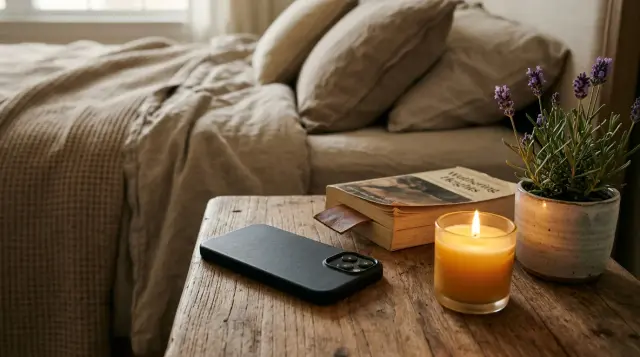
A: Yes. Beyond the temptation to check notifications, the phone emits blue light from alerts and generates low-level electromagnetic radiation. Moving it to another room removes both the EMF exposure and the psychological pull to scroll.
How Does Daytime Behavior Affect Nighttime Sleep Quality?
This surprises a lot of people: how to optimise sleep quality isn't just about what you do at night. It's largely determined by what happens during the day. Your circadian rhythm is a 24-hour cycle, not a nighttime-only system. And morning sun is one of its most powerful inputs.
Dr. Andrew Huberman, a neuroscientist at Stanford University, has popularized the idea of getting bright light exposure within the first 30 to 60 minutes of waking. The reasoning is simple. Morning light, especially the low-angle sunlight you get around sunrise, triggers a cortisol pulse that helps set the timing of your entire hormonal day. That pulse tells your body when to start the melatonin countdown, roughly 14 to 16 hours later. Skip the morning light and your body loses that anchor point.
Exercise matters too, but timing is key. A meta-analysis published in the British Journal of Sports Medicine in 2018 found that regular moderate exercise improved sleep quality across all measured outcomes. However, intense exercise within 2 hours of bedtime can raise core body temperature and adrenaline, making it harder to fall asleep. The sweet spot for most people? Morning or early afternoon workouts.
Then there's caffeine, quietly sabotaging sleep from hours away. According to the American Academy of Sleep Medicine, caffeine has a half-life of roughly 5 hours, but its quarter-life means that even 10 hours after your cup of coffee, 25% of the caffeine is still circulating. A 2 p.m. espresso still has a meaningful effect at midnight. That's why most sleep specialists, including those at the Cleveland Clinic, recommend cutting off caffeine by early afternoon at the latest [4].
For a broader perspective on how daily habits, nutrition, and mental health practices connect to nightly recovery, take a look at Integrative Wellness: The Complete Guide.
What Does a Full Digital Detox for Sleep Actually Look Like?
Let's put this all together into an actual plan, because abstract advice only gets you so far. A digital detox focused on improving sleep quality doesn't mean throwing your phone in a lake. It means creating intentional boundaries around technology use, especially in the 2 to 3 hours before bed and in your sleeping environment.
Week one: set a firm "screens off" time 90 minutes before bed. Charge all devices outside the bedroom. Replace scrolling with reading, stretching, or light conversation. This single change, according to a 2019 trial published in the Journal of Clinical Sleep Medicine, reduced sleep onset latency by an average of 20 minutes in participants with self-reported insomnia.
Week two: address your daytime digital habits. Set your phone to grayscale mode after 6 p.m., which reduces the dopamine-triggering color stimulation. Limit social media to defined windows. Get 15 to 30 minutes of direct morning sunlight. If you want a structured approach, How to Do a Digital Detox: Step by Step walks you through each phase.
Week three: optimize your bedroom environment. Blackout curtains. Cool temperature. White noise if you need it. And consider your EMF exposure. Proteck'd's Women's Wellness Collection offers comfortable, wearable EMF shielding designed for everyday use, including sleep. It's a practical solution for people who can't fully eliminate wireless devices from their home but want to reduce personal exposure during rest.
Week four and beyond: refine and maintain. Track what's working. Most people find they don't miss the late-night scrolling once they've experienced what genuinely restorative sleep feels like. The fog lifts. The morning grogginess fades. You actually wake up before your alarm. That's not wishful thinking. That's just what happens when your body gets to do its job without interference.
Can Supplements and Sleep Aids Replace a Digital Detox?
Short answer: no. Some supplements can help, but they work best when the underlying habits are already in place. Melatonin supplements, for example, are widely used and generally considered safe for short-term use by the Mayo Clinic. But here's the thing. If you're blasting your retinas with blue light until 11:30 p.m., a 3mg melatonin pill is fighting an uphill battle.
Research from MIT found that lower doses of melatonin (0.3 to 0.5mg) are actually more effective than the typical 3 to 10mg doses sold in stores, because they more closely mimic the body's natural production levels. Higher doses can cause grogginess and may even disrupt your natural rhythm over time. So if you do use melatonin, less is more.
Magnesium glycinate is another popular option. A 2012 study published in the Journal of Research in Medical Sciences found that magnesium supplementation improved subjective measures of insomnia, sleep time, and sleep onset latency in elderly participants. It's not a magic bullet. But for people who are deficient (and according to the NIH, roughly 50% of Americans consume less than the recommended amount of magnesium), it can be a helpful addition.
The bottom line: supplements are the finishing touch, not the foundation. How to optimise sleep quality starts with behavior. Fix your light exposure, your screen habits, your bedroom environment, and your daily routine first. Then, if you want to layer in supplements, they'll actually have something to build on.
How Long Does It Take to See Results from a Sleep-Focused Digital Detox?
Most people notice some improvement within the first 3 to 5 days. Falling asleep faster is usually the first change. Makes sense, right? You've removed the main thing keeping your brain in alert mode. Deeper, more continuous sleep tends to follow within 1 to 2 weeks as your circadian rhythm stabilizes.
A 2015 study from the National Institutes of Health on sleep hygiene interventions found that participants who consistently followed a set of behavioral changes (including limiting screen time) saw statistically significant improvements in sleep quality within 14 days, as measured by the Pittsburgh Sleep Quality Index (PSQI). The improvements continued to build over the following month.
Fair warning, though. The first few nights without your phone might feel weird. You might feel restless or bored. That's normal. Your brain is used to a dopamine drip from scrolling, and it takes a few days to adjust. Push through that discomfort. By day four or five, most people report that they actually look forward to the quiet. It becomes the favorite part of their day.
And if you've been dealing with chronic sleep issues, give it a full 30 days before you judge the results. Resetting a deeply entrenched circadian rhythm takes time. You're undoing potentially years of habits. Be patient with yourself, but stay consistent. The science is clear: reducing digital stimulation before bed works. You just have to let it.
- Blue light from screens suppresses melatonin production by up to 50%, making it significantly harder to fall asleep naturally
- A consistent 90-minute screen-free wind-down routine can reduce the time it takes to fall asleep by an average of 20 minutes
- Your bedroom environment should be cool (60 to 67°F), dark, and free of unnecessary electronic devices and EMF sources
- Daytime habits like morning sunlight exposure and early caffeine cutoffs are just as important as nighttime routines for sleep quality
- Supplements like melatonin and magnesium can help but should be layered on top of behavioral changes, not used as replacements
Frequently Asked Questions
At least 60 to 90 minutes before bed. This gives your brain enough time to start producing melatonin naturally. Research from Brigham and Women's Hospital showed that screen use right up until bedtime delayed the circadian clock by about 1.5 hours and reduced REM sleep.
A little, but it's not a complete fix. Night mode reduces some blue light without eliminating it entirely, and it does nothing to address the mental stimulation of scrolling through content. Putting the phone away completely is far more effective.
It can significantly improve insomnia symptoms, but it may not cure chronic insomnia on its own. A digital detox addresses one of the most common triggers for poor sleep: excessive screen stimulation. For persistent insomnia, cognitive behavioral therapy for insomnia (CBT-I) is the gold standard treatment recommended by the American Academy of Sleep Medicine.
Night shift workers face unique challenges because their schedule conflicts with natural light cycles. The key strategies are using blackout curtains during daytime sleep, wearing blue-light-blocking glasses on the commute home, and keeping a consistent sleep schedule even on days off. A digital detox before your sleep window is just as important regardless of what time that window falls.
It's not the alarm function that's the problem. It's the proximity and temptation. Having your phone on the nightstand makes it too easy to check notifications during the night or start scrolling if you wake up. Buy a simple alarm clock and charge your phone in another room.
Between 60 and 67 degrees Fahrenheit (15.5 to 19.5 degrees Celsius), according to the National Sleep Foundation. Your body needs to drop its core temperature to initiate sleep, and a cool room helps that process along. Some people find that cooling mattress pads or breathable bedding makes an additional difference.
This is an area of active research. Some studies suggest that RF electromagnetic field exposure may affect sleep architecture and melatonin production, though the evidence isn't definitive yet. As a precautionary measure, many sleep specialists suggest minimizing electronic devices in the bedroom. EMF-shielding products offer an additional layer of protection for those who are concerned.
Research from MIT suggests that 0.3 to 0.5mg is actually more effective than the 3 to 10mg doses commonly sold in stores. Lower doses more closely mimic your natural melatonin levels. Always start with the lowest dose and talk to your doctor, especially if you take other medications.
Yes, if it's a backlit Kindle. The 2014 PNAS study specifically tested light-emitting e-readers and found they suppressed melatonin and delayed sleep onset. However, Kindle models with e-ink displays that don't emit light (used with a side lamp) are comparable to reading a paper book and shouldn't disrupt your rest.
Read a physical book, do gentle stretching or yoga, practice breathing exercises, journal, listen to calming music or a podcast (with the screen face down), or have a conversation with someone in your household. The goal is to replace stimulating digital input with something that lets your nervous system wind down.
References
- Harvard Health Publishing, Harvard Medical School – Blue light suppresses melatonin production more powerfully than other light wavelengths and shifts the circadian clock
- Proceedings of the National Academy of Sciences (PNAS) – Evening use of light-emitting e-readers delayed the circadian clock, suppressed melatonin, and reduced next-morning alertness compared to reading printed books
- Cleveland Clinic – The National Sleep Foundation recommends a bedroom temperature between 60 and 67 degrees Fahrenheit for optimal sleep
- Mayo Clinic – Caffeine has a half-life of approximately 5 hours and should be limited to early in the day to avoid sleep disruption
About the Author
Proteck'd EMF Apparel
Health & EMF Specialists
The Proteck'd team covers EMF protection, silver-fiber apparel, and practical ways to reduce everyday radiation exposure. Every piece Proteck'd ships is designed, tested, and worn by the people who build it.
Get the Free EMF Home Audit Checklist
A room-by-room PDF that walks you through the biggest EMF sources in your house and what to do about each one. No cost, no fluff.
Download the Checklist →✓30-day returns✓Free shipping✓Free returns✓Silver fiber shielding


Leave a comment