


Smartwatch vs Fitness Tracker: An Honest Comparison

Here's a stat that caught me off guard: the average smartwatch owner checks their wrist over 80 times a day. That's more than most people check their phone. When something gets that much of your attention, picking the right one isn't just a fun gadget decision anymore. It's personal. So why does smartwatch comparison guide matter? Because you're choosing a device that will monitor your heart, track your sleep, and press against your skin for years.
The market is a mess. Apple, Samsung, Garmin, Fitbit, Google, and a flood of newcomers are all fighting for your wrist. Fitness trackers have gotten smarter. Smartwatches have gotten healthier. The line between them? Blurrier than ever. And most comparison guides just dump a spreadsheet of specs without telling you what actually matters for your life.
I spent weeks digging into the real differences. Not screen size and processor speed, but the stuff that shapes your daily experience. Sensor accuracy during actual workouts. Battery life outside of lab conditions. What happens when your wearable ecosystem refuses to play nice with your phone. And yes, the growing conversation around EMF exposure from a device you literally never take off.
This isn't a spec sheet. It's an honest comparison built to help you make a decision you won't regret six months from now. Let's get into it.
Key Takeaways
Why Does a Smartwatch Comparison Guide Actually Matter in 2025?
Five years ago, smartwatches were glorified notification mirrors. Glance at a text, maybe check the weather, done. In 2025, these devices carry FDA-cleared ECG apps, blood oxygen sensors, continuous skin temperature monitoring, and irregular heart rhythm notifications that have genuinely sent people to the ER in time [1]. The stakes are way higher than "which one looks cooler."
According to IDC research, global wearable device shipments hit 148.4 million units in the third quarter of 2024 alone. That's a staggering number of people making this exact decision. And the tricky part? "Best" depends entirely on who you are. A marathon runner needs one thing. A desk worker tracking stress needs another. A parent who wants to leave their phone behind at the playground needs something else entirely.
That's exactly why a smartwatch comparison guide matters. It's not about crowning a winner. It's about matching the right device to the right person. A $450 Apple Watch is overkill if you just want sleep tracking. A $79 fitness band is useless if you need standalone LTE for phone calls. The guide becomes a filter between marketing hype and personal fit.
If you've been curious about how different wearables stack up for specific lifestyles, I covered that angle in detail in The Best Wearable for Your Lifestyle: An Honest Comparison. It pairs well with what we're doing here.
How Accurate Are Health Sensors on Smartwatches vs. Fitness Trackers?
Let's talk about the elephant in the room. Most people buy wearables for health tracking. But how accurate are these sensors, really? The American Heart Association published findings showing that wrist-based optical heart rate monitors can have error rates between 10 and 15 percent during vigorous exercise [2]. That gap matters if you're training in specific heart rate zones or keeping tabs on a cardiac condition.
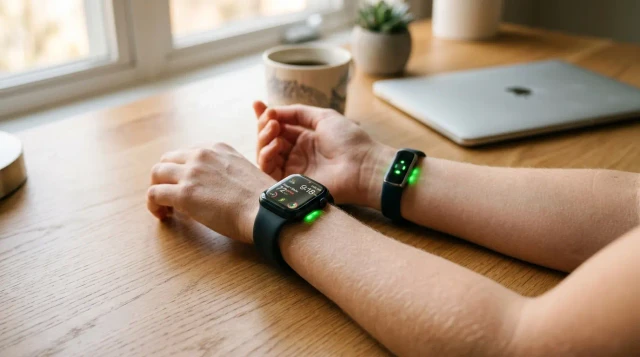
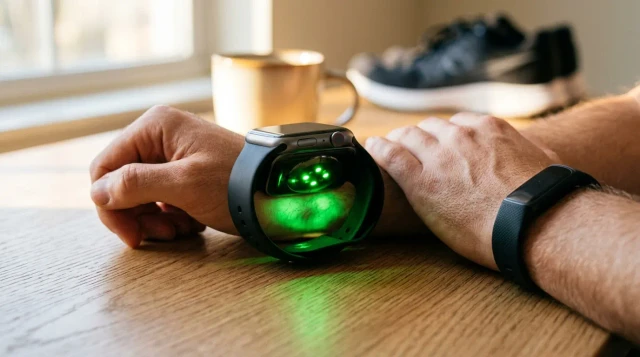
The technology behind it is called photoplethysmography, or PPG. It shines green LED light into your skin and measures blood volume changes. Works reasonably well at rest. But motion artifacts during running or cycling throw it off, which is why chest straps remain the gold standard for serious athletes. Smartwatches like the Apple Watch Series 9 and Samsung Galaxy Watch 6 have added more LEDs and improved algorithms to compensate. Still, physics is physics.
Quick Q&A
Q: Are smartwatch heart rate sensors accurate enough for medical use?
A: Smartwatch heart rate sensors are clinically useful for trend detection and irregular rhythm alerts, but they are not replacements for medical-grade monitors during active treatment.
Fitness trackers often use fewer LEDs and simpler algorithms, which can mean less accuracy but also less battery drain. Fitbit's Charge 6, for example, added Google's AI-enhanced heart rate tracking and saw measurable improvements in resting heart rate accuracy compared to the Charge 5. The gap between trackers and watches is shrinking. It just hasn't closed yet.
GPS accuracy is another battleground. Garmin's multi-band GPS, found in watches like the Fenix 8 and Enduro 3, consistently outperforms single-band GPS in dense urban environments and under heavy tree cover. If you're a trail runner, this isn't a small detail. It's the difference between accurate pace data and a squiggly mess on your post-run map.
What's the Real Difference in Battery Life Between Smartwatches and Fitness Trackers?
Battery life is where the smartwatch vs. fitness tracker debate gets interesting. The Apple Watch Series 9 gets about 18 hours on a charge. Eighteen. That means you're charging every single night, which also means you're either skipping sleep tracking or scrambling for a charger window. Samsung's Galaxy Watch 6 does slightly better at roughly 30 to 40 hours depending on usage, but it's still a daily or every-other-day ritual.
Compare that to the Garmin Enduro 3, which delivers up to 90 hours of active GPS tracking and weeks of regular smartwatch use. Or the Fitbit Inspire 3, which can go 10 full days between charges. If you want uninterrupted sleep tracking and don't want to think about cables, a dedicated fitness tracker or a Garmin watch simply wins this category.
The reason is straightforward. Bigger, brighter screens and always-on connectivity drain power fast. An AMOLED display running at 60Hz, pinging your phone over Bluetooth while also scanning for LTE signals, is doing a lot of work. Fitness trackers use smaller, dimmer screens (often OLED or even simple LCD) and skip the cellular radio entirely.
For people who travel a lot or spend weekends off-grid, battery life isn't a nice-to-have. It's a dealbreaker. I'd honestly recommend that anyone who values multi-day adventures make battery the first filter in their wearable comparison, not the last.
Your smartwatch sits on your skin 24 hours a day. It monitors your heart, tracks your location, and knows your sleep patterns. Choosing the right one isn't a gadget decision. It's a health decision, a privacy decision, and a lifestyle decision all wrapped into something the size of a postage stamp.
Does Ecosystem Lock-In Really Affect Your Smartwatch Experience?
Short answer: yes. And more than most people expect. If you own an iPhone, the Apple Watch is your only real full-featured option. It won't even pair with an Android phone. Samsung's Galaxy Watch works best with Samsung phones, though it does connect to other Android devices with reduced functionality. Google's Pixel Watch plays nicest with Pixels. Predictably.
This ecosystem question goes beyond just phone pairing. It extends to smart home control, payment systems, and app availability. Apple Watch users get Apple Pay, HomeKit control, and tight Siri integration. Galaxy Watch users get Samsung Pay and SmartThings. If you've built a smart home on one platform, your watch choice might already be made for you. For more on how these ecosystems connect to your home setup, check out Home Automation: The Complete Guide.
Fitness trackers sidestep this problem entirely. A Fitbit Charge 6 or Garmin Venu Sq works with both iOS and Android. You lose the ability to respond to texts from your wrist or make phone calls, but you gain the freedom to switch phones without replacing your wearable. That flexibility matters more than people realize.
Here's a real-world example. A friend of mine switched from iPhone to a Samsung Galaxy S24 last year. Her Apple Watch Series 8 became a paperweight overnight. She lost access to two years of Apple Health data in the process. Ecosystem lock-in is invisible until it isn't.
How Should You Think About EMF Exposure from Wearable Devices?
This is the topic most smartwatch comparison guides skip entirely, and I think that's a mistake. Wearables sit on your skin, often 24 hours a day, emitting low levels of radiofrequency electromagnetic radiation through Bluetooth, Wi-Fi, and in some cases LTE. The FCC requires all devices sold in the U.S. to stay below a specific absorption rate (SAR) of 1.6 W/kg, and current smartwatches comply [3].
But compliance with a regulatory limit doesn't mean zero exposure. The long-term effects of continuous, close-contact RF exposure are still being studied. The National Institute of Environmental Health Sciences (NIEHS) continues to fund research into the bioeffects of non-ionizing radiation, including the frequencies used by Bluetooth and Wi-Fi devices [4]. The science isn't settled. I think informed awareness beats either panic or dismissal.
Quick Q&A
Q: Do smartwatches emit enough EMF radiation to be a health concern?
A: Current smartwatches meet FCC safety limits, but long-term effects of continuous skin-contact RF exposure are still under active research by agencies including NIEHS.
This is where practical solutions come in. If you wear a device around the clock and want to reduce your overall electromagnetic field exposure during the rest of your day, Proteck'd makes clothing with built-in Faraday shielding. Their Faraday Protection Collection uses conductive fabrics to attenuate RF signals across your torso. That's a smart move if you're already stacking exposure from your watch, your phone in your pocket, and your laptop on your desk.
You can learn more about the science behind this at Proteck'd's EMF Protection Benefits page. And for the guys reading this, the Men's Faraday Tech Wear line manages to look like normal streetwear while incorporating silver-fiber shielding. It's one of those rare cases where the protective option doesn't require a style compromise.
Which Smartwatch Brand Wins for Which User in 2025?
Let me be direct. There is no single best smartwatch. There's only the best one for you. But here's how I'd break it down after testing and researching the major players.
Apple Watch Series 9 (or the newer Series 10) is the obvious pick if you're deep in the Apple ecosystem. Its health sensors are FDA-cleared, the app library is unmatched, and features like crash detection and fall detection work flawlessly. The tradeoff? Mediocre battery life and total iPhone dependence. It's a wrist computer that happens to tell time.
Samsung Galaxy Watch 6 (and the newer Watch 7/8 series) is the Android counterpart. Samsung's BioActive sensor combines optical heart rate, electrical heart signal, and bioelectrical impedance into one chip. That means body composition estimates alongside your heart rate data. Genuinely impressive hardware. Works best with Samsung phones, but any Android will pair.
Garmin wins endurance. Period. The Fenix 8, Enduro 3, and Forerunner 965 offer multi-band GPS, weeks of battery, and training metrics like VO2 max estimates, training load, and recovery advisors that serious athletes actually use. You won't get Spotify streaming or a rich app store, but you will get the most accurate, longest-lasting fitness wearable money can buy.
Fitbit (now owned by Google) owns the budget-to-midrange health tracker space. The Charge 6 is arguably the best fitness band you can buy under $160, with Google AI enhancements and solid sleep tracking. It's the pick for people who want health data without the complexity of a full smartwatch. For anyone weighing these options against their daily needs, remember that a smartwatch comparison guide matters most when you're honest about how you'll actually use the device, not how you imagine using it.
What About Security and Privacy with Always-On Wearables?
Your smartwatch knows your heart rate, your location, your sleep patterns, your contacts, and possibly your payment information. That's a tempting data package for bad actors. In 2023, researchers at Kaspersky Lab identified vulnerabilities in several popular fitness tracker companion apps that could expose user health data through unsecured API calls. This isn't theoretical. It's already happening.
Apple and Samsung both encrypt health data on-device and in transit, but third-party watch faces and apps can introduce vulnerabilities. Garmin learned this the hard way in 2020 when a ransomware attack took down Garmin Connect for days, affecting millions of users worldwide. The lesson: the wearable is only as secure as the ecosystem behind it.
If you want to go deeper on protecting yourself in our increasingly connected world, I'd recommend reading Cybersecurity in the Age of AI: The Complete Guide. It covers the broader picture of digital threats that extend well beyond your wrist.
Practical steps you can take right now: enable two-factor authentication on your wearable's companion app, review which third-party apps have access to your health data, and keep your device firmware updated. These are boring suggestions. They're also the ones that actually work.
Do You Actually Need a Smartwatch, or Is a Fitness Tracker Enough?
This is the question nobody wants you to ask, because the answer might save you $300. If you want to track steps, monitor sleep, get move reminders, and check your heart rate, a fitness tracker under $150 does all of that. The Fitbit Charge 6, Garmin Vivosmart 5, and Xiaomi Smart Band 8 Pro are all excellent at these core tasks.
You need a smartwatch if you want to reply to messages from your wrist, make phone calls without your phone, run standalone apps like maps or music streaming, or use advanced health features like ECG and blood oxygen monitoring. You also need one if your job or lifestyle genuinely benefits from wrist-based notifications that go beyond "you got a text."
Here's my honest take. About half the people wearing smartwatches would be better served by a fitness tracker. They bought the watch, used the apps for two weeks, and now it's basically a notification buzzer and step counter that needs charging every night. That's an expensive step counter.
Understanding why a smartwatch comparison guide matters starts with this self-assessment. Before you compare Apple to Samsung to Garmin, compare what you need to what you think you need. That honest evaluation will save you more money and frustration than any spec sheet ever could.
Frequently Asked Questions
Q: Why does a smartwatch comparison guide matter for first-time buyers?
The wearable market now includes over a dozen major product lines with wildly different strengths. A structured comparison guide helps you avoid spending $400 on features you'll never use, or $80 on a device that can't do what you need. It's especially useful because health sensor accuracy, battery life, and ecosystem compatibility vary a lot between brands.
Q: Is a fitness tracker accurate enough for serious health monitoring?
For basic metrics like resting heart rate, step counting, and sleep duration, yes. Modern fitness trackers from Fitbit and Garmin are quite reliable at rest. However, they typically lack FDA-cleared features like ECG and blood oxygen monitoring that some smartwatches offer, so they're not ideal for monitoring a diagnosed cardiac condition.
Q: Can I use an Apple Watch with an Android phone?
No. The Apple Watch requires an iPhone for pairing and setup. There's no workaround or third-party app that changes this. If you use an Android phone, your best smartwatch options are Samsung Galaxy Watch, Google Pixel Watch, or Garmin devices.
Q: How long does a smartwatch battery actually last in real-world use?
It depends heavily on the model and how you use it. The Apple Watch Series 9 typically lasts about 18 hours with regular use. Samsung Galaxy Watch 6 gets roughly 30 to 40 hours. Garmin watches like the Fenix 8 can last weeks in standard mode. Always-on display, GPS tracking, and LTE connectivity drain batteries fastest.
Q: Do smartwatches emit harmful levels of EMF radiation?
All smartwatches sold in the U.S. must comply with FCC SAR limits of 1.6 W/kg, and current devices meet that standard. However, the long-term effects of continuous skin-contact radiofrequency exposure are still being studied by organizations like NIEHS. Some people choose to reduce their overall exposure through EMF-shielding clothing as a practical precaution.
Q: What is the most accurate smartwatch for heart rate tracking in 2025?
Based on independent testing, the Apple Watch Series 9 and Garmin Forerunner 965 consistently rank highest for optical heart rate accuracy. Apple's sensor array performs well during both rest and moderate exercise, while Garmin's Elevate v5 sensor excels during high-intensity outdoor activities. Neither matches a dedicated chest strap for peak accuracy during vigorous exercise.
Q: Should I buy a smartwatch or fitness tracker for sleep tracking?
If sleep tracking is your main goal, a fitness tracker is often the better choice. Devices like the Fitbit Charge 6 offer detailed sleep stage analysis and can go a full week without charging, so you never have to skip a night. Smartwatches provide similar sleep data but typically need nightly or frequent charging, which interrupts consistent tracking.
Q: Are smartwatch health features FDA approved?
Some are. The Apple Watch has received FDA 510(k) clearance for its ECG app and blood oxygen monitoring. Samsung's Galaxy Watch has similar clearance for its ECG feature. That said, FDA clearance means the device is cleared for consumer wellness use, not that it replaces clinical medical devices. Always consult a doctor for medical diagnoses.
Q: What does EMF-shielding clothing actually do?
EMF-shielding clothing, like Proteck'd's Faraday line, uses conductive fabrics woven with silver or copper fibers to attenuate radiofrequency electromagnetic radiation. It reduces the amount of RF energy reaching your body from nearby devices. It doesn't eliminate all exposure, but it measurably reduces it across the shielded area.
Q: Is Garmin better than Apple Watch for fitness?
For dedicated athletes, yes. Garmin offers superior GPS accuracy with multi-band satellite support, dramatically longer battery life, and advanced training metrics like training status, VO2 max, and recovery time. Apple Watch offers a broader feature set including apps, calls, and payments, but its 18-hour battery and single-band GPS are limiting for endurance activities.
References
- U.S. Food and Drug Administration – The Apple Watch has received FDA 510(k) clearance for its ECG app, and the FDA actively monitors and regulates health features in consumer wearable devices.
- American Heart Association / Circulation (AHA Journals) – Wrist-based optical heart rate monitors can show error rates of 10-15% during vigorous physical activity compared to clinical-grade monitors.
- Federal Communications Commission (FCC) – The FCC requires all wireless devices sold in the U.S. to comply with a specific absorption rate limit of 1.6 W/kg averaged over 1 gram of tissue.
- National Institute of Environmental Health Sciences (NIEHS) – NIEHS continues to fund and coordinate research into the biological effects of non-ionizing electromagnetic radiation, including radiofrequency emissions from consumer wireless devices.
About the Author
Proteck'd EMF Apparel
Health & EMF Specialists
The Proteck'd team covers EMF protection, silver-fiber apparel, and practical ways to reduce everyday radiation exposure. Every piece Proteck'd ships is designed, tested, and worn by the people who build it.
Get the Free EMF Home Audit Checklist
A room-by-room PDF that walks you through the biggest EMF sources in your house and what to do about each one. No cost, no fluff.
Download the Checklist →✓30-day returns✓Free shipping✓Free returns✓Silver fiber shielding


