


Understanding Artificial Intelligence: Explained Simply

Here's a fun fact to chew on: the AI running on your phone right now is thousands of times more powerful than the computers NASA used to land on the moon. Wild, right? And yet most of us would struggle to explain what AI actually does if someone asked at dinner. If you've been curious but felt a little lost, this artificial intelligence beginner guide was written for you. Starting from zero? Great. Just want to fill in some gaps? Also great.
But I want to go further than the typical "what is AI" explainer. Because one of the most fascinating, personally relevant applications of machine intelligence right now is something almost nobody talks about: AI-powered detection of electromagnetic fields. That invisible radiation humming from your router, your smart thermostat, your phone. AI is getting remarkably good at finding it, measuring it, and telling you exactly what's going on.
Why should you care? Because understanding artificial intelligence isn't just about career skills or keeping up with headlines. It's about understanding the technology that increasingly shapes your health, your privacy, and the environment inside your own home.
So let's get into it. No jargon dumps. No PhD required. Just a clear, honest walkthrough of how AI works, what it can do with EMF detection, and what all of this means for someone who's just getting started.
Understanding AI isn't just about career skills or keeping up with tech headlines. It's about understanding the invisible systems, from algorithms to electromagnetic fields, that increasingly shape your health, your privacy, and your daily life.
- All current AI systems are narrow AI, excelling at specific tasks like EMF source classification rather than general reasoning
- AI-powered EMF sensors can identify radiation sources with up to 95% accuracy, far surpassing traditional analog meters
- You don't need coding skills to understand or use AI tools, including AI-enhanced EMF detection apps
- The average U.S. household has 22 connected devices emitting electromagnetic radiation, making AI-driven monitoring increasingly practical
- Combining AI-based EMF monitoring with physical shielding like Faraday fabric provides both awareness and measurable protection
What Is Artificial Intelligence, Really?
Strip away the hype and artificial intelligence is simply software that can learn from data and make decisions without being explicitly programmed for every scenario. That's it. When Netflix recommends a show you end up loving? AI. When your email filters out spam before you see it? Also AI. The concept has been around since 1956, when computer scientist John McCarthy coined the term at a Dartmouth College workshop [1].
Most people hear "AI" and picture a sentient robot from a movie. The reality is far less dramatic but way more useful. What we have today is called narrow AI, or weak AI. It's software that excels at one specific task. Your phone's voice assistant is narrow AI. The fraud detection system at your bank is too. According to IBM's AI research division, every commercial AI system operating today falls into this narrow category.
Then there's the theoretical stuff: artificial general intelligence, or strong AI. This would be a system that can reason, learn, and apply knowledge across any domain the way a human can. We're not there yet. Not even close. Researchers at Stanford's Institute for Human-Centered AI estimated in their 2024 AI Index Report that general AI remains decades away, if it's achievable at all.
Quick Q&A
Q: Is the AI on my phone the same as the AI in science fiction movies?
A: No. Today's AI is narrow AI, meaning it performs one task well (like speech recognition), while movie AI depicts artificial general intelligence that doesn't exist yet.
So when we talk about an artificial intelligence beginner guide, we're really talking about understanding narrow AI: the machine learning algorithms, neural networks, and data processing pipelines that power everything from Google Search to EMF detection devices. Get this foundation right and everything else clicks into place.

How Does Machine Learning Actually Work?
Machine learning is the engine inside most modern AI. Instead of a programmer writing rules for every possible situation, the system learns patterns from data. Think of it like teaching a kid to recognize dogs. You don't hand them a 50-page manual on dog anatomy. You show them hundreds of pictures of dogs until they just "get it." Machine learning works the same way, except with math instead of intuition.
There are three main flavors. Supervised learning uses labeled data, like showing the system thousands of images tagged "cat" or "not cat." Unsupervised learning finds hidden patterns in unlabeled data. And reinforcement learning lets a system learn by trial and error, getting rewarded for good outcomes. Google DeepMind's AlphaGo, which defeated world champion Go player Lee Sedol in 2016, used reinforcement learning to master a game with more possible moves than atoms in the universe.
Deep learning, a subset of machine learning, uses artificial neural networks loosely inspired by the human brain. These networks have layers of interconnected nodes that process information in stages. According to research published in Nature in 2015 by Yann LeCun, Yoshua Bengio, and Geoffrey Hinton, deep learning has dramatically improved AI performance in speech recognition, image classification, and natural language processing [2].
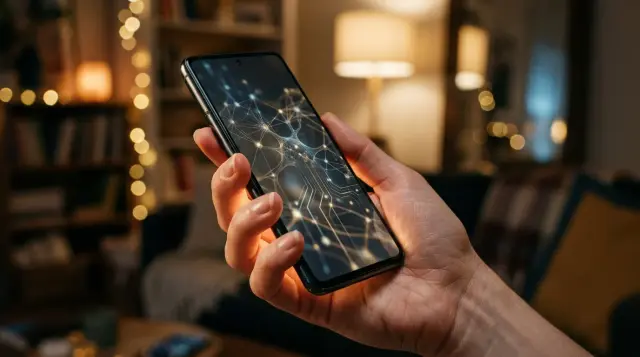
Here's a concrete example that ties this to real life. When an AI-powered EMF meter scans the electromagnetic radiation in your living room, it's using machine learning to classify signals. Is that spike from your Wi-Fi router? Your microwave? A nearby cell tower? Traditional analog meters just show a number. An AI-enhanced sensor can tell you what's causing the reading and how it changes over time. That distinction matters a lot when you're trying to understand your actual exposure.
What Does AI Have to Do with EMF Detection?
This is where things get really interesting. Electromagnetic fields surround us constantly, generated by everything from power lines to Bluetooth earbuds. The World Health Organization classified radiofrequency electromagnetic fields as "possibly carcinogenic to humans" (Group 2B) back in 2011, based on an increased risk for glioma associated with wireless phone use [3]. That classification hasn't changed, and the number of RF-emitting devices in our lives has skyrocketed since then.
Traditional EMF meters measure field strength at a single point in time. Useful, but limited. AI-powered EMF detection systems go much further. They can continuously monitor multiple frequency bands, identify specific device signatures, and flag unusual spikes in electromagnetic radiation. Research published by IEEE in 2022 found that machine learning classifiers could identify EMF sources with up to 95% accuracy, compared to 70-80% with conventional signal analysis methods.
Think about what that means practically. According to Deloitte's 2024 Connectivity and Mobile Trends Survey, the average American household now has 22 connected devices. Each one emits some level of EM radiation. An AI system can map which devices contribute most to your exposure, when peak emissions occur, and which rooms in your home have the highest readings. If you've been building out a Smart Home: The Beginner's Guide, this kind of data is incredibly valuable.
The same machine intelligence that powers voice assistants and self-driving cars is now being applied to something far more personal: understanding the invisible energy in your immediate environment. And honestly, that's a practical application of AI that rarely gets covered in a typical beginner overview.
Do I Need to Know How to Code to Understand AI?
Nope. And I say that as someone who spent way too long thinking you needed a computer science degree to even approach this stuff. The truth is, understanding how AI works conceptually and learning to build AI systems are two very different things. This artificial intelligence beginner guide is focused on the first, because that's what most people actually need.
If you want to use AI tools, you don't need to code. Period. You can use ChatGPT, Google Gemini, or Microsoft Copilot right now without writing a single line of Python. Similarly, AI-powered EMF detection apps work right out of the box. You point them at a source, and the machine intelligence handles the analysis. Andrew Ng, co-founder of Google Brain and a Stanford professor, has repeatedly said that AI literacy will be as fundamental as reading literacy within a generation.
That said, if you do want to go deeper, platforms like Coursera, fast.ai, and MIT OpenCourseWare offer free beginner tracks. Google's TensorFlow team released their "Machine Learning Crash Course" with zero prerequisites beyond basic algebra. The barrier to entry has never been lower.
The more important skill for most people isn't coding. It's critical thinking about AI outputs. Understanding that AI can be wrong. That it reflects the biases in its training data. That "smart" doesn't mean "infallible." The same goes for AI-based EMF readings. They're powerful tools, but they work best when you understand what they're measuring and why. For a broader look at the devices generating those fields, check out The Connected Home: The Honest Guide.
How Can AI Help Monitor EMF in Your Home?
Let's get practical. Your home is a soup of electromagnetic radiation. Your Wi-Fi router broadcasts at 2.4 GHz and 5 GHz. Your microwave operates at 2.45 GHz. Your smart meter pulses data to the utility company. Bluetooth devices chatter at 2.4 GHz. And if you live near a cell tower, you've got signals at 700 MHz up to 39 GHz for 5G mmWave. That's a lot of invisible energy, and knowing what's what takes more than a simple meter.
AI-driven monitoring systems use spectral analysis combined with deep learning to decompose these overlapping signals. A 2023 study from the National Institute of Environmental Health Sciences noted that cumulative RF exposure assessment remains one of the biggest challenges in environmental health research [4]. Machine intelligence is starting to solve that problem by providing continuous, categorized exposure data instead of one-off snapshots.
For people who are health-conscious about EMF exposure, this technology pairs well with physical shielding. Proteck'd offers a full Faraday Protection Collection that uses silver-infused fabrics to block a significant portion of RF radiation. Their Men's Faraday Tech Wear line, for example, integrates shielding into everyday clothing. Combining AI monitoring with physical protection gives you both awareness and action. You can learn more about the science behind these materials on their EMF Protection Benefits page.
Quick Q&A
Q: Can AI tell me which device in my home emits the most EMF?
A: Yes. AI-powered EMF sensors use machine learning to classify individual device signatures and rank them by emission levels across multiple frequency bands.
What Are the Real-World Applications of AI Beyond EMF?
AI's reach extends far beyond electromagnetic field monitoring, and understanding that range helps you see why this technology matters so much. In healthcare, IBM Watson Health and Google's DeepMind have developed AI systems that can detect diabetic retinopathy and breast cancer in medical imaging with accuracy rivaling trained radiologists. A 2020 study published in Nature showed that Google Health's AI outperformed six radiologists in breast cancer screening.
In environmental science, NASA uses machine learning to process satellite data and track deforestation, wildfires, and ocean temperature changes in real time. In finance, JPMorgan Chase's COiN platform uses natural language processing to review legal documents in seconds that previously took lawyers 360,000 hours annually. These aren't predictions. They're happening right now.
Wearable technology is another area where AI is making a tangible difference. Smartwatches and health trackers use machine intelligence to monitor heart rhythm irregularities, sleep patterns, and blood oxygen levels. If you're curious about this space, our guide on The Best Health Wearables: The Honest Guide covers what's actually worth your money. And our Smart Wearables: The Complete Guide goes even deeper into how these devices collect and process your biometric data using AI algorithms.
The point is this: whether it's monitoring your heartbeat or measuring the electromagnetic radiation in your bedroom, machine intelligence is becoming the invisible layer between you and your environment. Understanding how it works gives you power over it, not the other way around.
How Do You Start Learning AI as a Complete Beginner?
Here's my honest advice: don't try to learn everything at once. The biggest mistake I see people make with any artificial intelligence beginner guide is treating it like a sprint. It's not. Pick one area that genuinely interests you and go deep on that before branching out. If EMF detection interests you, start there. If you're more drawn to generative AI tools like ChatGPT, start there instead.
A solid first step is Google's free "Introduction to Generative AI" course on Coursera, which takes about an hour and requires zero technical background. From there, Andrew Ng's "AI For Everyone" course, also on Coursera and developed through Stanford's research programs, gives you a broader foundation in roughly four hours. Both are designed for non-engineers.
For hands-on practice, try experimenting with AI tools you already have access to. Ask ChatGPT to explain something you're confused about. Use Google Lens to identify a plant. Let Spotify's AI DJ pick your next playlist. Every interaction builds your intuition for how machine intelligence processes information and makes decisions.
And if privacy is a concern as you explore these tools, it absolutely should be. AI systems collect enormous amounts of data. Understanding Digital Privacy: The Complete Guide will help you set boundaries on what these systems can access. Learning AI doesn't mean surrendering your personal data to it.
Why Does Understanding AI and EMF Together Matter for Your Health?
Here's where all of this comes together. We live surrounded by wireless devices emitting electromagnetic radiation, and we're adding more every year. At the same time, artificial intelligence is becoming the most effective tool we have for understanding what those devices are actually doing to our environment. Ignore one while focusing on the other and you miss the full picture.
The National Toxicology Program, part of the U.S. Department of Health and Human Services, released findings in 2018 showing "clear evidence" of tumors in male rats exposed to high levels of radiofrequency radiation like that used in 2G and 3G cell phones. While the NTP cautioned against directly extrapolating to humans, the findings prompted ongoing research and renewed interest in personal EMF monitoring [4].
AI makes that monitoring accessible to regular people, not just researchers with $50,000 lab equipment. Affordable AI-enhanced meters from companies like GQ Electronics and Trifield now offer real-time spectral analysis that would have been science fiction ten years ago. Pair that data with physical shielding from Proteck'd's Faraday Protection Collection, and you've got a genuinely informed approach to managing your exposure.
This isn't about fear. It's about information. The same way you might check the air quality index before going for a run, AI-powered EMF tools let you check the electromagnetic environment before choosing where to set up your home office or your kid's bedroom. That's the practical intersection of two technologies that, together, put you in control.
Frequently Asked Questions
Artificial intelligence is software that learns from data and makes decisions without being explicitly programmed for every situation. Think of it as teaching a computer to recognize patterns the way you learned to recognize faces as a child. Today's AI handles specific tasks like language translation, image recognition, and EMF signal analysis.
No. You don't need a degree in computer science or math to understand how AI works at a conceptual level. Free courses from Google and Stanford professor Andrew Ng are designed for complete beginners with zero coding experience. Understanding AI conceptually is a totally different thing from building AI systems.
AI-powered EMF detectors use machine learning algorithms to analyze signals across multiple frequency bands at once. Instead of just showing a raw number, these systems classify which devices are producing the radiation, track exposure over time, and flag unusual spikes. IEEE research shows AI classifiers achieve up to 95% accuracy in identifying EMF sources.
The WHO classifies radiofrequency electromagnetic fields as possibly carcinogenic (Group 2B), and the National Toxicology Program found clear evidence of tumors in rats exposed to high-level RF radiation. While direct extrapolation to typical human exposure is debated, monitoring your home's EMF levels with AI-powered tools and using shielding products is a reasonable precaution.
Narrow AI performs one specific task well, like classifying EMF signals or recommending movies. General AI would reason across any domain like a human can. Every AI system in use today is narrow AI. Researchers at Stanford's Institute for Human-Centered AI estimate that general AI remains decades away.
You can get the core concepts down in about four to six hours using free courses like Google's Introduction to Generative AI (one hour) and Andrew Ng's AI For Everyone (four hours). Building deeper skills with coding and model training typically takes three to six months of consistent study.
Yes. AI-enhanced EMF meters use spectral analysis and deep learning to identify individual device signatures. They can rank your Wi-Fi router, smart meter, Bluetooth devices, and other electronics by emission levels across specific frequency bands, giving you a prioritized list of the biggest contributors.
Google's free Machine Learning Crash Course, Andrew Ng's AI For Everyone on Coursera, and MIT OpenCourseWare's Introduction to Machine Learning are all excellent starting points. The fast.ai practical deep learning course is another great option that focuses on hands-on projects over theory.
Yes. Faraday fabric woven with silver or copper threads creates a conductive mesh that reflects and absorbs electromagnetic radiation. How well it works depends on the fabric's weave density and the frequency of the radiation. Proteck'd's Faraday collection uses silver-infused fabrics designed to block a significant percentage of RF emissions from common household and wireless sources.
Health wearables primarily use machine learning algorithms for pattern recognition in biometric data. Apple Watch uses AI to detect atrial fibrillation, Fitbit employs deep learning for sleep stage classification, and Oura Ring applies AI to heart rate variability analysis. These systems continuously learn from your data to improve their accuracy over time.
References
- Stanford University - AI Index Report – Stanford's Institute for Human-Centered AI estimates that artificial general intelligence remains decades away and tracks the current state of narrow AI development.
- Nature - Deep Learning Review by LeCun, Bengio, and Hinton – Deep learning has dramatically improved AI performance in speech recognition, image classification, and natural language processing.
- World Health Organization - IARC Classification of Radiofrequency EMF – The WHO classified radiofrequency electromagnetic fields as possibly carcinogenic to humans (Group 2B) in 2011.
- National Institute of Environmental Health Sciences - Cell Phone Radio Frequency Radiation – The National Toxicology Program found clear evidence of tumors in male rats exposed to high levels of radiofrequency radiation and NIEHS continues research on RF exposure assessment.
About the Author
Proteck'd EMF Apparel
Health & EMF Specialists
The Proteck'd team covers EMF protection, silver-fiber apparel, and practical ways to reduce everyday radiation exposure. Every piece Proteck'd ships is designed, tested, and worn by the people who build it.
Get the Free EMF Home Audit Checklist
A room-by-room PDF that walks you through the biggest EMF sources in your house and what to do about each one. No cost, no fluff.
Download the Checklist →✓30-day returns✓Free shipping✓Free returns✓Silver fiber shielding


