


Creating an EMF Sanctuary: What Matters Most

Here's something most people never stop to consider: the average American home in 2026 has somewhere between 15 and 25 wireless devices humming away at any given moment. Routers, smart speakers, baby monitors, tablets, thermostats, even light bulbs. All emitting some level of electromagnetic radiation, all day, every day. Your home is supposed to be the place where your body can truly rest. But is it?
If you've started looking into the best EMF protection products, you already know the market is a mess. There are stickers that claim to "harmonize" radiation. Pendants with mysterious crystals. And then there are real shielding solutions grounded in physics and material science. Telling one from the other takes some homework. That's exactly what this guide is for.
I've spent a lot of time sorting through the claims, the studies, and the actual performance data on electromagnetic field protection. What I keep coming back to is simple: no single product solves your exposure problem. The real answer is a strategy, a layered approach that begins with understanding what you're actually dealing with inside your specific home.
So let's get into it. Room by room, product by product, trade-off by trade-off. By the end, you'll know what's worth your money and what belongs in the marketing-hype trash can.
What Actually Counts as EMF Protection in 2026?
Before we compare anything, let's be clear about what "EMF protection" actually means in practical terms. Electromagnetic fields come in different flavors. You've got extremely low frequency (ELF) radiation from power lines and household wiring, radiofrequency (RF) radiation from Wi-Fi routers and cell phones, and intermediate frequencies from things like dimmer switches. Each type behaves differently. Each one requires different shielding strategies.
The World Health Organization's International Agency for Research on Cancer (IARC) classified RF electromagnetic fields as Group 2B, a possible carcinogen, back in 2011 [1]. That classification hasn't been upgraded. It also hasn't been downgraded. And the 2018 National Toxicology Program study, a $30 million, decade-long project funded by the U.S. government, found clear evidence of heart tumors in male rats exposed to high levels of RF radiation [2]. That's not nothing.
Real EMF protection works on basic physics: shielding, distance, and time. You either block the radiation with a conductive material (like silver or copper mesh), move farther from the source, or reduce how long the source is active. If a product doesn't address one of those three mechanisms, it's probably not doing what it claims.
Quick Q&A
Q: Do "EMF harmonizer" stickers actually reduce electromagnetic radiation?
A: No. Independent testing shows that sticker-type products do not measurably reduce RF or ELF field levels; only conductive shielding materials produce verifiable attenuation.
So when I talk about the best EMF protection products, I'm talking about things that produce measurable, testable reductions in field strength. An EMF meter can verify them. Your feelings about crystals cannot. That distinction matters a lot when you're spending real money.
How Do You Measure EMF Levels in Your Home?
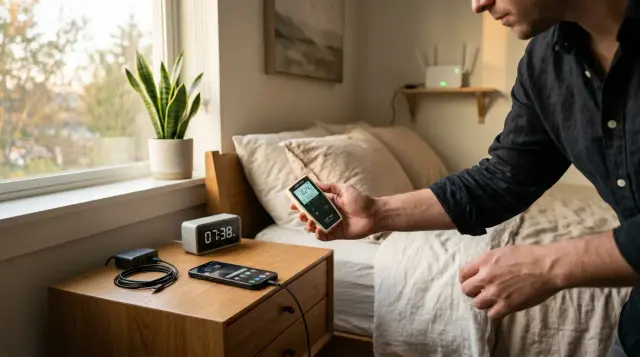
Step one in building any EMF sanctuary is figuring out what you're actually dealing with. You wouldn't try to fix a leak without finding it first, right? Same idea here. A quality EMF meter is the single most important purchase you'll make because it turns invisible radiation into numbers you can act on.
For most homeowners, a tri-axis meter that reads RF, magnetic fields, and electric fields covers the bases. The TriField TF2, made by AlphaLab Inc. in the U.S., is a popular choice in the $150 to $180 range. It measures all three types of EM radiation and has been the go-to recommendation from independent EMF consultants for years. If you need RF-only measurements with more sensitivity, the Acoustimeter AM-10 does that well but costs around $400.
Once you have a meter, do a room-by-room sweep. You'll probably be surprised. The highest readings aren't always where you'd expect. A bedside lamp with a bad ground wire might throw a stronger electric field than your router. The smart meter on the side of your house might spike periodically with peak power around 1 watt, even though it only transmits for about a minute total per day. For a deeper walkthrough, check out this guide on Low-EMF Home Design: A Complete Guide.
The point is: measure first, then decide where to spend your budget. That approach saves you from buying electromagnetic radiation protection you don't need while missing the spots where you actually do.
No single product eliminates all EMF exposure. The real answer is a layered strategy: measure your home, reduce sources, increase distance, and add shielding where it matters most. That's how you build a sanctuary, not with stickers and wishful thinking, but with physics.
Which Room-by-Room Strategies Make the Biggest Difference?
Your bedroom should be priority number one. You spend roughly a third of your life sleeping, and your body does its deepest repair work during those hours. If there's one room to make low-EMF, it's this one. Start simple: move your phone charger at least six feet from your head, switch your phone to airplane mode at night, and unplug any electronics you don't need running while you sleep.
For the bedroom, Faraday canopy beds and shielding curtains can block 95% to 99% of incoming RF signals. These use conductive fabrics woven with silver or copper threads. If that feels like too much, even switching to wired internet in the bedroom and putting your router on a timer can cut your nighttime RF exposure dramatically. If you want to explore how EMF-blocking fabrics work for sleep specifically, I wrote about it in EMF Blocking for Better Sleep: The Complete Guide and also in EMF Clothing for Better Rest: How It Works.
In the kitchen and living areas, the biggest culprits are usually microwaves (which leak small amounts of RF during use), smart appliances, and your Wi-Fi router. Distance is your best friend here. The inverse square law means that doubling your distance from a source cuts exposure by roughly 75%. Moving your router from the family room to a hallway closet can be one of the most effective free changes you make.
Home offices are another hotspot. Between the laptop, the Wi-Fi connection, the Bluetooth keyboard, and the phone sitting on your desk, you're surrounded. A hardwired Ethernet connection eliminates the biggest source instantly. An EMF laptop shield placed between the device and your body can reduce both RF and ELF exposure from the machine itself.

Does EMF-Blocking Clothing Actually Work?
I get asked this one constantly. Fair question. The short answer: yes, if the clothing uses real shielding materials like silver fiber and is properly constructed. The longer answer involves understanding what the fabric can and can't do.
Silver-threaded fabric, the kind used in Proteck'd's Faraday EMF Collection, works on the same principle as a Faraday cage. The conductive silver threads reflect and absorb electromagnetic radiation before it reaches your skin. Lab testing of quality silver-fiber textiles shows attenuation rates above 99% for RF frequencies between 10 MHz and 8 GHz. That covers Wi-Fi (2.4 and 5 GHz), cell signals, and Bluetooth.
The trade-off? Clothing only shields the parts of your body it covers. A shirt protects your torso. It doesn't create a bubble around your entire body. But here's why that still matters: your torso contains your heart, lungs, and most of your major organs. According to the FCC, cell phone RF emissions are limited to a specific absorption rate (SAR) of 1.6 W/kg averaged over 1 gram of tissue [3]. Reducing the RF your core organs absorb is a meaningful step, even without total-body coverage.
Quick Q&A
Q: Can you wash EMF-blocking clothing without ruining the shielding?
A: Yes, most quality silver-fiber garments can be gently washed; Proteck'd provides specific care instructions to maintain shielding effectiveness over dozens of wash cycles.
EMF-blocking clothing is especially practical because you wear it wherever you go. Your bedroom Faraday canopy doesn't help you at the coffee shop, the airport, or the office. That portability is a real advantage. If you're curious about the full range of what's available, including some pieces on sale, check out the current Proteck'd Sale.

What About Smart Meter Shields and Phone Cases?
Smart meter shields are one of the more straightforward EMF protection purchases you can make. Your utility company's smart meter sits on the side of your house and transmits usage data via RF pulses. Each pulse is short, but the meter can send thousands of them per day, and they penetrate the wall directly behind it. If your bedroom or a child's room is on the other side of that wall, it's worth addressing.
A smart meter guard is basically a Faraday cage that fits over the meter. It can reduce RF emissions toward your home by 90% to 98% depending on the product. They typically cost $30 to $80 and take about five minutes to install. One thing to watch: some utility companies say you're not allowed to cover the meter. Check your local regulations before you put one on.
Anti-radiation phone cases are another popular category. The credible ones use a shielding panel that sits between the phone and your body when the case is closed. This doesn't block the signal entirely (your phone would stop working if it did), but it redirects RF away from your head or hip. According to research from the National Institutes of Health, cell phone use close to the body can elevate local tissue SAR values, so redirecting that energy has practical value [4].
Here's the catch with phone cases: if the shielding panel covers the front of the phone, you need the case closed (like a flip cover) for it to work. An open case provides zero protection. It's a small behavioral change, but one that counts. For parents worried about kids and phone use, I'd recommend reading Kids and Electromagnetic Radiation: How to Protect Your Kids and Are Your Kids Getting Too Much EMF?: What the Research Shows.
How Do You Compare the Best EMF Protection Products Without Getting Scammed?
Here's my rule of thumb: if a company can't tell you what frequencies their product blocks and by how many decibels, walk away. Legitimate EMF shielding companies publish lab-tested attenuation data. They tell you the frequency range, the shielding effectiveness in dB, and often provide third-party test reports. Proteck'd, for instance, details the shielding properties of their silver-fiber garments on their EMF Protection Benefits page.
Red flags include vague language like "neutralizes harmful frequencies," "restructures the EMF field," or "uses quantum energy." None of those phrases describe a measurable physical process. The Federal Trade Commission has actually warned consumers about fraudulent EMF products, and several sticker and pendant companies have faced legal action for making unsubstantiated health claims.
When you're comparing EM radiation shielding products side by side, focus on three things. First, what type of EMF does it address (RF, ELF, or both)? Second, what's the verified attenuation level? Third, what's the practical use case? A Faraday blanket is great for the couch but useless on your morning commute. An EMF-shielding hoodie works everywhere but doesn't cover your legs.
The best emf protection products are the ones matched to your actual exposure patterns. That's why the meter comes first. Measure your home, identify your biggest exposure sources, then pick shielding that targets those specific problems. It's less exciting than a one-click miracle solution, but it actually works.
Can Nutrition and Lifestyle Changes Complement EMF Shielding?
This is an area that doesn't get nearly enough attention. Physical shielding reduces your exposure, sure. But certain nutrients may also help your body handle the oxidative stress that electromagnetic radiation can produce. A 2015 review published in the journal Electromagnetic Biology and Medicine found that RF exposure increases free radical production in cells, and that antioxidants could mitigate some of that damage.
Magnesium, zinc, selenium, vitamin C, vitamin E, and N-acetylcysteine (NAC) are the nutrients most commonly cited by researchers studying EMF and oxidative stress. Dr. Martin Pall at Washington State University has published extensively on voltage-gated calcium channel activation by EMFs, and his work suggests that magnesium supplementation may help counteract this mechanism.
Lifestyle changes matter too. Grounding (walking barefoot on earth or grass) has shown some promise in small studies for reducing inflammation markers, though the research is still early. Spending time in nature, away from dense wireless infrastructure, gives your body genuine breaks from RF exposure. These aren't replacements for shielding. Think of them as the fourth layer in your strategy: reduce sources, increase distance, add shielding, support your biology.
Building a low-EMF home doesn't require paranoia or a massive budget. It requires information, a decent meter, and smart choices about where to invest. Whether that's a smart meter guard, wired internet, or a silver-fiber shirt from Proteck'd's Faraday EMF Collection, every layer you add brings your sanctuary closer to what it should be: a genuinely restful place.
Key Takeaways
Frequently Asked Questions
What are the best EMF protection products for a bedroom?
A Faraday bed canopy and shielding curtains are the most effective bedroom solutions, blocking 95% to 99% of RF radiation. Pair them with a router timer that shuts off Wi-Fi during sleep hours and keep all electronics at least six feet from your head. EMF-blocking sleepwear made from silver fiber adds another layer if you want portable protection.
Do EMF protection stickers and pendants actually work?
No. Independent testing consistently shows sticker and pendant products produce no measurable reduction in electromagnetic field levels. The FTC has taken enforcement action against some of these companies for making unsubstantiated claims. Stick with products that use conductive shielding materials and publish verified attenuation data.
How much does it cost to shield a home from EMF?
Basic steps like an EMF meter ($150 to $400), a smart meter shield ($30 to $80), and a router timer ($15) can total under $500. More involved solutions like Faraday bed canopies ($200 to $600) and EMF-blocking clothing ($50 to $200 per piece) raise the investment. Most families can build a solid EMF reduction plan for under $1,000.
Is WiFi radiation harmful to health?
The WHO classifies radiofrequency radiation, which includes Wi-Fi, as a Group 2B possible carcinogen. The 2018 NTP study found clear evidence of tumors in rats exposed to RF radiation at higher levels. While typical home Wi-Fi operates at lower power, reducing unnecessary exposure follows the precautionary principle that many health professionals recommend.
Can EMF-blocking clothing be worn every day?
Yes. Quality silver-fiber garments like those in Proteck'd's Faraday collection are designed for daily wear. They look and feel like normal clothing and can be gently washed. The silver threads maintain their shielding effectiveness through dozens of wash cycles when you follow the manufacturer's care instructions.
What EMF meter should I buy for home use?
The TriField TF2 by AlphaLab Inc. is the most recommended option for home users, priced around $150 to $180. It measures RF, magnetic fields, and electric fields on a single device. For more sensitive RF-only readings, the Acoustimeter AM-10 is popular among EMF consultants but costs around $400.
Does turning off Wi-Fi at night reduce EMF exposure?
Yes, significantly. Your router is one of the strongest RF sources in most homes, and it broadcasts continuously even when nobody's using it. A simple outlet timer that cuts power during sleeping hours eliminates that exposure entirely during the 7 to 9 hours you're in bed. It's one of the easiest and cheapest changes you can make.
Are children more vulnerable to electromagnetic radiation than adults?
Research suggests yes. Children's skulls are thinner, their brain tissue has higher water content, and their cells divide more rapidly. All of that may increase RF absorption. The American Academy of Pediatrics has recommended the FCC update its RF exposure guidelines to account for children's smaller bodies. Reducing exposure in kids' bedrooms and limiting device contact time is a practical first step.
What is the difference between EMF shielding and EMF harmonizing?
EMF shielding uses conductive materials to physically block or reflect electromagnetic radiation, and you can measure its effectiveness in decibels with an EMF meter. EMF harmonizing is a marketing term with no standardized scientific definition and no measurable effect on field levels. Always choose products that shield rather than claim to harmonize.
How do I know if my smart meter is causing high EMF in my home?
Use an RF meter near the inside wall closest to your smart meter. You'll likely see periodic spikes as the meter transmits data. Peak power can reach 1 watt, though the total transmission time averages about 1 minute per day spread across thousands of short pulses. If the spikes are high and the meter is near a bedroom, a smart meter shield is a worthwhile investment.
References
- International Agency for Research on Cancer (IARC/WHO) – IARC classified radiofrequency electromagnetic fields as Group 2B, possibly carcinogenic to humans, in 2011.
- National Toxicology Program (NIEHS/NIH) – The NTP study found clear evidence of heart tumors (schwannomas) in male rats exposed to high levels of radiofrequency radiation.
- Federal Communications Commission (FCC) – The FCC limits cell phone RF emissions to a specific absorption rate of 1.6 W/kg averaged over 1 gram of tissue.
- National Institutes of Health (PubMed) – Cell phone use close to the body can elevate local tissue SAR values, supporting the use of distance and shielding to reduce RF absorption.
About the Author
Proteck'd EMF Apparel
Health & EMF Specialists
The Proteck'd team covers EMF protection, silver-fiber apparel, and practical ways to reduce everyday radiation exposure. Every piece Proteck'd ships is designed, tested, and worn by the people who build it.
Save 15% on Your First Order
Use code PROTECT15 at checkout on any Proteck'd Faraday piece. One code, real shielding, no catch.
Claim 15% Off →✓30-day returns✓Free shipping✓Free returns✓Silver fiber shielding


Laissez un commentaire