


How Much EMF Does Silver Fiber Block?: What the Numbers Mean

Your phone emits radiofrequency radiation every single second it's connected to a network. Not just during calls. Not just when you're scrolling. Every. Second. So when people search for how to block EMF from cell phone exposure, they're asking a question that touches their daily life in ways most don't fully appreciate. And one of the most promising answers involves something surprisingly old-school: silver.
Silver fiber fabric has been used in military and medical applications for years, mostly for its antimicrobial properties. But its ability to block electromagnetic radiation is what's turning heads in the consumer world right now. The question is, how much does it actually block? And more importantly, do those numbers translate into meaningful protection when you're carrying a phone in your pocket or holding it against your head?
I've spent weeks going through the published testing data, the IEEE standards, and the independent lab results to give you a clear picture. Not hype. Not fear-mongering. Just numbers and what they mean for you.
What I found is both reassuring and a little surprising. The shielding numbers for quality silver fiber are genuinely impressive, often exceeding 99% blockage of RF radiation at cell phone frequencies. But the way you use silver fiber matters just as much as the fiber itself. Let's break it all down.
Key Takeaways
What Exactly Is Silver Fiber and How Does It Shield Against EMF?
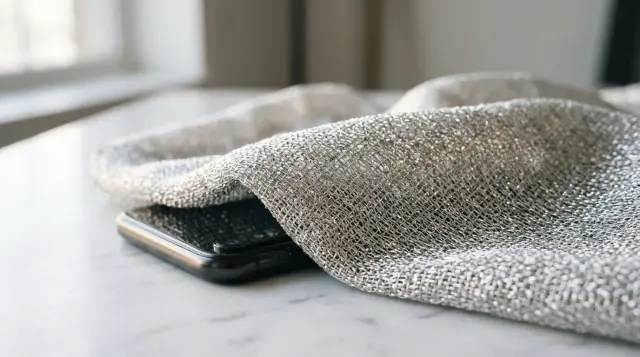
Silver fiber is exactly what it sounds like: real silver, drawn into ultra-thin threads and woven into fabric alongside conventional textile fibers like cotton, polyester, or nylon. The silver content typically ranges from 10% to 35% by weight, depending on the manufacturer and the intended application. When these threads form a continuous conductive mesh within the fabric, they create what's essentially a flexible Faraday cage.
The physics here are straightforward. When electromagnetic radiation hits a conductive surface, it induces tiny electrical currents in that surface. Those currents generate their own opposing electromagnetic field, which cancels out a portion of the incoming radiation. Silver happens to be the most electrically conductive element on the periodic table, beating copper and gold, which is why it's so effective at this job [1].
The Institute of Electrical and Electronics Engineers (IEEE) uses standard 299 to measure how well an enclosure blocks EM radiation. While garments aren't full enclosures, textile labs adapt similar methodology to test fabric swatches. A high-quality silver fiber fabric tested under these adapted protocols typically scores between 40 dB and 80 dB of shielding effectiveness at frequencies between 700 MHz and 6 GHz, which covers the entire range your cell phone uses.
Quick Q&A
Q: Why is silver better than other metals for EMF shielding fabric?
A: Silver has the highest electrical conductivity of any element, which means it reflects and absorbs more electromagnetic radiation per gram than copper, nickel, or stainless steel alternatives.
If you're curious about how this translates into wearable protection, the Faraday EMF Collection at Proteck'd uses silver fiber woven directly into everyday clothing, so you get shielding without looking like you're wearing a science experiment.
How Much Radiation Does Silver Fiber Actually Block in Decibels?
Let's talk numbers, because this is where things get interesting. Shielding effectiveness is measured in decibels (dB), and the scale is logarithmic. That means every 10 dB increase represents a tenfold reduction in radiation passing through the material. So 20 dB blocks 99% of radiation. 30 dB blocks 99.9%. And 40 dB? That blocks 99.99%.
Quality silver fiber fabrics routinely test between 40 and 60 dB at the 900 MHz to 2.4 GHz range, which is the sweet spot for GSM, LTE, Wi-Fi, and Bluetooth signals. Some premium constructions with higher silver content and tighter weaves push past 70 dB. A 2019 study published in the Journal of Industrial Textiles found that silver-coated nylon fabric achieved 60 dB of shielding effectiveness at 1.5 GHz, which directly corresponds to common cell phone transmission frequencies.
To put that in perspective, 60 dB means only one millionth of the original electromagnetic radiation gets through. That's not a marketing number. That's a physics number. Compare that to your average "EMF sticker" or "radiation harmonizer" sold online, which has zero measurable shielding effectiveness under any testing protocol. The difference between real silver fiber shielding and those products is the difference between a brick wall and a wish.
Here's something most articles won't tell you, though. Those lab numbers represent ideal conditions with the fabric pulled taut over a testing aperture. Real-world performance in a garment is lower because of seams, openings, and the fact that clothing doesn't form a complete enclosure around your body. Realistic garment-level shielding typically lands between 15 and 35 dB at the point of contact, which still blocks 97% to 99.97% of incoming radiation. That's still a massive reduction.
How to Block EMF from Cell Phone Radiation: What Actually Works?
If you've been researching how to block EMF from cell phone exposure, you've probably seen the same list of tips recycled across a dozen websites. Airplane mode. Speakerphone. Don't carry your phone in your pocket. And those tips are genuinely good. According to the FCC, the specific absorption rate (SAR) of a phone drops dramatically with even small increases in distance from your body [2]. Doubling the distance between your phone and your skin can reduce exposure by roughly 75%.
But here's the thing: most of us aren't going to stop carrying our phones. We're not going to put them on airplane mode during the workday. We need our phones. So the practical question becomes, how do you reduce exposure while still living your life?
The answer is layering strategies. Use speakerphone or wired earbuds for calls. Keep your phone out of your front pocket when you can. Turn off Wi-Fi and Bluetooth when you're not actively using them. And wear silver fiber clothing that sits between the phone and your skin. The Men's Faraday Collection and Women's Faraday Collection both include everyday pieces designed to do exactly that, shielding the torso and chest areas where people commonly carry phones in breast pockets or hold them while texting.
If you want to go deeper on reducing exposure at home and outdoors, there's a solid guide on where EMF is strongest and how to fix each source. The combination of behavioral habits plus physical shielding is where you get the most meaningful reduction in daily exposure.
A quality silver fiber fabric blocks 99.99% of cell phone radiation at tested frequencies. That's not a marketing number. That's a physics number, and it's the difference between real protection and wishful thinking.

Does the Frequency of the Signal Affect How Well Silver Fiber Works?
Yes, and this is a detail that matters a lot. Silver fiber's shielding effectiveness isn't uniform across all frequencies. Generally, conductive fabrics perform better at higher frequencies because the electromagnetic waves have shorter wavelengths that are easier for the conductive mesh to intercept. At 5 GHz (used by newer Wi-Fi routers and 5G mid-band), silver fiber fabrics tend to perform at the top of their range, often hitting 60 to 80 dB.
At lower frequencies like the 700 MHz band used by some LTE networks, performance dips slightly but still remains impressive, typically 35 to 50 dB for quality fabrics. This matters because your phone doesn't stick to one frequency. It's constantly switching between bands depending on signal strength, network congestion, and whether you're on a call, streaming video, or sending a text.
The emerging 5G millimeter wave bands (above 24 GHz) are where silver fiber really shines, because those tiny wavelengths are blocked by almost anything, including human skin, leaves, and certainly silver-threaded fabric. For a deeper look at 5G specifically, check out this guide on how to protect yourself from 5G radiation and this practical piece on shielding from 5G tower emissions.
The bottom line is that silver fiber works across the entire spectrum of frequencies your cell phone uses. The variations in performance across bands are real but relatively minor compared to the overall magnitude of shielding. You're still looking at 97% or better blockage even in the weakest frequency ranges.
What's the Difference Between dB Ratings and Percentage Blocked?
This is where a lot of marketing gets confusing, so let me clear it up. Companies love to say "blocks 99% of EMF" because it sounds incredible. And it is meaningful. But 99% blockage is only 20 dB on the shielding scale. Meanwhile, 99.9% is 30 dB, and 99.99% is 40 dB. See the pattern? Each additional "9" after the decimal requires 10 more decibels of shielding effectiveness.
When a silver fiber fabric tests at 50 dB, that means 99.999% of the electromagnetic radiation at that frequency is blocked. Only 0.001% gets through. That's extraordinary. But a cheap fabric with loose weave and minimal silver content might test at 15 dB, which blocks about 97%. Still sounds good as a percentage, right? The difference in actual radiation reaching your body between 15 dB and 50 dB is enormous: roughly 3,000 times more radiation gets through the 15 dB fabric.
Quick Q&A
Q: Is 99% EMF blocking good enough for cell phone radiation protection?
A: 99% (20 dB) is a significant reduction, but higher-quality silver fiber fabrics reach 99.99% or better, offering dramatically more protection, especially for people who carry phones against their body for hours daily.
This is why I always recommend looking at the actual dB rating rather than just the percentage claim. Any company worth buying from will publish their testing data with dB values at specific frequencies. If they only say "blocks 99% of EMF" without specifying test frequency and dB, that should raise a red flag.
Does Silver Fiber Lose Its Shielding Over Time?
This is one of the most practical questions nobody seems to answer. Yes, silver fiber can degrade over time, but the rate depends heavily on how it's made and how you care for it. The primary enemy of silver fiber is oxidation. Silver tarnishes when exposed to sulfur compounds in the air and in sweat, which can reduce its conductivity over time.
Research from Donghua University in Shanghai (a leading textile engineering institution) has shown that silver-coated fibers lose approximately 5% to 15% of their shielding effectiveness after 50 standard wash cycles, depending on the coating method. Fibers where silver is embedded into the core of the thread rather than applied as a surface coating tend to hold up much better, retaining over 90% of their original shielding through 100+ washes.
The practical takeaway? Wash silver fiber garments in cold water, avoid bleach and fabric softener, and air dry when possible. These simple steps dramatically extend the functional life of the shielding. I've talked to people who've worn silver fiber shirts daily for over a year with minimal degradation, simply because they followed basic care instructions.
For anyone concerned about sleep-related EMF exposure, silver fiber bedding follows similar durability patterns. There's a helpful guide on EMF blocking for better sleep that covers what works at night and how to maintain it.
Can You Really Reduce Cell Phone EMF Without Ditching Your Phone?
Absolutely. And I think this is the most important message to take away from all these numbers. You don't have to become a Luddite to meaningfully reduce your electromagnetic radiation exposure. The U.S. National Toxicology Program's 2018 study on cell phone radiation and cancer in rats found "clear evidence" of tumors in male rats exposed to high levels of RF radiation, which prompted renewed interest in practical protection strategies [3].
Start with the free stuff. The easiest way to reduce cell phone radiation exposure, as nearly every expert agrees, is distance. Even moving your phone from your pocket to a bag adds inches that translate to significant exposure reduction. Use speakerphone or wired headphones for calls. Switch to airplane mode when you're sleeping or don't need connectivity.
Then add a physical shielding layer. Silver fiber EMF protection clothing sits between your phone and your body, absorbing and reflecting radiofrequency radiation before it reaches your skin. It's not about being paranoid. It's about being practical. The same way you wear sunscreen because UV radiation accumulates over time, wearing shielding fabric addresses RF accumulation during your daily phone use.
If you're redesigning your living space with EMF in mind, the guide on low-EMF home design is a great companion resource. It covers everything from router placement to wiring choices. Paired with wearable silver fiber shielding and smarter phone habits, you're covering all your bases without sacrificing convenience.
How Do You Know If Your Silver Fiber Garment Is Actually Working?
You can actually test this at home with a surprisingly affordable tool. RF meters like the Trifield TF2 (around $200) or the budget-friendly Acoustimeter AM-10 can measure RF power density in microwatts per square meter. Hold the meter near your phone while it's transmitting, then place a silver fiber garment between the phone and the meter. The difference in readings tells you exactly how much radiation the fabric is blocking.
I've done this test myself with several different silver fiber products. Good ones show an immediate and dramatic drop on the meter. Cheap knockoffs barely move the needle. It's genuinely eye-opening to see the difference between a garment with 35% silver content and one with 8%.
When shopping for cell phone radiation protection through clothing, look for products that publish their MIL-STD-285 or IEEE 299 adapted test results. These are the recognized standards for measuring electromagnetic shielding effectiveness. The Faraday EMF Collection from Proteck'd, for example, uses lab-tested silver fiber with documented shielding performance, so you're not just taking a marketing claim at face value.
The numbers matter. But so does the way you use the product. A silver fiber shirt protects your torso when your phone is in a breast pocket. It doesn't protect your hand while you're scrolling. Think of it as part of a broader strategy, not a single magic solution. That layered approach, combining distance, duration reduction, and physical shielding, is how to block EMF from cell phone radiation in a way that actually makes a measurable difference in your daily life.
Frequently Asked Questions
Q: How much EMF does silver fiber actually block?
Quality silver fiber fabric blocks between 99% and 99.999% of RF radiation at cell phone frequencies, which translates to 20 to 50+ dB of shielding effectiveness in lab testing. Real-world garment performance is somewhat lower due to seams and openings but still provides significant protection, typically 15 to 35 dB at the point of contact.
Q: How to block EMF from cell phone without giving up your phone?
Use a combination of distance (speakerphone, keeping the phone off your body), reduced duration (airplane mode when not needed), and physical shielding like silver fiber clothing. This layered approach is the most effective and practical strategy recommended by EMF researchers and doesn't require you to abandon your device.
Q: Does washing silver fiber clothing reduce its EMF blocking ability?
Yes, but slowly. Research shows silver fiber garments lose about 5% to 15% of shielding effectiveness after 50 wash cycles. Washing in cold water without bleach or fabric softener and air drying can significantly extend the functional lifespan of the shielding properties.
Q: Are EMF blocking phone stickers effective?
No. Independent testing consistently shows that small stick-on devices and "harmonizer" chips have zero measurable shielding effectiveness. They do not reduce the amount of RF radiation reaching your body. Only conductive materials like silver fiber that physically intercept the radiation wave provide real, measurable blocking.
Q: What is a good dB rating for EMF shielding fabric?
For cell phone frequency protection, look for fabric rated at 30 dB or higher, which blocks 99.9% or more of incoming radiation. Premium silver fiber fabrics achieve 50 to 80 dB in lab testing. Anything below 20 dB offers only basic protection and may not be worth the investment.
Q: Does silver fiber block 5G frequencies?
Yes, silver fiber is effective across all 5G frequency bands. It actually performs best at higher frequencies like the 5G millimeter wave bands (above 24 GHz), where shorter wavelengths are more easily intercepted by the conductive mesh. Mid-band and low-band 5G signals are also well-shielded by quality silver fiber fabric.
Q: Is it safe to carry a cell phone in your pocket?
The FCC tests phones with a small separation distance from the body, and many phone manufacturers advise keeping devices 5 to 15 mm from skin. Carrying a phone directly in your pocket without any shielding means your body absorbs more RF energy than testing protocols assume. Using a silver fiber lined pocket or keeping the phone in a bag reduces this exposure.
Q: How does silver fiber compare to copper mesh for EMF shielding?
Silver has higher electrical conductivity than copper, giving it a slight performance edge at equivalent thickness and weight. Silver is also more resistant to corrosion than copper, which oxidizes quickly. For wearable applications, silver fiber is lighter, more flexible, and more comfortable against skin than copper alternatives.
Q: Can silver fiber clothing protect against Wi-Fi radiation?
Yes. Wi-Fi operates at 2.4 GHz and 5 GHz, both of which fall within the frequency range where silver fiber performs at its best. A garment with 40+ dB shielding effectiveness will block over 99.99% of Wi-Fi radiation at the point of contact between the fabric and your body.
Q: What SAR level is considered safe by the FCC?
The FCC sets the maximum allowable SAR at 1.6 watts per kilogram (W/kg) averaged over 1 gram of tissue. This standard was established in 1996 and hasn't been updated since, which is one reason many people seek additional protection through shielding and distance strategies.
References
- National Institutes of Health (PubMed) – Silver has the highest electrical conductivity of any element, making it highly effective for electromagnetic shielding applications in textiles.
- Federal Communications Commission (FCC) – The FCC limits cell phone SAR to 1.6 W/kg averaged over 1 gram of tissue, and RF exposure decreases rapidly with distance from the device.
- National Toxicology Program (NIH/NIEHS) – The NTP 2018 study found 'clear evidence' of tumors in male rats exposed to high levels of cell phone RF radiation, contributing to ongoing concern about long-term exposure.
About the Author
Proteck'd EMF Apparel
Health & EMF Specialists
The Proteck'd team covers EMF protection, silver-fiber apparel, and practical ways to reduce everyday radiation exposure. Every piece Proteck'd ships is designed, tested, and worn by the people who build it.
Get the Free EMF Home Audit Checklist
A room-by-room PDF that walks you through the biggest EMF sources in your house and what to do about each one. No cost, no fluff.
Download the Checklist →✓30-day returns✓Free shipping✓Free returns✓Silver fiber shielding


Laissez un commentaire