


Finding Your Personal Style: Without Spending a Fortune

Here's a number that might catch you off guard: the Bureau of Labor Statistics reported that the average American household spent $1,945 on clothing in 2022. Almost two grand a year. And most people still stand in front of their closet feeling like they have nothing to wear. Sound familiar?
The problem usually isn't how much you're spending. It's that you're buying a puffy jacket here, a pair of trendy pants there, and none of it works together.
I've been there. A closet stuffed with impulse buys, sale-rack grabs, and pieces I wore exactly once. Turning that around didn't require more money. It required a different way of thinking.
Personal style isn't about owning more things. It's about owning the right things. And the good news? Building a wardrobe that actually feels like you, where every piece pulls its weight, is completely possible without blowing your budget.
This guide walks you through the practical steps. We're talking about how to figure out what your style actually is, which foundation pieces deserve your dollars (yes, including that puffy jacket you keep eyeing), where to save, and where to strategically spend. No vague Pinterest-board advice. Real moves you can make this week.
What Does 'Personal Style' Actually Mean, and Why Do Most People Get It Wrong?
Personal style isn't a trend. It's not what a magazine tells you to wear this season, and it's not what looks good on someone else's Instagram feed. It's the visual shorthand for who you are, how you move through the world. The biggest mistake people make? Trying to copy someone else's version of it.
Fashion psychologist Dr. Carolyn Mair, author of The Psychology of Fashion published by Routledge in 2018, found that clothing choices significantly affect self-perception and confidence. When you wear things that feel genuinely "you," you carry yourself differently. That's not fluff. It's research-backed.
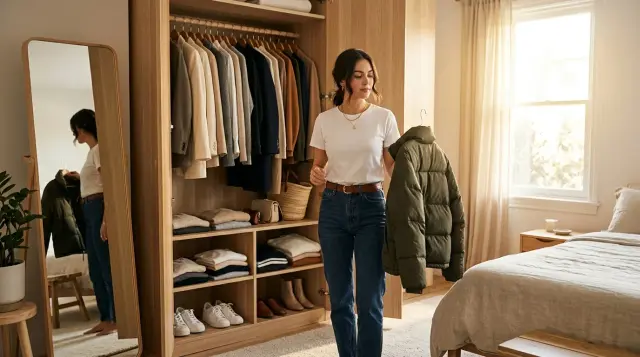
So before you spend a single dollar, try this: look at what you already reach for most. Not the stuff hanging in the back of your closet with tags still on. The things you actually grab on a Tuesday morning when you're running late. That tells you something real. Maybe you gravitate toward neutral tones and clean lines. Maybe you always reach for your favorite puffer coat the second the temperature drops. Those instincts? They're your starting point.
Quick Q&A
Q: How do I figure out my personal style if I have no idea where to start?
A: Look at the 10 items you wear most often and identify the common threads: colors, fits, fabrics, and formality level. Those patterns are your natural style DNA.
A friend of mine spent years trying to dress in a minimalist Scandinavian aesthetic because she admired it online. She looked fine. But she felt flat. When she finally admitted she loved color, texture, and a bit of edge, her wardrobe got smaller, cheaper, and ten times more her. The lesson? Honesty with yourself is free, and it saves you a fortune in wrong purchases.
How Do You Build a Wardrobe on a Budget Without Looking Cheap?
The capsule wardrobe concept, popularized by London boutique owner Susie Faux in the 1970s and later championed by designer Donna Karan, is probably the single most effective budget strategy in fashion. The idea is straightforward: own roughly 30 to 40 core pieces that all work together. Every top goes with multiple bottoms. Every layer complements every base. You stop buying randomly and start buying with purpose.
Think of it like this. A well-chosen puffy jacket in a neutral color, black, navy, or olive, works over a hoodie for weekend errands and over a button-down for a casual Friday meeting. One piece, multiple lives. That's the math that makes affordable fashion actually work. If you need inspiration for pieces that pull double duty, the Men's Proteck'd Collection has some solid examples of versatile staples designed to layer well.
The cost-per-wear formula is your best friend here. A $120 jacket you wear 80 times costs you $1.50 per wear. A $30 trendy top you wear twice costs $15 per wear. That "expensive" jacket was actually the bargain. According to ThredUp's 2023 Resale Report, the average consumer keeps a garment for about 3.3 years before discarding it, but high-quality basics tend to last significantly longer when cared for properly.
The trick to not looking cheap on a budget isn't about brand names. It's about fit and fabric. A $25 tee that fits perfectly looks better than a $100 tee that's a size too big. Every single time. If you want to go deeper on building a professional wardrobe without overspending, I covered that in detail in Building a Professional Closet on a Budget: What to Buy First.
Personal style isn't about spending more. It's about spending right. One thoughtful purchase that fits your life is worth ten impulse buys that sit in your closet collecting dust.
Is a Puffy Jacket Really Worth the Investment?
Short answer: absolutely, if you pick the right one. A quilted puffer jacket is one of those rare wardrobe pieces that checks every practical box. Warm, lightweight, packable, and it goes with almost anything. There's a reason the padded jacket has been a streetwear and outdoor staple since Eddie Bauer popularized down-filled outerwear back in the 1930s.
But not all puffer coats are created equal. A puffy jacket in a classic silhouette, clean lines without excessive bulk, will serve you for years. Something overly trendy, like a cropped metallic puffer, might feel fun for one season and then collect dust. When you're on a budget, lean toward timelessness over trendiness.
For women, the Women's Proteck'd Collection offers pieces that balance style with function, including outerwear that layers beautifully over everything from athleisure to smart casual. For men, a solid insulated jacket in matte black or deep navy is basically a wardrobe cheat code. It pairs with jeans, chinos, joggers. It works at a coffee shop or on a weekend hike.
Quick Q&A
Q: What color puffy jacket is the most versatile for everyday wear?
A: Black, navy, and olive are the three most versatile puffer jacket colors because they pair with virtually any outfit, from casual to semi-dressed-up.
If you want your insulated jacket to really earn its keep, look for one with a water-resistant shell. A sudden drizzle shouldn't ruin your whole look. Bonus points if it packs down small enough to toss in a bag when you're traveling.
Where Should You Actually Spend More, and Where Should You Save?
Here's a rule I've found genuinely useful: spend on things that touch the ground or keep you warm. Save on everything else. That means quality shoes and quality outerwear get the bigger slice of your budget. T-shirts, basic layering pieces, casual accessories? Those are where you can absolutely get away with affordable options.
According to the Environmental Protection Agency, 11.3 million tons of textile waste hit U.S. landfills in 2018 [1]. A huge chunk of that comes from cheap, poorly made pieces that fall apart fast and get tossed. Buying one well-constructed winter coat, whether it's a puffy jacket or a wool blend, means you're not replacing it every year. Better for your wallet. Better for the planet.
The Faraday Fashion Collection is an interesting example of how innovative features can add value to everyday clothing. When a piece does more than just look good, maybe it incorporates protective technology or especially durable materials, the cost-per-wear drops even further because you're getting added utility.
Meanwhile, save aggressively on trend pieces. That neon green anything? The oversized graphic tee that's everywhere this season? Buy those cheap. Wear them while they're fun. Move on without guilt. Your foundation stays solid while your trendy layer rotates in and out affordably. I talked about how accessories can do the heavy lifting for personality in Accessories That Elevate Any Outfit: What to Actually Buy.

How Do You Make Casual Outfits Look More Put Together?
This is where most people's style falls apart. You've got decent individual pieces, but somehow the whole outfit reads "I gave up." The fix is simpler than you'd think. It almost always comes down to three things: intentional layering, proper fit, and one polished element.
Take a basic scenario. Joggers and a hoodie can look sloppy, or they can look intentional. The difference? A structured puffer coat on top, clean sneakers, and maybe a watch or simple chain. Suddenly you look like you planned it. The clothes aren't expensive. The combination is just thoughtful. I wrote a whole piece about this exact transformation in How to Look Put Together in Sweats: What Makes the Difference.
Celebrity stylist Allison Bornstein, who's worked with clients including Katie Holmes, popularized the "three word method" on social media in 2022. You describe your ideal style in just three words (something like "relaxed, classic, sharp") and use those as a filter for every purchase. If a piece doesn't fit at least two of your three words, skip it. This eliminates so many wasteful buys it's almost silly how well it works.
A padded jacket layered over a crisp white tee, dark jeans, and leather boots? That's maybe $150 total if you shop smart, and it looks like a thousand bucks. The point isn't to trick people into thinking you spent more. It's that thoughtful choices naturally look more expensive than they are.
Can Secondhand Shopping Actually Help You Find Your Style Faster?
Yes. And here's why: when you're browsing secondhand, the usual marketing tricks disappear. There's no curated display, no influencer endorsement, no algorithmically placed "you might also like" nudge. You're forced to evaluate each piece on its own merits. Does this fit me well? Does it feel like my style? Will I actually wear it? That's pure style development.
ThredUp's 2023 Resale Report projected the global secondhand market will hit $350 billion by 2027 [2]. Platforms like ThredUp, Poshmark, and The RealReal have made it incredibly easy to find quality pieces from brands that would normally be way out of budget. I've personally found excellent quilted jackets and leather goods for a fraction of retail this way.
The other advantage of thrifting? It lets you experiment without financial risk. Not sure if you're a "blazer person"? Grab one for $12 at a consignment shop and test-drive it for a month. Curious about a bolder color palette? A secondhand piece takes the sting out of trying something new. If it doesn't work, you're out lunch money, not a car payment.
That said, there are pieces I'd always recommend buying new, especially items where fit, technology, or construction quality really matter. A well-engineered insulated jacket from a brand like Proteck'd, where the materials and design serve a specific purpose, is worth buying fresh. Same goes for foundational items like dress shoes or well-tailored trousers. For business-specific wardrobe advice, check out What to Wear to a Business Meeting: The Complete Guide.
What Are the Biggest Money Wasters When Building a Wardrobe?
Let's talk about what to stop doing. Because avoiding bad spending habits matters just as much as building good ones.
Number one: buying something just because it's on sale. Retailers are smart. A 2019 study published in the Journal of Consumer Research found that sale tags increase purchase likelihood by over 50%, even when the actual price isn't particularly low [3]. That "70% off" sticker is doing psychological work on you. If you wouldn't pay full price for it, the discount doesn't make it a good buy. It makes it a cheaper bad buy.
Number two: ignoring care instructions. A beautiful knit sweater that requires dry cleaning every time you wear it is going to cost you an extra $10 to $15 per wear in maintenance. Multiply that across a season and your "affordable" sweater just became your most expensive piece. Look for machine-washable fabrics when possible, especially for everyday layering items.
Number three: chasing every micro-trend on social media. TikTok cycles through aesthetics faster than most people cycle through laundry. "Coastal grandmother" one month, "dark academia" the next. If you rebuilt your wardrobe for each one, you'd go broke and still feel lost. Pick the elements from trends that genuinely resonate with your three-word style description. Ignore the rest. Your wallet and your closet will both thank you.
How Do You Actually Maintain Your Style Once You've Built It?
Building a great wardrobe is one thing. Keeping it great? That's a different challenge. The key is what I call the "one in, one out" rule. Every time a new piece comes in, something goes. This keeps your closet at a manageable size and forces you to think about whether a new purchase is actually better than something you already own.
Marie Kondo made decluttering mainstream with her Netflix series in 2019, but you don't need to hold every garment and ask if it sparks joy. A more practical test: have you worn it in the last 12 months? If the answer is no, and it's not a seasonal piece like a puffy jacket or a formal suit, it's probably time to let it go. Donate it, sell it on Poshmark, or swap it with a friend.
Seasonal audits help too. At the start of each season, spend 20 minutes going through your closet. Identify gaps. Do you need a lightweight layering piece for spring? Is your winter outerwear still holding up, or has your insulated jacket seen better days? Knowing what you actually need before you start shopping is the single greatest defense against impulse purchases.
And here's something people overlook: proper garment care extends the life of everything you own. Wash on cold. Hang knits to dry instead of tossing them in the dryer. Store winter coats properly during summer. The American Cleaning Institute recommends washing most clothes in cold water, which not only protects fabric but saves energy. These small habits mean your favorite pieces last years longer. And really, that's the ultimate budget move.
Key Takeaways
Frequently Asked Questions
How much should I spend on a puffy jacket?
A good everyday puffy jacket typically runs between $80 and $200 for solid quality that'll last several years. The sweet spot for most people is around $100 to $150, where you get durable construction and decent insulation without overpaying for brand premiums. Do the cost-per-wear math: if you wear it 3 times a week for 4 months, even a $150 jacket works out to about $3 per wear.
What's the difference between a puffy jacket and a puffer coat?
They're the same thing. Puffy jacket, puffer jacket, puffer coat, quilted jacket, padded jacket. All refer to insulated outerwear with quilted sections filled with down or synthetic fill. The terminology shifts depending on region and brand, but the construction is identical.
How do I find my personal style if I've never had one?
Start by looking at the 10 to 15 pieces you already wear most. Notice patterns in color, fit, and formality. Then try celebrity stylist Allison Bornstein's three-word method: pick three adjectives that describe how you want to look and use them as a filter for every purchase. It gives you a clear decision-making framework without needing any innate fashion knowledge.
Can I build a good wardrobe for under $500?
Absolutely, especially if you combine smart new purchases with secondhand shopping. Focus your budget on 8 to 10 core pieces: a versatile jacket or puffer coat, two pairs of well-fitting pants, a few quality tops, and one pair of clean shoes. Fill gaps with thrifted items. Plenty of capsule wardrobe practitioners report spending less than $500 on a functional seasonal wardrobe.
Is it better to buy fewer expensive clothes or more cheap ones?
Generally, fewer and better wins. The cost-per-wear calculation proves this consistently. A quality piece worn 50+ times is cheaper per use than a cheap piece worn 5 times before it falls apart. But for trend pieces you know you'll only wear a season, go cheap. The best strategy is mixing: quality basics plus affordable seasonal items.
How many items should be in a capsule wardrobe?
Most guidelines suggest 30 to 40 core pieces, not counting underwear, workout clothes, or specialty items like formal wear. That typically breaks down to around 8 to 10 tops, 4 to 5 bottoms, 2 to 3 outerwear pieces, 3 to 4 pairs of shoes, and a handful of accessories. The exact number really depends on your lifestyle and climate.
What puffy jacket color goes with everything?
Black is the most universally versatile puffy jacket color. It pairs with literally any outfit. Navy is a close second, offering a slightly softer feel. Olive green works surprisingly well as a neutral, especially with earth tones and denim. If you want one jacket that goes everywhere, matte black is the safest bet.
How do I stop buying clothes I never wear?
Two rules work well. First, use the 24-hour rule: if you see something you want, wait a full day before buying. Impulse purchases drop dramatically with that pause. Second, apply the three-word style test to every potential purchase. If it doesn't match at least two of your three style words, put it back. Research in the Journal of Consumer Research shows that sale tags alone increase purchase likelihood by over 50%, so just being aware of that psychological pull helps.
Are expensive brands really better quality than budget brands?
Not always. Brand name and price don't automatically equal better construction. What matters is fabric quality, stitching, and fit. Some mid-range brands like Proteck'd offer excellent quality at reasonable prices by cutting marketing overhead rather than material quality. Always check seams, zippers, fabric weight, and care instructions before assuming a higher price means a better garment.
How often should I update my wardrobe?
Do a closet audit at the start of each season, roughly four times a year. That doesn't mean buying a whole new wardrobe. It means spotting 2 to 3 gaps and filling them with intention. Most core pieces like a good insulated jacket, quality denim, or classic shoes should last 3 to 5 years with proper care. Only trend pieces need regular refreshing.
References
- U.S. Environmental Protection Agency – 11.3 million tons of textile waste ended up in U.S. landfills in 2018
About the Author
Proteck'd EMF Apparel
Health & EMF Specialists
The Proteck'd team covers EMF protection, silver-fiber apparel, and practical ways to reduce everyday radiation exposure. Every piece Proteck'd ships is designed, tested, and worn by the people who build it.
Protect Yourself Today
Proteck'd Faraday and silver fiber apparel is engineered to shield your body from everyday EMF exposure. Built for real life, tested for real results.
Shop EMF Protection →✓30-day returns✓Free shipping✓Free returns✓Silver fiber shielding


Laissez un commentaire