


How to Build a Streetwear Wardrobe From Scratch: The Practical Guide

Here's the thing nobody tells you about streetwear: most people start it backwards. They buy the $300 hoodie before they own a decent pair of jeans. They chase hype drops and end up with a closet full of pieces that don't work together. Then they wonder why getting dressed still feels so hard. A solid streetwear wardrobe starts with the boring stuff. A good lightweight beanie, a couple of plain tees that actually fit, and sneakers you can walk in. Not hype. Structure.
I've watched friends blow entire paychecks on a single collab piece, only to pair it with ill-fitting cargo pants from 2009. The outfit looked terrible. Meanwhile, someone in all-black basics with a clean knit cap and white sneakers walked by looking effortlessly put together. That's the difference between having expensive clothes and having a wardrobe.
This guide is for the person who wants to do it right from the start. Whether you've got $200 or $2,000, the principles don't change. We're going to cover every category that matters, from headwear to footwear, and I'll show you how each piece connects to the next.
No gatekeeping. No brand worship. Just a practical roadmap for building something you'll actually want to wear every day.
Key Takeaways
What Are the Core Pieces Every Streetwear Wardrobe Needs?
Strip streetwear down to its skeleton and you're looking at about seven categories: tees, bottoms, outerwear, hoodies or sweatshirts, sneakers, headwear, and accessories. That's it. Everything else is variation on those themes. According to a 2022 report from the U.S. Bureau of Labor Statistics, the average American household spent $1,945 annually on apparel. You can build a solid streetwear foundation for well under that if you're smart about it [1].
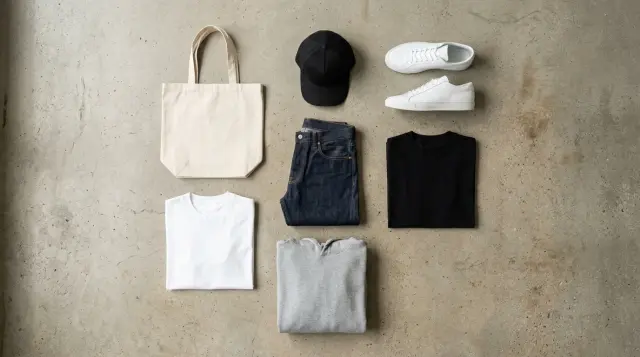
Start with three to four oversized tees in neutral tones. White, black, grey, maybe an earth tone. These are your canvas. Then grab two pairs of bottoms: one pair of straight-leg or relaxed-fit denim, one pair of cargos or joggers. The silhouette should be intentionally loose, not sloppy. There's a real difference, and it comes down to where the garment tapers.
For headwear, a lightweight beanie is non-negotiable. It's the single most cost-effective way to upgrade a basic outfit. A simple knit cap in black or charcoal works year-round, especially thinner options made from merino wool or bamboo blends that won't overheat you indoors. If you want to see what a well-rounded essentials list actually looks like, check out Wardrobe Essentials: The Definitive List for a deeper breakdown.
One hoodie, one bomber or coach jacket, and a pair of clean sneakers round out the basics. With just these 12 to 15 items, you've got more outfit combinations than most people realize. The key? Making sure every piece talks to every other piece in your closet.
How Do You Choose the Right Fit for Streetwear?
Fit is where streetwear either looks intentional or accidental. The oversized silhouette that defines modern street style traces back to hip-hop culture in the 1990s, but its current form really crystallized when Kanye West debuted Yeezy Season 1 in February 2015. That show gave the fashion industry permission to treat oversized as high fashion, not just something you wore because you couldn't find your size. Today, brands like Fear of God Essentials and Stüssy have built entire empires on relaxed proportions.
But here's where beginners mess up: they buy too big. Oversized doesn't mean three sizes up. It means one size up, with specific proportions. The shoulder seam should sit an inch or two past your natural shoulder. The hem should hit mid-hip or slightly below. Sleeves should be slightly long but not past your knuckles. That's the sweet spot.
Quick Q&A
Q: Should streetwear always be oversized?
A: No. Modern streetwear mixes oversized tops with slimmer bottoms (or vice versa) to create contrast and proportion.
For your specific body type, the rules shift. Taller folks can go bigger on tops without looking swallowed. Shorter frames benefit from cropped proportions and higher-waisted bottoms that maintain leg length. If you want real guidance on this, How to Dress for Your Body Shape: The Honest Guide goes deep on tailoring streetwear fits to different builds.
The bottom line: try things on. Look in a mirror. If it looks like you borrowed your older brother's clothes, and not in a cool way, size down. Intentionality is everything.
Why Does Headwear Matter So Much in Streetwear?
Ask any stylist what the easiest upgrade to a basic outfit is, and most will point to your head. A fitted cap, a bucket hat, or a lightweight beanie instantly tells people you thought about your look. It's the visual period at the end of the sentence. Tyler, the Creator built an entire aesthetic identity partly around headwear. Pharrell's Vivienne Westwood mountain hat at the 2014 Grammy Awards became one of the most talked-about fashion moments of that decade.
For beginners, a thin knit cap or skull cap is the most versatile starting point. It works with a hoodie and sneakers on a cold morning. It works at a concert. It even works layered under the hood of a jacket for that street-ready silhouette you see all over Instagram. Materials matter, though. A heavy acrylic beanie from a gas station is not the same thing as a breathable merino wool or bamboo-blend cap that weighs under two ounces.
The Faraday Fashion Collection at Proteck'd offers headwear that goes beyond aesthetics, incorporating EMF-shielding technology into clean, streetwear-friendly designs. That kind of dual-purpose thinking, where the piece looks good and actually does something, is exactly the direction urban fashion is heading.
Don't overlook color coordination, either. Your beanie should either match a tone already in your outfit or serve as a deliberate contrast piece. A bright orange knit cap with an all-black fit? That works. A random brown beanie with navy and grey? That just looks like you grabbed whatever was by the door. For a broader look at how accessories tie outfits together, read Accessories 101: The Complete Guide.
Streetwear isn't about owning the most expensive pieces. It's about owning the right pieces and knowing exactly why each one is in your closet. A $15 knit cap worn with intention will always look better than a $300 hoodie worn carelessly.

What Should You Buy First on a Tight Budget?
Let's be honest. Streetwear has a spending problem. Hype culture has convinced people they need $500 sneakers and $200 tees just to participate. You don't. The real move, especially when you're starting from scratch, is to build a capsule wardrobe street style that maximizes outfit variety from a small number of pieces. According to research from the Ellen MacArthur Foundation, the average garment is worn only 7 times before being discarded [2]. Buying fewer, better pieces breaks that cycle and saves money.
If I had exactly $100, here's what I'd buy: two plain oversized tees (about $25 total from Uniqlo or H&M), one pair of black slim cargos ($30), and a lightweight beanie in black ($10 to $15). That leaves me $30 to $35 for a pair of secondhand sneakers from a local thrift store or an app like Depop. That's a complete outfit with room for mixing. Not glamorous, but it works. For more ideas at this price point, Fashion on a $100 Budget: How to Make It Work maps out the whole strategy.
Quick Q&A
Q: What's the single most important streetwear piece to buy first?
A: A well-fitting plain tee in black or white, because it pairs with everything else you'll eventually add.
Once you've got your basics locked in, the next purchases should be layering pieces. A hoodie in a neutral shade and some kind of light jacket, whether that's a bomber, a coach jacket, or an overshirt. These multiply your outfit count dramatically because they create top-half variation. The Men's Proteck'd Collection has layering options that blend clean streetwear aesthetics with functional fabrics, which is exactly what you want when you're investing in fewer, harder-working pieces.
Resist the urge to buy statement pieces early. That graphic hoodie or those bold-patterned pants? Save them for month three, when your basics are solid and you know what gaps actually need filling.
How Do You Layer Streetwear Without Looking Bulky?
Layering is the beating heart of good streetwear. It separates a flat, one-dimensional outfit from something with real visual depth. But bad layering? That just makes you look like you're wearing everything you own at once. The trick is managing fabric weight and length progression. It's simpler than you think.
Think in three tiers. Your base layer is a fitted or slightly oversized tee. Your mid layer is a hoodie, crewneck sweatshirt, or flannel. Your outer layer is a jacket or coat. Each layer should be slightly longer and slightly wider than the one beneath it so that hems peek out at different levels. This creates that stacked, intentional look you see on streetwear blogs and sneaker culture accounts all over TikTok.
Japanese streetwear brands like WTAPS and Neighborhood, both founded in Tokyo's Ura-Harajuku district in the late 1990s, practically invented this approach. They've been doing three-plus layers in warm weather since before most of us were paying attention to fashion. Their secret? Lightweight fabrics. A thin cotton overshirt over a mesh-panel tee under a nylon shell weighs almost nothing but looks incredibly considered.
And don't forget your head. Topping a layered outfit with a thin knit cap or skull cap ties the whole thing together visually. It adds a finished quality, like putting a frame around a painting. The Women's Proteck'd Collection includes pieces designed specifically for this kind of layered, urban fashion styling, with silhouettes that work as mid-layers without adding unnecessary bulk.
What Role Do Sneakers Play in a Streetwear Wardrobe?
Sneakers are the foundation of streetwear. Literally. They're the first thing most people notice, and in sneaker culture, your shoes signal what tribe you belong to. Are you a Nike Air Force 1 purist? A New Balance 550 convert? A Vans Old Skool loyalist? According to market research firm NPD Group (now Circana), athletic footwear sales in the United States reached $21.2 billion in 2022, driven largely by lifestyle and streetwear crossover demand.
For your first pair, go clean and versatile. White or off-white leather sneakers work with literally everything. The Nike Air Force 1 Low has been a streetwear staple since its mainstream adoption in New York City in the mid-1980s, and it still works today. Want something less common? The Adidas Samba or a pair of Asics Gel-Kayano 14s give you the same versatility with a slightly different flavor.
Your second pair should introduce contrast. If your first pair was white, go with something darker or chunkier. A black New Balance 990v5 or a pair of Salomon XT-6 trail runners adds an entirely different energy to your rotation. Two pairs of sneakers, chosen wisely, can carry your wardrobe for months.
Keep them clean. I know that sounds obvious, but scuffed, yellowed sneakers undermine even the best outfit. A $10 sneaker cleaning kit pays for itself immediately. For broader advice on sneaker culture outfits and how accessories work around footwear, The Best Accessories: For Every Budget is a great companion read.
How Do You Develop a Personal Streetwear Style?
This is where most guides stop, and it's the part that actually matters most. Buying the right pieces is mechanics. Developing a style is identity. Nobody can hand you an identity off a rack. You have to build it through experimentation, which means you're going to have some outfits that don't work. That's fine. That's how it's supposed to go.
Start by studying people whose style you admire, but pay attention to the principles, not just the items. When A$AP Rocky wears a Rick Owens leather jacket over a plain white tee, the principle is contrast between high and low. When Emma Chamberlain pairs vintage Levi's with a designer bag, the principle is mixing eras. You don't need their pieces. You need their logic.
Create a visual reference folder. I use a private Pinterest board, but a saved folder on Instagram works too. After a few weeks, you'll start noticing patterns. Maybe you keep saving fits with earth tones and workwear elements. Maybe you're drawn to monochromatic looks with a single pop of color. Those patterns are your style trying to tell you something. Listen.
Then iterate. Wear your outfits, photograph them, and review what works after a couple of weeks. The fits where you felt confident and got compliments? Those are your direction. Double down. The ones that felt awkward? Analyze why. Usually it's a proportion issue or a color clash. Over time, your wardrobe naturally refines itself into something that's distinctly yours.
Can Streetwear Also Be Functional and Tech-Forward?
One of the most interesting shifts in streetwear over the past five years is the rise of functional fashion, sometimes called "techwear" or "urban utility." Brands like Acronym (founded by Errolson Hugh in Berlin in 2002) proved that garments could be waterproof, modular, and still look incredible. That ethos is trickling down to more accessible price points now, and it's changing how people think about what their clothes should actually do.
Think about what you really need from your wardrobe. If you commute by bike, water-resistant outerwear isn't a luxury. It's a requirement. If you carry your phone in your pocket all day, you might consider EMF-shielding fabrics like those in the Faraday Fashion Collection. According to the National Institute of Environmental Health Sciences, research into the biological effects of radiofrequency electromagnetic fields is ongoing, and the agency continues to monitor new findings [3]. Clothing that incorporates shielding technology addresses those concerns without asking you to change your habits.
A lightweight beanie with built-in tech features is a perfect example of this convergence. It looks like any other clean, minimal knit cap, but it's doing more. That's the future of streetwear: pieces that perform double duty. You shouldn't have to choose between looking good and being thoughtful about what's touching your body all day.
The best functional streetwear doesn't scream "tech." It whispers it. Clean lines, familiar silhouettes, but with materials and construction that go beyond what a basic fast-fashion piece offers. That balance of form and function is exactly what makes brands like Proteck'd worth paying attention to.
Frequently Asked Questions
Q: What is a lightweight beanie and how is it different from a regular beanie?
A lightweight beanie is a thin knit cap, usually made from merino wool, bamboo fiber, or fine-gauge acrylic, that weighs under two ounces. Unlike thick winter beanies, it's designed to be comfortable across seasons without causing overheating. It gives you just enough warmth for cool weather and works as a pure style piece indoors.
Q: How many pieces do you need to start a streetwear wardrobe?
You can build a functional streetwear capsule wardrobe with 12 to 15 core pieces. That includes three to four tees, two pairs of bottoms, one hoodie, one jacket, two pairs of sneakers, a beanie, and a couple of accessories. This foundation gives you enough combinations for varied daily outfits without blowing your budget.
Q: Can you build a streetwear wardrobe on a tight budget?
Absolutely. A solid starter outfit can come together for under $100 by shopping brands like Uniqlo and H&M for basics, thrifting sneakers, and picking up a clean knit cap for $10 to $15. Stick with neutral colors and versatile cuts so every piece pairs with everything else. It's about buying fewer, smarter items rather than chasing hype.
Q: What are the best colors for a beginner streetwear wardrobe?
Black, white, grey, and earth tones like olive and tan form the most versatile streetwear palette. These neutrals mix effortlessly, meaning every piece in your closet works with every other piece. Once your basics are locked in, you can start adding one or two bolder colors as accent pieces.
Q: How should a streetwear outfit fit?
Modern streetwear favors a relaxed, slightly oversized fit on top with more tapered or structured bottoms for balance. The shoulder seam should sit one to two inches past your natural shoulder, and the hem should hit around mid-hip. Going too large makes you look sloppy rather than intentional, so aim for one size up, not three.
Q: What sneakers should you buy first for streetwear?
A clean, versatile sneaker in white or off-white is the best starting point. The Nike Air Force 1 Low, Adidas Samba, and New Balance 550 are all widely recommended because they pair with virtually any streetwear outfit. Your second pair should offer contrast, something darker or chunkier to give variety to your rotation.
Q: Is streetwear the same as athleisure?
No. There's some overlap, but streetwear draws from skateboarding, hip-hop, and surf culture with an emphasis on graphics, layering, and sneaker culture. Athleisure is rooted in athletic performance wear adapted for casual settings. You'll see hoodies in both, but the styling intent and cultural references are pretty different.
Q: Can women wear the same streetwear basics as men?
Yes, many streetwear staples are unisex by design. Oversized tees, hoodies, beanies, and sneakers work across all genders. The main difference is in proportion and how you choose to style them. Women's streetwear often plays more with cropped lengths and high-waisted bottoms to adjust oversized tops for different body proportions.
Q: How do you layer streetwear without looking bulky?
Use the three-tier system: a fitted base layer, a mid-weight piece like a hoodie or flannel, and a lighter outer layer like a nylon jacket or overshirt. Each layer should be slightly longer than the one beneath it so hems peek out at staggered levels. Choose thinner fabrics so the layers add visual depth without physical bulk.
Q: What accessories matter most in streetwear?
Headwear and bags tend to have the biggest visual impact. A lightweight beanie, a crossbody bag, or a simple chain can transform a basic tee-and-jeans outfit into something that looks intentional. Accessories are also the easiest way to bring personality and color into a neutral-toned wardrobe without overhauling your entire closet.
References
- National Institute of Environmental Health Sciences (NIEHS) – Research into the biological effects of radiofrequency electromagnetic fields is ongoing, and the agency continues to monitor new findings.
About the Author
Proteck'd EMF Apparel
Health & EMF Specialists
The Proteck'd team covers EMF protection, silver-fiber apparel, and practical ways to reduce everyday radiation exposure. Every piece Proteck'd ships is designed, tested, and worn by the people who build it.
Get the Free EMF Home Audit Checklist
A room-by-room PDF that walks you through the biggest EMF sources in your house and what to do about each one. No cost, no fluff.
Download the Checklist →✓30-day returns✓Free shipping✓Free returns✓Silver fiber shielding


Laissez un commentaire