


Biohacking: The Beginner's Guide

Here's something most people get wrong about sleep: they obsess over mattresses, blackout curtains, and melatonin supplements while completely ignoring the thermostat. If you've ever Googled "what is optimal sleep temperature," you're already asking one of the smartest questions in the biohacking playbook. The answer is surprisingly specific, backed by decades of research, and it probably means your bedroom is too warm right now.
For most adults, the sweet spot is 60 to 67 degrees Fahrenheit. That's 15.5 to 19.4 Celsius. Sounds chilly. It is. But your body has been wired over millennia to sleep in cooler conditions, and fighting that biology is one of the most common reasons people wake up at 3 a.m. feeling groggy and annoyed.
I started paying attention to sleep temperature about two years ago, after months of mediocre sleep tracker scores despite doing "everything right." Dropping my thermostat from 72°F to 66°F was the single change that moved the needle most. My deep sleep increased by nearly 20 minutes per night within the first week. That's not a miracle. That's just biology doing its thing when you stop getting in the way.
This guide is for anyone curious about biohacking but unsure where to begin. Temperature is the perfect starting point because it's free, it's immediate, and the science is rock solid. We'll cover why your body cools down at night, what happens when your bedroom fights that process, how aging changes the equation, and a handful of other biohacking strategies that stack beautifully with a cooler sleep environment.
If you've already explored our guide on Sleep Optimization: The Complete Guide, consider this the deep cut on the thermal side of things. Let's get into it.
Key Takeaways
Why Does Your Body Temperature Drop When You Sleep?
Your body runs on a 24-hour internal clock called the circadian rhythm, and temperature is one of its primary signals. About two hours before your typical bedtime, your core body temperature starts to decline. According to research published by the National Institutes of Health, this drop of roughly 1 to 2 degrees Fahrenheit is one of the strongest cues your brain uses to kick off sleep [1]. It's not random. It's deeply programmed biology.
The mechanism works through your skin. As bedtime approaches, blood vessels near the surface of your hands and feet dilate, a process called vasodilation. This pushes warm blood toward your extremities, releasing heat from your core outward. Ever notice your feet get warm right before you drift off? That's your thermoregulatory system doing exactly what it's supposed to do.
Here's where your bedroom environment matters. If the room is too warm, your body can't offload that heat efficiently. Core temperature stays elevated, and your brain gets a mixed signal: it's bedtime according to the clock, but the thermal cue says "stay alert." A study from the Journal of Physiological Anthropology in 2012 found that elevated ambient temperature during sleep significantly increased wakefulness and reduced both slow-wave sleep and REM sleep [2].
Quick Q&A
Q: Why do I feel sleepy when a room is cool?
A: A cooler environment helps your core body temperature drop faster, which signals your brain's suprachiasmatic nucleus to release melatonin and initiate sleep onset.
Think of it like this. Your body is a furnace that needs to vent. A cool bedroom is the open window. A hot bedroom is a sealed box. The furnace doesn't stop running just because the window is shut. It just overheats. For a deeper look at how your full sleep environment plays a role, check out The Perfect Sleep Environment: What Makes the Biggest Difference.
What Is the Best Bedroom Temperature for Sleep?
So what is optimal sleep temperature in practical terms? The most widely cited recommendation comes from the National Sleep Foundation, which places the ideal range for adults at 60 to 67°F (15.5 to 19.4°C). The Cleveland Clinic echoes this, noting that temperatures above 75°F can fragment sleep architecture and significantly reduce the time you spend in restorative deep sleep stages [3].
That range might feel surprisingly cold if you're used to keeping your thermostat at 72 or higher. But here's a useful real-world benchmark: most sleep labs, the actual facilities where researchers study sleep, are kept between 64 and 68°F. They're not doing that for comfort. They're doing it because they need subjects to fall asleep efficiently and cycle through all sleep stages normally. If the professionals control for temperature first, maybe we should too.
Within that 60 to 67°F window, personal preference still matters. Some people sleep best at the cooler end, especially those who run hot or share a bed with a partner (two bodies generate a lot of heat under one duvet). Others, particularly older adults or people with lower body mass, may gravitate toward 65 to 67°F. The key is experimentation. Try dropping your thermostat by two degrees for a week and track how you feel. Then adjust from there.
One thing that consistently surprises people: what you wear to bed matters as much as the room temperature. Heavy synthetic pajamas can trap body heat and undo the work your thermostat is doing. Breathable, natural, or purpose-built fabrics make a measurable difference. Proteck'd's Faraday Health Collection uses silver-infused fabrics that are not only antimicrobial and EMF-shielding but also naturally thermoregulating, helping your skin release heat more efficiently while you rest.
What Happens When You Sleep Too Hot or Too Cold?
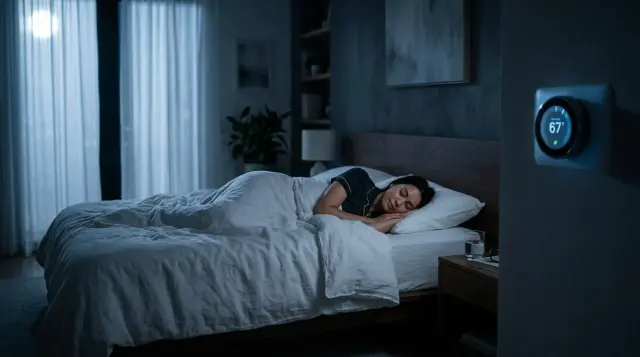
Sleeping too hot is the more common problem. It's also more damaging than most people realize. When ambient temperature climbs above 75°F, your body struggles to complete its natural cool-down process. The result is fragmented sleep, meaning you cycle in and out of lighter stages without spending adequate time in slow-wave (deep) sleep or REM. According to a review published through the National Library of Medicine, heat exposure during sleep suppresses both of these stages [2].
The practical effects are rough. You wake up feeling unrested even after 8 hours. Your cognitive performance the next day drops. Your emotional regulation gets shaky. I've personally had nights where I logged 8.5 hours of sleep in a warm hotel room and felt worse than after 6 hours at home in a cool bedroom. The quantity was there. The quality wasn't.
Sleeping too cold has its own issues, though they're less common in modern homes. When the room drops below about 54°F, your body can enter a mild stress response, elevating cortisol and adrenaline to generate heat. Research from Harvard Medical School's sleep division suggests that while mild coolness promotes sleep, extreme cold activates the sympathetic nervous system. That's the opposite of what you want at bedtime.
The sweet spot isn't just "cold." It's "cool enough that your body can offload heat, but warm enough that you're not shivering." A good test: if you need more than a light blanket and breathable sleepwear to feel comfortable, your room might be too cold. If you're kicking covers off in the middle of the night, it's too warm. For more on dialing this in, read our breakdown of Sleep Hygiene: What Makes the Biggest Difference.
Your body is a furnace that needs to vent. A cool bedroom is the open window. A hot bedroom is a sealed box. The furnace doesn't stop running just because the window is shut. It just overheats.
Does Ideal Sleep Temperature Change With Age?
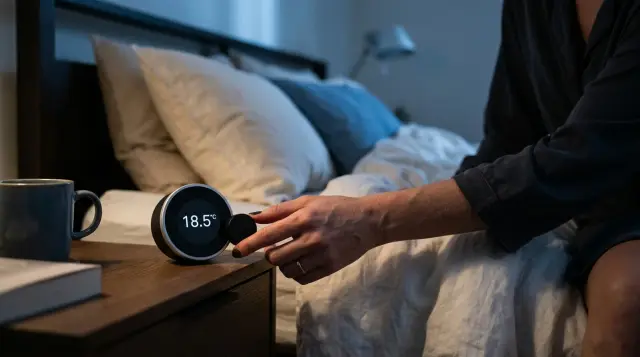
Yes. And this is something most sleep guides gloss over. The best room temperature for rest shifts across the lifespan, and ignoring that can lead to problems at both ends of the age spectrum.
For infants, the American Academy of Pediatrics (AAP) recommends a sleep environment between 68 and 72°F. Babies can't regulate their body temperature as effectively as adults, and overheating is a recognized risk factor for sudden infant death syndrome (SIDS). The AAP advises against heavy blankets and layered clothing, suggesting instead a single sleep sack in a room that feels comfortable to a lightly clothed adult.
Older adults face a different challenge. Research from the National Institute on Aging shows that thermoregulation becomes less efficient with age. The body's ability to detect temperature changes diminishes, and vasoconstriction and vasodilation responses slow down. A 70-year-old might not feel that the room is too warm even when their sleep quality is being compromised. For seniors, erring on the slightly cooler side (65 to 68°F) while using breathable bedding tends to produce better outcomes.
For adults in their 20s through 50s, the standard 60 to 67°F guideline holds well. But hormonal fluctuations can change things. Women going through perimenopause or menopause often experience night sweats and hot flashes that make temperature control especially important. Cooling pillows, moisture-wicking sheets, and thermoregulating sleepwear from collections like Proteck'd's Women's Wellness Collection can be genuine sleep savers during these transitions.
How Can You Cool Your Bedroom Without Cranking the AC?
Not everyone can afford to run air conditioning all night, and not everyone wants to. Good news: there are plenty of low-cost and no-cost strategies that make a real difference in your nightly recovery.
Start with airflow. A simple box fan or ceiling fan creates convective cooling across your skin, which speeds up heat dissipation even if the room temperature stays the same. Point a fan toward your bed, not directly at your face but across your body, and you can drop your perceived temperature by several degrees. In a 2019 survey by the Better Sleep Council, 65% of respondents who used a fan reported improved sleep quality compared to nights without one.
Next, think about what's on your bed. Cotton or bamboo sheets breathe far better than polyester blends. If you're using a memory foam mattress, be aware that dense foam traps heat. A breathable mattress topper or a cooling mattress pad can counteract this. Some biohackers swear by devices like the Eight Sleep Pod or ChiliPad, which circulate temperature-controlled water through your mattress. They're pricey, but the temperature precision is hard to beat.
Finally, control the heat sources in your bedroom. Electronics generate ambient warmth. Charging your phone on the nightstand, running a laptop, even having a TV on standby adds thermal load to a small room. There's an additional reason to minimize electronics near your bed: electromagnetic field exposure. Growing research suggests EMF from devices can interfere with melatonin production. You can learn more about that connection on our EMF Health Benefits page. Reducing device heat and EMF exposure at the same time is a two-for-one biohacking win.
What Other Biohacking Strategies Stack With Sleep Temperature?
Temperature optimization is powerful on its own. But the real fun with biohacking is stacking interventions. When you combine a cooler bedroom with other evidence-backed strategies, the compounding effect on sleep quality can be dramatic.
Light exposure is the biggest one. Dr. Andrew Huberman at Stanford University's Department of Neurobiology has popularized the importance of morning sunlight for setting your circadian clock. Getting 10 to 15 minutes of bright light within the first hour of waking helps anchor your body's temperature rhythm, making that evening cool-down more reliable. On the flip side, reducing blue light exposure after sunset (using amber glasses or screen filters) prevents artificial delays in melatonin release.
Meal timing is another underrated lever. Research from the Salk Institute for Biological Studies, led by Dr. Satchin Panda, shows that eating within a consistent 8 to 10 hour window supports circadian alignment. Your gut has its own clock, and late-night eating can raise core body temperature through digestive thermogenesis, working directly against your cooling efforts. Our article on The Gut-Brain Connection: The Complete Guide covers this relationship in much more detail.
Quick Q&A
Q: What is the single best biohacking tip for better sleep?
A: Lowering your bedroom temperature to 65°F and getting morning sunlight within 30 minutes of waking are consistently the two highest-impact, lowest-cost sleep biohacks supported by research.
Then there's what you wear. This sounds trivial, but it's not. Clothing that traps heat or creates static charge works against your thermoregulatory system. Proteck'd's Faraday line uses silver-fiber technology that serves double duty: the fabric naturally wicks heat and moisture away from skin, and it shields against ambient EMF that may disrupt melatonin cycles. If you're going to optimize the room, optimize what's touching your body too. For more on stacking these strategies, see Sleep Optimization: What Actually Works.
How Do You Track Whether Temperature Changes Are Working?
You can't manage what you don't measure. That's one of the core principles of biohacking, and it applies perfectly to sleep temperature experiments.
The simplest approach is a sleep journal. For two weeks, record your bedroom temperature (a $10 thermometer on your nightstand works fine), what you wore to bed, and a subjective 1 to 10 rating of how you felt the next morning. Patterns show up fast. In my own tracking, the correlation between room temperature and morning energy was more consistent than any supplement I've tried.
If you want more data, wearable trackers like the Oura Ring (Gen 3), Whoop 4.0, or Apple Watch Ultra can estimate your sleep stages, heart rate variability (HRV), and skin temperature trends overnight. A 2020 validation study published in Sensors journal found that the Oura Ring detected sleep stages with approximately 79% accuracy compared to polysomnography, which is the gold standard clinical method. Not perfect, but more than enough to spot trends across weeks.
The key metric to watch is deep sleep duration. If you're consistently getting less than 60 to 90 minutes of slow-wave sleep per night (for adults aged 20 to 50), temperature is one of the first variables to tweak. Track it, change one thing at a time, and give each adjustment at least five nights before drawing conclusions. That's biohacking in its purest form: structured self-experimentation with real data.
Frequently Asked Questions
Q: What is optimal sleep temperature for adults?
The optimal sleep temperature for adults is 60 to 67°F (15.5 to 19.4°C), according to the National Sleep Foundation. In this range, your body can efficiently release core heat through vasodilation, which promotes faster sleep onset and more time in deep and REM sleep stages.
Q: Is 72°F too warm for sleeping?
For most adults, yes. While it won't cause severe sleep disruption, research suggests that temperatures above 67°F begin to chip away at sleep quality. You may not notice it subjectively, but sleep trackers typically show less deep sleep at 72°F compared to 65°F.
Q: What is the best sleep temperature for babies?
The American Academy of Pediatrics recommends keeping an infant's sleep environment between 68 and 72°F. Babies can't regulate their body temperature as well as adults, and overheating is a known risk factor for SIDS. Dress them in a single layer or sleep sack rather than heavy blankets.
Q: Does sleeping in a cold room help you lose weight?
There's some evidence it can help modestly. A 2014 study published in Diabetes journal by researchers at the National Institutes of Health found that sleeping in a 66°F room increased brown fat activity and improved insulin sensitivity over four weeks. It's not a weight loss miracle, but it's a nice metabolic bonus on top of better sleep.
Q: Why do I wake up sweating in the middle of the night?
Night sweats can result from a bedroom that's too warm, heavy bedding, hormonal changes (especially during menopause), or certain medications. If your room is above 70°F, try dropping it to 65°F and switching to breathable sheets. If sweating persists regardless of environment, consult a doctor to rule out underlying conditions.
Q: Can what I wear to bed affect my sleep temperature?
Absolutely. Synthetic fabrics trap heat and moisture against your skin, raising your microclimate temperature even if the room is cool. Breathable materials like cotton, bamboo, or silver-infused technical fabrics help your body release heat naturally. That's why sleepwear choice is considered a legitimate biohacking variable.
Q: Does EMF from electronics affect sleep quality?
There is growing research suggesting that electromagnetic fields from phones, routers, and other devices may suppress melatonin production. The science is still evolving, but reducing EMF exposure in the bedroom by removing devices or using shielding products is a low-risk strategy that many biohackers report benefits from.
Q: How long does it take to notice better sleep from lowering room temperature?
Most people notice a difference within three to five nights. Your body adapts quickly to a cooler environment, and sleep tracker data often shows increased deep sleep within the first week. Give any temperature change at least five consecutive nights before deciding whether it's working.
Q: Is it better to use a fan or air conditioning for sleep?
Both work, but they operate differently. Air conditioning lowers the actual room temperature, which is ideal. A fan creates convective airflow that speeds up heat evaporation from your skin, making you feel cooler without changing the ambient temperature much. For best results, use both: AC to hit 65°F and a low fan for gentle airflow.
Q: Should older adults sleep in warmer rooms?
Not necessarily warmer, but slightly less cold. Older adults often have reduced thermoregulation, so the extreme low end of the range (60°F) may be uncomfortable or trigger stress responses. A range of 65 to 68°F with breathable, warm bedding tends to work best for adults over 65, according to guidance from the National Institute on Aging.
References
- National Institutes of Health (National Library of Medicine) – Core body temperature drops 1 to 2 degrees Fahrenheit before sleep onset as a key circadian signal for sleep initiation.
- Journal of Physiological Anthropology (via PubMed) – Heat exposure during sleep increased wakefulness and decreased slow-wave and REM sleep in controlled studies.
- Cleveland Clinic – Bedroom temperatures above 75°F can fragment sleep architecture and reduce time in restorative deep sleep stages; the recommended range is 60 to 67°F.
About the Author
Proteck'd EMF Apparel
Health & EMF Specialists
The Proteck'd team covers EMF protection, silver-fiber apparel, and practical ways to reduce everyday radiation exposure. Every piece Proteck'd ships is designed, tested, and worn by the people who build it.
Protect Yourself Today
Proteck'd Faraday and silver fiber apparel is engineered to shield your body from everyday EMF exposure. Built for real life, tested for real results.
Shop EMF Protection →✓30-day returns✓Free shipping✓Free returns✓Silver fiber shielding


Laissez un commentaire