


Smartwatch vs Fitness Tracker: Which One to Buy

There are over 500 wearable devices on the market right now. Five hundred. So if you've ever stood frozen in a Best Buy aisle or scrolled through Amazon reviews until your eyes glazed over, you're not alone. The how to reduce smartwatch comparison guide search keeps climbing because people are genuinely overwhelmed. And honestly? Most "comparison" articles just dump a spec sheet on you without telling you what actually matters for your life.
Here's the thing. A smartwatch and a fitness tracker are not the same product solving the same problem. They overlap, sure. But picking the wrong category can mean spending $400 on features you'll never touch, or saving $100 only to realize you can't answer texts from your wrist during meetings.
I've tested both categories extensively, from the Apple Watch Ultra 2 down to a $40 Xiaomi Mi Band. The biggest lesson? The best wearable isn't the one with the longest spec sheet. It's the one that matches how you actually live.
This guide covers every factor that matters: health sensors and how accurate they really are, battery life (the single most underrated spec), OS compatibility traps, price tiers, and something almost nobody talks about, the electromagnetic radiation these devices press against your skin all day. Let's get into it.
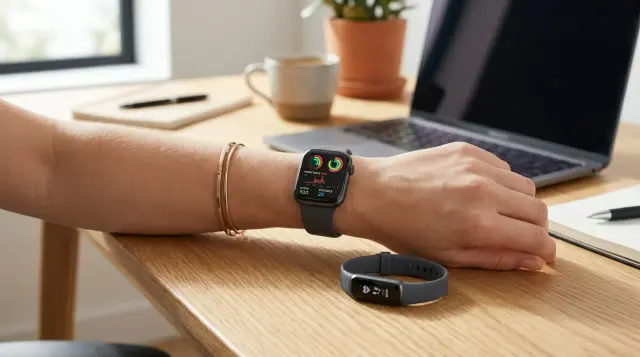
The best wearable isn't the one with the highest spec sheet. It's the one that matches how you actually live, charges when it's convenient, and doesn't introduce more electromagnetic exposure than you're comfortable with.
What's the Real Difference Between a Smartwatch and a Fitness Tracker?
At the simplest level, a fitness tracker is a sensor platform. It counts steps, monitors heart rate, tracks sleep, and maybe buzzes when you get a phone call. That's about it. Think Fitbit Charge 6, Garmin Vivosmart 5, or Xiaomi Smart Band 8. They're slim, light, and designed to disappear on your wrist.
A smartwatch is a miniature computer. The Apple Watch Series 10, Samsung Galaxy Watch 7, and Google Pixel Watch 3 all run full operating systems. They handle apps, reply to messages, stream music, make payments via NFC, and yes, they track fitness too. But fitness is one feature among dozens.
The overlap is where confusion lives. Samsung's Galaxy Watch 8 tracks VO2 max and body composition. Fitbit's Charge 6 has built-in GPS and Google integration. The lines keep blurring, and that's exactly why a how to reduce smartwatch comparison guide matters. You need a framework, not just another feature list.
Quick Q&A
Q: Can a fitness tracker do everything a smartwatch does?
A: No. Fitness trackers lack full app ecosystems, on-device messaging, and NFC payments, but they excel at core health metrics with longer battery life and lower cost.
If you want a deeper side-by-side breakdown, I wrote a full piece on Smartwatch vs Fitness Tracker: An Honest Comparison that gets into the weeds on specific models.
How Accurate Are Health Sensors in Wearables?
This is the question nobody asks until they get a reading that seems off. Your watch says you slept 7.5 hours. You know for a fact you were staring at the ceiling until 2 AM. Or it claims you burned 800 calories on a casual walk. What's going on?
According to a 2022 review published in npj Digital Medicine, optical photoplethysmography (PPG) sensors, those green lights on the back of your wearable, achieve roughly 95% accuracy for resting heart rate [1]. That's genuinely useful. But during high-intensity exercise, accuracy drops because sweat, motion artifacts, and skin tone all mess with the signal. Wrist-based sensors simply can't match a chest strap like the Polar H10 during a hard interval session.
Blood oxygen (SpO2) readings are another area where consumer devices fall short of clinical standards. The FDA has not cleared most smartwatch SpO2 sensors for medical use, and Apple explicitly notes its Blood Oxygen app is "not intended for medical use" [2]. Sleep staging tends to overestimate deep sleep compared to polysomnography, the gold standard used in sleep labs at institutions like the Mayo Clinic.
Does that make wearable health data useless? Not even close. Trends over weeks and months are where wearables shine. A single night's sleep score is noise. Thirty nights of data showing a declining trend? That's a signal worth bringing to your doctor. For a more detailed look at what you can trust and what to take with a grain of salt, check out How Reliable Are Health Wearables?: What to Trust and What to Ignore.
Does Battery Life Really Matter That Much?
Yes. Way more than you think. Battery life is the single biggest day-to-day differentiator between a smartwatch and a fitness band, and it causes the most buyer's remorse. The Apple Watch Series 10 lasts about 18 hours. That means charging every single night. The Samsung Galaxy Watch 7 is similar, roughly 30 to 40 hours with moderate use. Forget your charger on a weekend trip and you've got an expensive bracelet by Saturday afternoon.
Fitness trackers tell a completely different story. They routinely hit 7 to 14 days. The Garmin Vivosmart 5 lasts up to 7 days. The Xiaomi Smart Band 8 can stretch past two weeks. That's a fundamentally different relationship with the device. You charge it on Sundays, forget about it, and it just works.
There's a middle ground worth knowing about: hybrid smartwatches like the Garmin Venu 3, which offers up to 14 days in smartwatch mode with a full AMOLED display, or the Amazfit T-Rex Ultra at up to 20 days. These devices run lighter operating systems, which means fewer apps but dramatically better endurance.
If you care about sleep tracking, battery life matters even more. A watch that dies at midnight isn't tracking anything. I've seen people buy an Apple Watch Ultra specifically because its 36-hour battery means they can actually wear it to bed without stressing about the morning charge. That $799 premium is partly a battery tax.
Which Smartwatch Operating System Should You Choose?
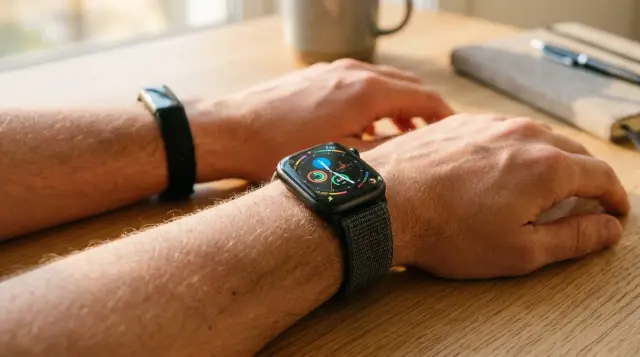
Here's a compatibility trap that catches people every single year: not every smartwatch works with every phone. The Apple Watch only pairs with iPhones. Full stop. If you're on Android, the Apple Watch doesn't exist for you. Meanwhile, Samsung's Galaxy Watch lineup runs Wear OS and works with any Android phone, but Samsung-exclusive features like body composition analysis and ECG only kick in when paired with a Samsung Galaxy phone.
Google's Pixel Watch 3 and Pixel Watch 4 run Wear OS 5 and play nicely with most Android devices, though some features remain Pixel-exclusive. For a broader look at how smart devices work together (or don't), Smart Home: The Beginner's Guide covers the ecosystem question in depth.
Fitness trackers are generally more flexible. Fitbit works with both iOS and Android. Garmin works with both. Xiaomi works with both. If you switch phones often or share a household with mixed platforms, a fitness tracker avoids the lock-in problem entirely.
My recommendation? Before you compare a single spec, confirm your phone's operating system and check the manufacturer's compatibility page. According to a 2023 Counterpoint Research report, roughly 27% of smartwatch returns are driven by compatibility issues the buyer didn't anticipate. That's an expensive lesson you can dodge in two minutes.
How Much Do Smartwatches and Fitness Trackers Actually Cost?
Let's talk real numbers. Entry-level fitness trackers start around $30 to $50. The Xiaomi Smart Band 8 retails for about $35. The Fitbit Inspire 3 sits around $80. The Fitbit Charge 6, which is genuinely excellent, goes for about $140. You can get a very capable wrist-based health tracker for under $100.
Smartwatches are a different world. The Google Pixel Watch 3 starts at $350. The Apple Watch Series 10 starts at $399. The Samsung Galaxy Watch 7 begins at $300. Premium models like the Apple Watch Ultra 3 ($799) and Garmin Fenix 8 ($999) push close to four figures. And that's before you add bands, cases, or charging accessories.
Then there are subscriptions. Fitbit Premium runs $9.99 per month for advanced health insights. Oura Ring (technically a wearable competitor) charges $5.99 per month. Apple and Samsung include most health features without a subscription, but Garmin gates some training plans behind Garmin Connect Plus. When building your smartwatch comparison, factor in the total annual cost. Not just the sticker price.
Quick Q&A
Q: Is a $400 smartwatch really worth 10x the price of a $40 fitness band?
A: Only if you'll use the extras like apps, NFC payments, LTE calls, and voice assistants daily. For pure fitness and sleep tracking, a $40 to $140 band delivers 80% of the value.
Should You Worry About EMF Exposure from Wearables?
This is the section most tech sites skip entirely. I think that's a mistake. Wearable devices, whether smartwatches or fitness bands, emit low-level radiofrequency (RF) electromagnetic radiation. Bluetooth operates at 2.4 GHz. Wi-Fi-enabled watches add another radio. LTE cellular watches add yet another. And these devices sit directly on your skin, sometimes 24 hours a day if you're tracking sleep.
The FCC requires all wearable devices sold in the United States to comply with a specific absorption rate (SAR) limit of 1.6 W/kg averaged over 1 gram of tissue [3]. Most smartwatches fall well below this threshold. But "below the legal limit" and "zero concern" aren't the same thing, especially for people who are sensitive to electromagnetic fields or simply prefer to minimize cumulative exposure.
According to the World Health Organization's International Agency for Research on Cancer (IARC), radiofrequency electromagnetic fields are classified as "possibly carcinogenic to humans" (Group 2B), based primarily on associations observed in studies of heavy cell phone use [4]. Wearables operate at much lower power than phones, but the duration of skin contact is far longer. If you're wearing a Bluetooth-active watch 23 hours a day, that adds up.
So what can you actually do? One practical step is enabling airplane mode on your wearable at night. That cuts Bluetooth and Wi-Fi while still allowing offline sleep tracking on most devices. For daytime, Proteck'd's Faraday Protection Collection offers clothing woven with silver-fiber fabric that shields against RF radiation. Their Men's Faraday Tech Wear line looks like normal streetwear while reducing the electromagnetic radiation your body absorbs from devices. You can learn more about how this shielding works on their EMF Protection Benefits page.
For anyone doing a thorough smartwatch comparison, factoring in EMF exposure is part of the picture. Not as a fear-driven decision, but as an informed one. For a full rundown on wearable categories and what they emit, see our Smart Wearables: The Complete Guide.
What About AI Features in Modern Wearables?
AI is everywhere right now, and wearable manufacturers are racing to bake it in. Samsung's Galaxy Watch 7 and Watch 8 use on-device AI to generate a daily "Energy Score" based on sleep, activity, and heart rate variability. Apple's watchOS 11 introduced adaptive activity rings that use machine learning to adjust daily goals based on your recent trends. Google's Pixel Watch 4 uses Fitbit's AI-driven "Daily Readiness Score" to suggest when to push hard and when to rest.
When they work, these are genuinely useful features. Samsung's sleep coaching AI, developed in partnership with the National Sleep Foundation, adapts its recommendations over weeks as it learns your patterns. Apple's crash detection algorithm, which has been credited with calling emergency services in real car accidents, runs on a combination of accelerometer data and machine learning models trained on over a million hours of driving data.
But AI in wearables also means more data collection. And more data means more privacy questions. Where does your heart rate data live? Who can access your sleep patterns? Samsung Health data syncs to Samsung's cloud. Apple stores HealthKit data in iCloud with end-to-end encryption. Fitbit (now Google) stores data on Google servers. If digital privacy matters to you, Digital Privacy: The Complete Guide is worth reading before you strap on any AI-powered wearable.
The AI in these devices gets smarter with every software update. But smarter algorithms also mean more sensors running, more radios active, and shorter battery life. There's always a trade-off. The how to reduce smartwatch comparison guide question ultimately comes down to which trade-offs you're comfortable making.
How to Actually Decide: A Simple Framework
After all these details, here's the framework I use when someone asks me what wearable to buy. Ask yourself three questions. What's the one thing I want this device to do every day? How long do I need it to last between charges? And how much am I willing to spend per year, including subscriptions?
If your answer is "track my runs and sleep, last a week, and cost under $150," you want a fitness tracker. The Fitbit Charge 6 or Garmin Vivosmart 5 will make you happy. If your answer is "replace my phone for quick tasks, handle notifications, and support my Apple or Samsung ecosystem," you want a smartwatch. Accept the daily charging and pay the premium.
Somewhere in between? The hybrid category is genuinely worth a look. The Garmin Venu 3 gives you a gorgeous AMOLED screen, strong health sensors, and multi-day battery life. It doesn't run Wear OS, so you won't get a full app store, but for most people that's not a real loss.
And if EMF exposure is a concern, factor that into your decision. Choose devices with airplane mode capability, consider shielded apparel from Proteck'd's Faraday Protection Collection, and remember that reducing your wearable's radio activity doesn't mean giving up the data. Many devices sync in batches, so you get the health insights with less continuous RF output.
The best way to reduce smartwatch comparison fatigue is to stop comparing everything and start filtering ruthlessly. Know your category. Know your budget. Know your phone's OS. Everything else is just noise.
- Fitness trackers excel at core health metrics with 7 to 14 day battery life and prices under $150
- Smartwatches offer full app ecosystems and AI features but require daily charging and cost $200 to $800+
- Wearable heart rate sensors are roughly 95% accurate at rest but lose precision during intense exercise
- Always verify OS compatibility before buying. Apple Watch only works with iPhone, and some Samsung features require Galaxy phones
- EMF exposure from wearables is low but constant. Airplane mode at night and Faraday-shielded clothing can reduce cumulative RF absorption
Frequently Asked Questions
A fitness tracker is usually the better starting point. It's simpler, cheaper, and stays focused on the basics like steps, heart rate, and sleep. You won't get buried in app settings and notification controls. The Fitbit Inspire 3 at around $80 is one of the best starter picks.
No. The Apple Watch requires an iPhone to pair and function. There's no workaround for this. If you're on Android, look at Samsung Galaxy Watch, Google Pixel Watch, or Garmin models instead.
Most mainstream smartwatches last 1 to 2 days on a single charge. The Apple Watch Series 10 gets about 18 hours, while the Samsung Galaxy Watch 7 can reach roughly 40 hours with moderate use. Hybrid models like the Garmin Venu 3 can last up to 14 days.
They're accurate enough for tracking trends over time, but not for clinical diagnosis. Resting heart rate accuracy is around 95% according to peer-reviewed research, but SpO2 and sleep staging can vary quite a bit from medical-grade equipment. Always talk to a doctor about actual health concerns.
Yes. Smartwatches emit low-level radiofrequency electromagnetic radiation from Bluetooth, Wi-Fi, and sometimes LTE radios. All devices sold in the U.S. must meet the FCC's SAR limit of 1.6 W/kg. The exposure per device is low, but it's continuous since the watch sits on your skin all day.
The Xiaomi Smart Band 8 at around $35 is the best budget pick. It offers reliable heart rate and sleep tracking, a bright AMOLED display, and battery life exceeding two weeks. For about $80 more, the Fitbit Charge 6 adds GPS and Google integration.
You don't need to power it down completely. Just enable airplane mode at night. That cuts Bluetooth and Wi-Fi emissions while still allowing offline sleep tracking on most devices. It reduces your cumulative RF exposure during the 7 to 8 hours the device is pressed against your skin.
Use airplane mode when you don't need real-time notifications, especially during sleep. Consider Faraday-shielded clothing from brands like Proteck'd that block RF radiation through silver-woven fabrics. You can also choose fitness trackers over smartwatches, since trackers typically only use Bluetooth rather than multiple radios.
Depends on the brand. Fitbit Premium costs $9.99 per month for advanced health insights and workout programs. Garmin and Apple include most features for free. Always check the subscription model before buying, because a "cheap" tracker with a monthly fee can end up costing more over two years than a pricier one with no subscription.
Wear OS is Google's smartwatch platform, used by Samsung, Google, and other Android-compatible watches. watchOS is Apple's proprietary system, exclusive to Apple Watch and iPhone users. They don't cross over. Your phone's operating system determines which platform you can use.
References
- npj Digital Medicine (Nature) – Consumer wrist-worn optical heart rate monitors using PPG sensors achieve approximately 95% accuracy for resting heart rate but lose precision during high-intensity exercise.
- U.S. Food and Drug Administration (FDA) – Most consumer smartwatch SpO2 sensors have not been cleared by the FDA for medical use and should not be relied upon for clinical decisions.
- Federal Communications Commission (FCC) via National Institutes of Health – The FCC limits specific absorption rate (SAR) for devices used near or on the body to 1.6 W/kg averaged over 1 gram of tissue.
- International Agency for Research on Cancer (IARC), World Health Organization – IARC classified radiofrequency electromagnetic fields as possibly carcinogenic to humans (Group 2B) based on evidence from studies of heavy cell phone use.
About the Author
Proteck'd EMF Apparel
Health & EMF Specialists
The Proteck'd team covers EMF protection, silver-fiber apparel, and practical ways to reduce everyday radiation exposure. Every piece Proteck'd ships is designed, tested, and worn by the people who build it.
Get the Free EMF Home Audit Checklist
A room-by-room PDF that walks you through the biggest EMF sources in your house and what to do about each one. No cost, no fluff.
Download the Checklist →✓30-day returns✓Free shipping✓Free returns✓Silver fiber shielding


