


The Best Smart Home Devices: Ranked and Reviewed

Here's a number that stopped me cold: the average American household now runs 21 connected devices. Twenty-one. That's everything from the voice assistant on your kitchen counter to the robot vacuum bumbling around your living room. With that many gadgets fighting for your Wi-Fi bandwidth and your wallet, it's fair to ask what does best smart home devices mean in a market this crowded.
The honest answer? "Best" doesn't just mean "most features" or "highest Amazon rating." It means a device that works reliably day after day, plays nicely with the rest of your setup, keeps your data reasonably safe, and actually solves a real problem in your life. A $300 smart lock that freezes every third Tuesday isn't the best anything.
I spent weeks reviewing lab tests from Consumer Reports, hands-on evaluations from PCMag, and expert roundups from Forbes to build this ranked guide. But I also added something those outlets tend to skip: the EMF and privacy angle. Because when you're filling your home with wireless transmitters, your health and digital security deserve a seat at the table too.
So whether you're just getting started with home automation systems or you're upgrading a connected home that's grown into a tangled mess, this guide will help you cut through the noise. Let's get into it.
Key Takeaways
What Does 'Best Smart Home Devices' Actually Mean in 2026?
When someone searches what does best smart home devices mean, they're usually not looking for a dictionary definition. They want to know which products are worth their money and which ones will end up collecting dust in a junk drawer. That's a practical question. It deserves a practical answer.
In 2026, "best" comes down to five measurable factors: reliability, ecosystem compatibility, security, energy efficiency, and genuine usefulness. The Matter 1.4 standard, released in late 2025 by the Connectivity Standards Alliance, now covers over 30 device categories with cross-platform interoperability. Translation? Your Google Nest thermostat can finally talk to your Apple HomeKit setup without a third-party hack. That's a big deal, because ecosystem lock-in used to be one of the biggest headaches in the home IoT devices world.
But compatibility is just the starting line. A 2023 Pew Research Center survey found that 57% of U.S. adults use at least one smart home device, yet satisfaction varies wildly by category [1]. Smart speakers score high on daily use. Smart kitchen gadgets? Most people abandon them within six months. The best connected home technology is the stuff you actually keep using.
Quick Q&A
Q: What's the single most important factor in choosing a smart home device?
A: Ecosystem compatibility, because even the best gadget is useless if it can't communicate with the rest of your connected home setup.
I also think "best" should include how a device handles your personal data. If you haven't already, check out our Digital Security: The Complete Guide for a deeper look at what these devices are actually doing with your information behind the scenes.
Which Smart Speakers Are Actually Worth Buying?
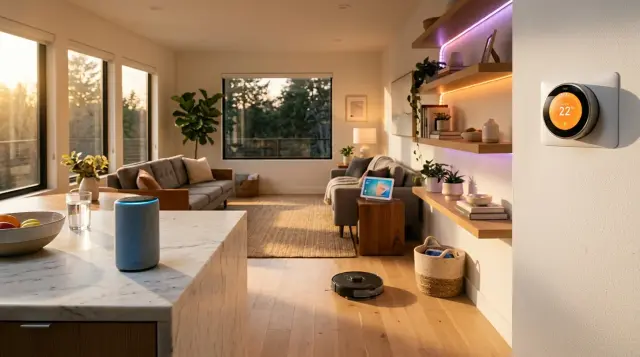
Smart speakers are the gateway drug of home automation. You buy one to set timers and play music. Six months later you're automating your entire morning routine. The category is dominated by three players in 2026: Amazon Echo, Google Nest, and Apple HomePod.
The Amazon Echo Hub (4th Gen) is the frontrunner for most people. It doubles as a smart home hub with a built-in Zigbee and Matter controller, letting you manage lights, locks, and cameras from a single touchscreen. PCMag gave it an Editors' Choice award, praising the 8-inch display and the improved Alexa LLM that rolled out in early 2026. For Apple households, the HomePod (2nd Gen) delivers noticeably better audio quality, but it's locked into the HomeKit ecosystem, which still supports fewer devices than Alexa or Google Home.
The Google Nest Hub Max remains a strong choice if you're invested in Google's world. Its camera doubles as a Nest security cam, which is clever multitasking. But here's the thing people forget: every one of these speakers is a microphone that's always listening for a wake word. That means constant low-level wireless transmission.
If that makes you uneasy, you're not alone. The WHO's International EMF Project has recommended that individuals minimize unnecessary radiofrequency exposure from household devices [2]. For folks looking to balance convenience with EMF awareness, Proteck'd's Faraday Protection Collection offers wearable shielding that can reduce your personal RF exposure even in a wireless-heavy home.
Do Smart Thermostats Really Save You Money?
Yes. And it's not even close.
The Ecobee Premium and Google Nest Learning Thermostat are the two standout models in 2026, and both have independent data backing their energy savings claims. According to a 2023 study published by the American Council for an Energy-Efficient Economy (ACEEE), smart thermostats reduce heating and cooling costs by 8% to 15% on average compared to manual thermostats. The Ecobee Premium takes this further with its built-in air quality monitor and Siri/Alexa integration. Google's Nest Learning Thermostat (4th Gen), released in late 2025, uses on-device machine learning to adapt to your schedule within a week. In my experience, the Nest is better for "set it and forget it" users, while the Ecobee appeals to people who want granular control and room-by-room sensors.
Here's a concrete example. A friend of mine in Austin, Texas switched from a basic programmable thermostat to the Ecobee Premium last summer. His electricity bill dropped $38 per month during peak cooling season, which means the $249 device paid for itself in about seven months. That's not a marketing claim. That's one guy's actual utility bill.
Smart thermostats are one of the few connected home technology categories where the ROI is obvious and measurable. If you're only going to buy one smart home device, make it this one.
The best smart home device isn't the one with the most features or the flashiest design. It's the one that works so reliably you forget it's there, keeps your data safe, and doesn't turn your home into an RF hotbox in the process.

Are Smart Doorbells and Security Cameras Worth the Privacy Tradeoff?
This is where things get interesting. And a little uncomfortable.
Video doorbells and home security cameras are among the fastest-growing smart home categories. The Google Nest Doorbell (wired, 2nd Gen) and Ring Video Doorbell 4 are the top picks in most 2026 reviews, including Consumer Reports' lab-tested rankings. The Nest Doorbell excels with on-device AI processing, meaning it can tell the difference between a person, a package, and a raccoon without sending video to the cloud. Ring, owned by Amazon, has improved its encryption since a series of privacy controversies in 2022 and 2023, but it still requires a Ring Protect subscription ($4.99/month) for video history. For standalone security cameras, the Arlo Pro 5S and the Eufy SoloCam S340 lead the pack. Eufy's advantage is fully local storage with no mandatory cloud subscription.
Now let's talk about the elephant in the room. These devices collect enormous amounts of data, including video of everyone who approaches your home. A 2024 investigation by the Electronic Frontier Foundation found that several major doorbell brands shared metadata with third-party advertisers. If you value digital privacy, our guide on Taking Back Your Online Life is worth reading alongside any smart camera purchase.
From an EMF standpoint, these wireless home security gadgets add another layer of constant RF transmission in and around your home. One more reason to think about shielding, especially if your doorbell camera sits inches from where your family gathers. Proteck'd's Men's Faraday Tech Wear is designed precisely for people who live surrounded by connected devices but want to limit their personal RF exposure.
What Are the Best Smart Locks and Do They Actually Keep You Safe?
Smart locks are the category where people's anxiety runs highest. "What if it gets hacked?" "What if the battery dies and I'm locked out?" Fair questions. Let's address them.
The August Wi-Fi Smart Lock (4th Gen) is the top pick across Forbes, PCMag, and Consumer Reports for 2026. It retrofits over your existing deadbolt, so you keep your physical keys as a backup. The Yale Assure Lock 2 is the runner-up, offering a sleek design and Matter compatibility out of the box. Both support auto-lock, auto-unlock based on geofencing, and temporary guest codes. Genuinely useful if you rent your place on Airbnb or have a dog walker.
On security: modern smart locks use AES-128 or AES-256 encryption, the same standard banks use. The realistic risk isn't some hacker picking your Bluetooth lock from across the street. It's someone stealing the phone that controls it. Use a strong PIN, enable two-factor authentication, and you're far safer than with a traditional lock that can be bumped open in seconds with a $10 tool from YouTube.
Quick Q&A
Q: Can a smart lock be hacked remotely?
A: While theoretically possible, modern smart locks with AES-256 encryption and two-factor authentication are significantly harder to breach than traditional pin-tumbler locks, which can be physically bypassed with basic tools.
Battery life is the other big concern. The August Wi-Fi Smart Lock runs on CR123 batteries and lasts roughly six months with average use. It sends low-battery alerts to your phone weeks before dying. I've never heard of someone actually getting locked out because of a dead smart lock battery, though the fear keeps plenty of people from buying one.
How Do Robotic Vacuums Compare in 2026?
Robotic vacuums have come a ridiculously long way since the original Roomba bumped into walls like a confused beetle. The 2026 lineup is genuinely impressive, and two models sit clearly above the rest.
The iRobot Roomba j9+ and the Roborock S8 MaxV Ultra are the top-tier picks. Consumer Reports' lab testing gave the Roomba j9+ its highest score ever for a robotic vacuum, praising its object avoidance (it won't eat your shoelaces anymore) and a self-emptying dock that holds 60 days of debris. The Roborock S8 MaxV Ultra is the better choice if you want mopping and vacuuming in one device. Its VibraRise 3.0 mopping system lifts the mop pad when it detects carpet. Small detail, huge practical difference.
Budget picks exist too. The Eufy X10 Pro Omni delivers about 80% of the Roborock's performance at roughly 60% of the price, making it the best value in smart home automation systems for floor care. According to Deloitte's 2025 Digital Consumer Trends report, robotic vacuums now have a 22% household penetration rate in the U.S., up from just 14% in 2022.
One thing to keep in mind: these devices map your home's layout and, depending on the brand, may upload that floor plan to the cloud. iRobot has committed to not selling home mapping data, but not every manufacturer has made that same promise. If you want to understand the broader picture of digital privacy in a connected home, our Best Smart Home Devices: What Actually Works companion piece covers this in more detail.
Should You Worry About EMF Exposure From Smart Home Devices?
Here's the section most smart home guides completely skip, and I think that's a mistake. When you ask what does best smart home devices mean, safety should be part of the conversation. Every Wi-Fi router, smart speaker, video doorbell, and connected light bulb emits radiofrequency electromagnetic radiation. Individually, the levels are low. But add them all up? In a home with 21 connected devices, you're living inside a web of constant wireless signals.
The World Health Organization classifies radiofrequency electromagnetic fields as "possibly carcinogenic to humans" (Group 2B), based on the International Agency for Research on Cancer's evaluation in 2011 [2]. That's the same classification as pickled vegetables and talc-based body powder, so context matters. But the WHO also explicitly recommends taking practical steps to reduce exposure where possible, especially for devices that transmit continuously.
What does that look like in practice? Simple things. Place your Wi-Fi router in a central location away from bedrooms. Choose wired connections where feasible. Turn off smart devices overnight. You don't have to go off the grid. For people who want an extra layer of protection, Proteck'd specializes in EMF-shielding apparel. You can learn more about the science behind their products on the EMF Protection Benefits page, and browse the Faraday Protection Collection for wearable options that fit into everyday life.
We've also written about how wearable tech interacts with your body in The Best Health Wearables: What's Actually Worth Buying and How Reliable Are Smartwatches: What the Research Shows. If you're building out a connected home, it's worth understanding what all those wireless signals mean for your wellbeing, not just your convenience.
How Do You Choose the Right Smart Home Ecosystem?
This might be the most consequential decision you make, and most people stumble into it by accident. You buy an Echo Dot because it's on sale for $22 on Prime Day, and suddenly you're locked into Amazon's Alexa ecosystem for the next five years. Sound familiar?
In 2026, you've got four primary ecosystems: Amazon Alexa, Google Home, Apple HomeKit, and Samsung SmartThings. Alexa has the largest device library by far, with over 300,000 compatible products. Google Home integrates best with Android phones and Google services. Apple HomeKit is the most privacy-focused option, processing most commands on-device, but it supports the fewest third-party gadgets. Samsung SmartThings is strong if you already own Samsung appliances.
The Matter protocol has helped bridge these walled gardens significantly. Devices certified for Matter work across all four platforms, so you're less likely to get stuck. My advice? Pick your ecosystem based on which phone you carry and which voice assistant you prefer, then buy Matter-compatible devices whenever possible. This gives you the flexibility to switch later without replacing everything.
And whatever ecosystem you choose, don't forget the security layer. Every smart home hub is a potential entry point for bad actors. Use unique passwords, enable two-factor authentication on every account, and segment your IoT devices onto a separate Wi-Fi network if your router supports it. Our Digital Security: The Complete Guide walks through this setup step by step.
Frequently Asked Questions
Q: What does best smart home devices mean?
It means the connected home products that deliver the strongest combination of reliability, ecosystem compatibility, security, and real-world usefulness. A device doesn't qualify as "best" just because it has the most features. It has to work consistently, integrate with your existing setup, and genuinely make your daily routine better.
Q: Which smart home ecosystem should I choose in 2026?
Go with what matches the phone and voice assistant you already use. Amazon Alexa has the largest device library (300,000+ compatible products), Google Home integrates best with Android, and Apple HomeKit offers the strongest privacy protections. Buying Matter-compatible devices reduces lock-in no matter which platform you pick.
Q: Do smart thermostats actually save money on energy bills?
They do. According to the American Council for an Energy-Efficient Economy, smart thermostats cut heating and cooling costs by 8% to 15% on average. Most models pay for themselves within 6 to 12 months depending on your climate and usage patterns.
Q: Are smart locks safe from hackers?
Modern smart locks using AES-128 or AES-256 encryption are extremely difficult to hack remotely. The bigger real-world risk is someone stealing the phone that controls the lock. Enable two-factor authentication and use a strong PIN. Traditional pin-tumbler locks are actually easier to bypass with cheap physical tools.
Q: Do smart home devices emit harmful EMF radiation?
Each individual device emits low levels of radiofrequency electromagnetic radiation. The WHO's International Agency for Research on Cancer classifies RF fields as "possibly carcinogenic" (Group 2B) and recommends minimizing unnecessary exposure. In homes with 20+ connected devices, cumulative exposure is worth thinking about, and wearable EMF shielding can help.
Q: What is the Matter protocol and why does it matter for smart homes?
Matter is an open-source connectivity standard that lets devices from different brands work together across Alexa, Google Home, Apple HomeKit, and Samsung SmartThings. Version 1.4, released in late 2025, supports over 30 device categories. It effectively eliminates the old frustration of buying a device that only works with one platform.
Q: Which robotic vacuum is the best value in 2026?
The Eufy X10 Pro Omni offers about 80% of the performance of the top-tier Roborock S8 MaxV Ultra at roughly 60% of the price. It handles both vacuuming and mopping, includes a self-emptying station, and uses LiDAR navigation. For most homes, it's more than enough.
Q: Can smart home devices compromise my privacy?
Yes. Smart speakers are always listening for wake words, doorbell cameras record everyone who approaches your home, and robotic vacuums map your floor plan. Some brands share metadata with third-party advertisers. Choose devices with local processing and on-device storage when possible, and read the privacy policy before you buy.
Q: How many smart home devices does the average household have?
According to Deloitte's 2025 Digital Consumer Trends report, the average U.S. smart home contains 21 connected devices. That includes everything from smart speakers and thermostats to connected light bulbs and streaming sticks. The number has been climbing by about 3 to 4 devices per year.
Q: What's the best smart home device to buy first?
A smart thermostat. It's the one category where the return on investment is immediate and measurable. You'll see lower energy bills within the first month, and the device pays for itself within a year. Smart speakers are a close second because they serve as a control hub for everything you add later.
Q: How can I reduce EMF exposure in my smart home?
Place your Wi-Fi router away from bedrooms, use wired Ethernet connections where practical, and power off smart devices overnight. Wearable EMF shielding, like Faraday fabric clothing from Proteck'd, can also reduce personal RF exposure during the day. You don't need to ditch smart devices entirely. Just be intentional about placement and usage.
References
- World Health Organization – International EMF Project – The WHO classifies radiofrequency electromagnetic fields as possibly carcinogenic to humans (Group 2B) and recommends minimizing unnecessary RF exposure from household wireless devices
- IARC / WHO – Monograph on RF-EMF – The International Agency for Research on Cancer classified radiofrequency electromagnetic fields as Group 2B (possibly carcinogenic to humans) in 2011
About the Author
Proteck'd EMF Apparel
Health & EMF Specialists
The Proteck'd team covers EMF protection, silver-fiber apparel, and practical ways to reduce everyday radiation exposure. Every piece Proteck'd ships is designed, tested, and worn by the people who build it.
Protect Yourself Today
Proteck'd Faraday and silver fiber apparel is engineered to shield your body from everyday EMF exposure. Built for real life, tested for real results.
Shop EMF Protection →✓30-day returns✓Free shipping✓Free returns✓Silver fiber shielding


