


How to Dress for Your Body Type: The Honest Guide

Here's something nobody tells you in a fitting room: the problem usually isn't your body. It's the clothes. Most menswear is cut for a single generic silhouette that doesn't exist in real life. When something doesn't sit right on your frame, the instinct is to blame yourself rather than the pattern maker who never considered your proportions. I've spent years writing about men's clothing affiliate programs and menswear partnerships, and the biggest revelation isn't some secret brand. It's understanding that fit is a science, not a lottery.
Think about the last time you tried on a blazer. Did the shoulders hit right but the midsection billow? Or did the waist fit perfectly while the chest strangled you? That's not bad luck. That's a mismatch between your body type and the garment's intended silhouette. Once you figure out which category your frame falls into, shopping stops being a guessing game and starts feeling like a targeted mission.
This guide is the honest version. No fluff about "embracing your inner confidence" without giving you something concrete. We're going to break down the five most common male body types, the specific cuts and styles that work for each, and how the explosion of men's fashion affiliate partnerships has actually made it easier than ever to find brands that cater to real bodies.
Whether you're built like a linebacker, a distance runner, or somewhere in between, there's a strategy here for you. Let's get into it.
Key Takeaways
What Are the Five Main Male Body Types?
Before you can dress well, you need to know what you're working with. The most widely used framework breaks male bodies into five categories: ectomorph (lean and long), mesomorph (naturally muscular), endomorph (rounder and broader), trapezoid (wide shoulders tapering to narrow hips), and rectangle (shoulders and hips roughly the same width). These categories come from William Sheldon's somatotype theory, developed at Harvard in the 1940s. The science has been updated considerably since then, but the basic shape classifications still hold up as a practical starting point [1].
You don't need to fit neatly into one box. Most guys are a blend. Maybe you've got mesomorph shoulders with an endomorph midsection, or ectomorph limbs on a rectangular torso. That's normal. The goal isn't to label yourself. It's to identify your dominant proportions so you can make smarter choices in the fitting room.
A quick way to figure out your type: stand in front of a mirror in fitted underwear and compare three things. Your shoulder width relative to your hips. Your torso length relative to your legs. And where you naturally carry weight. According to the Harvard T.H. Chan School of Public Health, your waist-to-hip ratio is one of the most reliable indicators of your overall shape, and it takes about ten seconds to measure [2].
Quick Q&A
Q: How do I measure my waist-to-hip ratio at home?
A: Measure your waist at the narrowest point (usually just above the navel), then your hips at the widest point, and divide waist by hips. A ratio above 0.90 for men typically indicates an apple-shaped build.
Once you've got a rough sense of your proportions, the next step is understanding what each body type needs from clothing. Really, it's about creating visual balance. A well-dressed person doesn't necessarily have perfect proportions. They just know how to use fabric, cut, and color to create the illusion of them.
How Should Slim or Lean Men Dress to Add Visual Weight?
If you're on the leaner side, an ectomorph or slim rectangle, your biggest challenge is clothes that hang off you like a tent. Standard US men's sizing is built around a 5'10" frame with roughly a 6-inch "drop" between chest and waist measurements. If your drop is smaller or your limbs are longer than average, off-the-rack shirts will billow at the sides and pants will break awkwardly at the ankle.
The fix isn't buying tighter clothes. It's buying structured clothes. Look for blazers with a defined shoulder, heavier fabrics like Oxford cloth and flannel that add dimension, and horizontal visual elements like Breton stripes or patterned knits. Layering is your best friend. I've written about that in detail in our guide on How To Layer Clothing Without Looking Bulky. A slim guy in a well-fitted henley under an unstructured blazer looks completely different from the same guy drowning in an oversized crew neck.
Brands like Bonobos and Todd Snyder have built entire sub-lines around slim and tailored fits, and both run popular men's clothing affiliate programs that bloggers and style creators regularly promote. Through these menswear referral programs, you'll often find exclusive discount codes that make the tailored-fit options more accessible. The Men's Proteck'd Collection also offers fitted options in innovative fabrics that drape well on leaner frames without looking like you borrowed someone else's shirt.
One concrete example: a slim 6'1" friend of mine switched from medium tees to small tall tees from a direct-to-consumer brand he found through a men's fashion affiliate link on Instagram. Same general size, completely different silhouette. The shirt actually followed the line of his torso instead of creating a boxy shape. Small change. Massive visual impact.
What Fits Work Best for Muscular or Athletic Builds?
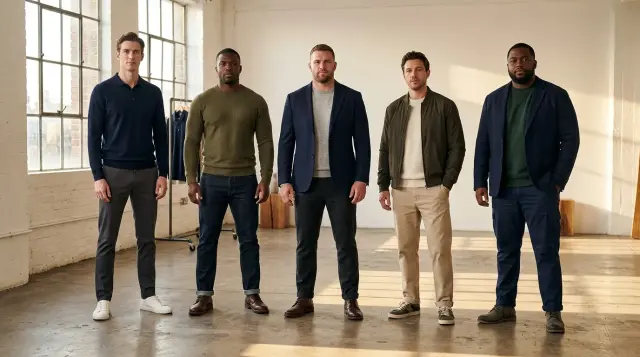
If you've got a mesomorph or trapezoid build, congratulations. You've won the genetic lottery in terms of how most clothes are designed. But that doesn't mean everything fits. In fact, the more muscular you are, the harder it gets. Standard shirts strain across the chest and biceps while gaping at the waist. Pants that fit your thighs are huge at the calves. It's a specific kind of frustrating.
The key for athletic builds is stretch fabrics and athletic cuts. Brands like Barbell Apparel (which grew out of a 2014 Kickstarter campaign raising over $735,000) specifically design for lifters with larger quads and glutes. Their jeans have a higher rise and more room through the thigh without looking baggy. That kind of targeted design used to be hard to find, but men's clothing affiliate programs have changed things dramatically by giving niche brands wider distribution through content creators and fitness bloggers.
For your upper body, look for shirts labeled "athletic fit" or "muscle fit." These typically have a wider chest, slightly tapered waist, and shorter sleeve length to sit at the bicep rather than past it. V-necks and henleys work better than crew necks because they elongate the neck and break up the visual mass of a broad chest. The Faraday Fashion Collection from Proteck'd uses performance-oriented fabrics with enough give to accommodate bigger arms and shoulders while maintaining a clean silhouette.
Avoid anything too tight. I know the temptation. But a shirt stretched to its limit across your pecs doesn't look muscular. It looks like you're wearing the wrong size. You want the fabric to follow your body, not cling to it for dear life. There's a real difference.
The best-dressed guys you know probably aren't buying more expensive clothes. They're getting them altered, choosing fabrics that move with their body, and treating fit as a system rather than a lucky guess.
How Do You Dress Well with a Bigger Midsection?
Let's be real about this one. Most style guides either skip the endomorph body type entirely or handle it with condescending euphemisms. Here's the honest truth: if you carry weight through your midsection, hips, or chest, there are specific things that will make you look sharper, and specific things that will work against you. None of it has to do with hiding or being ashamed. It's geometry.
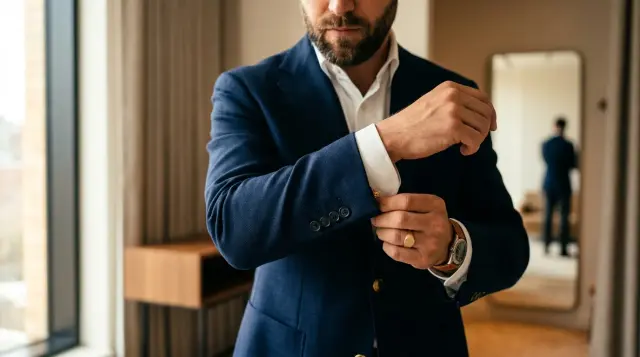
First, avoid extremes. Super baggy clothes don't conceal anything. They just make you look bigger and shapeless. Super tight clothes create tension lines across your stomach that draw the eye exactly where you don't want it. The sweet spot is structured, well-fitted pieces that skim the body. A sport coat or blazer is genuinely the single best garment for this body type because it creates a defined shoulder line and drapes over the midsection without clinging to it.
Dark, monochromatic outfits create a continuous vertical line that's inherently slimming. A navy V-neck sweater over dark jeans and brown boots is a dead-simple formula that works every time. For a deeper look at strategies for larger builds, check out Plus-Size Fashion: What Nobody Tells You, which covers brand recommendations and fit hacks that most guides leave out.
Brands like DXL and Bonobos Extended Sizes have made huge strides in offering proportional sizing for bigger guys, not just scaling up a standard pattern but actually redesigning the cut. According to NPD Group data from 2022, the extended-size menswear segment grew 20% faster than standard sizing, and men's fashion affiliate partnerships have played a role in getting those brands in front of the right audience. When a fitness-positive content creator links to an extended-size brand through a referral program, it normalizes shopping for your actual body instead of an aspirational one.
Quick Q&A
Q: Should bigger guys avoid horizontal stripes?
A: Not necessarily. A 2012 study published by Peter Thompson at the University of York actually found that horizontal stripes can create a slimming illusion depending on spacing and garment fit. The old rule isn't as simple as people think.
Why Does Fabric Choice Matter as Much as Fit?
Most body type guides focus entirely on cut and silhouette, but fabric is half the equation. A slim-fit shirt in stiff, cheap cotton will bunch and pull in ways that a slim-fit shirt in a cotton-modal blend simply won't. The drape of a fabric, meaning how it falls and moves with your body, determines whether a garment looks tailored or tortured.
Heavier fabrics like denim, flannel, and twill add structure and visual weight, which is great for thinner guys. Lighter fabrics like linen, chambray, and jersey knit are more forgiving on larger frames because they don't create rigid tension lines. Performance fabrics with 2% to 5% elastane or spandex are a revelation for athletic builds because they accommodate movement without distorting the cut.
This is where sustainable and tech-forward brands are doing interesting work. The Women's Proteck'd Collection and the men's line both use EMF-shielding fabrics that happen to have excellent drape properties, which is a nice bonus when you're trying to find clothes that look as good as they perform. If you're curious about the broader sustainability angle, our Green Clothing: The Complete Beginner's Guide breaks down what "eco-friendly" actually means in menswear.
A quick real-world test: grab a fistful of fabric on a garment and release it. If it springs back to smooth within a few seconds, it's got good recovery and will look cleaner on your body throughout the day. If it stays wrinkled and crumpled, it's going to show every fold and crease by lunchtime. That matters way more than the brand name on the tag.
How Can Men's Clothing Affiliate Programs Help You Discover Better-Fitting Brands?
Here's where this guide takes a different turn from the usual body-type article. The rise of men's clothing affiliate programs has fundamentally changed how regular guys find brands that actually fit their body type. Ten years ago, your options were whatever the local mall carried. Today, a style blogger or YouTube creator can link you directly to a niche brand specializing in your exact build and earn a commission for the referral. It works out well for everyone involved.
The top menswear affiliate programs, including Mr Porter (5% to 6% commission), ASOS (up to 7%), and Todd Snyder (8% to 10%), give content creators an incentive to provide genuinely useful fit advice because their income depends on you actually buying and keeping the clothes. A creator who steers you toward ill-fitting garments loses return-adjusted commission and audience trust at the same time. It's a self-correcting system, at least with the honest creators.
Smaller brands like Proteck'd also run affiliate partnerships that allow style-focused writers and influencers to recommend purpose-driven clothing, think EMF-shielding performance wear and sustainably produced basics, to audiences who wouldn't have found them through traditional advertising. The Men's Proteck'd Collection is a perfect example of a brand that benefits from affiliate-driven discovery because its technology story requires explanation that a banner ad simply can't deliver.
If you're a content creator reading this, the men's fashion affiliate space is worth exploring. According to Statista, the global affiliate marketing industry was valued at $17 billion in 2023 and is projected to reach $27.8 billion by 2027. Menswear is one of the fastest-growing verticals within that space because the content, especially fit guides and body-type advice, converts remarkably well.
What Are the Universal Fit Rules Every Man Should Know?
Regardless of your body type, some rules are universal. Your shoulder seam should hit at the edge of your shoulder bone, not drooping down your arm or riding up toward your neck. Your shirt collar should allow one finger between fabric and skin. And your pants should break only once at the ankle. No pooling, no stacking.
The "one finger" rule is a classic from Savile Row tailoring tradition, dating back to the early 20th century. If you can slide one finger between the buttoned collar and your neck, the fit is right. Two fingers means it's too loose and will gap. Zero fingers means it's too tight and will pull. This single test eliminates about 60% of off-the-rack dress shirts for most men, which tells you a lot about how poorly standardized sizing really is.
Accessories also play a role in visual proportioning. A well-chosen watch, belt, or hat can redirect the eye and add structure to an outfit. For a deeper breakdown, check out Accessories 101: The Rules, which covers how to match accessories to your frame without overdoing it.
And here's the most underrated fit hack I know: get a tailor. A $15 hem or $25 waist adjustment can make a $50 pair of pants look like a $200 pair. According to a 2019 survey by the Custom Tailors and Designers Association of America, men who use tailoring services report 40% higher satisfaction with their wardrobe than those who wear clothes entirely off the rack. The best-dressed guys you know probably aren't buying more expensive clothes. They're just getting them altered.
Does Your Body Type Change Over Time, and How Should Your Wardrobe Adapt?
Short answer: yes. Your body at 25 is not your body at 40. Metabolism shifts, muscle mass changes, weight redistributes. A 2020 study published in The BMJ found that men gain an average of 1.1 kg per year between ages 25 and 45 [3]. That's roughly 22 kilograms over two decades. Your wardrobe needs to evolve with those changes, not pretend they aren't happening.
The smartest approach is to invest in versatile, adjustable staples rather than trend pieces in precise sizing. Drawstring waist pants, stretch-blend chinos, unstructured blazers, and knit polos all accommodate moderate fluctuations without looking sloppy. Building a wardrobe around "stretch-tolerant" basics means you won't need to replace everything every time your weight shifts by five pounds.
This is also where the affiliate-driven direct-to-consumer model shines. Brands discovered through men's fashion affiliate partnerships, especially those with flexible sizing or custom-fit options like MTailor (which uses phone-camera body scanning), make it easy to update your wardrobe as your body changes without starting from scratch. The whole point of dressing for your body type isn't achieving a single perfect outfit. It's developing a system that works as you evolve.
So don't treat this guide as a one-time exercise. Revisit your proportions every year or two. Try new cuts when your lifestyle changes. Stay curious about emerging brands. Your style should grow with you. That's the whole point.
Frequently Asked Questions
Q: What is the easiest way to determine my body type at home?
Stand in front of a full-length mirror in fitted underwear and compare your shoulder width to your hip width. Then measure your waist-to-hip ratio with a tape measure. If your shoulders are significantly wider than your hips, you're likely a trapezoid or mesomorph. If they're roughly equal, you're a rectangle. Those two data points cover about 80% of the classification.
Q: Do men's clothing affiliate programs offer real discounts or just track commissions?
Most do both. Many men's clothing affiliate programs provide exclusive discount codes, typically 10% to 20% off, that creators share with their audiences. The creator earns a commission and you get a genuine discount. Programs from brands like ASOS, Todd Snyder, and Mr Porter regularly offer these co-branded deals.
Q: Should tall, thin men avoid slim-fit clothing?
Not at all, but there's a caveat. Slim-fit works well on lean frames as long as the garment has enough structure. Avoid ultra-skinny cuts that make long limbs look even longer. Instead, go for slim-straight fits in heavier fabrics like Oxford cloth or flannel, which add visual weight without looking baggy.
Q: What's the single best clothing item for bigger guys?
An unstructured blazer or sport coat. It creates a defined shoulder line, drapes over the midsection without clinging, and instantly makes any outfit look more intentional. Choose one in a dark solid color, navy or charcoal, and make sure the shoulders fit perfectly. Everything else can be tailored.
Q: How much does basic tailoring cost?
Basic alterations are surprisingly affordable. Hemming pants typically costs $10 to $15. Taking in a shirt at the waist runs $15 to $25. Shortening sleeves on a jacket costs $20 to $40. According to the Custom Tailors and Designers Association, even simple alterations dramatically improve how off-the-rack clothing looks and feels.
Q: Are body type categories scientifically accurate?
They're a useful simplification, not a medical classification. William Sheldon's original somatotype system from the 1940s has been widely criticized for its methodology, but the basic shape categories (lean, muscular, round) remain practical for clothing purposes. Think of them as a starting framework, not a rigid diagnosis.
Q: Can the right fabric make cheap clothes look expensive?
Absolutely. A $30 shirt in a cotton-modal blend with good drape can look better than a $100 shirt in stiff, low-quality cotton. The key indicators of fabric quality are drape (how it falls), recovery (whether it bounces back from wrinkles), and weight (heavier generally reads more expensive). Always feel the fabric before you buy.
Q: How do men's fashion affiliate partnerships differ from regular advertising?
Traditional ads pay for impressions regardless of whether anyone buys. Affiliate partnerships only pay the creator when a sale actually happens, which means creators are incentivized to recommend products that people genuinely like and keep. This performance-based model tends to produce more honest recommendations than standard display advertising.
Q: What percentage of men wear the wrong size clothing?
Research varies, but a widely cited 2019 Mintel study found that approximately 46% of men in the US reported difficulty finding clothes that fit properly. The issue is worse for men at the extremes of the size spectrum, both very slim and plus-size, because standard sizing caters to a narrow middle range.
Q: Is it worth investing in EMF-shielding clothing if I work near electronics all day?
It depends on your exposure level and personal priorities. Brands like Proteck'd integrate EMF-shielding silver and copper fibers into everyday clothing like t-shirts and hoodies, so you're not sacrificing style for function. If you spend 8+ hours daily near screens, routers, and devices, it's a reasonable investment that also happens to produce well-fitting garments with excellent fabric properties.
References
- Harvard T.H. Chan School of Public Health – Waist-to-hip ratio is one of the most reliable indicators of body shape and a predictor of health outcomes related to body composition.
- Harvard University Department of Psychology (Sheldon's somatotype research origin) – William Sheldon developed the somatotype classification system at Harvard in the 1940s, categorizing body types into ectomorph, mesomorph, and endomorph.
- The BMJ (British Medical Journal) – Men gain an average of approximately 1.1 kg per year between ages 25 and 45, contributing to significant body composition changes over two decades.
About the Author
Proteck'd EMF Apparel
Health & EMF Specialists
The Proteck'd team covers EMF protection, silver-fiber apparel, and practical ways to reduce everyday radiation exposure. Every piece Proteck'd ships is designed, tested, and worn by the people who build it.
Get the Free EMF Home Audit Checklist
A room-by-room PDF that walks you through the biggest EMF sources in your house and what to do about each one. No cost, no fluff.
Download the Checklist →✓30-day returns✓Free shipping✓Free returns✓Silver fiber shielding


Leave a comment