


Mindfulness: The Beginner's Guide

Here's something that might surprise you: your brain physically changes shape when you practice paying attention on purpose. Not after years of monastic silence. After about eight weeks. A 2011 study from Massachusetts General Hospital found measurable increases in gray matter density in brain regions linked to memory, learning, and emotional regulation after just an eight-week meditation program [1]. That's not guru wisdom. That's an MRI scanner.
So why write another mindfulness meditation guide when thousands already exist? Because most of them either water the practice down to a couple of breathing tips or bury you under so much philosophy that you never actually sit down and try it. I wanted something in between. Something honest about what mindfulness is, what it isn't, and how to actually do it when your brain won't shut up.
And let me say this right up front: your brain won't shut up. That's not the goal. The goal is to notice the chatter and gently come back to the present moment. That's the whole practice. It sounds almost too simple, which is exactly why most people assume they're doing it wrong.
Whether you're here because you're stressed, you can't sleep, or you just feel like life is moving too fast to actually experience it, this guide is built for you. We'll cover the brain science, walk through beginner meditation techniques step by step, and explore ways to weave present-moment awareness into the parts of your day you're already living. No incense required.
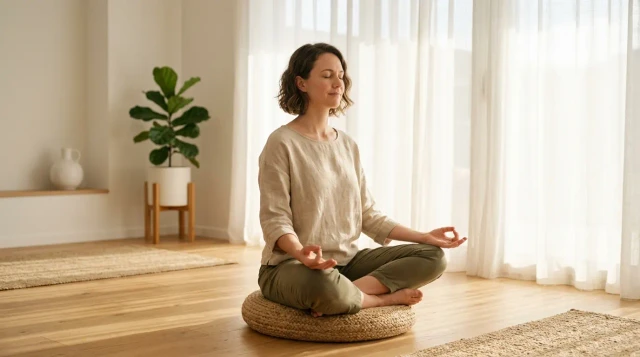
What Is Mindfulness Meditation, Really?
Let's get the definition out of the way, because people use the word "mindfulness" to mean about fifty different things. Jon Kabat-Zinn, the molecular biologist who founded the Mindfulness-Based Stress Reduction (MBSR) program at the University of Massachusetts Medical Center in 1979, defined it as "paying attention, on purpose, in the present moment, non-judgmentally." That's the working definition most researchers and clinicians still use today.
Notice what's not in that definition. Nothing about clearing your mind. Nothing about relaxation, though relaxation often shows up as a side effect. Mindfulness is an attention practice, not a relaxation technique. You're training your brain to notice where your attention goes and to redirect it when it wanders. That's it.
Think of it like this. You're sitting in a park, watching cars go by on the road. The cars are your thoughts. Mindful awareness means watching them pass without chasing one down the street. You notice a thought about your grocery list. You notice a pang of anxiety about tomorrow's meeting. And instead of climbing into that mental car and driving off, you stay on the bench. You come back to your breath.
This is different from concentration meditation, where you lock focus onto a single object like a candle flame or a mantra. Mindfulness is broader. You're aware of whatever arises, sounds, body sensations, emotions, thoughts, and you simply observe without getting tangled. If you want a deeper look at how different meditation styles compare, check out Meditation: What It Actually Is for a full breakdown.
Quick Q&A
Q: Is mindfulness the same as meditation?
A: Mindfulness is a quality of attention (present-moment, non-judgmental awareness), while meditation is the formal practice used to train that quality.
How Does Mindfulness Change Your Brain?
This is where things get genuinely exciting. Neuroscientists have been studying meditators' brains for over two decades, and the findings aren't subtle. Research led by Dr. Sara Lazar at Harvard-affiliated Massachusetts General Hospital showed that people who completed an 8-week MBSR program had increased cortical thickness in the prefrontal cortex, the part of the brain responsible for decision-making, focus, and self-regulation [1].
At the same time, the amygdala, your brain's alarm system that triggers the fight-or-flight response, actually shrank. Reduced gray matter density in the amygdala correlated with lower self-reported stress levels. So the brain's fear center literally gets quieter while the executive center gets stronger. That's not a metaphor. That's structural change visible on brain scans.
A 2014 meta-analysis from Johns Hopkins University, published in JAMA Internal Medicine, reviewed 47 clinical trials involving 3,515 participants. The researchers found moderate evidence that mindfulness meditation programs reduced anxiety, depression, and pain [2]. The effect sizes were comparable to those seen with antidepressant medications. That's a remarkable finding for a practice that requires zero prescriptions.
There's also growing evidence that consistent mindful awareness practice improves working memory. A 2010 study by Dr. Amishi Jha at the University of Miami found that military service members who participated in mindfulness training maintained their working memory capacity during high-stress pre-deployment periods, while a control group's capacity declined. Your ability to hold information, think clearly under pressure, and regulate emotions all improve when you strengthen this one skill.
And here's a connection many people miss: when you reduce your stress response through mindfulness, you also support your gut health. The gut-brain axis is a real, bidirectional communication highway, and chronic stress disrupts it. If that connection interests you, our Gut Health: The Complete Guide goes deep on the science.
Mindfulness isn't about stopping your thoughts. It's about noticing them without climbing aboard. That moment of recognition, the instant you realize you've drifted, is the whole practice. Everything else is just sitting.
How Do You Practice Mindfulness Meditation Step by Step?
Alright. Enough theory. Let's get practical. This is a simple mindful breathing exercise you can do right now, today, with zero equipment and no app. It takes about 10 minutes, though honestly, even 5 minutes counts when you're starting out. Consistency matters far more than duration.
Find a quiet spot. Sit in a chair with your feet flat on the floor, or sit cross-legged on a cushion. Keep your back straight but not rigid. Let your hands rest on your thighs. Close your eyes or soften your gaze toward the floor about four feet in front of you. Take two or three deep breaths to settle in, then let your breathing return to its natural rhythm.
Now bring your full attention to the sensation of breathing. Not the idea of breathing. The actual physical feeling. The air entering your nostrils. Your chest expanding. Your belly rising and falling. You're not trying to control the breath or breathe in any special pattern. You're just observing what's already happening.
Within about 30 seconds, your mind will wander. I promise. You'll start thinking about lunch, or that email you forgot to send, or whether you're "doing this right." That moment of noticing, the instant you realize you've drifted, is the most important moment in the whole practice. That's the mental bicep curl. Gently, without beating yourself up, bring your attention back to your breath. Do this over and over for the full 10 minutes.
When you're ready to build this into a real routine, we've written a companion piece that lays out exactly how to scale from a few minutes to a sustainable daily habit. Read How to Build a Meditation Practice: The Practical Guide for the full roadmap.

What Is Walking Meditation and How Do You Do It?
Sitting still isn't for everyone, especially when you're new to this. Walking meditation is one of the oldest forms of mindful awareness practice. It's been used in Zen Buddhist traditions for centuries and was formally incorporated into Jon Kabat-Zinn's MBSR curriculum. It's exactly what it sounds like: walking slowly and deliberately while paying close attention to the physical sensations of each step.
Here's how to try it. Find a path about 20 feet long, indoors or outdoors. Stand at one end. Feel the weight of your body pressing into your feet. Begin walking at about half your normal pace. Pay attention to the lifting of your foot, the forward movement of your leg, and the placement of your heel back on the ground. When you reach the end of your path, pause, turn slowly, and walk back.
The key difference from regular walking? Intentional slowness and sensory focus. You're not going anywhere. The destination is irrelevant. You're practicing sustained attention on physical experience. A lot of people who struggle with sitting meditation find this much more accessible because movement gives the restless mind something tangible to anchor to.
I like doing this outdoors when the weather cooperates. There's something about feeling grass or gravel underfoot that pulls you right into the moment. And if you're someone who already wears EMF-shielding clothing during outdoor activities, something from the Faraday Health Collection for example, walking meditation becomes a nice way to pair environmental protection with mental clarity. Two forms of self-care in one walk.

Can You Practice Mindfulness While Eating?
Absolutely. And honestly? This might be the most eye-opening daily mindfulness practice for beginners. Mindful eating was one of the first exercises Kabat-Zinn used in his MBSR program at UMass, and it's famously done with a single raisin. Yes, one raisin. For about five minutes.
Here's the exercise. Take a small piece of food, a raisin, a single almond, a piece of chocolate. Before putting it in your mouth, look at it as if you've never seen this food before. Notice the texture, the color, the weight. Bring it to your nose. Smell it. Place it on your tongue without chewing. Notice the impulse to bite down. Then chew slowly, paying attention to the flavor, the changing texture, the moment you swallow.
Most people report that a raisin has never tasted so intense. That's not because the raisin changed. Your attention did. When you eat on autopilot, which is most meals for most people, you're barely tasting anything. Research from the Harvard T.H. Chan School of Public Health suggests that mindful eating may support healthier weight management and reduce binge eating behaviors by restoring awareness of satiety signals.
You don't need to eat every meal this way. But try it once. Just once. Pick your morning coffee or the first three bites of dinner. Notice what happens when you actually show up for the experience instead of scrolling your phone through it.
Quick Q&A
Q: How long should a beginner practice mindful eating?
A: Start with just the first three bites of one meal per day, spending about 30 seconds per bite with full sensory attention.
What Is the 5-4-3-2-1 Grounding Technique?
If formal meditation feels like too big a commitment right now, grounding techniques offer a shortcut to present-moment awareness that takes less than two minutes. The 5-4-3-2-1 method is widely used by therapists and recommended by organizations like the Cleveland Clinic for managing acute anxiety and panic attacks.
Here's how it works. Wherever you are, pause and notice 5 things you can see, 4 things you can touch, 3 things you can hear, 2 things you can smell, and 1 thing you can taste. That's it. By cycling through your five senses in descending order, you pull your attention out of anxious future-thinking and anchor it in your physical surroundings.
I've used this one in airport security lines, in waiting rooms, and during those 3 a.m. spirals when sleep won't come. Speaking of sleep, poor rest and an overactive mind are deeply connected, and this grounding technique can work well as a pre-sleep ritual. For a full breakdown of how to improve your nightly recovery, check out Sleep: The Science-Backed Guide and the companion piece, How to Sleep Better Tonight: The Complete Checklist.
The beauty of the 5-4-3-2-1 technique is that nobody around you knows you're doing it. You can practice stress reduction principles in a board meeting, on a crowded subway, or while waiting for test results. It's invisible self-regulation. And it works surprisingly well for something so simple.
How Do You Bring Mindfulness Into Daily Life?
The real test of any mindfulness meditation guide isn't whether you can sit quietly for 10 minutes. It's whether that awareness follows you off the cushion. The formal practice is training wheels. Daily life is the bike ride.
One of the most practical strategies comes from Thich Nhat Hanh, the Vietnamese Zen teacher who popularized mindfulness in the West long before Silicon Valley adopted it. He suggested picking ordinary activities as "bells of mindfulness." Every time you wash your hands, for example, you do it with full attention. Feel the water temperature. Notice the soap lather. Stay present with just that experience for those 20 seconds. Every doorknob you turn becomes a reminder to check in with yourself. Am I here right now?
Another approach: single-tasking. Pick one activity per day that you normally do while multitasking, and do only that activity. Drink your coffee without reading the news. Listen to a song without doing anything else. Walk to your car without looking at your phone. A 2009 Stanford University study led by Professor Clifford Nass found that chronic multitaskers performed worse on every measure of attention and memory than people who single-tasked. Mindful attention isn't just good for your soul. It makes you better at your actual work.
Your environment matters here, too. If you're trying to cultivate calm awareness but you're bathed in digital noise and electromagnetic stimulation all day, you're fighting an uphill battle. That's one reason I appreciate what Proteck'd is doing with their Women's Wellness Collection. Reducing EMF exposure while building a more intentional life just makes sense. You can learn more about the science behind that approach on their EMF Health Benefits page.
The point isn't to become some serene, floating being who never gets stressed. It's to build small pockets of awareness throughout your day so that when stress hits, you've got a muscle to respond with instead of just reacting on autopilot. That muscle gets stronger every time you use it.
Why Do Most Beginners Quit Mindfulness Practice?
Let's be honest about this. Most people who try meditation quit within the first two weeks. A 2018 study published in PLOS ONE found that roughly 50% of participants dropped out of a digital mindfulness training program before completing it. So if you've tried and stopped, you're not uniquely bad at this. You're average.
The most common reason people give up? They think they're failing. "I can't stop my thoughts" is something every meditation teacher has heard a thousand times. But remember: noticing that your mind wandered IS the practice. You didn't fail. You just did a rep. The frustration comes from a misunderstanding about what success actually looks like.
Unrealistic expectations about timeline are another culprit. People read about stress reduction and brain changes and expect to feel profoundly different after three sessions. The research shows structural brain changes after eight weeks of consistent practice [1]. Not three days. If you went to the gym three times and didn't have visible abs, you wouldn't conclude that exercise doesn't work. Give this the same patience.
Start absurdly small. Five minutes. Even two. Dr. Judson Brewer, a psychiatrist and neuroscientist at Brown University who studies habit formation, suggests linking your meditation to an existing habit. Meditate right after you brush your teeth in the morning. The habit stacks onto something you already do, which dramatically increases the odds it sticks. This isn't about willpower. It's about design.
Key Takeaways
Frequently Asked Questions
How long should a beginner meditate each day?
Start with 5 minutes a day. Research shows that consistency matters more than duration, so a short daily session beats an occasional 30-minute one. After two weeks, try bumping it to 10 minutes. Many MBSR programs build up to 45 minutes over eight weeks, but there's no rush.
Is mindfulness meditation religious?
No. While its roots include Buddhist contemplative traditions, the MBSR program Jon Kabat-Zinn developed in 1979 was explicitly designed as a secular, science-based approach. Modern mindfulness meditation as practiced in clinical and secular settings carries no religious requirements. You don't need any spiritual beliefs to benefit.
Can mindfulness meditation help with anxiety?
Yes. A 2014 meta-analysis by Johns Hopkins researchers, published in JAMA Internal Medicine, found moderate evidence that mindfulness programs reduce anxiety symptoms. The effect sizes were comparable to those of antidepressant medications. That said, mindfulness is not a substitute for professional treatment of clinical anxiety disorders.
What's the difference between mindfulness and meditation?
Mindfulness is a quality of attention, specifically, non-judgmental awareness of the present moment. Meditation is the formal practice you use to build that quality. You can be mindful without meditating (while washing dishes, for example), but meditation is the most effective training method for strengthening the skill.
Why can't I stop my thoughts during meditation?
You're not supposed to. The goal of mindfulness isn't to eliminate thoughts. It's to notice them and let them pass without getting caught up. Every time you catch your mind wandering and bring your attention back to the breath, you're doing the exercise. That's the whole point, not a sign of failure.
How long does it take for mindfulness to change your brain?
About eight weeks of consistent practice. A 2011 study from Massachusetts General Hospital found measurable increases in gray matter density in brain regions associated with memory, learning, and emotional regulation after an 8-week MBSR program. Participants practiced an average of 27 minutes per day.
Can you practice mindfulness without sitting still?
Absolutely. Walking meditation, mindful eating, and grounding techniques like the 5-4-3-2-1 method all involve movement or active sensory engagement. Jon Kabat-Zinn's MBSR program includes walking meditation as a core component alongside seated practice.
What is the best time of day to practice mindfulness meditation?
Morning tends to work best for most people because it sets a focused tone for the day and is less likely to get disrupted. But the best time is really whatever time you'll actually stick with. Dr. Judson Brewer at Brown University recommends linking meditation to an existing habit, like brushing your teeth, to build a reliable routine.
Does mindfulness meditation help with sleep?
Yes. A 2015 study published in JAMA Internal Medicine found that older adults who completed a mindfulness awareness program had significantly improved sleep quality compared to a control group that received sleep hygiene education. Mindfulness reduces the rumination and hyperarousal that commonly keep people awake.
Can mindfulness meditation replace therapy or medication?
No. Mindfulness is a valuable complementary practice, but it shouldn't replace professional mental health treatment for diagnosed conditions like major depression, PTSD, or severe anxiety. Always consult a healthcare provider before making changes to treatment plans. Many therapists do incorporate mindfulness into evidence-based approaches like Mindfulness-Based Cognitive Therapy.
References
- Massachusetts General Hospital / Harvard Gazette – Eight weeks of mindfulness practice increased gray matter density in the hippocampus and reduced gray matter in the amygdala, correlating with decreased self-reported stress.
- JAMA Internal Medicine (Johns Hopkins meta-analysis) – A review of 47 trials with 3,515 participants found moderate evidence that mindfulness meditation programs reduce anxiety, depression, and pain.
- Mayo Clinic – Meditation can produce a deep state of relaxation and is considered a type of mind-body complementary medicine with benefits for emotional well-being and overall health.
About the Author
Proteck'd EMF Apparel
Health & EMF Specialists
The Proteck'd team covers EMF protection, silver-fiber apparel, and practical ways to reduce everyday radiation exposure. Every piece Proteck'd ships is designed, tested, and worn by the people who build it.
Get the Free EMF Home Audit Checklist
A room-by-room PDF that walks you through the biggest EMF sources in your house and what to do about each one. No cost, no fluff.
Download the Checklist →✓30-day returns✓Free shipping✓Free returns✓Silver fiber shielding


Leave a comment