


Data Protection: The Complete Guide

Here's a number worth sitting with: the typical American household now has over 22 connected devices running at any given moment. Smart speakers answering questions. AI assistants controlling your lights. Wearables tracking your sleep. Routers pushing WiFi through every wall. Each one emits electromagnetic radiation. Not a lot on its own. But all of them together? That's a question science is still working to answer, and it's exactly why smart device radiation protection has become something informed, tech-forward people are actually thinking about.
I'm not here to tell you to toss your Alexa in the garbage or yank your smart thermostat off the wall. That ship has sailed for most of us. What I want to do is walk you through what these devices actually emit, what current research says about health effects, and what you can do right now to lower your exposure without going full off-grid hermit.
This guide is built for people who are both curious and practical. You want context? It's here. You want action steps? Those are here too. And if you want to understand why some researchers are raising red flags while regulatory agencies keep saying everything's fine, we'll untangle that contradiction honestly.
Because here's the reality: our homes are getting denser with electromagnetic fields every single year, and the regulations governing exposure limits haven't been meaningfully updated since 1996. That gap between technology and policy? That's the gap this guide is designed to help you fill, on your own terms.
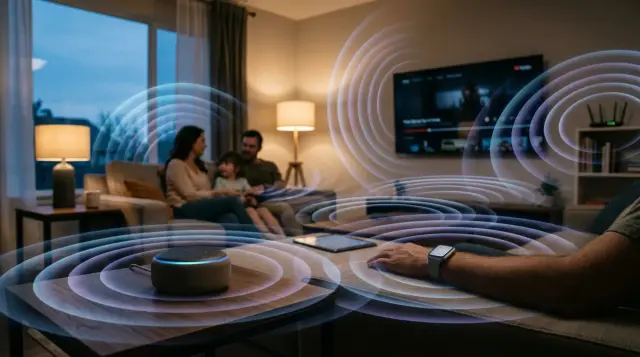
The FCC's SAR guidelines were designed in 1996 for a world where one person carried one phone. They were never built to address the cumulative exposure from dozens of simultaneously transmitting devices in a single room. Until regulations catch up, informed personal protection is your best option.
What EMF Radiation Do Smart Home Devices Actually Emit?
Let's start with the basics. Every connected device in your home communicates using radiofrequency (RF) radiation. Your WiFi router, your smart TV, your Ring doorbell, your voice assistant, your smart plugs. They all send and receive data wirelessly, and that communication happens through electromagnetic fields at specific frequencies. Usually 2.4 GHz or 5 GHz for WiFi, and around 2.4 GHz for Bluetooth.
Here's what a lot of people miss: these devices don't just emit RF radiation when you're actively using them. Most of them are always on. Constantly pinging your router or cloud servers. Updating firmware. Listening for wake words. Syncing data. A smart speaker like an Amazon Echo, for example, maintains a persistent WiFi connection while its microphone array continuously monitors for its activation phrase. That means it's producing low-level electromagnetic radiation around the clock.
According to the World Health Organization, radiofrequency electromagnetic fields in the range used by consumer electronics are classified as non-ionizing radiation, meaning they don't carry enough energy to break chemical bonds in DNA the way X-rays or gamma rays do [1]. But "non-ionizing" doesn't automatically mean "zero biological effect." That distinction matters more than most product marketing would have you believe.
Quick Q&A
Q: Do smart home devices emit EMF radiation even when not actively in use?
A: Yes, most smart devices maintain persistent wireless connections and emit low-level radiofrequency radiation continuously, even in standby mode.
Smart meters deserve a special mention here. Installed by utility companies across North America, these devices transmit your energy usage data wirelessly, sometimes pulsing RF signals thousands of times per day. Unlike a phone you can put down, a smart meter is bolted to the side of your house. If your bedroom shares a wall with one, you're getting a steady, involuntary dose of RF exposure while you sleep.
How Dangerous Is EMF From Smart Devices? What Does the Research Say?
This is where things get genuinely complicated. I want to be straight with you about that. The scientific community is not in unanimous agreement on the health effects of long-term, low-level RF exposure. There are credible researchers on multiple sides of this question, and pretending otherwise would be dishonest.
The most significant study to date is the U.S. National Toxicology Program (NTP) study, completed in 2018 after over a decade of research and $30 million in funding. The NTP found "clear evidence" of malignant heart tumors (schwannomas) in male rats exposed to high levels of RF radiation similar to 2G and 3G cell phone emissions [2]. They also found "some evidence" of brain tumors. These weren't marginal findings. The NTP used the highest confidence language in its classification system for the heart tumor results.
On the other side, the WHO's International Agency for Research on Cancer (IARC) classified RF electromagnetic fields as Group 2B, "possibly carcinogenic to humans," back in 2011 [1]. That puts RF radiation in the same category as pickled vegetables and talcum powder. Not exactly a ringing alarm bell, but not a clean bill of health either. The IARC has indicated it plans to re-evaluate this classification, and many researchers expect it to move to Group 2A ("probably carcinogenic") based on the weight of accumulated evidence.
What's especially relevant to the smart device conversation is cumulative exposure. Most safety standards, including the FCC's specific absorption rate (SAR) limit of 1.6 W/kg, were designed to evaluate one device at a time. Nobody in 1996 imagined a household with 22 connected devices operating simultaneously. If you're curious about how wearable tech fits into this picture, our breakdown on How Reliable Are Health Wearables?: What the Research Shows covers the specific concerns around devices worn directly on the body.
Children and pregnant women may be more vulnerable to electromagnetic field exposure. A 2012 review published in the Journal of Microscopy and Ultrastructure found that children absorb more RF energy than adults because of thinner skulls, higher tissue conductivity, and smaller body mass [3]. This isn't fringe science. It's biophysics. And it's one reason why the American Academy of Pediatrics has called for updated FCC exposure guidelines.
Who Is Most Vulnerable to Smart Device Electromagnetic Radiation?
Not everyone is equally affected by radiofrequency radiation. Understanding who's most at risk can help you prioritize protective measures in your home. Children top the list. Their developing nervous systems, thinner cranial bones, and proportionally greater ratio of head size to body size mean they absorb significantly more RF energy from any given source than an adult would [3].
Think about it practically. A toddler watching a tablet propped six inches from their face is getting far more RF exposure per unit of brain tissue than you are sitting three feet from your laptop. And that tablet is connecting via WiFi and possibly Bluetooth at the same time, maintaining multiple active radio connections.
Pregnant women represent another high-concern group. A 2017 study from the Kaiser Permanente Division of Research in Oakland, California, led by Dr. De-Kun Li, found that pregnant women with higher measured magnetic field exposure had a 2.72 times greater risk of miscarriage compared to those with lower exposure. The study measured actual EMF levels using monitoring devices worn by 913 participants, making it one of the more rigorous observational studies in the field.
People who work from home are worth mentioning too. If you're spending 8 to 10 hours a day surrounded by a WiFi router, a laptop, a smartphone, a smartwatch, wireless earbuds, and maybe a smart display, your cumulative daily exposure is dramatically higher than someone who spends most of their day outdoors. This is the new reality for millions of remote workers, and it's one more reason smart device radiation protection deserves genuine attention, not hand-waving. For a broader look at how your digital environment shapes your wellbeing, check out Taking Back Your Online Life: The Complete Guide.
What Are Practical Ways to Reduce EMF Exposure at Home?
Good news: you don't have to choose between modern convenience and reducing your electromagnetic radiation exposure. There are concrete, practical steps that make a real difference, and most of them cost nothing.
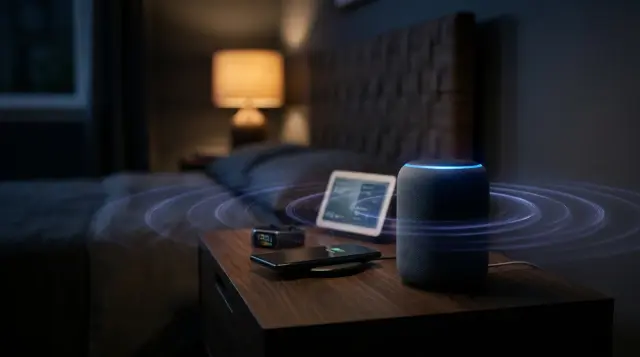
Distance is your single most powerful tool. RF radiation intensity drops dramatically with distance, following an inverse square law. Move your WiFi router from your desk to across the room and your exposure drops significantly. Keep your phone on the table instead of in your pocket. Place smart speakers on shelves rather than nightstands next to your head. A 2019 analysis from the Environmental Health Trust emphasized that even 12 inches of additional distance from a device can reduce RF exposure by 75% or more.
Wired connections are seriously underrated. You can hardwire your computer via Ethernet, use wired headphones instead of Bluetooth earbuds, and connect your smart TV directly to your router with a cable. Each wired connection you make is one fewer source of continuous RF emission in your space. If you're interested in where computing technology is headed and how wired versus wireless might evolve, take a look at The Future of Computing: The Trends Shaping Tomorrow.
Turn off what you're not using. Most people leave every smart device powered on 24/7 by default. But do you really need your smart speaker active at 3 AM? Many routers have scheduling features that let you disable WiFi during sleeping hours. Some smart plugs can be set to cut power to devices on a timer. Reducing your always-on device count during sleep can cut nighttime EMF exposure substantially.
Quick Q&A
Q: What is the single most effective way to reduce smart device EMF exposure?
A: Increasing your physical distance from devices is the most effective strategy, since RF radiation intensity decreases rapidly with distance following the inverse square law.
Does EMF Shielding Clothing Actually Work?
Fair question. It deserves a straight answer. Yes, properly engineered EMF shielding fabrics do work, but the quality and effectiveness vary enormously across the market. The principle behind shielding clothing is the same physics that makes a Faraday cage function: conductive materials (typically silver or copper woven into fabric) create a barrier that reflects and absorbs electromagnetic radiation before it reaches your body.
Michael Faraday demonstrated this principle in 1836, and it's been used in military, medical, and industrial applications ever since. The technology isn't new or controversial. What's newer is the application to everyday clothing that you'd actually want to wear. This is where Proteck'd has done something genuinely interesting with their Faraday Protection Collection, which incorporates silver-fiber shielding into apparel that looks like normal streetwear rather than a tinfoil costume.
The key metric to look for in any EMF shielding product is attenuation, measured in decibels (dB). A fabric offering 30 dB of shielding blocks approximately 99.9% of incoming RF radiation at tested frequencies. Lab testing by accredited facilities is what separates legitimate products from marketing gimmicks. If a company can't show you test data from an independent lab, move on. For more detail on what EMF shielding can and can't do, Proteck'd's page on EMF Protection Benefits is a solid resource.
For men looking at everyday options, the Men's Faraday Tech Wear line is worth checking out. It's designed for people who want EMF shielding integrated into clothing they'd wear to the office, the gym, or out on the weekend. The point is that smart device radiation protection doesn't have to look weird or feel like a sacrifice. It can be something you just build into what you're already wearing.
How Will AI Make the EMF Problem Worse?
Here's what nobody seems to be talking about enough. The next generation of AI-powered devices isn't going to reduce your EMF exposure. It's going to increase it, probably by a lot. Every AI feature added to a device means more data processing, more cloud communication, and more continuous wireless transmission.
Look at what's already happening. Apple Intelligence, Google's Gemini integration, Samsung's Galaxy AI. All of them are pushing always-on AI processing into smartphones, tablets, and wearables. These features require constant communication with cloud servers. Your phone isn't just sending a text anymore. It's uploading voice data, images, and contextual information for real-time AI processing. That means more frequent and more sustained RF transmissions from the device in your pocket. For perspective on how smartwatches fit into this AI future, our piece on How Reliable Are Smartwatches?: What to Trust and What to Ignore is worth reading.
Then there's the proliferation of entirely new device categories. AI-powered home robots. Smart glasses with built-in AI assistants. Health monitors that stream biometric data continuously. Each one is another source of radiofrequency radiation in your personal space. Market research firm IDC projected that the number of IoT-connected devices worldwide would exceed 55 billion by 2025, up from 18 billion in 2018.
The regulatory framework isn't keeping pace. The FCC's SAR guidelines, set in 1996, were designed for a world where one person might carry one cell phone. They were never intended to address cumulative exposure from dozens of simultaneously transmitting devices in a single room. Until regulations catch up, personal EMF protection strategies and shielding solutions are a practical form of self-defense. Our Digital Security: The Complete Guide covers the broader picture of protecting yourself in an increasingly connected world.
Can You Measure EMF Levels in Your Own Home?
Absolutely. And I'd actually recommend it. Consumer-grade EMF meters have become surprisingly affordable and accurate over the last few years. A device like the TriField TF2, which costs around $170, can measure electric fields, magnetic fields, and RF radiation. It won't give you lab-grade precision, but it will show you which areas of your home have the highest exposure levels. The results might genuinely surprise you.
When I first measured my home office, I expected the router to be the biggest source. It was significant, sure. But my wireless charging pad, sitting six inches from my keyboard and emitting a constant magnetic field, was putting out readings I didn't expect. The smart display on my kitchen counter was another hot spot, broadcasting at higher levels than my phone during an active call.
Walk through your home with a meter and pay special attention to sleeping areas. Your bedroom is where you spend 7 to 9 hours in a fixed position, so any EMF sources near your bed represent your most sustained exposure. Common culprits include WiFi routers in adjacent rooms, smart alarm clocks on nightstands, baby monitors (which transmit continuously), and smart mattress pads or sleep trackers placed directly under or on your body.
Once you've identified your hotspots, you can make targeted changes. Maybe the router moves downstairs. Maybe the baby monitor switches from WiFi to a lower-emission audio-only model. Maybe you swap Bluetooth earbuds for wired ones during your eight-hour workday. Data makes your electromagnetic field reduction strategy specific and effective rather than vague and hopeful.
What's the Difference Between EMF Blocking and EMF Shielding?
These terms get tossed around interchangeably, but they describe different approaches. The difference matters when you're choosing the right smart device radiation protection strategy.
EMF blocking aims to completely prevent electromagnetic radiation from passing through a barrier. A true Faraday cage does this. When your phone is inside a properly constructed Faraday bag, it can't receive or send signals at all. No calls, no texts, no data. This is complete blocking, and it's useful for specific applications like securing devices from hacking or ensuring privacy. But you can't use your phone while it's fully blocked, which makes total blocking impractical for everyday life.
EMF shielding, on the other hand, reduces exposure without necessarily eliminating it entirely. Shielding garments and materials are designed to deflect or absorb a percentage of incoming RF radiation. A well-made shielding fabric might attenuate 99% of RF at certain frequencies while still allowing your devices to function normally. This is the approach that makes sense for daily wear and home use, because you still get the benefits of your technology while meaningfully reducing the radiation your body absorbs.
The analogy I find most useful is sunscreen versus staying indoors. Total blocking is like never going outside. Shielding is like wearing SPF 50. You're still out in the world, still using your devices, but you've added a practical layer of protection between yourself and the exposure. Companies like Aires Tech market modulation-based approaches that claim to restructure EMF rather than block it, though independent validation of those claims is harder to find compared to straightforward Faraday-cage-principle shielding [4].
- Every connected smart device in your home emits radiofrequency radiation continuously, even in standby mode, and the average household now has over 22 such devices.
- The NTP's 2018 study found clear evidence of tumors in rats from RF exposure, while the WHO classifies RF fields as 'possibly carcinogenic' with a potential upgrade coming.
- Distance is your most powerful free tool: moving just 12 inches farther from a device can reduce RF exposure by 75% or more.
- EMF shielding clothing using silver-fiber Faraday fabrics can attenuate up to 99.9% of RF radiation at tested frequencies when properly engineered and independently lab-tested.
- AI integration into consumer devices will increase RF exposure levels as always-on cloud communication, voice processing, and data streaming become standard features.
Frequently Asked Questions
WiFi routers emit low-level radiofrequency radiation continuously. While levels fall below current FCC limits, the long-term effects of 24/7 exposure are still being studied. The WHO classifies RF radiation as Group 2B, 'possibly carcinogenic.' Reducing exposure is simple: place your router in a central but less-occupied area of your home and consider turning it off during sleeping hours.
Aim for at least 6 feet between your bed and any continuously transmitting device like a WiFi router, smart speaker, or wireless charging pad. RF radiation intensity drops significantly with distance, so even moving a device from your nightstand to across the room makes a real difference. Your bedroom matters most because you spend 7 to 9 hours there in a fixed position.
Yes. Smart speakers maintain a persistent WiFi connection, and their microphone arrays continuously monitor for wake words. That means they emit low-level RF radiation around the clock. Unplugging them when not in active use or moving them away from areas where you spend extended time are simple ways to cut your exposure.
Legitimate EMF shielding phone cases can reduce RF exposure on the side of the case facing your body, typically by redirecting radiation away from you. The key is choosing cases tested by FCC-accredited labs with published attenuation data. Be cautious of products making claims without independent lab verification. The market includes both effective and ineffective options.
5G uses higher frequencies (up to millimeter wave bands around 24 to 39 GHz) that don't penetrate the body as deeply as lower-frequency 4G signals. However, 5G networks require more base stations placed closer together, which could increase ambient RF levels in urban areas. The full health implications are still being studied, and no long-term epidemiological data on 5G-specific frequencies exists yet.
Yes. Research published in the Journal of Microscopy and Ultrastructure found that children absorb more RF energy than adults because of thinner skulls, higher tissue water content, and proportionally larger heads relative to body size. The American Academy of Pediatrics has recommended that the FCC update its exposure guidelines to better account for children's unique vulnerabilities.
The TriField TF2 (around $170) is widely recommended for consumers because it measures electric fields, magnetic fields, and RF radiation in a single device. It's accurate enough for identifying hot spots in your home and comparing relative exposure levels between rooms and devices. For RF-only measurements, the Acoustimeter AM-10 is another popular choice among EMF consultants.
Airplane mode disables cellular, WiFi, and Bluetooth transmissions, which eliminates the primary sources of RF radiation from your phone. The phone still emits very low-level electromagnetic fields from its processor, battery, and screen. For practical purposes though, airplane mode reduces your phone's RF emissions to near zero and is an excellent habit during sleep.
Yes. Bluetooth earbuds transmit RF radiation directly into your ear canal, very close to your brain. Wired headphones don't emit RF radiation at all. While Bluetooth earbuds operate at low power levels (typically Class 1 Bluetooth at about 1 milliwatt), the proximity to sensitive brain tissue makes wired alternatives a simple and effective way to reduce head-area exposure.
Silver is highly conductive. When it's woven into fabric, it creates a flexible Faraday-style mesh that reflects and absorbs electromagnetic radiation. Depending on the weave density and silver content, these fabrics can attenuate 99% or more of RF radiation at tested frequencies. The same principle has been used in military and medical settings for decades, and it's now being applied to everyday clothing and accessories.
References
- World Health Organization / IARC – IARC classified radiofrequency electromagnetic fields as Group 2B, possibly carcinogenic to humans, in 2011
- National Toxicology Program (NIH/NIEHS) – The NTP found clear evidence of malignant heart tumors (schwannomas) in male rats exposed to high levels of RF radiation
- National Library of Medicine (PubMed) – Children absorb more RF energy than adults due to thinner skulls, higher tissue conductivity, and smaller body mass
- World Health Organization – RF fields from mobile phones and other wireless devices are classified as non-ionizing radiation
About the Author
Proteck'd EMF Apparel
Health & EMF Specialists
The Proteck'd team covers EMF protection, silver-fiber apparel, and practical ways to reduce everyday radiation exposure. Every piece Proteck'd ships is designed, tested, and worn by the people who build it.
Get the Free EMF Home Audit Checklist
A room-by-room PDF that walks you through the biggest EMF sources in your house and what to do about each one. No cost, no fluff.
Download the Checklist →✓30-day returns✓Free shipping✓Free returns✓Silver fiber shielding


