


Integrative Wellness: The Beginner's Guide

Here's a stat that might wake you up: the CDC estimates that roughly 70 million Americans deal with chronic sleep problems [3]. That's not a small number. And it's not a small problem, either. Poor sleep is tied to heart disease, obesity, depression, and a weakened immune system.
Yet most people spend more time choosing what to watch on Netflix before bed than thinking about how to optimise sleep environment for actual rest. Funny how that works.
The good news? You don't need a sleep lab or a $5,000 mattress. The biggest wins come from surprisingly simple tweaks to your bedroom setup, your evening habits, and the way you think about nightly recovery as part of your broader health.
I've spent a lot of time reading sleep research and, honestly, experimenting on myself. Some of the advice floating around is overcomplicated. Some is flat-out wrong. What I want to give you here is a practical, no-fluff beginner's guide that combines the best evidence with real-world tips you can start using tonight.
This guide fits into a bigger picture. If you're curious about the broader framework, check out our Integrative Wellness: The Complete Guide. But if sleep is where you want to start, and honestly it's a great place to start, keep reading.
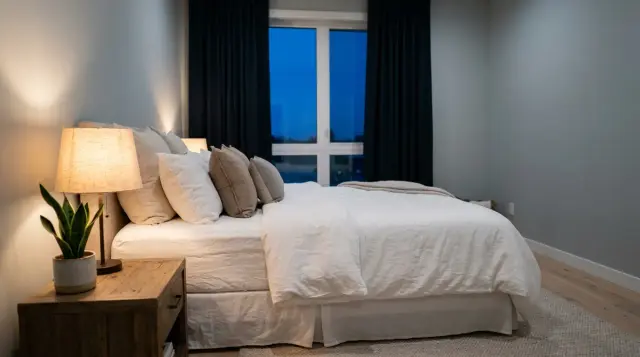
Why Does Your Sleep Environment Matter So Much?
Your brain doesn't just flip a switch when you close your eyes. Falling asleep is a process. Your environment sends signals that either help or sabotage that process. Researchers at Harvard Medical School have shown that environmental cues like light, temperature, and noise directly affect your circadian rhythm, the internal clock that tells you when to feel sleepy and when to feel alert [1].
Think about it this way. Imagine trying to have a serious conversation in a loud, brightly lit restaurant versus a quiet living room. Same conversation. Completely different outcomes. Your bedroom works the same way. The conditions you set up tell your nervous system whether it's time to wind down or stay on guard.
A 2022 review in Sleep Medicine Reviews found that environmental modifications like temperature control and light reduction improved sleep efficiency by measurable margins across multiple studies. These weren't just subjective "I feel better" reports. Researchers used polysomnography data showing more time spent in slow-wave deep sleep.
Quick Q&A
Q: What's the single most impactful change I can make to my bedroom for better sleep?
A: According to Cleveland Clinic sleep specialists, lowering your room temperature to between 60°F and 67°F provides the most consistent improvement in sleep quality across all age groups [2].
This isn't about perfection. You don't need to turn your bedroom into some kind of biohacker's cave by tomorrow. Small, targeted changes stack up. And understanding why each one matters helps you actually stick with them.
How to Optimise Sleep Environment: Temperature, Light, and Sound
Let's get specific. The National Sleep Foundation recommends keeping your bedroom between 60°F and 67°F (roughly 15°C to 19°C). Why so cool? Your core body temperature naturally drops as part of your circadian rest cycle. A warm room fights that process, keeping you in lighter sleep stages and waking you up more often.
If you don't have great temperature control at home, a fan can do a lot. So can breathable bedding made from natural fibers. I swapped polyester sheets for cotton and noticed a real difference in how often I woke up sweaty at 3 a.m. Way less often, if you're wondering.
Then there's light. Even small amounts of artificial light in your bedroom can suppress melatonin production. According to Harvard Medical School, blue light exposure in the evening can suppress melatonin by up to 50% and shift your circadian rhythm by as much as 3 hours [1]. Blackout curtains are a solid investment. So is covering or removing any devices with LED indicator lights. Yes, even that little red dot on your TV.
Sound matters too, but it's personal. Some people sleep best in total silence. Others need white noise to mask traffic or a snoring partner. A study from Northwestern University's Feinberg School of Medicine found that pink noise, a softer version of white noise, actually enhanced deep sleep in older adults. Worth trying.
The common thread here? Reduce stimulation. Your bedroom should be boring. That's literally the goal. Cool, dark, quiet, and boring. If your bedroom setup for better sleep checks those boxes, you're already ahead of most people.
Your bedroom should be boring. Cool, dark, quiet, and boring. That's the goal. Every dollar and every minute you spend making it less stimulating pays you back in deeper, more restorative sleep that affects everything else in your life.
Should You Remove Electronics from Your Bedroom?
Short answer: yes, as many as you reasonably can. Longer answer: it depends on which devices and how you use them.
Phones and tablets are the obvious culprits. The blue light is one problem, but the bigger issue might be psychological. Every notification is a tiny hit of cortisol. Every "just one more scroll" pushes your bedtime back. If you've been struggling with this, our guide on How to Reduce Screen Time: The Method That Works offers a framework that doesn't rely on willpower alone.
There's another angle most sleep guides skip over: electromagnetic fields. A 2019 study in the Journal of Physiological Anthropology found that pre-sleep EMF exposure from electronic devices delayed sleep onset and reduced sleep quality. Your phone, your Wi-Fi router, your smart speaker. They're all emitting low-level electromagnetic radiation throughout the night, even when the screens are off.
This is actually one of the reasons I started looking into EMF-shielding clothing and gear. Products from the Faraday Health Collection at Proteck'd use Faraday fabric technology to reduce your body's exposure to electromagnetic fields. You can learn more about the science behind it on the EMF Health Benefits page. It sounds out there until you actually sit down with the research.
For a deeper reset, consider a full digital detox step by step. Even one night per week with devices out of the bedroom can show you what you've been missing.
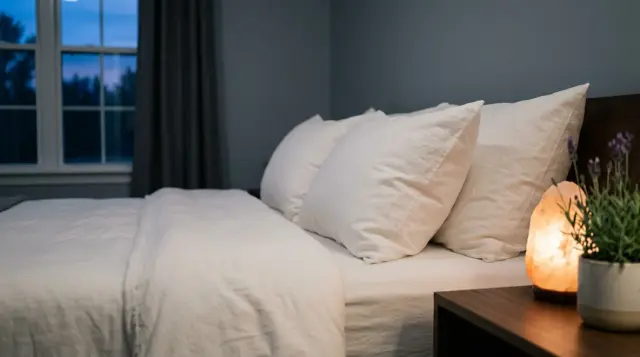
What's the Best Bedtime Routine for Deep Sleep?
A routine sounds boring. I know. But your brain loves patterns. When you repeat the same calming sequence before bed each night, your nervous system starts associating those cues with sleep. It's classical conditioning, Pavlov style, except instead of a bell and food, it's dim lighting and a book.
Dr. Cheri Mah, a physician and sleep researcher at the University of California, San Francisco, recommends a 30 to 60 minute wind-down routine that includes at least one relaxation practice. That could be gentle stretching, journaling, reading a physical book, or meditation. If meditation feels intimidating, our How to Start Meditating: The Practical Guide makes it approachable for total beginners.
Here's what a sample routine might look like. At 9:00 p.m., put your phone in another room. At 9:15, take a warm shower. (The post-shower temperature drop actually mimics the body's natural cooling signal for sleep.) At 9:30, read or do a short meditation. By 10:00, lights out. It doesn't have to be this exact schedule. The consistency is what makes it work.
Quick Q&A
Q: How long before bed should I stop using screens?
A: Harvard researchers recommend stopping screen use at least 60 to 90 minutes before your intended sleep time to allow melatonin levels to rise naturally [1].
The American Academy of Sleep Medicine recommends that adults aim for at least 7 hours of sleep per night. But hitting that number means you actually need to be in bed, lights off, for closer to 7.5 to 8 hours. Building a routine helps you protect that window instead of losing it to one more episode or one more email.

How Do Stress and Daytime Habits Affect Your Sleep Quality?
You can have the perfect bedroom. Perfect temperature. Blackout curtains thick enough to film a movie behind. But if your stress levels are through the roof, you'll still stare at the ceiling. Sleep hygiene tips are only half the equation. The other half is what happens during the day.
According to the American Psychological Association's 2023 Stress in America survey, 43% of adults reported that stress caused them to lie awake at night in the past month. Cortisol, the stress hormone, directly works against melatonin. If cortisol is still elevated at bedtime, your body is getting conflicting signals: one system says sleep, another says stay alert.
Exercise is one of the most effective tools for managing stress and improving sleep. A meta-analysis in the Journal of Sleep Research found that regular moderate exercise improved sleep onset latency, total sleep time, and sleep efficiency. Timing matters, though. The Sleep Foundation recommends finishing vigorous workouts at least 1 to 2 hours before bed. Morning or early afternoon exercise tends to produce the best sleep outcomes.
Daylight exposure is the other big lever. Getting natural sunlight within the first hour of waking helps set your circadian rhythm. According to Stanford neuroscientist Dr. Andrew Huberman, even 10 to 15 minutes of morning sunlight can significantly improve both sleep onset and deep sleep optimization later that night. Overcast day? Still works. The light intensity outdoors, even under clouds, is dramatically higher than indoor lighting.
For a more complete approach to cutting digital stress, our Digital Detox: The Complete Guide walks through the connection between screen habits, stress, and rest quality.
Can What You Wear to Bed Actually Affect Your Sleep?
This one surprises people. But yes. What you wear (or don't wear) to bed affects thermoregulation, skin comfort, and potentially your exposure to electromagnetic radiation overnight.
Tight, synthetic sleepwear traps heat and moisture against the skin. That works against your body's natural cooling process during sleep. Loose, breathable fabrics are better. And if you're someone curious about reducing EMF exposure while you rest, there are now options that handle both.
Proteck'd's Women's Wellness Collection and their broader Faraday Health Collection incorporate silver-infused Faraday fabric that shields against electromagnetic fields. It's a practical way to address EMF concerns without overhauling your bedroom. You're just putting on a shirt. The fabric does the work while you sleep.
I know EMF-blocking clothing sounds like something from a sci-fi movie. But the technology is straightforward: silver threads woven into fabric create a Faraday cage effect at the garment level. It's the same principle used in hospital shielding and military applications, scaled down to something you can actually wear comfortably. If you want to understand how to optimise sleep environment at every layer, including what's touching your skin, it's worth looking into.
How Do You Track Whether Your Sleep Changes Are Working?
Making changes is one thing. Knowing if they're working is another. "I feel more rested" is a great start, but it helps to get a little more objective about it.
Sleep tracking has gotten remarkably accessible. Devices like the Oura Ring, Whoop strap, and even the Apple Watch offer decent estimates of sleep stages, heart rate variability, and total sleep time. A 2020 validation study in Nature and Science of Sleep found that consumer-grade wearables were reasonably accurate for total sleep time, though less reliable for distinguishing specific sleep stages compared to clinical polysomnography.
Don't want to wear a device? A simple sleep diary works. Record when you got into bed, roughly when you fell asleep, how many times you woke up, and how you felt in the morning. Rate your energy on a 1 to 10 scale. After two weeks of your baseline, make one change (say, lowering the temperature or removing your phone) and track for another two weeks. The pattern tells you what you need to know.
The key is changing one variable at a time. If you simultaneously cool the room, start meditating, buy new pillows, and cut caffeine, you won't know what actually helped. Treat it like a personal experiment. It takes patience, but the payoff in nightly recovery quality is real and lasting.
What Does Integrative Wellness Have to Do with Sleep?
Integrative wellness is the idea that your health isn't a collection of separate problems to fix in isolation. Your sleep affects your mood. Your mood affects your eating. Your eating affects your energy. Your energy affects your exercise. And your exercise affects your sleep. It's all connected.
When you learn how to optimise sleep environment, you're not just fixing one issue. You're pulling a thread that unravels a whole chain of downstream problems. Better sleep means better cognitive function, which means less reliance on caffeine, which means less afternoon anxiety, which means an easier time falling asleep. The positive cycle starts with the basics.
This is why I think sleep is the best entry point for anyone curious about integrative wellness. You don't need to overhaul your entire life at once. Start with your bedroom. Make it cooler, darker, and free from screens. Build a simple wind-down routine. Pay attention to how you feel after a week. Then layer in other changes when you're ready.
If you want to go deeper, everything connects. Reducing screen time feeds into better sleep hygiene. Meditation reduces the stress that keeps you awake. A digital detox gives your nervous system the break it's been begging for. Each piece supports the others. That's the whole point. And it all starts with the room where you rest.
Key Takeaways
Frequently Asked Questions
What is the ideal bedroom temperature for sleep?
Aim for 60°F to 67°F (about 15°C to 19°C). This supports your body's natural core temperature drop as you fall asleep. Both the Cleveland Clinic and the National Sleep Foundation recommend this range based on research showing improved sleep efficiency in cooler rooms.
How do I optimise my sleep environment on a budget?
Start with free changes: move your phone out of the bedroom, close curtains, and switch off standby lights on electronics. A basic fan for airflow and white noise costs under $30. These low-cost adjustments address the three biggest sleep disruptors (light, temperature, and screen stimulation) without any expensive equipment.
Does blue light from screens really affect sleep quality?
Yes, and quite a lot. Harvard Medical School research shows that blue light suppresses melatonin production by up to 50% and can shift your circadian rhythm by up to 3 hours. Stopping screen use 60 to 90 minutes before bed allows melatonin levels to rise on their own.
Can EMF from electronics in the bedroom disrupt sleep?
Research suggests it can. A 2019 study in the Journal of Physiological Anthropology found that pre-sleep EMF exposure delayed sleep onset and reduced overall sleep quality. Removing devices from the bedroom or using EMF-shielding products like Faraday fabric clothing can help cut exposure.
How many hours of sleep do adults actually need?
The American Academy of Sleep Medicine recommends at least 7 hours per night for adults aged 18 to 60. Some people do best on 8 to 9 hours. To consistently get 7 hours of actual sleep, you typically need to be in bed with the lights off for 7.5 to 8 hours.
Is white noise or silence better for sleep?
That depends on your environment and your preferences. If you're in a noisy area, white or pink noise can mask disruptive sounds. A Northwestern University study found that pink noise specifically enhanced deep sleep in older adults. If your bedroom is already quiet, silence may be all you need.
What time should I stop exercising before bed?
Wrap up vigorous exercise at least 1 to 2 hours before bedtime. Intense workouts raise core body temperature and stimulate cortisol production, both of which interfere with falling asleep. Morning or early afternoon exercise tends to produce the best sleep outcomes according to sleep researchers.
Should I use a sleep tracker to monitor my sleep?
Sleep trackers can be useful for spotting patterns and measuring the impact of changes you make. A 2020 study in Nature and Science of Sleep found consumer wearables reasonably accurate for total sleep time. That said, a simple sleep diary with subjective ratings works well too and costs nothing.
Does what I wear to bed affect my sleep quality?
It can. Tight or synthetic fabrics trap heat and moisture, working against your body's natural cooling process. Loose, breathable materials are better. EMF-shielding sleepwear made with silver-infused Faraday fabric, like Proteck'd's collections, adds another layer of protection by reducing electromagnetic field exposure while you sleep.
How long does it take for sleep environment changes to show results?
Most people notice subjective improvements within a few days of making changes like lowering bedroom temperature or removing screens. Measurable shifts in sleep patterns typically show up after about two weeks of consistent adjustments. Be patient and change one variable at a time so you can tell what's actually making the difference.
References
- Harvard Medical School, Division of Sleep Medicine – Blue light exposure at night suppresses melatonin production and can shift circadian rhythm by up to 3 hours
- Cleveland Clinic – The ideal bedroom temperature for sleep is between 60°F and 67°F to support natural thermoregulation
- Centers for Disease Control and Prevention – 1 in 3 American adults regularly gets less than the recommended 7 hours of sleep per night
About the Author
Proteck'd EMF Apparel
Health & EMF Specialists
The Proteck'd team covers EMF protection, silver-fiber apparel, and practical ways to reduce everyday radiation exposure. Every piece Proteck'd ships is designed, tested, and worn by the people who build it.
Get the Free EMF Home Audit Checklist
A room-by-room PDF that walks you through the biggest EMF sources in your house and what to do about each one. No cost, no fluff.
Download the Checklist →✓30-day returns✓Free shipping✓Free returns✓Silver fiber shielding


Leave a comment