


How to Build a Meditation Practice: The Practical Guide

One question keeps popping up in health forums and comment sections: is how to start meditating safe? Honestly, it's a fair thing to wonder. You're sitting still, turning inward, sometimes bumping into thoughts you'd rather not face. Could that actually backfire?
The answer, backed by decades of clinical research, is reassuring. For the vast majority of people, meditation is not only safe but measurably beneficial.
Here's what surprises most beginners: meditation doesn't require you to "empty your mind." That myth has probably scared off more would-be meditators than anything else. Your mind will wander. That's not failure. That's the entire exercise.
I started meditating about six years ago. My first session lasted roughly ninety seconds before I picked up my phone. Sound familiar? The good news is that even short, imperfect sessions produce results. A 2018 study published in Behavioural Brain Research found that just 13 minutes of daily meditation over eight weeks improved attention and working memory [4].
This guide isn't going to ask you to chant or visualize white light. We're going to cover what meditation actually is, how to do it step by step, the different styles you can try, and how to make it stick as a daily habit. Think of it as the owner's manual nobody gave you for your own brain.
Whether you're here because of anxiety, poor sleep, or just plain curiosity, you're in the right spot. Let's get into it.
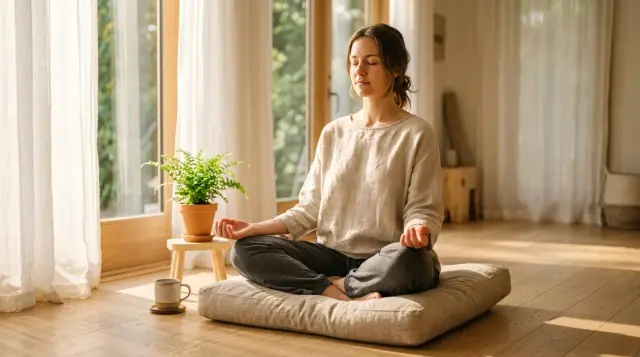
What Is Meditation, Really?
Meditation is the practice of training your attention. That's it. You pick an object of focus, like your breath, a sound, or a body sensation, and you practice returning to it when your mind drifts. It's more like doing reps at the gym than achieving some transcendent state. The rep is the moment you notice you've wandered and come back.
The confusion comes from how meditation gets portrayed in pop culture. You picture someone cross-legged on a mountaintop, completely serene. In reality, most meditators sit on their couch and spend half the session thinking about what's for dinner. That's normal. Researchers at Johns Hopkins University conducted a 2014 meta-analysis in JAMA Internal Medicine, reviewing 47 clinical trials. They found moderate evidence that meditation programs improved anxiety, depression, and pain. Not because practitioners achieved mental silence, but because they practiced redirecting attention [1].
There's also a common worry that meditation is inherently religious. It doesn't have to be. Mindfulness-based stress reduction, or MBSR, was developed by Jon Kabat-Zinn at the University of Massachusetts Medical School in 1979 as a secular, clinical program. It's now used in hospitals and clinics worldwide. You can practice mindfulness meditation without subscribing to any spiritual framework whatsoever.
Quick Q&A
Q: Do I need to clear my mind completely to meditate correctly?
A: No. Meditation is about noticing when your mind wanders and gently returning to your focus point. A wandering mind is part of the process, not a sign of failure.
If you've read our piece on How to Build a Meditation Practice: Without the Woo, you know we take a practical, no-nonsense approach. The point here is the same: meditation is a skill, and skills improve with repetition.
Is Starting a Meditation Practice Safe for Everyone?
Let's tackle the safety question head on, because it's the reason many of you are here. Is how to start meditating safe for a typical healthy adult? The NIH's National Center for Complementary and Integrative Health says yes. They classify meditation as "generally considered to be safe for healthy people" [2]. The risks are low. The benefits are well documented.
That said, there are edge cases worth knowing about. A 2020 study published in Acta Psychiatrica Scandinavica found that approximately 8% of regular meditators reported unwanted negative effects, including increased anxiety or depersonalization. These effects were more common in people doing intensive, multi-hour retreats and in individuals with pre-existing psychiatric conditions like severe PTSD or psychosis. If that's your situation, talk to your therapist before starting.
For the other 92% of us? The research is overwhelmingly positive. A well-cited study from Harvard Medical School, led by Dr. Sara Lazar and published in Psychiatry Research: Neuroimaging in 2011, showed that 8 weeks of mindfulness practice produced measurable increases in gray matter density in brain regions tied to memory, empathy, and stress regulation [3]. Your brain literally changes shape.
So the real question isn't whether beginning a meditation practice is safe. It's whether you can afford not to try it. The risk of doing nothing, continuing to run on stress and distraction, is arguably the bigger gamble. If you're also looking to reduce external stressors in your environment, check out Proteck'd's EMF Health Benefits page for another angle on protecting your wellbeing.
Meditation isn't about achieving a blank mind. It's about catching yourself thinking and choosing to come back. That tiny moment of noticing? That's the whole workout. Everything else is just sitting in a chair.
How Do You Actually Meditate? A Step-by-Step Walkthrough
Enough theory. Here's how to actually do it. I'm going to walk you through a basic breath awareness meditation, which is the foundation most beginner techniques build on. You don't need an app. You don't need a cushion. A chair works fine.
Step 1: Sit down somewhere reasonably quiet. You don't need a dedicated meditation room. A bedroom, a parked car, a break room at work. I've meditated on airplanes. The only requirement is that you're in a stable, upright position. Lying down works too, but you'll probably fall asleep. Your call.
Step 2: Set a timer for 5 minutes. Not 20. Not 30. Five. Research from the University of Waterloo, published in Consciousness and Cognition in 2017, found that even 10 minutes of mindful breathing improved focus on subsequent tasks. But five is plenty when you're brand new. You can always add time later.
Step 3: Close your eyes and focus on the physical sensation of breathing. Don't try to breathe in a special way. Just notice where you feel the breath most. Maybe it's the air moving through your nostrils. Maybe it's the rise and fall of your chest. Pick one spot and keep your attention there.
Step 4: When you notice your mind has wandered, gently bring it back. This is the whole game. You'll think about work. You'll think about that weird thing you said in 2014. You'll notice an itch on your nose. Every time, just return to the breath. No judgment. That moment of catching yourself? That IS the meditation.
Step 5: When the timer goes off, open your eyes slowly. Sit for another few seconds. Notice how you feel. Some days you'll feel calmer. Other days you'll feel exactly the same. Both are fine. The benefits of a daily meditation routine build over weeks, not minutes.

What Types of Meditation Are Best for Beginners?
Breath awareness is the starting point, but it's not the only option. If sitting with your breath makes you want to crawl out of your skin (and honestly, it does for some people), there are other styles worth trying.
Guided meditation is probably the most beginner-friendly. Someone talks you through the practice, telling you where to place your attention. Apps like Insight Timer offer thousands of free sessions. The structure removes that "am I doing this right?" anxiety that trips up so many newcomers. If you want a deeper look at getting started, our companion article How to Start Meditating: The Practical Guide covers this in more detail.
Body scan meditation is another accessible entry point. You systematically move your attention from your toes to the top of your head, noticing sensations in each area. Jon Kabat-Zinn made this a cornerstone of his MBSR program at UMass Medical School, and it's particularly effective for people who hold stress physically. Think chronic tension headaches or tight shoulders.
Loving-kindness meditation (also called Metta) involves silently repeating phrases like "may I be happy, may I be healthy" and then extending those wishes to others. A 2008 study by Dr. Barbara Fredrickson at the University of North Carolina found that seven weeks of loving-kindness practice increased positive emotions and life satisfaction. It sounds cheesy. It works anyway.
Mindfulness practice for beginners can also happen off the cushion entirely. Washing dishes while paying full attention to the water temperature, the soap, the weight of each plate. Walking while noticing how your feet feel on the ground. These informal practices build the same attention muscle as formal sitting.

How Do You Make Meditation a Daily Habit?
This is where most people fall off. They meditate for three days, feel good, then forget about it for six months. I've done this. Multiple times. What finally made it stick was understanding that consistency matters far more than duration.
The most effective strategy I've found is called "habit stacking," a concept popularized by James Clear in Atomic Habits. You attach your meditation to something you already do every day. For me, it's right after my morning coffee. The cue is already there. I don't have to think about when to meditate. Coffee brews, I sit for five minutes. Done.
Another thing that helps: remove friction. If you meditate at home, cut down on distractions. That means putting your phone in another room. Our guide on How to Break Your Phone Addiction: The Method That Works has some practical strategies for this. When your phone is three feet away and buzzing, your meditation session is basically a battle with your notifications.
Quick Q&A
Q: How long should a beginner meditate each day?
A: Start with 5 minutes daily. A 2018 study in Behavioural Brain Research found 13 minutes per day over 8 weeks significantly improved attention and memory, so even short sessions produce real results.
Track your sessions if that motivates you. Even a simple checkmark on a calendar works. Research on habit formation from University College London, published by Dr. Phillippa Lally in the European Journal of Social Psychology in 2009, found that new habits take an average of 66 days to become automatic. Not 21, like the old myth says. Give yourself at least two months before deciding whether meditation "works" for you.
What Are the Proven Benefits of a Regular Meditation Practice?
You've probably heard meditation reduces stress. That's true, but it's also vague. Let's get specific about what the research actually shows.
The 2014 JAMA Internal Medicine meta-analysis reviewed 18,753 citations and 47 trials. It found moderate evidence that meditation programs improved anxiety (effect size 0.38), depression (0.30), and pain (0.33) [1]. Those effect sizes are comparable to what you'd see with antidepressant medications in some populations. That's not a small deal.
Sleep is another area where meditation shines. A 2015 randomized clinical trial published in JAMA Internal Medicine, led by Dr. David Black at the University of Southern California, found that mindfulness meditation significantly improved sleep quality in older adults with moderate sleep disturbances. If sleep is something you're working on, pair this with the tips in our How to Sleep Better Tonight: The Complete Checklist.
There's also growing evidence linking meditation to gut health improvements through the gut-brain axis. Chronic stress disrupts the microbiome, and stress reduction through mindfulness appears to support better digestive function. Our Gut Health: The Complete Guide explores this connection in more depth.
And then there's the focus benefit. In a world saturated with digital stimulation, the ability to sustain attention is becoming a real competitive advantage. Meditation trains exactly that. Think of it as interval training for your prefrontal cortex.
How Does Your Environment Affect Your Meditation?
Most meditation guides skip this, but your physical environment matters more than you'd expect. You don't need a Zen garden, but you do need a space where your nervous system can actually downshift. That means managing noise, light, and yes, even electromagnetic signals around you.
Think about it. If you're meditating next to a router, phone on your lap, smartwatch buzzing every thirty seconds, you're fighting a losing battle against distraction. Reducing digital noise in your space is one of the simplest things you can do to deepen your practice. Proteck'd's Faraday Health Collection includes EMF-shielding apparel designed to reduce your exposure to ambient electromagnetic radiation, which some people find supports a calmer, more focused state.
For women looking for shielding options that actually look good, the Women's Wellness Collection offers pieces you can wear during your practice or throughout the day. The idea is straightforward: remove one more source of environmental stress so your body can do what it's designed to do when it's not in fight-or-flight mode.
Temperature matters too. A room that's too warm makes you drowsy. Too cold and you can't relax. Somewhere around 65 to 70 degrees Fahrenheit seems to be the sweet spot for most people. Keep a blanket nearby if you tend to get cold sitting still.
Finally, consider consistency of place. Meditating in the same spot every day creates what psychologists call a "contextual cue." Your brain starts to associate that chair, that corner, that cushion with the practice. Over time, just sitting down there begins to shift your mental state before you even close your eyes.
What Mistakes Do Beginners Make When Starting Meditation?
The biggest mistake is expecting immediate results. Meditation isn't a painkiller. You don't take it and feel better in twenty minutes. It's more like exercise: the benefits compound over weeks and months. If you quit after three sessions because you "didn't feel anything," that's like doing three push-ups and giving up because you don't see biceps.
Another common error is trying to suppress thoughts. New meditators often think the goal is a perfectly blank mind. When thoughts show up, they get frustrated or feel like they're failing. This creates a counterproductive cycle of tension. The instruction is simpler than you think: notice the thought, let it go, return to the breath. The noticing IS the practice.
Sitting for too long, too soon is another trap. I've seen people start with 30-minute sessions because some app told them to, then burn out within a week. Dr. Judson Brewer, a psychiatrist and neuroscientist at Brown University's Mindfulness Center, recommends beginners keep sessions short and build gradually. Five minutes daily for two weeks. Then seven. Then ten. You're building a habit, not proving something.
Lastly, people often skip meditation on "bad days," which is exactly when it's most useful. The sessions where your mind is racing, where you feel restless, where you'd rather do literally anything else? Those are the most valuable reps. They're the heavy sets at the gym. Leaning into discomfort, gently, is where the real adaptation happens.
Key Takeaways
Frequently Asked Questions
Is how to start meditating safe for people with anxiety?
Yes, for most people with anxiety, meditation is safe and beneficial. The 2014 JAMA Internal Medicine meta-analysis found moderate evidence that meditation programs improved anxiety outcomes across 47 trials [1]. That said, if you have severe anxiety or a trauma history, start with short sessions and consider working with a therapist who incorporates mindfulness.
How long should a beginner meditate each day?
Start with 5 minutes. That's enough to build the habit and start training your attention. A 2018 study found that 13 minutes of daily practice over 8 weeks improved attention and working memory [4]. You can increase gradually, but consistency at 5 minutes beats sporadic 30-minute sessions every time.
Do I need special equipment to meditate?
Nope. You need a place to sit and a timer on your phone. A chair works perfectly. Cushions, apps, and candles are optional extras. The only thing that matters is showing up consistently and practicing the skill of returning your attention to your chosen focus point.
What's the best type of meditation for beginners?
Breath awareness meditation is the simplest starting point because it requires nothing but your attention. Guided meditation is a close second, especially if you feel unsure about technique. Apps like Insight Timer offer thousands of free guided sessions that walk you through each step.
Can meditation make anxiety worse?
In rare cases, yes. A 2020 study in Acta Psychiatrica Scandinavica found about 8% of regular meditators experienced negative effects, but those cases were concentrated among people doing intensive retreats or those with pre-existing psychiatric conditions. Short, daily sessions are very unlikely to cause problems for most people.
How long does it take for meditation to work?
You might notice subtle shifts in focus or mood within a few days, but measurable changes in brain structure and function typically show up after 6 to 8 weeks of consistent practice. Harvard's 2011 study detected gray matter changes after 8 weeks of MBSR [3]. Be patient with the process.
Is meditation religious?
It doesn't have to be. While meditation has roots in Buddhist, Hindu, and other traditions, secular programs like MBSR were specifically designed for clinical settings without religious content. You can practice mindfulness meditation with zero spiritual framework and still get the full cognitive and emotional benefits.
What should I do if I can't stop thinking during meditation?
You're not supposed to stop thinking. The goal is to notice when you've drifted and gently return to your anchor, usually the breath. Every time you catch your mind wandering and redirect it, you're successfully meditating. The wandering isn't the problem. It's the raw material of the practice.
Can I meditate lying down?
Yes, but you'll likely fall asleep, especially if you're tired. Sitting upright helps maintain alertness. If you have back issues or physical limitations that make sitting uncomfortable, lying down with your knees bent is a reasonable alternative. Just be aware of the drowsiness factor.
Is it better to meditate in the morning or at night?
Morning tends to work better for most people because it sets a tone for the day and is easier to schedule consistently. Evening meditation can be great for unwinding before sleep, though. The best time is whichever time you'll actually do it. Consistency matters more than timing.
References
- JAMA Internal Medicine (Johns Hopkins University) – A 2014 meta-analysis of 47 trials found meditation programs showed moderate evidence of improving anxiety, depression, and pain.
- National Center for Complementary and Integrative Health (NIH) – Meditation is generally considered to be safe for healthy people.
- Harvard Medical School / Psychiatry Research: Neuroimaging – Eight weeks of mindfulness meditation produced measurable increases in gray matter density in brain regions associated with memory, empathy, and stress regulation.
- Behavioural Brain Research (Basso et al., 2019) – Thirteen minutes of daily meditation over 8 weeks improved attention, working memory, and mood in non-experienced meditators.
About the Author
Proteck'd EMF Apparel
Health & EMF Specialists
The Proteck'd team covers EMF protection, silver-fiber apparel, and practical ways to reduce everyday radiation exposure. Every piece Proteck'd ships is designed, tested, and worn by the people who build it.
Get the Free EMF Home Audit Checklist
A room-by-room PDF that walks you through the biggest EMF sources in your house and what to do about each one. No cost, no fluff.
Download the Checklist →✓30-day returns✓Free shipping✓Free returns✓Silver fiber shielding


Leave a comment