


EMF-Blocking Clothing: Is It Worth It?

Most of us own somewhere between three and five wireless devices. Phone, laptop, smartwatch, that Wi-Fi router humming away in the corner. They all emit electromagnetic radiation, all day, every day. So when someone asks whether an emf blocker you can actually wear is worth the money, it's a fair question. And the answer has more layers than you'd expect.
I've spent a lot of time looking into this. Not because I want to scare anyone, but because I think people deserve a straight answer instead of marketing fluff or dismissive eye-rolls. The science around electromagnetic field exposure is still evolving. Some of the data genuinely deserves your attention.
Here's the thing, though. Not all EMF-blocking products are created equal. Some are outright scams. Others use real physics and real materials to deliver measurable shielding. Knowing the difference is everything, and that's exactly what this guide will break down for you.
Whether you're already sold on EMF protection or you're a skeptic who just wants the facts, stick around. By the end, you'll know what to look for, what to avoid, and whether wearable electromagnetic radiation shielding actually makes sense for your daily life.
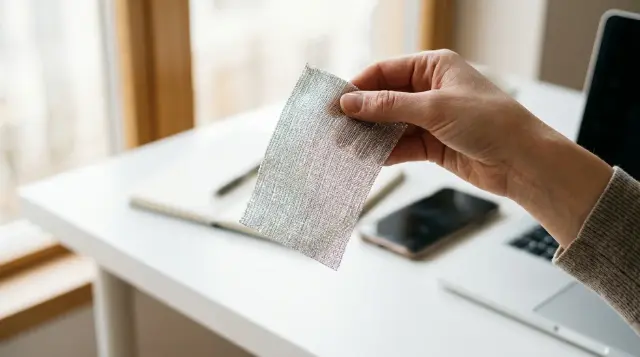
The most effective EMF blocker is the one you'll actually wear every day. A garment sitting in your closet because it's uncomfortable doesn't protect you from anything. Look for tested shielding, real materials, and a design you genuinely want to put on in the morning.
What Does an EMF Blocker Actually Do?
Let's start with the basics. An emf blocker, when we're talking about clothing, is a garment made with conductive materials woven into the fabric. These materials (usually silver, copper, or nickel) create a mesh that reflects or absorbs electromagnetic fields before they reach your skin. The concept goes back to the Faraday cage, first demonstrated by physicist Michael Faraday in 1836. A conductive enclosure blocks external electric fields. Same idea, different form factor.
When the mesh openings in the fabric are smaller than the wavelength of the incoming radiation, the signal can't pass through. For RF frequencies between about 300 MHz and 10 GHz, which covers everything from your cell phone to your Wi-Fi router and 5G antennas, a tightly woven silver fabric can block 99% or more of the signal [1].
Quick Q&A
Q: How is EMF-blocking fabric different from wrapping yourself in aluminum foil?
A: EMF-blocking textiles use microscopic conductive fibers woven permanently into breathable fabric, providing consistent shielding without sacrificing comfort or airflow.
Now, a garment isn't a sealed Faraday cage. It doesn't cover your entire body, and it has openings at the neck, sleeves, and hem. So it won't eliminate 100% of your exposure. But it can significantly reduce the electromagnetic radiation hitting the areas it covers, especially the torso. Think of it less like a force field and more like sunscreen. It doesn't make you invincible, but it meaningfully reduces your dose.
The Faraday EMF Collection from Proteck'd, for example, uses silver-infused fibers specifically designed for this purpose. The shielding is built into the fabric itself, not sprayed on or stuck on as an afterthought. That distinction matters more than most people realize.
Does the Science Support Wearing EMF Protection Clothing?
This is where things get nuanced. Let's be honest about what we know and what we don't. The World Health Organization's International Agency for Research on Cancer (IARC) classified radiofrequency electromagnetic fields as Group 2B, meaning "possibly carcinogenic to humans," back in 2011 [1]. That same classification includes things like talcum powder and pickled vegetables. It's not a definitive "this causes cancer" statement. But it's not a clean bill of health, either.
A 2017 meta-analysis published in Environmental Research found a statistically significant association between long-term cell phone use (10+ years) and glioma, with an odds ratio of 1.33 [2]. The National Toxicology Program's landmark $30 million study in 2018 found "clear evidence" of heart tumors in male rats exposed to RF radiation similar to 2G and 3G cell phone frequencies [3]. These aren't fringe studies. They're peer-reviewed and government-funded.
On the other side, the FCC maintains that devices meeting their SAR limit of 1.6 W/kg are safe for consumer use. Many mainstream health organizations echo that position. The FDA has stated it hasn't found sufficient evidence to establish a causal link between RF exposure and adverse health effects in humans. So the honest answer? The science is unsettled. Reasonable people can disagree on the level of precaution that's warranted.
For people who want to reduce their exposure while the research continues, RF shielding clothing is one of the more practical options available. It doesn't require you to give up your phone or move off the grid. It's just a layer of protection. For a lot of people, that peace of mind has real value. If you're curious about broader strategies, our guide on Protecting Your Family from 5G Radiation: What Actually Works goes deeper into the full picture.
Does Silver Fabric Actually Block EMF?
Yes. And it's not magic. It's physics. Silver is one of the most electrically conductive elements on the periodic table, with a conductivity of approximately 6.3 × 10⁷ S/m. When you weave silver threads into textile fibers, the resulting fabric acts as a flexible conductive mesh. According to testing standards like IEEE 299 and ASTM D4935, quality silver-threaded fabrics consistently demonstrate 30 to 60 dB of shielding effectiveness across frequencies used by cell phones, Wi-Fi, Bluetooth, and 5G.
To put that in practical terms: 30 dB of attenuation means 99.9% of the signal is blocked. At 60 dB, you're stopping 99.9999%. Those are real numbers, verifiable with an RF meter. Not marketing claims you have to take on faith.
One thing to watch out for is wash durability. Cheaper products sometimes use a silver coating that degrades after a handful of washes. Higher-quality garments, like those in Proteck'd's Men's EMF Apparel and Women's EMF Apparel lines, use silver fibers woven directly into the yarn. The shielding is part of the fabric's structure, not a surface treatment that washes away.
Quick Q&A
Q: Can I verify EMF-blocking claims at home?
A: Yes, an affordable RF meter like the TriField TF2 (around $180) lets you measure the signal on both sides of the fabric and confirm the attenuation yourself.
Copper and nickel are also used in some EMF protection clothing, and they work on the same principle. Silver has the advantage of being antimicrobial and relatively comfortable against skin, though, which is why it's the most popular choice for wearable shielding. If someone tells you their product blocks EM radiation but won't tell you what conductive material is in the fabric? That's a red flag.

How Can You Tell If an EMF-Blocking Product Actually Works?
This might be the most important question in the entire article. The market is full of products that make big promises with zero evidence. Here's a simple framework: if a company can't show you lab test results or third-party shielding data, walk away. Period.
Legitimate EMF protection clothing should reference specific testing standards. The two most common are ASTM D4935 for planar materials and IEEE 299 for shielding enclosures. These tests measure shielding effectiveness in decibels (dB) across a range of frequencies. Ask the brand for their test results. If they can't provide them, or if they substitute vague language like "harmonizes your energy field" instead of measurable attenuation data, you're looking at a gimmick.
You can also do your own testing. Buy an RF meter. I've mentioned the TriField TF2, but even a cheaper model like the Acoustimeter AM-11 will give you useful readings. Hold it near a Wi-Fi router, note the reading, then drape the garment between the meter and the router. The difference in signal strength is your shielding effectiveness. Takes about 30 seconds. Removes all guesswork.
Here's a real example. I tested a generic "EMF-blocking" phone sticker I found online. It did absolutely nothing. Zero change in the meter reading. Then I tested a silver-fiber t-shirt from a reputable brand. The reading dropped from 1.8 V/m to 0.02 V/m. That's the difference between real electromagnetic field shielding and a sticker that costs $29.99 and does nothing but drain your wallet.
What About EMF Exposure While You Sleep?
Sleep is actually where the EMF conversation gets really interesting. Your body does its most critical repair work at night. Research from the University of Melbourne published in 2014 found that exposure to RF electromagnetic radiation affected melatonin production in some study participants, and melatonin is the hormone that regulates your sleep-wake cycle [4]. If your bedroom is full of wireless signals, you might be sabotaging your rest without realizing it.
Think about what's in your bedroom right now. Phone on the nightstand. Maybe a smart speaker. A Wi-Fi router in the next room, broadcasting 24/7. If you live in an apartment, you might be picking up signals from a dozen neighboring routers. The cumulative electromagnetic radiation exposure in a typical bedroom is actually higher than most people assume.
This is one area where wearable EMF shielding can complement broader strategies. Wearing an EMF-blocking shirt to bed, for instance, reduces the radiation hitting your core while you sleep. But clothing is just one piece of the puzzle. For the full strategy, check out EMF Blocking for Better Sleep: The Complete Guide or our article on Why You Can't Sleep: Could EMF Be the Cause?.
Simple changes make a big difference. Put your phone in airplane mode. Move the router out of the bedroom. Consider a shielding canopy over your bed. If you want to go further, our guide to A Low-EMF Bedroom: The Simple Sleep Upgrade walks you through it step by step. The point isn't to live in fear. It's to sleep better. Reducing your nighttime EM radiation exposure is one evidence-based way to do that.
Is EMF-Blocking Clothing Comfortable Enough for Daily Wear?
A few years ago, I would have said no. Early EMF protection clothing felt like wearing a science experiment. Stiff. Weird-looking. About as breathable as a raincoat. But the textile technology has improved dramatically. Modern silver-fiber fabrics feel remarkably similar to regular cotton or polyester blends. You wouldn't know there's shielding built in unless someone told you.
Proteck'd has been at the forefront of this shift. Their garments are designed to look and feel like normal streetwear, not protective gear. I think that matters a lot, because the most effective emf blocker is the one you'll actually wear every day. A product sitting in your closet because it's uncomfortable doesn't protect you from anything.
Breathability is another common concern. Silver fibers are naturally thermoregulating, meaning they help dissipate heat. Many wearers actually report that silver-threaded shirts feel cooler than comparable cotton tees. Silver is also naturally antimicrobial, which means less odor buildup. That's a legitimate bonus for something you're wearing all day.
The biggest trade-off is price. A silver-fiber shirt costs more than a basic cotton tee. Expect to pay anywhere from $60 to $150 depending on the garment and the silver content. Is that a lot? Compared to a regular t-shirt, sure. But compared to other health investments people make without blinking, like a $50 monthly supplement stack or a $200 air purifier, it's in the same ballpark. And unlike supplements, you can actually test a garment's effectiveness with a $30 meter.
What Types of EMF-Blocking Products Are Available Beyond Clothing?
Clothing is one category in a much larger ecosystem of electromagnetic field protection products. Other commonly recommended products include EMF-blocking phone cases, airtube headphones (which prevent RF signals from traveling up wired earbuds to your head), smart meter shields, and router guards. Each one addresses a different source of exposure.
An EMF meter is arguably the single most useful product you can buy, because it turns invisible radiation into a visible number. Without measurement, you're just guessing. Popular options include the TriField TF2, the Safe and Sound Pro II, and the Cornet ED88TPlus. Prices range from about $50 for basic models to $400 or more for professional-grade instruments.
For whole-room protection, Faraday canopies and window films can shield an entire sleeping area or home office. These use the same conductive mesh principle as clothing but on a larger scale. If you're planning a broader approach, our Low-EMF Home Design: A Complete Guide covers everything from paint to curtains to wiring strategies.
What I'd avoid: stickers, pendants, and "harmonizing" devices that claim to neutralize EMF without any conductive material or measurable shielding. If a product can't demonstrate attenuation in decibels, it's not an emf blocker. It's a placebo with a price tag. Stick with products grounded in conductivity and Faraday principles, and you'll be on solid ground.
So, Is EMF-Blocking Clothing Actually Worth the Investment?
Let me be straight with you. If you're looking for absolute certainty that RF radiation at consumer levels causes harm, the science isn't there yet. But if you're looking for zero-risk certainty that it's completely safe, the science isn't there either. We're in that uncomfortable middle ground where the precautionary principle actually makes a lot of sense.
The WHO's IARC classification, the NTP study findings, and the growing body of epidemiological research all point in the same direction: there are legitimate reasons to reduce your exposure where practical [1] [3]. Wearable EMF protection does exactly that, without requiring you to change your lifestyle, give up technology, or spend thousands on whole-home solutions.
For people who carry their phone in a pocket all day, who work near cell towers or in buildings saturated with Wi-Fi, or who simply want to lower their overall electromagnetic radiation load, a quality EMF-blocking shirt or pair of boxers is one of the easiest steps you can take. The Faraday EMF Collection is a good place to start if you want tested, wearable shielding that doesn't compromise on style.
Is it for everyone? Maybe not. But for the growing number of people who want to take a measured, evidence-informed approach to their health, it's a practical tool that does what it claims, when it's built right. In a market full of gimmicks, that's worth something.
- EMF-blocking clothing works through conductive fibers (silver, copper, nickel) that reflect electromagnetic radiation, with quality fabrics blocking 99% or more of RF signals.
- The WHO classified RF electromagnetic fields as a Group 2B possible carcinogen in 2011, and the NTP found clear evidence of tumors in animal studies at similar frequencies.
- Always verify EMF protection claims with third-party lab test results (ASTM D4935 or IEEE 299 standards) or your own RF meter test.
- Sleep is a high-leverage time to reduce EMF exposure, since your body performs critical repair work at night and melatonin production may be affected by RF radiation.
- Avoid products that use vague language like 'harmonizing' or 'neutralizing' without measurable shielding data in decibels.
Frequently Asked Questions
Yes, when it contains conductive materials like silver, copper, or nickel woven into the fabric. Quality garments tested to ASTM D4935 standards show 30 to 60 dB of attenuation, which translates to blocking 99% to 99.9999% of RF radiation. The key is verifying claims with lab data or your own RF meter.
The most common material is silver fiber, prized for its high conductivity, comfort against skin, and antimicrobial properties. Copper and nickel show up in some products too. The conductive material needs to be woven into the fabric structure, not just coated on the surface, to maintain effectiveness through washing.
Most silver-fiber garments can be machine washed on a gentle cycle with mild detergent. Avoid bleach and fabric softener, though, because they can degrade the conductive fibers over time. Always check the care label. Some brands recommend cold water only or air drying to preserve shielding effectiveness.
Grab an RF meter like the TriField TF2 or Cornet ED88TPlus. Place the meter near a Wi-Fi router or your cell phone, note the reading, then drape the garment between the device and the meter. A genuine EMF-blocking garment will show a significant drop. The whole test takes about 30 seconds.
The science is still evolving. The WHO's IARC classified RF electromagnetic fields as Group 2B (possibly carcinogenic) in 2011, and the US National Toxicology Program found clear evidence of tumors in rats exposed to RF radiation. However, agencies like the FCC and FDA maintain that devices meeting current SAR limits are safe. The precautionary principle suggests reducing exposure where practical.
It depends on the frequency. Sub-6 GHz 5G signals, which make up most current 5G networks, are well within the shielding range of silver-fiber fabrics. Millimeter wave 5G (24 to 39 GHz) has shorter wavelengths that are actually easier to block with the same fabrics, since the mesh openings are smaller than the wavelength.
Expect to pay between $60 and $150 for a quality EMF-blocking shirt or undergarment. The higher cost reflects the silver or copper content in the fabric. Budget products under $30 often use thin metallic coatings that degrade after a few washes and provide minimal shielding.
EMF-blocking products use conductive materials to physically reflect or absorb electromagnetic radiation. Their effectiveness is measurable in decibels with an RF meter. EMF-harmonizing products claim to "neutralize" or "restructure" radiation without any conductive material. There's no peer-reviewed evidence supporting harmonizing claims, and they produce no measurable change on an RF meter.
Many users report improved sleep quality when reducing nighttime EMF exposure. Research from the University of Melbourne suggests RF radiation may affect melatonin production, which regulates your sleep cycle. Wearing an EMF-blocking shirt to bed is one strategy, ideally combined with putting your phone in airplane mode and moving your router out of the bedroom.
Quality EMF-blocking phone cases use a shielding material on one side (the side facing your body) to redirect RF radiation away from you. They don't block the signal entirely, since your phone still needs to communicate with cell towers. According to independent testing, well-designed cases can reduce SAR exposure by 60 to 90% on the shielded side.
References
- International Agency for Research on Cancer (IARC), WHO – IARC classified radiofrequency electromagnetic fields as Group 2B, possibly carcinogenic to humans, in 2011
- National Institutes of Health (PubMed) – A 2017 meta-analysis in Environmental Research found a statistically significant association between long-term cell phone use and glioma risk
- National Institute of Environmental Health Sciences (NIEHS) – The National Toxicology Program found clear evidence of heart tumors in male rats exposed to RF radiation similar to 2G and 3G frequencies
- National Institutes of Health (PubMed) – Research suggests RF electromagnetic radiation exposure may affect melatonin production and sleep quality
About the Author
Proteck'd EMF Apparel
Health & EMF Specialists
The Proteck'd team covers EMF protection, silver-fiber apparel, and practical ways to reduce everyday radiation exposure. Every piece Proteck'd ships is designed, tested, and worn by the people who build it.
Get the Free EMF Home Audit Checklist
A room-by-room PDF that walks you through the biggest EMF sources in your house and what to do about each one. No cost, no fluff.
Download the Checklist →✓30-day returns✓Free shipping✓Free returns✓Silver fiber shielding


Hinterlassen Sie einen Kommentar