


How Reliable Are Health Wearables?: What the Research Shows

Here's a number that might stop you mid-scroll: Stanford University researchers found that popular wearables can overestimate calorie burn by as much as 93%. Not 9.3%. Ninety-three percent. That's your fitness tracker telling you that you torched 600 calories when the real number was closer to 310. So if you've been wondering how to reduce wearable technology health monitoring errors and actually make sense of the gadgets on your wrist, you're asking exactly the right question.
The global wearable health device market is on track to exceed $180 billion by 2030. Apple, Fitbit, Garmin, Samsung. They're all racing to cram more sensors into smaller packages. Heart rate, blood oxygen, skin temperature, sleep stages, stress scores. The pitch is seductive: clinical-grade health data, on your body, around the clock.
But pitch and reality don't always line up. A 2024 systematic review in Neural Computing and Applications used the PRISMA methodology to examine wearable health tech literature from 2021 through 2025, and the results were mixed at best [1]. Some metrics genuinely hold up. Others are more like educated guesses dressed in a lab coat.
Then there's the stuff that never comes up at product launches. The EMF exposure from constant Bluetooth and Wi-Fi signals pressed against your skin all day. The privacy questions around sharing biometric data with cloud servers. The environmental cost of devices built to be replaced every two years. This article breaks down what the research actually says about wearable reliability, where you can trust the numbers, and what you can do to protect yourself.
Key Takeaways
How Accurate Are Health Wearables for Heart Rate and Step Counting?
Good news first. Heart rate tracking is the most reliable thing consumer wearables do. Most modern devices use photoplethysmography (PPG), which shines green LED light into your skin and measures blood volume changes. A 2023 review in BMJ Open found that wrist-worn optical sensors came within 5-10% of medical-grade chest-strap ECG monitors during rest and moderate activity [2]. That's actually useful information.
Step counting holds up well, too. Accelerometers have been around for decades and the tech is mature. Research from the National Institutes of Health shows that most popular fitness trackers hit within about 5% accuracy during normal walking. The catch? Accuracy drops when your arm movements get irregular, like pushing a shopping cart or carrying groceries. Your tracker might miss 20-30% of your steps when your wrist stays still.
Things get shakier during high-intensity exercise. When you're sprinting or doing CrossFit, blood flow patterns shift, your wrist sweats, and the sensor bounces around. A Cleveland Clinic study noted that wearable heart rate accuracy declined significantly above 150 BPM, sometimes lagging real-time heart rate by 10 or more beats per minute. If you're a serious athlete? A chest strap still beats your watch.
Quick Q&A
Q: Are fitness trackers accurate enough for medical decisions?
A: No. The FDA classifies most consumer health wearables as general wellness products, not medical devices, meaning they haven't been validated to clinical accuracy standards.
So here's the baseline: heart rate and steps are your wearable's strongest suit. Not perfect, but solid enough for general wellness awareness. If you want to see how other smartwatch metrics stack up, we've covered that in our guide on How Reliable Are Smartwatches: What to Trust and What to Ignore.
Why Are Calorie Burn and Sleep Tracking So Unreliable?
This is where the research gets awkward for wearable manufacturers. In 2017, Stanford University's School of Medicine tested seven popular wearables, including the Apple Watch and Fitbit Surge, and found that the most accurate device was still off by 27% on calorie expenditure. The least accurate missed by 93%. That study, led by Dr. Euan Ashley, tested 60 participants across diverse skin tones and body types. The errors weren't random. They were systematic.
The core problem? Calorie burn depends on things your wearable simply can't measure. Muscle mass. Metabolic rate. Hormonal state. Digestion. Body composition. Your watch knows your heart rate and your movement patterns, and it runs those through an algorithm built on a pile of assumptions. Those assumptions fall apart for anyone who isn't an average-sized adult doing predictable exercise.
Sleep tracking has similar issues. Most wearables estimate sleep stages using movement data combined with heart rate variability. But a 2022 study in Nature and Science of Sleep compared consumer wearable sleep data against polysomnography, the clinical gold standard, and found that wearables overestimated total sleep time by 30 to 50 minutes on average. They also frequently got sleep stages wrong, tagging light sleep as deep sleep about 40% of the time.
Does that make sleep and calorie data worthless? Not completely. Trends over weeks and months can still reveal useful patterns, like whether your sleep duration is consistently dropping or your activity level is creeping upward. Just treat these numbers as rough directional signals, not measurements you'd bet money on. For a deeper look at which wearable metrics actually deserve your trust, check out How Accurate Are Health Wearables: What to Trust and What to Ignore.
Can You Reduce EMF Exposure From Wearable Devices?
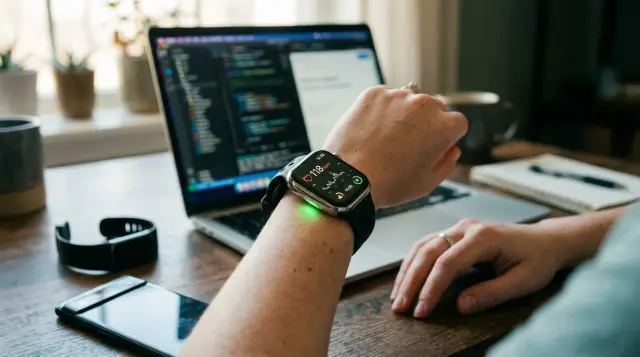
Your smartwatch communicates with your phone via Bluetooth Low Energy, which operates at 2.4 GHz. Some devices also use Wi-Fi for software updates and cellular connections for standalone functionality. That means there's a small radio transmitter strapped to your skin for up to 24 hours a day. The power output is low, typically around 1 milliwatt, but the duration of exposure is the part that raises questions.
The International Agency for Research on Cancer (IARC), a branch of the World Health Organization, classified radiofrequency electromagnetic fields as "possibly carcinogenic to humans" (Group 2B) back in 2011 [3]. That classification covers the same frequency range used by Bluetooth and Wi-Fi. Now, "possibly carcinogenic" is a long way from "definitely dangerous," and plenty of researchers argue the evidence remains inconclusive. But if you'd rather minimize exposure while still using wearable health tech, you've got options.
The simplest approach to how to reduce wearable technology health monitoring EMF concerns comes down to three strategies. First, enable airplane mode on your wearable when you don't need real-time syncing. Second, avoid sleeping with your device pressed against your skin, or at least set it on a bedside table. Third, consider wearing EMF-shielding clothing during extended use. Proteck'd's Faraday Protection Collection is specifically designed to attenuate electromagnetic radiation, and you can learn more about the science behind it on the EMF Protection Benefits page.
Quick Q&A
Q: How much EMF does a typical smartwatch emit?
A: Most smartwatches emit Bluetooth Low Energy signals at about 1 milliwatt of power at 2.4 GHz, which is well below FCC SAR limits but represents continuous low-level exposure when worn 24/7.
For men who want everyday style with practical RF shielding built in, the Men's Faraday Tech Wear line offers garments woven with silver fiber that block a measurable percentage of electromagnetic radiation. It's one concrete way to reduce wearable technology health monitoring exposure without giving up the device entirely.
Your wearable can tell you your heart rate with 90-95% accuracy, but it might be off by 93% on calories burned. The smartest thing you can do is know which numbers to trust, which to question, and how to protect yourself from the risks nobody talks about at product launches.

What Happens to Your Health Data After Your Wearable Collects It?
Here's a question most people never think to ask: who actually owns the biometric data your wearable generates? In most cases, the answer isn't you. When Google acquired Fitbit in 2021 for $2.1 billion, one of the central concerns raised by the European Commission was the massive health dataset that came with the deal. Heart rate records, sleep patterns, menstrual cycles, GPS-tracked exercise routes. All of it, for millions of users worldwide.
A 2023 report from the Mozilla Foundation's "Privacy Not Included" project evaluated 15 popular fitness wearables and found that 12 of them shared user health data with third parties for advertising or analytics purposes. Only three provided genuinely transparent opt-out options. The data isn't just sitting on your wrist. It's flowing to cloud servers, getting processed by algorithms, and in many cases being monetized.
The Health Insurance Portability and Accountability Act, better known as HIPAA, doesn't cover consumer wearable data unless it's explicitly integrated with a healthcare provider's system. Your Fitbit data has fewer legal protections than a doctor's handwritten note. If you want to understand how to reduce wearable technology health monitoring privacy risks, start by reviewing what permissions your device's companion app actually requests. Then check our guide on Digital Security: The Complete Guide for a broader look at protecting your personal information.
Also worth doing: review your device's data-sharing settings regularly. Both Apple Health and Google Fit allow you to restrict third-party access, but the defaults tend to be permissive. For a more comprehensive approach to digital privacy, we've put together a resource on Taking Back Your Online Life that covers everything from app permissions to browser habits.
Do Wearables Actually Improve Health Outcomes?
The big question is whether all this monitoring actually makes people healthier. The evidence is more complicated than you'd expect. A 2024 review in the journal Cureus examined chronic disease management using wearable devices and concluded that they do improve adherence to physical activity goals and medication schedules, particularly for patients with cardiovascular conditions [4]. Patients using wearable cardiac monitors caught atrial fibrillation episodes an average of 4.2 days earlier than those relying on symptoms alone.
But there's a flip side. A phenomenon researchers call "cyberchondria" is growing, where constant health monitoring fuels anxiety rather than well-being. A 2023 study from King's College London found that 29% of participants who used health wearables for more than six months reported increased health-related anxiety. Some described obsessively checking their heart rate. Others lost sleep over minor fluctuations in their readings.
The sweet spot, according to the research, seems to be periodic rather than continuous monitoring. Wearing your device during workouts and checking trends weekly appears to deliver most of the benefits without the psychological downsides. Dr. Gregory Marcus, a cardiologist at UC San Francisco, has argued publicly that "the data should serve you, not the other way around." That's a mantra worth borrowing.
If you're curious about the specific sensors inside your smartwatch and how they compare to clinical tools, How Reliable Are Smartwatches: What the Research Shows goes sensor by sensor through the evidence. Knowing where your device excels, and where it doesn't, is the first step toward using it wisely.
How Can You Reduce the Environmental Impact of Wearable Health Tech?
This one doesn't get talked about enough. A 2024 article in Nature examined the environmental footprint of wearable healthcare electronics and found that a single fitness tracker generates roughly 7.6 kg of CO2 equivalent over its lifecycle, from mineral extraction through manufacturing to disposal. Multiply that by the estimated 500 million units shipped annually and the numbers get big fast.
The biggest contributor isn't the electricity your watch uses. It's lithium battery production and the mining of rare earth metals like tantalum and cobalt. The average wearable gets replaced every 18 to 24 months, creating a steady stream of e-waste. According to the Global E-waste Monitor 2024, only about 22% of consumer electronics are properly recycled globally.
So what can you actually do? Extend your device's lifespan. The environmental cost is front-loaded in manufacturing, so keeping your current wearable for an extra year makes a bigger difference than buying a supposedly "greener" replacement. Choose devices with replaceable bands and batteries when possible. And when you do upgrade, use manufacturer take-back programs. Apple, Samsung, and Garmin all offer trade-in or recycling options.
There's a parallel here with how to reduce wearable technology health monitoring's broader footprint. Being a thoughtful consumer means thinking about more than just the data on your wrist. It means considering the full supply chain behind the device that generates it.
What's the Smartest Way to Use a Health Wearable in 2025?
After going through the research, here's what I'd tell a friend who just bought a new health wearable. Trust the heart rate data during rest and moderate exercise. Pay attention to step counts and activity trends. Be skeptical of calorie estimates, sleep-stage breakdowns, and "stress scores." And never make a medical decision based solely on a consumer wearable's reading without confirming it with a healthcare provider. Just don't.
Manage your EMF exposure proactively. You don't have to choose between useful health data and minimizing electromagnetic radiation. Simple habits make a real difference: take your watch off during sleep, use airplane mode when you're not actively tracking, and consider shielding garments from Proteck'd's Faraday Protection Collection. You get the benefits without ignoring the precautionary principle.
Protect your data like you'd protect your Social Security number. Biometric data is uniquely sensitive because, unlike a password, you can't change your heart rate pattern or your gait signature. Review app permissions. Opt out of data sharing where you can. Stay informed.
And finally, don't let the numbers on your wrist replace the way you actually feel. The best health wearable is a tool that supports your awareness without hijacking your attention. The research shows these devices work best when you use them intentionally rather than obsessively. That might be the most useful finding of all.
Frequently Asked Questions
Q: How accurate are health wearables compared to medical devices?
For heart rate, most wearables land within 5-10% of clinical ECG monitors during rest and moderate exercise. But for metrics like calorie burn, blood oxygen, and sleep stages, accuracy drops considerably. Stanford University research found calorie estimates can miss by up to 93%. The FDA does not classify most consumer wearables as medical devices.
Q: Do health wearables emit harmful EMF radiation?
Health wearables emit low-level radiofrequency EMF through Bluetooth and Wi-Fi, typically at 2.4 GHz with about 1 milliwatt of power. The WHO's IARC classifies this type of radiation as "possibly carcinogenic" (Group 2B), though the evidence remains inconclusive. The primary concern is cumulative exposure from wearing devices 24/7 against the skin.
Q: How can I reduce EMF exposure from my smartwatch?
You can cut exposure by enabling airplane mode when you don't need real-time data syncing, removing the device during sleep, and wearing EMF-shielding garments. Proteck'd's Faraday Protection Collection uses silver-fiber fabric designed to attenuate electromagnetic radiation while you wear your devices.
Q: Is my health wearable data protected by HIPAA?
In most cases, no. HIPAA only applies when wearable data is integrated into a healthcare provider's system. A 2023 Mozilla Foundation report found that 12 out of 15 popular fitness wearables shared user health data with third parties for advertising or analytics.
Q: Can fitness trackers cause health anxiety?
They can, yes. A 2023 King's College London study found that 29% of long-term wearable users reported increased health-related anxiety. Researchers recommend periodic rather than continuous monitoring, and focusing on weekly trends instead of fixating on real-time fluctuations.
Q: Should I trust my wearable's sleep tracking data?
With a healthy dose of skepticism. Studies comparing wearable sleep data to polysomnography found that wearables overestimate total sleep time by 30-50 minutes and misclassify sleep stages about 40% of the time. Trend data over weeks can still be useful, but individual night readings aren't precise enough for clinical use.
Q: How often should I replace my fitness tracker?
From both a performance and environmental standpoint, keeping your device longer than the typical 18-24 month cycle is the smarter move. Manufacturing accounts for most of the environmental impact, so an extra year with your current device makes a bigger difference than upgrading to a newer "eco-friendly" model.
Q: What is the most reliable metric on a health wearable?
Heart rate during rest and moderate activity consistently comes out on top, typically within 5-10% of medical-grade monitors. Step counting is a close second, with most devices accurate within about 5% during normal walking. Both rely on mature sensor technology with years of refinement behind them.
Q: Do health wearables actually help people get healthier?
The evidence says yes, with some caveats. A 2024 review in Cureus found that wearable devices improve adherence to physical activity goals and can flag cardiac events like atrial fibrillation days earlier than symptom-based detection. However, the benefits seem strongest when devices are used periodically and intentionally rather than obsessively.
Q: How do I reduce the environmental impact of my wearable device?
The single most effective step is extending your device's lifespan, since manufacturing accounts for most of the environmental cost. Choose devices with replaceable bands and batteries when possible. When you do upgrade, use manufacturer take-back programs from Apple, Samsung, or Garmin to ensure proper recycling of rare earth metals and lithium batteries.
References
- Neural Computing and Applications (Springer Nature) – A 2024 PRISMA systematic review examining wearable health tech literature from 2021-2025 found significant variability in sensor reliability across devices and metrics.
- BMJ Open – Wrist-worn optical heart rate sensors achieved accuracy within 5-10% of medical-grade chest-strap ECG monitors during rest and moderate activity.
- International Agency for Research on Cancer (WHO/IARC) – IARC classified radiofrequency electromagnetic fields as possibly carcinogenic to humans (Group 2B) in 2011.
- Cureus (PMC/National Library of Medicine) – Wearable devices improve adherence to physical activity goals and medication schedules in chronic disease management, particularly for cardiovascular conditions.
About the Author
Proteck'd EMF Apparel
Health & EMF Specialists
The Proteck'd team covers EMF protection, silver-fiber apparel, and practical ways to reduce everyday radiation exposure. Every piece Proteck'd ships is designed, tested, and worn by the people who build it.
Get the Free EMF Home Audit Checklist
A room-by-room PDF that walks you through the biggest EMF sources in your house and what to do about each one. No cost, no fluff.
Download the Checklist →✓30-day returns✓Free shipping✓Free returns✓Silver fiber shielding


