


The Future of AI: A Realistic Look Ahead

Here's a number worth sitting with: by 2030, the average person will interact with AI systems more than 4,000 times per day. Most of those interactions? You won't even notice them. That's not science fiction. It's a projection built on the current trajectory of smart devices, autonomous agents, and ambient computing already creeping into our lives. So how does future technology trends work, and what does all of this actually mean for you?
The short answer: these trends don't show up one at a time. They stack. Artificial intelligence feeds quantum computing research. Quantum breakthroughs speed up machine intelligence. Faster networks connect everything. And before you know it, your home, your car, and your clothes are all part of one enormous, always-on digital mesh.
That connectivity brings real benefits. Faster medical diagnoses. Smarter energy grids. Personalized education that actually adapts to how you learn. But it also brings something most tech forecasts skip right over: a massive increase in the electromagnetic radiation humming through your environment every single day.
I've spent the last several months reading the major reports from Deloitte, Accenture, and academic institutions to piece together a realistic picture of where we're headed. Not the breathless hype. Not the doom spiral either. Just a clear look at what's coming, why it matters, and what you can actually do about the parts that affect your health and privacy.
Let's get into it.
Key Takeaways
How Does Future Technology Trends Work in Practice?
Understanding how does future technology trends work starts with one idea: convergence. Individual technologies like AI, 5G, and edge computing don't evolve on their own. They feed each other. According to Deloitte's Tech Trends 2026 report, the most successful organizations are the ones recognizing these overlapping patterns and moving from experimentation to measurable impact [1].
Think of it like layers in a cake. At the bottom sits raw computing power, expanding through quantum research and specialized AI chips from companies like NVIDIA and Google DeepMind. On top of that you've got connectivity: 5G, satellite internet from Starlink, and early 6G research. Then come the applications most people actually see. Generative AI tools. Autonomous vehicles. Smart home systems.
Accenture's 2025 Technology Vision calls this the era of "abundance, abstraction, and autonomy" [2]. Development costs for AI-powered applications are plummeting, which means more software, more connected devices, and more data flowing through the air around you. Every layer of this cake generates electromagnetic fields. Your smart thermostat. Your neighbor's Ring doorbell. The cell tower that went up last year. They're all contributing.
If you've been following along with The Future of Technology: The Trends Shaping Tomorrow, you already know these trends are speeding up, not slowing down. The question isn't whether this tech is coming. It's whether you're ready for the side effects.
Quick Q&A
Q: What makes future tech trends different from past innovation cycles?
A: Unlike previous waves, today's trends hit simultaneously. AI, quantum computing, and pervasive connectivity all reinforce each other, accelerating change at a pace that creates compounding effects on daily EMF exposure.
What Are the Biggest Emerging Technology Trends Through 2030?
Let's break down the five shifts that virtually every major research firm agrees on. These aren't speculative. They're already happening.
Agentic AI Systems. This is the big one. We've moved past chatbots. According to Stanford University's 2024 AI Index Report, investment in autonomous AI agents that can plan, execute, and self-correct has surged more than 60% year over year [3]. Google's Gemini, OpenAI's GPT architecture, and Meta's LLaMA models are all racing toward agents that don't just answer questions but actually complete multi-step tasks on your behalf. Ordering groceries. Managing your calendar. Negotiating with your insurance company. These agents will run around the clock, connected to the cloud, generating constant data traffic.
Quantum Computing. IBM's Condor processor hit 1,121 qubits in late 2023, and the company is targeting 100,000-qubit systems by 2033. Quantum won't replace your laptop, but it will transform drug discovery, cryptography, and logistics behind the scenes. For everyday people, the biggest impact will be on cybersecurity. If you care about protecting your digital life, our guide on Cybersecurity in the Age of AI covers that angle in detail.
Edge AI and Low-Latency Infrastructure. Instead of sending all your data to a distant server, edge computing processes it locally. On your phone. In your car. Inside the sensor on your front door. This is faster and more private, but it also means more wireless devices in more locations, all emitting radiofrequency energy. 5G networks can support up to one million connected devices per square kilometer. That's a staggering amount of ambient RF radiation in dense urban areas.
Human-Machine Interfaces. Brain-computer interfaces (BCIs) from companies like Neuralink and Synchron are moving from lab experiments to clinical trials. Elon Musk's Neuralink received FDA clearance for human trials in May 2023. Wearable health monitors, AR glasses, and haptic feedback systems are also blurring the line between your body and your tech. This trend makes the conversation about EMF Protection Benefits more relevant than it's ever been.
The Convergence of Digital and Physical Systems. Digital twins, smart cities, and industrial IoT are merging the virtual and physical worlds. Deloitte estimates that by 2027, organizations using digital twins will see a 20% improvement in operational efficiency [1]. But all of those connected sensors, all of that wireless communication, means your physical environment is being saturated with electromagnetic fields in ways that simply didn't exist a decade ago.
Why Should You Care About Increased EMF Exposure from AI and IoT?
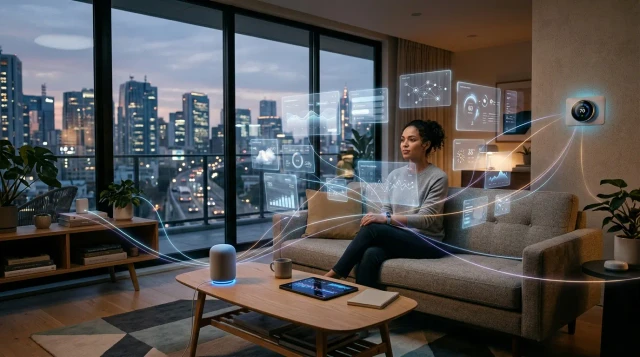
Here's the thing most future-of-tech articles won't tell you. Every connected device in your life is a tiny radio transmitter. Your smart speaker. Your fitness tracker. Your Wi-Fi mesh system. Each one adds to the total electromagnetic radiation floating through your living space. And as emerging tech trends push us toward hundreds of connected devices per household, that cumulative exposure keeps climbing.
The World Health Organization's International Agency for Research on Cancer (IARC) classified radiofrequency electromagnetic fields as "possibly carcinogenic to humans" (Group 2B) back in 2011 [4]. That classification hasn't been downgraded. Meanwhile, the number of RF-emitting devices in the average home has grown from about 10 in 2011 to over 25 in 2024, with projections pushing past 50 by 2030.
I'm not saying you should throw your phone in a lake. What I am saying is this: as the tech world adds more wireless layers to your environment, being intentional about reducing unnecessary exposure just makes sense. Same logic as sunscreen. The sun isn't evil. But you don't lie in it for eight hours without some kind of protection.
That's exactly why products like Proteck'd's Faraday Protection Collection exist. These aren't tinfoil hats. They're garments made with silver-infused fabrics that have been tested to block a measurable percentage of RF radiation. If you're someone who spends all day around devices (and honestly, who doesn't?), having a layer of physical shielding is a practical step, not a paranoid one.
For men specifically, the Men's Faraday Tech Wear line offers options that look like normal, well-designed clothing while incorporating Faraday fabric technology. You can wear EMF-shielding apparel to work, to the gym, or around the house without anyone knowing the difference. That's how protection should work. Quietly and consistently.
Quick Q&A
Q: Does more smart home technology mean more EMF exposure?
A: Yes. Each Wi-Fi-connected device emits radiofrequency radiation, and as homes add more IoT devices, the cumulative EMF exposure inside the home increases proportionally.
The people who thrive in this future won't be the ones who reject technology entirely. They'll be the ones who adopt it thoughtfully, managing both their digital exposure and their physical environment with equal intention.
How Will AI Change Your Home and Daily Routine by 2030?
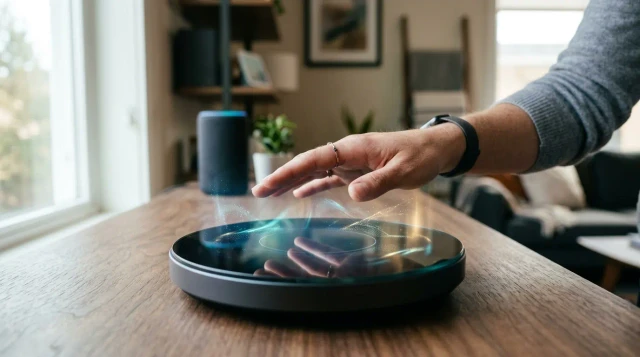
Let's get specific. By 2028, Gartner predicts that 75% of enterprises will shift from piloting generative AI to fully operationalizing it. That shift will ripple into consumer life fast. Your home will likely have an AI agent managing your energy usage, another monitoring your health through wearables, and a third handling your home security system. These won't be separate apps. They'll talk to each other continuously, creating a web of wireless communication inside your walls.
Smart home automation is already on this trajectory. If you're curious about where things stand right now, check out Home Automation Trends: How Your Home Will Change and Home Automation: The Complete Guide for a deeper breakdown. The speed of adoption is genuinely surprising.
What this means for your morning: machine intelligence will be embedded in almost every interaction you have before you walk out the door. Your alarm adjusts based on traffic patterns. Your coffee maker fires up when your sleep tracker senses you stirring. Your mirror shows your calendar while analyzing your skin. It sounds convenient, and it genuinely is. But every one of those devices is pinging a server or communicating locally through Bluetooth or Wi-Fi.
The people who thrive in this future won't be the ones who reject technology entirely. They'll be the ones who adopt it with their eyes open. That means choosing devices with better privacy settings, understanding how future technology trends work in terms of data collection, and taking physical steps to manage the EM radiation in their environment. It's not about fear. It's about making informed choices.
What Practical Steps Can You Take to Protect Yourself?
So what do you actually do with all this information? Here are real, actionable steps. Not abstract advice.
First, audit your digital exposure. Count how many wireless devices are active in your home right now. Router, phones, tablets, smart TV, smart speakers, wearables, smart plugs, security cameras. Most people are genuinely shocked when they tally it up. Once you know the number, you can make deliberate decisions about which devices need to stay on 24/7 and which can be powered down or hardwired with Ethernet.
Second, protect your data and your privacy. As AI agents become more autonomous, they'll have access to more of your personal information. That's a cybersecurity conversation and a personal boundaries conversation rolled into one. Our article on Taking Back Your Online Life walks through practical steps anyone can take right now.
Third, consider physical EMF shielding. This is where most tech-forward people have a blind spot. They'll encrypt their data, use a VPN, and install a firewall, but they won't think about the radio waves passing through their body all day. Proteck'd's Faraday Protection Collection uses silver-fiber technology woven into everyday apparel to block a significant portion of RF and EMF radiation. It's a tangible layer of defense that complements your digital security setup.
Fourth, stay informed but don't panic. Things change constantly. Understanding how does future technology trends work gives you the framework to evaluate new developments as they come, rather than reacting emotionally to every headline. Bookmark reliable sources, follow the research, and make decisions based on evidence.
Will Quantum Computing Break Current Security Systems?
I get asked this one a lot. The honest answer: eventually, yes. But not tomorrow. Current encryption standards like RSA-2048 rely on mathematical problems that classical computers can't solve in any reasonable timeframe. Quantum computers, once they reach sufficient scale and error correction, will crack those problems. The National Institute of Standards and Technology (NIST) has been working on post-quantum cryptography standards since 2016 and finalized the first set of algorithms in 2024.
For most people, the immediate risk isn't that a quantum computer will steal your bank password next Tuesday. The real risk is something researchers call "harvest now, decrypt later." Adversaries are already collecting encrypted data today with the plan to decrypt it once quantum machines are powerful enough. According to the NIST, transitioning critical infrastructure to quantum-resistant encryption will take 10 to 15 years. The clock is already ticking.
On a personal level, this reinforces why understanding how future tech trends work matters beyond just the gadget of the month. Security, privacy, and physical health aren't separate conversations. They're all facets of the same challenge: living well in an increasingly connected world.
Whether it's shielding your body from ambient electromagnetic radiation with Faraday-fabric clothing or shielding your data with quantum-resistant encryption, the principle is the same. Be proactive. The people who wait until a problem is unavoidable always end up paying more than the ones who prepared early.
Frequently Asked Questions
Q: How does future technology trends work?
Future technology trends work through convergence. Advances in AI, quantum computing, connectivity, and edge processing build on each other and create compounding effects. No single trend operates alone. For example, faster 5G networks enable edge AI, which in turn enables autonomous vehicles and smart home systems, all of which increase data traffic and ambient electromagnetic radiation.
Q: What is agentic AI and why does it matter?
Agentic AI refers to artificial intelligence systems that can plan, carry out, and adjust multi-step tasks without constant human supervision. Unlike a chatbot that waits for your prompt, an AI agent might independently research flights, compare prices, and book a ticket for you. Stanford's AI Index shows investment in this category grew over 60% in a single year.
Q: Will 5G and IoT devices increase my EMF exposure at home?
Yes, significantly. Every Wi-Fi-connected smart device emits radiofrequency radiation, and 5G infrastructure supports up to one million devices per square kilometer. As homes adopt more IoT devices, the cumulative RF exposure inside living spaces grows proportionally. Reducing unnecessary wireless devices and using EMF-shielding products can help manage this.
Q: Does Faraday fabric actually block EMF radiation?
It does. Faraday fabric uses conductive metal fibers, most commonly silver, woven into textile to create a shield against electromagnetic fields. Effectiveness depends on the fabric's construction and the frequency of the radiation, but tested Faraday garments can block a measurable and significant percentage of RF radiation from common sources like phones and Wi-Fi routers.
Q: Is radiofrequency radiation actually dangerous?
The WHO's International Agency for Research on Cancer classifies radiofrequency electromagnetic fields as Group 2B, meaning possibly carcinogenic to humans. That's not the same as saying RF definitively causes cancer, but it indicates enough evidence to warrant caution, especially as the number of RF-emitting devices in our environments keeps growing.
Q: When will quantum computing affect everyday people?
Quantum computing's biggest near-term impact on everyday life will come through cybersecurity. NIST estimates a 10 to 15 year transition to quantum-resistant encryption standards. The worry right now is "harvest now, decrypt later" attacks, where encrypted data gets stolen today to be cracked by future quantum machines. Most consumer-facing quantum applications are still 5 to 10 years out.
Q: How can I reduce EMF exposure without giving up my devices?
You don't have to go off-grid. Start by auditing your wireless devices and turning off or hardwiring the ones you can. Keep your phone away from your body when you're not using it. Consider wearing EMF-shielding clothing made with Faraday fabric for passive, everyday protection. Small changes in habits and environment can meaningfully reduce cumulative exposure.
Q: What is edge computing and how does it differ from cloud computing?
Edge computing processes data locally, on or near the device that creates it, instead of sending everything to a centralized cloud server. This reduces lag and can improve privacy since your data doesn't travel as far. The tradeoff is that edge computing requires more local wireless devices and processors, which adds to the ambient electromagnetic radiation in your immediate space.
Q: How many connected devices will the average home have by 2030?
Current projections put the number at over 50, up from around 25 in 2024. That includes smart speakers, thermostats, security cameras, appliances, health monitors, and AI assistants. Each device communicates wirelessly, adding to the overall RF radiation inside the home.
Q: Are there wearable options for EMF protection that look like normal clothes?
Yes. Companies like Proteck'd design everyday apparel with Faraday fabric woven right into the garments. Their Men's Faraday Tech Wear line, for example, includes shirts and jackets that look like standard modern clothing while incorporating silver-fiber shielding. The protection is built into the fabric itself, so there's no visible difference from what you'd normally wear.
References
- Stanford University HAI AI Index Report – Investment in autonomous AI agents surged more than 60% year over year, and the global AI market is projected to exceed $300 billion by 2025.
- WHO International Agency for Research on Cancer (IARC) – IARC classified radiofrequency electromagnetic fields as possibly carcinogenic to humans (Group 2B) in 2011.
About the Author
Proteck'd EMF Apparel
Health & EMF Specialists
The Proteck'd team covers EMF protection, silver-fiber apparel, and practical ways to reduce everyday radiation exposure. Every piece Proteck'd ships is designed, tested, and worn by the people who build it.
Protect Yourself Today
Proteck'd Faraday and silver fiber apparel is engineered to shield your body from everyday EMF exposure. Built for real life, tested for real results.
Shop EMF Protection →✓30-day returns✓Free shipping✓Free returns✓Silver fiber shielding


