


The Connected Home: The Honest Guide

The average American household now has over 22 connected devices. Twenty-two. Smart speakers, WiFi cameras, robot vacuums, connected thermostats, smart bulbs, and a whole constellation of gadgets chattering away on your home network around the clock. It's convenient. Genuinely cool sometimes. But it also means your home is humming with radiofrequency energy that simply didn't exist a generation ago. If you've wondered about smart home radiation risks, you're not being paranoid. You're asking a reasonable question.
I want to be upfront. This isn't a fear-mongering piece, and it's not a dismissive one either. The science around RF exposure from consumer devices is genuinely complicated. Anyone who tells you it's all perfectly fine, or that it's definitely harming you, is oversimplifying. The truth is messier, more interesting, and more actionable than either extreme.
What I've done here is pull together real research, from the World Health Organization to the National Toxicology Program, and translate it into something you can actually use. We'll look at what your smart home devices are really emitting, what the regulatory limits mean (and don't mean), and what concrete steps you can take if you want to reduce your exposure without going off the grid.
Because here's the thing: you don't have to choose between a connected home and peace of mind. You just need better information. Let's get into it.
Key Takeaways
How Much RF Radiation Does a Typical Smart Home Actually Produce?
Let's start with real numbers, because vague worries don't help anyone. A standard WiFi router emits radiofrequency energy at roughly 30 to 100 milliwatts. That's well under the FCC's 1-watt limit for most consumer devices [1]. A smart speaker like an Amazon Echo or Google Nest Hub transmits at similar or lower power levels. Individually, none of these devices come close to regulatory limits.
But here's where things get interesting. Those regulatory limits were designed with single-device exposure in mind. According to Deloitte's 2023 Connectivity and Mobile Trends Survey, the average U.S. household has 22 connected devices. Some tech-forward homes have 40 or more. Nobody has really studied what happens when you stack two dozen always-on RF emitters in a 1,500-square-foot space. The cumulative electromagnetic field exposure in a fully connected home? That's a genuinely open question.
Think about it this way. One candle in a room barely changes the temperature. Twenty-two candles? You'll notice. RF energy isn't heat at these power levels, but the analogy holds for cumulative signal density. Your body is being reached by overlapping radiofrequency signals from multiple directions, 24 hours a day, 7 days a week. That's a fundamentally different exposure profile than holding a phone to your ear for a 10-minute call.
For more context on how electromagnetic radiation interacts with your daily life, including wearable tech, check out The Best Health Wearables: The Honest Guide. It covers a lot of the same territory from a different angle.
What Does the Science Actually Say About Smart Home Radiation Risks?
Let's talk about the studies everyone references, and what they actually found. The big one is the National Toxicology Program (NTP) study, completed in 2018 and funded by the National Institute of Environmental Health Sciences (NIEHS). Researchers exposed rats to RF radiation at 900 MHz for two years. The results? Clear evidence of malignant heart tumors (schwannomas) in male rats, and some evidence of brain tumors [2]. That sounds alarming. It should be taken seriously. But there are caveats worth understanding.
The exposure levels in the NTP study were significantly higher than what any consumer device produces. We're talking whole-body SAR levels of 1.5 to 6 W/kg, compared to the FCC's limit of 1.6 W/kg for localized tissue exposure [1]. The rats were also exposed for 9 hours a day for their entire lives. So the study doesn't prove your smart speaker is giving you cancer. What it does prove is that RF radiation at high enough levels and long enough durations can cause biological effects in mammals. That's not nothing.
Quick Q&A
Q: Did the National Toxicology Program study prove that WiFi causes cancer?
A: No. The NTP study found tumor growth in rats exposed to RF levels far higher than consumer WiFi devices emit, but it confirmed that radiofrequency energy can produce biological effects in mammals at sufficient intensity and duration.
Then there's the WHO's International Agency for Research on Cancer (IARC), which in 2011 classified radiofrequency electromagnetic fields as Group 2B, meaning "possibly carcinogenic to humans" [3]. That's the same category as pickled vegetables and talcum powder. It doesn't mean RF is definitely dangerous. It means there's enough evidence that we can't rule it out, and more research is needed. The distinction matters a lot.
A 2020 review published by the FDA evaluated existing literature and concluded that current evidence doesn't establish a causal link between RF exposure at existing regulatory levels and adverse health outcomes in humans [4]. But even that review acknowledged the limitations of the studies it drew on, particularly around long-term, low-level, multi-source exposure. Which is, of course, exactly the kind of exposure a smart home creates.

Which Smart Home Devices Emit the Most Electromagnetic Radiation?
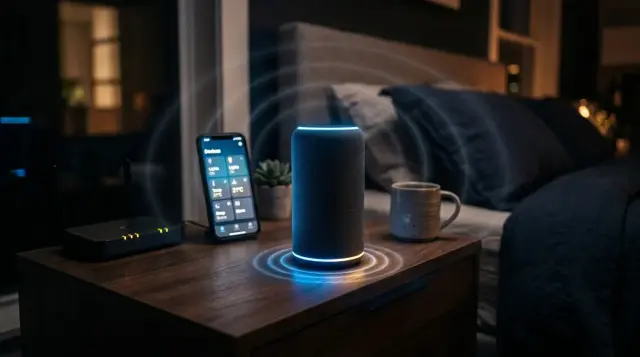
Not all IoT devices are equal when it comes to RF output. Your WiFi router is the biggest continuous emitter in most homes. It broadcasts on 2.4 GHz and/or 5 GHz bands, and newer WiFi 6E routers add a 6 GHz band as well. Mesh systems like Google Nest WiFi or Amazon Eero deserve special attention because they place multiple access points throughout your home. You're never far from a strong RF source.
Smart speakers rank next. Amazon reported over 500 million Alexa-enabled devices sold globally by 2023, and each one is constantly listening for its wake word. That means its WiFi radio is always active. Smart TVs, video doorbells like Ring, and security cameras also maintain persistent connections. Even your smart light bulbs are transmitting, though most use Zigbee or Z-Wave protocols at much lower power levels than WiFi.
Bluetooth devices are lower-powered still. A Bluetooth Low Energy (BLE) device typically transmits at about 1 milliwatt. But they add to the overall electromagnetic field density in your home. When you stack a Bluetooth speaker, a BLE-connected smart lock, a Bluetooth-enabled thermostat, and your phone's Bluetooth radio all in the same room, you've got a lot of low-level signals overlapping. If you're curious about how wearable tech factors into this equation, Smart Wearables: The Complete Guide breaks down the specifics.
Pay the most attention to devices closest to your body for the longest stretches. That means your phone, your smartwatch, and anything in your bedroom. Distance is your best friend here, since signal strength drops off with the square of the distance.
The connected home isn't inherently dangerous, but it isn't inherently safe either. The honest position is somewhere in the middle, where you take the science seriously, make informed choices, and don't let convenience override common sense.
Why Do Smart Home Radiation Risks Get Dismissed So Quickly?
This one genuinely frustrates me. Whenever someone raises concerns about IoT device radiation or WiFi EMF exposure, there's a reflexive response from some corners: "It's non-ionizing, so it can't hurt you." That's a massive oversimplification. Yes, radiofrequency radiation is non-ionizing, meaning it doesn't have enough energy per photon to break chemical bonds or damage DNA the way X-rays or gamma rays can. True. Important.
But non-ionizing doesn't mean non-interacting. RF energy is absorbed by biological tissue. That's literally how your microwave oven works. At the power levels of consumer devices, the thermal effect is negligible. But researchers at institutions like the Ramazzini Institute in Italy have reported biological effects at levels below thermal thresholds, including oxidative stress markers in animal models. A 2015 appeal signed by over 240 scientists from 41 countries, submitted to the United Nations, called for stronger precautionary guidelines around non-ionizing electromagnetic fields.
The regulatory framework hasn't kept pace with how we actually live, either. The FCC's current RF exposure guidelines were last meaningfully updated in 1996. Before WiFi existed in most homes. Before smart speakers. Before the Internet of Things. In August 2021, the U.S. Court of Appeals for the D.C. Circuit ruled that the FCC had failed to adequately explain why it declined to update its RF exposure limits, calling the agency's response "arbitrary and capricious." That's not some fringe lawsuit. That's a federal court saying the regulator hasn't done its homework.
Quick Q&A
Q: When were the FCC's RF exposure guidelines last updated?
A: The FCC's radiofrequency exposure limits were last substantively updated in 1996, and in 2021, a federal court ruled the agency failed to justify not revising them for modern multi-device environments.
So when someone tells you smart home radiation risks are a non-issue because "it's just non-ionizing radiation," they're ignoring a lot of legitimate scientific nuance and a regulatory gap you could drive a truck through.
How Can You Reduce RF Exposure Without Ditching Your Smart Home?
Good news: you don't have to live in a cabin in the woods. There are practical, meaningful steps you can take to lower your overall electromagnetic radiation exposure while still enjoying a connected home. Most of them are free.
First, use wired connections wherever possible. Your router, your desktop computer, your smart TV, even some gaming consoles can all run on Ethernet. Every device you switch from WiFi to a cable is one less RF emitter. Second, move your router out of bedrooms and living areas where you spend the most time. Remember, RF power drops dramatically with distance. Putting your router in a hallway closet instead of on your nightstand makes a real difference.
Third, schedule your devices. Many routers let you disable WiFi on a timer. Turning off your WiFi radio from 11 PM to 6 AM means seven hours of reduced exposure every night while you sleep. Some people also put smart speakers on smart plugs and power them down at night. Takes 10 seconds to set up. Costs you nothing.
For times when you can't control your environment, like working from home surrounded by tech, EMF-shielding clothing is a surprisingly practical option. Proteck'd makes apparel with silver-fiber Faraday fabric that blocks a significant percentage of incoming RF signals. Their Faraday Protection Collection includes everyday pieces you can actually wear to the office or around the house. And if you want something specifically designed for men, the Men's Faraday Tech Wear line blends EMF protection with a clean, modern look. You can learn more about how the shielding technology works on their EMF Protection Benefits page.
What About Privacy and Data Risks From Smart Home Devices?
Smart home radiation risks get a lot of attention, but there's another kind of exposure that deserves equal weight: your data. Every connected device in your home is a potential data collection point. Amazon's Alexa logs voice recordings. Google's Nest cameras process video through cloud servers. Your smart thermostat knows when you're home and when you're away. Ring doorbells have shared footage with law enforcement without user consent in documented cases.
In 2023, Amazon agreed to pay a $25 million fine to the FTC for violating children's privacy through its Alexa voice assistant, retaining kids' voice recordings and geolocation data even after parents requested deletion. That's not a theoretical privacy concern. That's a real company, a real fine, and real data that was kept when it shouldn't have been.
If you're building a smart home, privacy should be baked into your setup from day one. Use local-processing alternatives where they exist, like Home Assistant running on a Raspberry Pi. Segment your IoT devices onto a separate WiFi network so a compromised smart bulb can't access your laptop. Audit your device permissions regularly. For a deeper look at protecting your digital life, Digital Privacy: The Complete Guide covers the full picture.
The connected home offers real convenience. But treating every smart device as both an RF emitter and a data collector gives you a much more complete understanding of what you're actually inviting into your living space.
Is There a Safe Number of Smart Devices for One Home?
I get asked this a lot, and I wish I had a clean number to give you. The honest answer? No regulatory body or research institution has established a "safe" number of connected devices per household. The FCC regulates individual device emissions, not the aggregate RF environment inside your specific home. That's a gap in the current framework that researchers are starting to flag.
What we can say is that every device you add increases your home's ambient electromagnetic field level. A 2019 study from the Swiss Tropical and Public Health Institute measured RF exposure in homes with varying numbers of connected devices and found a clear linear relationship: more devices meant higher ambient RF levels, with WiFi routers and cordless phone base stations contributing the most.
My personal approach? Be intentional. Ask yourself whether each connected device actually adds value to your life. Do you really need a WiFi-connected coffee maker, or is the regular one working just fine? I went through my own home and removed about a third of the smart devices I'd accumulated over the years. The ones that stayed are things I genuinely use daily. Everything else was just adding to the noise. Literally.
If you're someone who likes the quantified approach to health, measuring your home's RF environment with a basic EMF meter (like the Trifield TF2, which runs about $180) gives you real data to work with. You might be surprised where the hotspots are. Pair that knowledge with protective wearables from Proteck'd's Faraday Protection Collection, and you've got a genuinely informed strategy instead of vague anxiety.
Frequently Asked Questions
Q: Are smart home devices safe to use around children?
There's no definitive answer yet, but children may be more vulnerable to RF exposure because of thinner skulls and still-developing nervous systems. The American Academy of Pediatrics has urged the FCC to adopt updated RF standards that account for children's unique physiology. Keeping WiFi routers and smart speakers out of kids' bedrooms is a sensible precaution.
Q: Does WiFi radiation from a router cause cancer?
There's no confirmed causal link between WiFi-level RF exposure and cancer in humans. However, the WHO's IARC classified RF electromagnetic fields as Group 2B (possibly carcinogenic) in 2011, and the National Toxicology Program found tumor evidence in rats at higher exposure levels. The science is still evolving.
Q: How far should I keep my WiFi router from my bed?
At least 10 feet (3 meters) is a commonly recommended minimum. RF signal strength drops rapidly with distance following the inverse-square law, so even moving a router from your nightstand to across the room makes a measurable difference. Ideally, keep it out of the bedroom entirely.
Q: Do smart speakers like Alexa emit radiation all the time?
Yes. Smart speakers maintain an active WiFi connection at all times to listen for wake words and receive updates. They emit low-level radiofrequency energy continuously, not just when you talk to them. Placing them on a smart plug and powering them off at night is an easy way to cut down on overnight exposure.
Q: Can EMF-shielding clothing really block smart home radiation?
Yes, when made with properly conductive materials like silver-fiber Faraday fabric. Proteck'd's shielding garments are independently tested and can attenuate a significant percentage of incoming RF signals. They won't eliminate all exposure, but they meaningfully reduce the amount of radiofrequency energy reaching your body in areas the fabric covers.
Q: Is 5 GHz WiFi more dangerous than 2.4 GHz?
Not necessarily. The 5 GHz band has a shorter range and gets absorbed more readily by walls and obstacles, which means it typically penetrates the body less deeply than 2.4 GHz. Both bands operate well within FCC power limits. The practical health difference between the two frequencies at consumer power levels isn't well established.
Q: Should I turn off my WiFi router at night?
It's a simple, effective precaution. Turning off WiFi during sleep eliminates roughly 7 to 8 hours of RF exposure per day, about a third of your total daily exposure time. Many routers support scheduling features that automate this, so you don't even have to remember.
Q: What's the difference between ionizing and non-ionizing radiation from smart devices?
Smart home devices emit non-ionizing radiation, which doesn't carry enough energy to break DNA bonds the way ionizing radiation (X-rays, gamma rays) does. However, non-ionizing RF energy is still absorbed by body tissue and can produce thermal and potentially non-thermal biological effects at sufficient intensities. The debate centers on whether chronic low-level non-ionizing exposure has long-term consequences.
Q: Are Bluetooth devices safer than WiFi devices?
Bluetooth devices, especially Bluetooth Low Energy (BLE), transmit at much lower power levels than WiFi, typically around 1 milliwatt compared to 30 to 100 milliwatts for a WiFi router. In terms of raw RF output, Bluetooth is the lower-exposure option. But Bluetooth devices are often worn right on the body, so the distance advantage disappears.
Q: Do smart home radiation risks increase with the number of devices?
Yes. Ambient RF levels in a home increase roughly linearly with the number of active connected devices. Research from the Swiss Tropical and Public Health Institute confirmed this. Each additional WiFi, Bluetooth, or Zigbee device adds to the cumulative electromagnetic field in your living space, even if every single one is within regulatory limits on its own.
References
- Federal Communications Commission (FCC) – The FCC limits radiofrequency exposure to a specific absorption rate (SAR) of 1.6 W/kg averaged over 1 gram of tissue.
- National Institute of Environmental Health Sciences (NIEHS) – National Toxicology Program – The NTP study found clear evidence of malignant heart tumors (schwannomas) in male rats exposed to high levels of RF radiation.
- International Agency for Research on Cancer (IARC/WHO) – IARC classified radiofrequency electromagnetic fields as Group 2B, possibly carcinogenic to humans, in 2011.
- U.S. Food and Drug Administration (FDA) – The FDA's 2020 review concluded that current evidence does not establish a causal link between RF exposure at current regulatory levels and adverse health outcomes in humans.
About the Author
Proteck'd EMF Apparel
Health & EMF Specialists
The Proteck'd team covers EMF protection, silver-fiber apparel, and practical ways to reduce everyday radiation exposure. Every piece Proteck'd ships is designed, tested, and worn by the people who build it.
Protect Yourself Today
Proteck'd Faraday and silver fiber apparel is engineered to shield your body from everyday EMF exposure. Built for real life, tested for real results.
Shop EMF Protection →✓30-day returns✓Free shipping✓Free returns✓Silver fiber shielding


