


The Most Surprising Facts About How the Internet Works: The Numbers

Here's a number that might break your brain: every single day, humanity creates about 402.74 million terabytes of data. Photos, emails, streaming video, GPS pings, smart home commands, and about a billion other things your devices do without you even thinking about it. If you've ever wondered how does technology facts interesting work at the scale we're living in right now, the answer starts with truly absurd numbers.
I remember the first time I saw a map of undersea internet cables. It looked like someone had dropped a plate of spaghetti on a globe. More than 500 cables sit on the ocean floor right now, stretching over 1.3 million kilometers [1]. That's how your video call to someone across the world actually works. Not magic. Fiber optics and seawater.
But the stats go way beyond cables and connections. The tech we carry in our pockets, wear on our bodies, and fill our homes with runs on electromagnetic signals that most of us never even think about. Every WiFi router, every Bluetooth earbud, every cell tower is broadcasting radiation. That's just how wireless tech functions.
So let's get into it. I've pulled together the most surprising, sometimes unsettling, and genuinely fascinating tech numbers out there. Some will make you laugh. A few might make you rethink how you interact with your devices. All of them are real.

We generate 402 million terabytes of data every day, send it through cables on the ocean floor, and carry devices that reshape our brain's sensory processing. The numbers behind our digital world aren't just interesting. They're a wake-up call about how deeply technology has woven itself into our biology.
How Much Data Does the World Actually Create Each Day?
According to research from the International Data Corporation (IDC), global data creation and replication reached 120 zettabytes in 2023. One zettabyte is a trillion gigabytes. The entire Netflix library? Estimated at around 10 to 15 petabytes. So we're generating the equivalent of millions of Netflix libraries every year. That's not a typo.
Where does it all come from? About 294 billion emails get sent daily, though the Radicati Group estimates nearly half are spam. Google alone handles roughly 5 billion searches per day. YouTube users upload more than 500 hours of video every single minute. TikTok, Instagram, X, and every other platform pile on top of that.
Then there's the stuff you don't see. IoT devices, think smart thermostats, connected cars, industrial sensors, generate enormous streams of data constantly. Cisco projected that by 2025 there would be over 75 billion connected devices globally. Each one chatting away on the network, sending data back to servers, receiving instructions.
Quick Q&A
Q: How much data does the world produce in a single day?
A: Roughly 402.74 million terabytes per day, based on IDC's 2023 estimate of 120 zettabytes created annually.
And all this data has to go somewhere. That somewhere is data centers, massive warehouse-like buildings packed with servers. The International Energy Agency reported in 2024 that data centers consume between 1% and 1.5% of the world's total electricity [2]. That percentage is climbing fast with the rise of AI training workloads.
What's Physically Underneath the Internet?
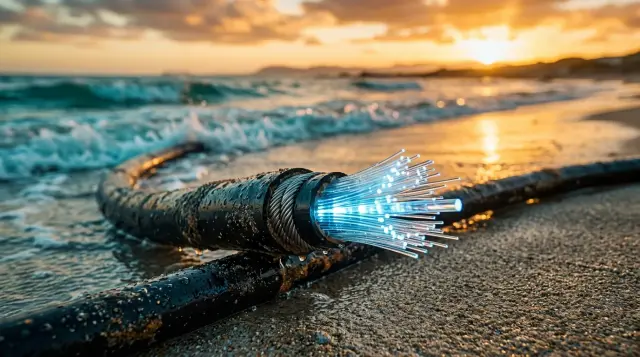
Most people picture the internet as something floating in the cloud. Wireless. Invisible. The reality is way more industrial. About 95% of all intercontinental data travels through submarine fiber optic cables laid on the ocean floor [1]. These cables are roughly the width of a garden hose and are engineered to survive earthquakes, shark bites (yes, really), and deep-sea pressure.
As of early 2024, TeleGeography's Submarine Cable Map tracked over 550 active and planned submarine cable systems. Some of the newest ones, like Google's Firmina cable connecting the U.S. East Coast to South America, can carry about 340 terabits per second. That's enough to stream roughly 17 million HD videos simultaneously.
When these cables get damaged, things get ugly fast. In 2008, two undersea cables in the Mediterranean were severed, and internet speeds across the Middle East and India dropped by up to 70%. It's a stark reminder that the digital world depends on very physical, very breakable infrastructure. If you're curious about the electromagnetic energy these systems use and emit, we've covered The Strange Science of Electromagnetic Waves: Explained Simply in a separate piece.
On land, the story looks similar. Millions of miles of fiber optic cable run under streets, through buildings, and along railway lines. Cell towers broadcast wireless signals using radio frequency electromagnetic fields. The whole thing is a sprawling physical network that most of us walk past every day without noticing. Once you start understanding how digital tech infrastructure actually works, it's one of those rabbit holes that just keeps going.
How Much Electromagnetic Radiation Do Your Devices Emit?
Every wireless device you own emits non-ionizing electromagnetic radiation. Your smartphone. Your WiFi router. Your laptop. Your smartwatch. It's the fundamental mechanism that allows wireless communication. Radio waves carry data between your device and the nearest tower or router, and those waves are a form of EM radiation.
The Federal Communications Commission (FCC) in the United States sets the legal limit for cell phone radiation exposure at a Specific Absorption Rate (SAR) of 1.6 watts per kilogram, averaged over 1 gram of tissue [3]. In Europe, the limit set by ICNIRP is 2.0 W/kg averaged over 10 grams. Most modern smartphones fall below these thresholds, but the fact that limits exist at all tells you regulators take the exposure seriously.
Here's where it gets interesting for anyone asking how does technology facts interesting work in terms of personal exposure. The World Health Organization's International Agency for Research on Cancer (IARC) classified radiofrequency electromagnetic fields as "possibly carcinogenic to humans" (Group 2B) back in 2011 [4]. That classification hasn't changed. It means there's limited evidence, not conclusive proof, but enough to warrant caution.
If this topic interests you, I'd recommend reading our article on 7 Surprising Facts About Electromagnetic Radiation: You Won't Believe Are True. For people who want a practical layer of protection, Proteck'd EMF Protection makes clothing designed to shield you from everyday EMF exposure. Their Faraday Collection uses silver-infused fabric to block a significant percentage of RF radiation, and yes, the science behind Faraday cages is well established.
What Are the Most Mind-Blowing Tech History Facts?
Honestly, the tech trivia from history might be even better than the current stats. Samsung was founded in 1938. That's a full 38 years and one month before Steve Jobs and Steve Wozniak launched Apple in 1976. And Samsung didn't start in electronics. It started as a grocery trading store in South Korea, selling dried fish and noodles.
The first VCR, built by Ampex in 1956, was the size of a piano and cost $50,000. That's over $570,000 in today's money. Called the Ampex VRX-1000, only television networks could afford it. Fast-forward a few decades and you could pick one up at a garage sale for five bucks.
Then there's the word "robot." It comes from the Czech word "robota," meaning forced labor or servitude. Czech writer Karel Čapek introduced it in his 1920 play R.U.R. (Rossum's Universal Robots), where artificial people rebel against their creators. Pretty dark origin story for the little disc vacuuming your living room floor.
And about that Firefox logo? The "fox" in the Mozilla Firefox browser logo is actually a red panda, not a fox. Red pandas are sometimes called "firefoxes" in Chinese. Meanwhile, Google has literally rented goats to mow the lawn at their Mountain View headquarters since 2009. About 200 goats from a company called California Grazing handle the job. These fun technology facts remind you the tech world has always been a little weird.
How Fast Is the Internet Actually Growing?
The International Telecommunication Union (ITU) reported that by the end of 2023, approximately 4.9 billion people were using the internet worldwide. That's roughly 67% of the global population. A decade earlier, in 2013, that number was closer to 2.7 billion. Internet adoption basically doubled in ten years.
The speed of the internet itself has grown even more dramatically. In 1999, the average U.S. internet speed was about 56 kilobits per second on a dial-up modem. Remember that sound? According to Ookla's Speedtest Global Index, the global median fixed broadband download speed hit around 93 Mbps by late 2024. That's roughly a 1,600x improvement in 25 years.
5G networks are pushing things even further. Theoretically, 5G can hit peak speeds of 20 Gbps, though real-world speeds typically land between 100 Mbps and 1 Gbps depending on the network and location. As these networks expand, they also add more electromagnetic frequency emissions to our environment, which is something worth understanding. We wrote about this in detail in The Strange Science of Electromagnetic Waves: What Nobody Taught You in School.
Quick Q&A
Q: How many people use the internet worldwide?
A: Approximately 4.9 billion people used the internet by the end of 2023, according to the International Telecommunication Union.
Does Your Brain Actually Think Your Phone Is Vibrating When It's Not?
Yes. And there's a name for it. Phantom Vibration Syndrome is the sensation that your phone is buzzing in your pocket when it actually isn't. A study published by Dr. Robert Rosenberger at Georgia Institute of Technology found that around 89% of undergraduates in his survey had experienced it. It's become so common that researchers consider it a byproduct of how deeply smartphones have woven themselves into our body awareness.
What happens is your brain rewires its interpretation of sensory input. Minor muscle twitches or clothing friction get misidentified as a phone buzz because your brain is primed to expect it. A small, harmless example of something bigger: technology is literally changing how our nervous system processes information.
This is part of why I find the question of how technology facts and interesting details work so compelling. It's not just about hardware and software. It's about what constant connectivity does to us physically and mentally. The always-on nature of our devices means our bodies are continuously interacting with screens, signals, and electromagnetic fields.
For those who want to reduce their passive EMF exposure, options exist that don't require going off the grid. Learn About EMF Protection on the Proteck'd site if you're curious about how shielding fabrics actually work. It's one of the more practical responses to a world that's only getting more connected.
What Will the Internet Look Like by 2030?
Predictions vary, but a few trends are backed by solid data. The ITU expects near-universal internet access in developed nations by 2030 and roughly 75% to 80% global penetration. The number of connected IoT devices is projected to exceed 100 billion. And the energy demands of AI and cloud computing are expected to push data center electricity consumption past 3% of global supply, according to estimates from Goldman Sachs Research.
Quantum computing is another wildcard. IBM's 2023 Condor processor hit 1,121 qubits, and Google's Sycamore processor demonstrated quantum supremacy in 2019 by completing a calculation in 200 seconds that would take a classical supercomputer an estimated 10,000 years. These machines won't replace your laptop, but they could transform cryptography, drug discovery, and logistics optimization.
With all this growth comes more wireless infrastructure. More cell towers. More satellite constellations like SpaceX's Starlink, which already has over 5,000 satellites in orbit as of 2024. And more ambient electromagnetic radiation in our daily lives. How does technology facts interesting work in this future context? The same way it always has: by sending information through electromagnetic waves. Just more of them, faster, everywhere.
If you're someone who pays attention to the intersection of technology and personal health, exploring topics like Interesting Facts About Cicadas: Life Cycle might seem like a left turn, but nature's own signaling systems are a fascinating counterpoint to our digital ones. And for wearable tech that actually protects you from the signals around you, the Faraday Collection from Proteck'd is worth a look.
- Over 500 submarine cables on the ocean floor carry 95% of the world's intercontinental internet data.
- The world creates roughly 120 zettabytes of data per year, and data centers use 1% to 1.5% of global electricity.
- The FCC limits cell phone radiation to 1.6 W/kg SAR, and the WHO classified RF fields as possibly carcinogenic in 2011.
- Phantom Vibration Syndrome affects nearly 89% of smartphone users, showing how tech reshapes sensory perception.
- By 2030, connected devices could exceed 100 billion, and data center energy use may surpass 3% of global electricity.
Frequently Asked Questions
The internet runs primarily through undersea fiber optic cables, land-based cable networks, and wireless signals from cell towers and satellites. About 95% of intercontinental data travels through more than 500 submarine cables on the ocean floor. Your device connects to local networks via WiFi or cellular signals, which route data through this global cable infrastructure.
The world creates approximately 402.74 million terabytes of data per day, based on IDC's 2023 estimate of 120 zettabytes annually. That includes emails, social media posts, streaming content, IoT sensor data, and much more. The figure is growing rapidly because of AI workloads and expanding internet access.
The WHO's IARC classified radiofrequency electromagnetic fields as "possibly carcinogenic" (Group 2B) in 2011, meaning there's limited but not conclusive evidence of risk. The FCC limits phone SAR to 1.6 W/kg in the U.S. Most researchers recommend precautionary measures like using speakerphone or EMF-shielding accessories rather than panic.
Phantom Vibration Syndrome is when you feel your phone vibrating in your pocket even though it isn't. Research by Dr. Robert Rosenberger at Georgia Tech found roughly 89% of surveyed undergraduates had experienced it. It happens because your brain becomes conditioned to expect phone vibrations and misinterprets other sensory signals as a buzz.
Google processes approximately 5 billion search queries per day as of 2024. That works out to about 58,000 searches per second. The volume has grown steadily every year since Google launched in 1998.
A Faraday cage is an enclosure made of conductive material that blocks electromagnetic fields from passing through. When EM radiation hits the cage, the conductive material redistributes the charge, canceling the field inside. This principle is used in everything from scientific labs to EMF-protective clothing like Proteck'd's Faraday Collection.
Data centers consume roughly 1% to 1.5% of the world's total electricity, according to the International Energy Agency. With the rise of AI training and cloud computing, Goldman Sachs Research estimates this could exceed 3% by 2030. Cooling the servers alone accounts for a big portion of that energy.
Yes. The animal in the Mozilla Firefox logo is a red panda, not a fox. Red pandas are sometimes called "firefoxes" in Chinese culture. Mozilla has even adopted red pandas at zoos as part of its branding efforts over the years.
Internet speed has grown roughly 1,600 times in 25 years. In 1999, most Americans used 56 Kbps dial-up connections. By late 2024, global median fixed broadband download speeds reached about 93 Mbps according to Ookla. 5G can theoretically reach 20 Gbps, though real-world speeds are typically 100 Mbps to 1 Gbps.
Approximately 4.9 billion people used the internet by the end of 2023, according to the International Telecommunication Union. That's about 67% of the world's population. A decade earlier, the number was closer to 2.7 billion, meaning internet adoption roughly doubled in ten years.
References
- Federal Communications Commission (FCC) – The FCC limits cell phone radiation exposure to a Specific Absorption Rate (SAR) of 1.6 watts per kilogram averaged over 1 gram of tissue.
- World Health Organization / IARC – IARC classified radiofrequency electromagnetic fields as possibly carcinogenic to humans (Group 2B) in 2011.
About the Author
Proteck'd EMF Apparel
Health & EMF Specialists
The Proteck'd team covers EMF protection, silver-fiber apparel, and practical ways to reduce everyday radiation exposure. Every piece Proteck'd ships is designed, tested, and worn by the people who build it.
Get the Free EMF Home Audit Checklist
A room-by-room PDF that walks you through the biggest EMF sources in your house and what to do about each one. No cost, no fluff.
Download the Checklist →✓30-day returns✓Free shipping✓Free returns✓Silver fiber shielding


Laissez un commentaire