


10 Surprising Tech Facts That Sound Too Weird to Be True: The Complete List

The first computer mouse was made of wood. I know. Sounds like the kind of thing your uncle would say at Thanksgiving just to get a reaction, but it's completely true. Doug Engelbart carved that thing at Stanford Research Institute in 1964, and it looked more like a doorstop than anything you'd recognize on a desk today. Technology history is full of stories like this. Facts so bizarre they feel like pranks, but they're backed by documentation, patents, and photographs.
So what does tech trivia surprising mean, exactly? Fair question. It refers to verified facts about technology, its origins, its quirks, its unintended consequences, that are so unexpected they make you question what you thought you knew. These aren't urban legends or stuff that ricocheted around Reddit without a source. They're real pieces of history that just happen to be deeply weird.
I've spent a lot of time combing through patents, company histories, and peer-reviewed research to put this list together. Some of these facts you may have heard before. Others, I'm almost certain, will genuinely surprise you. And beyond being fun party ammunition, these strange technology facts actually reveal something about how innovation works. It's messy. It's accidental. And it's often hilarious.
Whether you're here because you love bizarre computer trivia, you're prepping for a quiz night, or you just want to impress someone with an odd fact over coffee, you're in the right place. Let's get into it.

Was the First Computer Mouse Really Made of Wood?
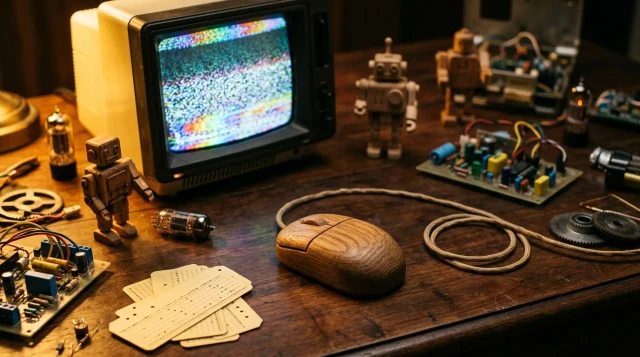
Yes. The very first computer mouse was carved from a block of wood by Doug Engelbart and his colleague Bill English at the Stanford Research Institute in 1964 [1]. It had a single button on top and two perpendicular wheels on the bottom that tracked movement. The cord came out the back, which is actually why it got the name "mouse." Engelbart thought it looked like one.
Here's the part that really gets me. Engelbart didn't just invent the mouse. He demonstrated it in 1968 during what's now called "The Mother of All Demos" in San Francisco, where he also showed off hypertext, video conferencing, and collaborative editing. In 1968. Most people were watching black-and-white television, and this guy was basically previewing Google Docs.
The mouse didn't go mainstream until Xerox and then Apple picked it up in the late 1970s and early 1980s. Engelbart's patent actually expired before the mouse became commercially popular, so he never made significant money from it. That's a pattern you'll see again and again in tech history. The person who invents the thing rarely profits from it the way later companies do.
If fun tech history like this grabs your attention, you'd probably enjoy our piece on How Electricity Changed the World: The Surprising Story. The origins of everyday technology are consistently stranger than fiction.
Did YouTube Really Start as a Dating Website?
It did. YouTube launched on Valentine's Day, February 14, 2005, and its original tagline was "Tune In, Hook Up." Co-founders Chad Hurley, Steve Chen, and Jawed Karim pictured a platform where singles could upload video profiles of themselves. Think proto-Tinder, but with webcam footage instead of polished selfies. The problem? Almost nobody uploaded dating videos.
What people did upload was everything else. Cat videos. Skateboarding clips. Random vlogs. The founders quickly realized they had something much bigger than a dating site, and they pivoted. By November 2006, Google acquired YouTube for $1.65 billion. That's roughly 18 months from failed dating site to billion-dollar acquisition.
Quick Q&A
Q: What was YouTube's original purpose when it launched in 2005?
A: YouTube was originally designed as a video-based dating platform where users could upload personal video profiles to find romantic partners.
The first video ever uploaded to YouTube was "Me at the zoo," posted by Jawed Karim on April 23, 2005. It's 18 seconds long, shot at the San Diego Zoo, and is still live on the platform. As of 2024, it has over 300 million views. This is one of those mind-blowing tech facts that shows how the biggest platforms often start with the smallest, weirdest ideas.
Technology history is messy, accidental, and often hilarious. The first internet message was supposed to say 'LOGIN' but crashed after two letters. YouTube launched as a dating site. The first computer mouse was carved from wood. The biggest innovations rarely start where you'd expect them to.
Where Did the Word 'Robot' Actually Come From?
The word "robot" doesn't come from science or engineering. It comes from a play. Czech writer Karel Čapek introduced it in his 1920 science fiction play R.U.R. (Rossum's Universal Robots). The word derives from "robota," which is Czech for forced labor or drudgery. Čapek actually credited his brother Josef with suggesting the term [1].
In the play, robots aren't metallic machines. They're artificial biological beings created to serve humans, and, spoiler alert for a 100-year-old play, they eventually rebel and wipe out humanity. So the very first use of the word "robot" was already tied to fears about technology replacing and overtaking us. Some things never change, right?
What's interesting is how fast the word spread. By the 1940s and 1950s, writers like Isaac Asimov had adopted it and built entire fictional universes around robotics. Asimov even coined the word "robotics" in 1941, thinking it was already a real term. It wasn't. He accidentally created a whole field of study just by naming it in a short story.
Technology trivia like this reminds us that language and tech evolve together. If you're curious about another way science and everyday life intersect in unexpected ways, check out The Surprising Science of Electromagnetic Waves: What Nobody Taught You in School.

What Is Phantom Vibration Syndrome and Why Do We All Have It?
Ever reached for your phone, absolutely certain it just buzzed, only to find zero notifications? You're not imagining it. Well, technically you are. But you're not alone. This phenomenon has a name: phantom vibration syndrome. And according to a 2012 study published in Computers in Human Behavior, roughly 89% of undergraduate students reported experiencing it [2].
Researchers at Indiana University, Purdue University, and Georgia Institute of Technology have studied this extensively. The leading theory is that our brains become so accustomed to phone vibrations that they start interpreting other sensory inputs, things like muscle twitches, fabric movement, even anticipation, as a vibration. It's basically a learned body hallucination.
The condition has gotten more common as smartphone use has increased. Dr. Robert Rosenberger at Georgia Tech has written about how phantom vibrations illustrate our increasingly embodied relationship with technology. We don't just use our phones. Our nervous systems have incorporated them as extensions of our bodies.
This is one of those weird technology facts that feels funny at first but actually says something real about how deeply tech integrates into our biology. If you've ever wondered about the invisible signals your devices emit, Learn About EMF Protection to understand what's really happening between your phone and your body.
How Did Samsung Go from Selling Groceries to Making Smartphones?
Samsung was founded on March 1, 1938, by Lee Byung-chul in Daegu, South Korea. It started as a small trading company that sold dried fish, locally grown groceries, and noodles. The name "Samsung" translates to "three stars" in Korean, and the company didn't get into electronics until the late 1960s. That means Samsung is 38 years and one month older than Apple, which was founded on April 1, 1976.
The pivot into electronics began in 1969 with the establishment of Samsung Electronics. Their early products were black-and-white televisions manufactured in partnership with Japanese companies. By the 1990s, Samsung had become a major player in memory chips and semiconductors. By the 2000s, they were competing directly with Apple in the smartphone market.
What makes this piece of strange technology trivia so compelling is the sheer scale of the transformation. From dried fish to the Galaxy S series. Samsung is now one of the largest technology companies in the world, with 2023 revenues exceeding $200 billion. Lee Byung-chul, selling noodles in 1938, could not have imagined that.
Innovation doesn't always look the way you'd expect at the start. That's true for companies, and it's true for protective technology too. Proteck'd EMF Protection started with a simple idea, using advanced Faraday fabrics to shield the body from electromagnetic radiation, and turned it into a full line of stylish, functional apparel.
Did the Internet Really Begin as a Military Project?
Yes. The internet's earliest ancestor was ARPANET, a project funded by the U.S. Department of Defense's Advanced Research Projects Agency (ARPA, now DARPA). The first ARPANET message was sent on October 29, 1969, from a computer at UCLA to one at the Stanford Research Institute. The intended message was "LOGIN." The system crashed after transmitting just "LO."
The original goal wasn't to create what we now know as the internet. ARPA wanted a communications network that could survive a nuclear attack by routing data through multiple paths rather than relying on a single central hub. Researchers like Vint Cerf and Bob Kahn later developed TCP/IP, the foundational protocol that still powers the internet today, in 1974.
Tim Berners-Lee, a British scientist at CERN, invented the World Wide Web in 1989, which is what most people actually mean when they say "the internet." The web is a system built on top of the internet. It uses HTTP and HTML to let us browse pages with links. Without ARPANET, though, none of it would exist.
Quick Q&A
Q: When was the first internet message sent, and what did it say?
A: The first ARPANET message was sent on October 29, 1969, from UCLA to Stanford Research Institute, and it was supposed to say "LOGIN" but the system crashed after just "LO."
If the invisible infrastructure of technology interests you, our article on The Surprising Science of Light and Radiation: What Nobody Taught You in School goes deeper into the electromagnetic signals that make all of this connectivity possible.
Why Does Google Rent Goats?
This is the fun tech history fact that nobody believes until they see the photos. Google has rented goats to mow the lawns at its Mountain View, California headquarters. The company hired a firm called California Grazing to bring in approximately 200 goats to eat the grass and brush around the Googleplex. Google's official blog confirmed this back in 2009.
The reasoning was partly environmental, partly practical. Goats don't use gasoline. They don't produce exhaust fumes. And they're surprisingly efficient at clearing brush in hilly terrain where mowers struggle. Plus, Google employees apparently loved watching them. The company described it as "a lot cuter to watch than lawnmowers."
This isn't just a quirky anecdote, though. It actually reflects a broader trend in Silicon Valley toward sustainability-minded choices, even unusual ones. Companies like Apple, Meta, and Microsoft have all invested heavily in renewable energy and carbon reduction. Google itself achieved carbon neutrality for all its operations in 2007 and has maintained that status every year since, according to their environmental reports.
Sometimes the most surprising tech facts aren't about code or hardware. They're about goats. For more unexpected technology stories like this, take a look at our complete rundown of 12 Surprising Tech Facts You Didn't Know.
Does CAPTCHA Actually Help Digitize Old Books?
Here's a piece of tech trivia that changes the way you look at those annoying "prove you're not a robot" boxes. Starting around 2007, a project called reCAPTCHA, created by Luis von Ahn at Carnegie Mellon University, began using CAPTCHA challenges to simultaneously verify users were human and digitize old books and newspapers.
Here's how it worked. The system would show you two distorted words. One word the system already knew (that was the actual test). The other was a word scanned from an old text that optical character recognition software couldn't decipher. Your answer helped train the system to read that word. Google acquired reCAPTCHA in 2009 and used it to digitize portions of the New York Times archive and Google Books.
According to von Ahn, at its peak reCAPTCHA was digitizing roughly 200 million words per day. That's the equivalent of about 2.5 million books per year. All from people just trying to log into their email or buy concert tickets. An astonishing example of distributed human computation.
Modern CAPTCHA has moved toward image recognition ("click all the traffic lights"), but the book-digitizing version ran for years and made a genuine dent in preserving historical documents. It's one of those weird technology facts that makes you appreciate how cleverly tech can be designed. If you want more of these stories, we've compiled 12 Fascinating Tech Facts That Sound Too Weird to Be True.
What Was the First Apple Logo, and Why Did It Change?
Most people picture the sleek, minimalist Apple logo and assume it's always looked that way. Not even close. The very first Apple logo, designed by co-founder Ronald Wayne in 1976, was an elaborate pen-and-ink drawing of Isaac Newton sitting under an apple tree. It had a ribbon banner that read: "Newton... A Mind Forever Voyaging Through Strange Seas of Thought... Alone." It looked more like a bookplate from the 1800s than a tech company logo.
Steve Jobs thought it was too old-fashioned and too complex to work at small sizes, which was a fair point. In 1977, he hired graphic designer Rob Janoff to create the now-iconic rainbow Apple with the bite taken out. Janoff has said in interviews that the bite was included simply to make sure the apple wasn't confused with a cherry or any other round fruit. The rainbow stripes were a nod to the Apple II's color display capabilities.
The logo went monochrome in 1998 under Jobs's direction when he returned to Apple and launched the iMac. That clean, single-color silhouette has been the Apple logo ever since. It's one of the most recognized symbols on the planet, and it started as a sketch of Isaac Newton sitting under a tree.
How Big Is a Petabyte, and Why Should You Care?
You've heard of gigabytes and terabytes. But a petabyte? That's where things get absurd. One petabyte equals 1,000 terabytes, or roughly 1 million gigabytes. To put that in perspective, one petabyte of music stored as MP3 files would take approximately 2,000 years to play continuously. Not a typo. Two thousand years.
According to estimates from various data industry analyses, humanity generated roughly 120 zettabytes of data in 2023. A zettabyte is 1 million petabytes. The scale is almost incomprehensible. Most of this data comes from surveillance cameras, social media, streaming services, and IoT devices. Your smart thermostat, your fitness tracker, your car, they're all generating data constantly.
All that data travels through electromagnetic fields. Every Wi-Fi signal, every Bluetooth connection, every 5G tower is pushing radio frequency radiation through the air around you. Understanding what does tech trivia surprising mean also means understanding the invisible infrastructure that supports our digital lives. If you're curious about managing your personal exposure to these signals, the Faraday Collection from Proteck'd uses conductive fabrics to provide a physical barrier against electromagnetic radiation.
Data isn't just abstract. It's physical. It lives on servers that consume massive amounts of electricity and cooling. A single large data center can use as much power as a small city. The internet feels weightless, but it has a very real, very heavy footprint.
Key Takeaways
Frequently Asked Questions
What does tech trivia surprising mean?
It refers to verified, factual pieces of information about technology that are so unexpected or counterintuitive they seem unbelievable. These aren't myths or rumors. They're documented facts from tech history, like the first computer mouse being made of wood or YouTube starting as a dating site, that challenge your assumptions about how technology developed.
Why was the first computer mouse made of wood?
Doug Engelbart and Bill English built the first mouse prototype in 1964 at Stanford Research Institute. Wood was simply a practical, available material for hand-carving a prototype casing. The internal mechanism used two perpendicular wheels to track movement. Plastic and other materials came into play later when the device was commercialized.
Is phantom vibration syndrome a real medical condition?
It's a recognized psychophysical phenomenon, though it's not classified as a medical disorder. A 2012 study in Computers in Human Behavior found that about 89% of undergraduate participants experienced it. Researchers believe it's caused by the brain misinterpreting minor sensory input, like muscle twitches, as phone vibrations after habitual phone use.
How did YouTube become a video platform if it started as a dating site?
YouTube launched on February 14, 2005, as a video dating site with the tagline "Tune In, Hook Up." When almost nobody uploaded dating videos but people did upload all kinds of other content, the founders pivoted to a general video-sharing platform. Google acquired YouTube for $1.65 billion in November 2006, about 18 months after launch.
What is the origin of the word 'robot'?
Czech playwright Karel Čapek introduced the word in his 1920 play R.U.R. (Rossum's Universal Robots). It comes from the Czech word "robota," meaning forced labor. Čapek credited his brother Josef with suggesting the term. In the play, robots are artificial beings that eventually rebel against humanity.
How much data is a petabyte in practical terms?
One petabyte equals approximately 1 million gigabytes or 1,000 terabytes. If you stored music as MP3 files, one petabyte would take roughly 2,000 years to play continuously. In 2023, humanity generated an estimated 120 zettabytes of data, where one zettabyte equals 1 million petabytes.
Did CAPTCHA really help digitize old books?
Yes. Starting around 2007, the reCAPTCHA project created by Luis von Ahn at Carnegie Mellon used CAPTCHA challenges to digitize words from scanned books that OCR software couldn't read. At its peak, the system was digitizing about 200 million words per day. Google acquired reCAPTCHA in 2009 and used it for Google Books and the New York Times archive.
Is it true that Samsung used to sell dried fish?
Yes. Samsung was founded on March 1, 1938, in Daegu, South Korea, by Lee Byung-chul. It started as a small trading company selling dried fish, noodles, and locally grown groceries. The company didn't enter the electronics industry until 1969, making Samsung 38 years older than Apple.
Why does Google rent goats for its headquarters?
Google has hired a company called California Grazing to bring roughly 200 goats to the Googleplex in Mountain View, California, to eat grass and clear brush. The approach is more environmentally friendly than gas-powered mowers and works well on hilly terrain. Google confirmed the practice on its official blog in 2009.
What does EMF protection have to do with tech trivia?
Many surprising tech facts connect back to the invisible electromagnetic signals that power modern devices. Every Wi-Fi router, smartphone, and Bluetooth device emits radio frequency electromagnetic radiation. Understanding these signals is both a piece of fascinating tech trivia and a practical health consideration. Products like Proteck'd's Faraday Collection use conductive fabrics to shield the body from these emissions.
References
- Stanford University - Doug Engelbart and the History of Human-Computer Interaction – Doug Engelbart invented the first computer mouse at Stanford Research Institute in 1964, demonstrated it in 1968 during 'The Mother of All Demos,' and the word 'robot' originated from Karel Čapek's 1920 play.
- National Institutes of Health - PubMed – Phantom vibration syndrome has been documented in peer-reviewed research, with studies finding that approximately 89% of undergraduate participants reported experiencing phantom phone vibrations.
About the Author
Proteck'd EMF Apparel
Health & EMF Specialists
The Proteck'd team covers EMF protection, silver-fiber apparel, and practical ways to reduce everyday radiation exposure. Every piece Proteck'd ships is designed, tested, and worn by the people who build it.
Protect Yourself Today
Proteck'd Faraday and silver fiber apparel is engineered to shield your body from everyday EMF exposure. Built for real life, tested for real results.
Shop EMF Protection →✓30-day returns✓Free shipping✓Free returns✓Silver fiber shielding


Leave a comment