


7 Mind-Blowing Tech Facts You Didn't Know: With Sources

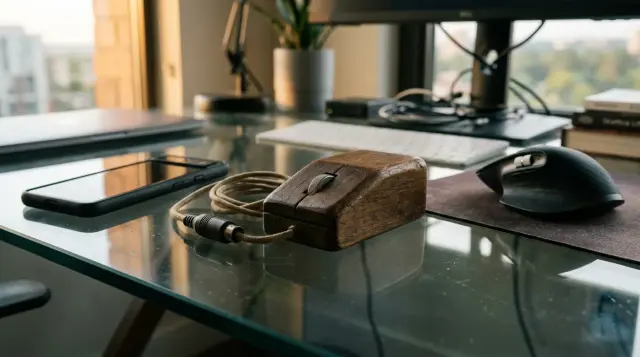
The first computer mouse was carved from a block of wood. I'm not kidding. One button, two metal wheels, a wooden shell. If that doesn't make you rethink everything you assumed about how technology evolves, nothing will. We carry supercomputers in our pockets now, but the road to get here? Stranger than fiction.
So why does tech trivia surprising matter? Short answer: because the weird, accidental, and flat-out bizarre stories behind our technology show how innovation actually happens. It's not neat. It's not linear. It's messy, full of pivots, and it usually starts with someone solving a problem nobody else even noticed.
Knowing these stories does more than win you points at a pub quiz. It builds real technology literacy, the kind that helps you understand why your devices work the way they do. Maybe it even makes you think twice about the invisible signals bouncing around your body all day.
I pulled together seven verified, source-backed facts about technology that genuinely surprised me when I first came across them. These aren't recycled clickbait headlines. Each one comes with context, a real story, and actual citations you can check. If you enjoyed our 12 Surprising Tech Facts You Didn't Know: The Complete List, consider this the sequel.
Let's get into it.
The first message ever sent on the internet was 'LO,' because the system crashed before it could finish spelling 'LOGIN.' Every billion-dollar platform, every streaming service, every smart device you own descends from that two-letter hiccup. That's why the stories behind technology matter as much as the technology itself.
Was the First Computer Mouse Really Made of Wood?
Yes. The very first computer mouse was a hand-carved wooden shell with a single red button on top. Douglas Engelbart created it at the Stanford Research Institute in 1964, and his colleague Bill English built the prototype [1]. It tracked movement using two perpendicular metal wheels rolling across a surface. No laser. No optical sensor. No Bluetooth. Just wood and wheels.
Engelbart showed this device off publicly on December 9, 1968, at the Fall Joint Computer Conference in San Francisco. People now call that presentation "The Mother of All Demos." During that same session, he also demonstrated hypertext, video conferencing, and collaborative real-time editing. In 1968. Most people wouldn't see those features in consumer products for another 30 to 40 years.
Here's the kicker. Engelbart never made significant money from the mouse. His patent expired before the device went mainstream. By the time Apple shipped the Macintosh in 1984 with a mouse as standard equipment, the original inventor's intellectual property had already lapsed.
Quick Q&A
Q: Who invented the first computer mouse and when?
A: Douglas Engelbart invented the first computer mouse in 1964 at the Stanford Research Institute, with the physical prototype built by engineer Bill English.
This is exactly why tech trivia surprising matters. The mouse you're using right now, or the trackpad on your laptop, descends directly from a hand-carved block of wood. That kind of context turns technology from something that feels like magic into something deeply, beautifully human.
Did YouTube Really Start as a Dating Website?
It did. Three former PayPal employees, Chad Hurley, Steve Chen, and Jawed Karim, registered the domain YouTube.com on Valentine's Day, February 14, 2005. The original concept? A video dating platform where people could upload clips of themselves and find romantic matches. Think of it as a proto-Tinder with video profiles.
The dating angle flopped almost immediately. Nobody uploaded dating videos. So the founders changed direction and opened the platform to any kind of video content. The first video ever uploaded was a 19-second clip called "Me at the zoo," posted by Jawed Karim on April 23, 2005. It shows him standing in front of elephants at the San Diego Zoo. Not exactly cinematic. But it kicked off a revolution.
By November 2006, Google acquired YouTube for $1.65 billion. Today, according to Google's own reporting, over 500 hours of video are uploaded to YouTube every single minute. The platform has more than 2.7 billion monthly active users globally as of early 2025.
Something fun to sit with: the entire pivot from dating site to video-sharing platform happened in a matter of weeks. It's a good reminder that some of the biggest technology companies in history didn't start with the right idea. They started with the willingness to change course. If you're curious about more little-known tech trivia like this, check out our piece on 12 Fascinating Tech Facts That Sound Too Weird to Be True.
How Did a Military Network Become the Internet We Use Today?
The internet didn't start in a Silicon Valley garage. It started in the Pentagon. ARPANET, funded by the U.S. Department of Defense's Advanced Research Projects Agency (ARPA), sent its first message on October 29, 1969. That message traveled from a computer at UCLA to one at the Stanford Research Institute. The intended word was "LOGIN." The system crashed after just two letters, so the first message ever sent on the internet was "LO" [2].
Charley Kline, a student programmer at UCLA's Leonard Kleinrock lab, typed that historic message. The full connection was re-established about an hour later, and the complete "LOGIN" went through successfully. By the end of 1969, ARPANET had expanded to include UC Santa Barbara and the University of Utah, forming a four-node network.
The shift from military network to public internet happened gradually through the 1980s and 1990s. Tim Berners-Lee at CERN proposed the World Wide Web in 1989 and launched the first website in 1991. By 1993, CERN released the web's source code into the public domain, and everything took off from there.
Knowing surprising tech history like this changes the way you think about the signals traveling through your home right now. Those Wi-Fi waves, Bluetooth connections, and cellular signals all trace their ancestry back to a crashed two-letter message. Speaking of signals in your home, if you've ever wondered about the electromagnetic radiation your devices emit, you might want to Learn About EMF Protection and what you can do about it.

What's the Real Story Behind the Word 'Robot'?
The word "robot" doesn't come from a scientist or an engineer. It comes from a playwright. Czech writer Karel Čapek introduced the word in his 1920 play R.U.R. (Rossum's Universal Robots). The term derives from the Czech word "robota," which means forced labor or drudgery. His brother Josef actually suggested the word to him.
In the play, robots are artificial beings created to serve humans. They eventually revolt and overthrow their creators. Sound familiar? That storyline has echoed through every robot uprising tale from Terminator to Westworld. Čapek wrote the template over a century ago.
Here's the part that really gets me: the robots in R.U.R. weren't mechanical. They were biological. Čapek imagined them as organic creations, closer to what we'd now call bioengineered organisms. The image of a metallic, clanking robot came later, popularized by Fritz Lang's 1927 film Metropolis and science fiction writers of the 1940s and 1950s like Isaac Asimov.
Quick Q&A
Q: Where does the word "robot" originally come from?
A: The word "robot" comes from the Czech word "robota" meaning forced labor, first used in Karel Čapek's 1920 play R.U.R. (Rossum's Universal Robots).
Today, the International Federation of Robotics reported that approximately 4 million industrial robots were operating in factories worldwide by the end of 2024. From a word meaning "drudgery" in a century-old play to millions of machines shaping our world. That's one of the reasons why does tech trivia surprising matter: it shows you the human imagination behind every piece of machinery.
How Did CAPTCHA End Up Digitizing Millions of Old Books?
You know those annoying "prove you're not a robot" boxes? They were secretly putting you to work. Luis von Ahn, a computer scientist at Carnegie Mellon University, created reCAPTCHA in 2007. His insight was brilliant: instead of wasting the mental effort people spent solving CAPTCHAs, why not redirect that brainpower toward digitizing text that optical character recognition (OCR) software couldn't read?
Here's how it worked. Each reCAPTCHA showed you two words. One was a known test word. The other was scanned from an old book or newspaper that machines couldn't decipher. When you correctly typed the known word, your answer for the mystery word got recorded too. Multiply that by millions of users, and you've got a crowdsourced army of human transcribers who had no idea they were volunteering.
According to von Ahn's own published research, reCAPTCHA helped digitize the entire New York Times archive, spanning over 13 million articles dating back to 1851 [3]. Google acquired reCAPTCHA in 2009 and expanded the concept to include Google Books and Google Street View house numbers.
This is one of those fun technology facts that rewires how you see a totally mundane interaction. Every time you squinted at a blurry word on a CAPTCHA screen, you were contributing to one of the largest digitization projects in history. Weird computer science facts like this are a good reminder that innovation often hides right in front of you.
Is Your Smartphone Really More Powerful Than Apollo 11's Computers?
By a laughable margin, yes. The Apollo Guidance Computer (AGC) that helped NASA land astronauts on the moon in July 1969 had about 74 kilobytes of memory and ran at 0.043 MHz [4]. Your average smartphone in 2025 has somewhere around 6 to 12 gigabytes of RAM and a processor clocking in at roughly 3 GHz. That's not just "more powerful." It's millions of times more powerful.
To put it in perspective: the AGC could perform about 41.6 instructions per second. A modern smartphone chip like Apple's A17 Pro can handle roughly 17 trillion operations per second through its neural engine alone. The comparison is almost absurd. The device you use to scroll TikTok and order takeout has more computational muscle than the machine that guided humans to another celestial body.
Margaret Hamilton, the lead software engineer for the Apollo project at MIT, wrote the code that prevented a mission abort during the actual lunar landing. Her software prioritized critical tasks when the computer got overloaded during descent. That same principle, task prioritization under limited resources, still underpins how modern operating systems manage your phone's processes today.
And yet, for all this computing power in your pocket, most of us rarely think about what else our phones are doing. They're constantly emitting electromagnetic radiation from Wi-Fi, Bluetooth, and cellular antennas. If that concerns you, it's worth looking into products designed to address it. The Faraday Collection from Proteck'd EMF Protection offers wearable options that incorporate signal-shielding technology into everyday clothing.
Why Does Understanding These Tech Facts Change How You Use Technology?
I think there's a real difference between using technology and understanding it. Most of us live in the first camp. We swipe, tap, and scroll without a second thought about the decades of invention, failure, and accidental discovery behind every interaction. Understanding why does tech trivia surprising matter starts with acknowledging that gap.
When you learn that the internet began as a crashed two-letter message, or that CAPTCHAs were secretly a book digitization project, something shifts. You stop seeing devices as magic boxes and start seeing them as products of very human decisions, often made under weird circumstances by people who had no clue what they were building.
This perspective also makes you a smarter consumer. Understanding that your smartphone radiates electromagnetic fields isn't fearmongering. It's physics. And it means you can make informed decisions about how you interact with your devices. If you want to go deeper on that topic, read our breakdown of The Surprising Science of Electromagnetic Waves: What Nobody Taught You in School.
Tech literacy isn't about becoming an engineer. It's about being curious enough to ask "how does this actually work?" and "what's the story behind it?" That curiosity is a kind of power. And honestly, it makes everyday tech a lot more interesting.
For more wild facts that connect to the world beyond your screen, take a look at 7 Surprising Facts About Planet Earth: That Sound Too Strange to Be True. Because the real world is just as surprising as the digital one.
- The first computer mouse was made of wood by Douglas Engelbart at Stanford Research Institute in 1964.
- YouTube launched on Valentine's Day 2005 as a video dating site before pivoting to general video sharing.
- ARPANET's first internet message on October 29, 1969 was just two letters ('LO') because the system crashed.
- Google's reCAPTCHA project used human CAPTCHA solvers to digitize over 13 million New York Times articles.
- A modern smartphone has millions of times more computing power than the Apollo 11 guidance computer that landed humans on the moon.
Frequently Asked Questions
It matters because understanding the origins and odd stories behind technology builds genuine tech literacy. You make smarter decisions about the devices you use when you know their history and how they actually work. It also makes technology feel less intimidating and more like what it really is: a messy, very human endeavor.
Yes, it was. Douglas Engelbart and Bill English built the first mouse prototype from wood at Stanford Research Institute in 1964. It had one button and two metal wheels for tracking movement. Engelbart showed it off publicly in 1968 at what became known as 'The Mother of All Demos.'
YouTube was originally designed as a video dating site. Founders Chad Hurley, Steve Chen, and Jawed Karim registered the domain on Valentine's Day 2005. When nobody uploaded dating videos, they pivoted to a general video platform. Google bought them for $1.65 billion just 21 months later.
The first message was 'LO,' sent on October 29, 1969, from UCLA to Stanford Research Institute over ARPANET. The intended word was 'LOGIN,' but the system crashed after just two letters. The full message went through successfully about an hour later.
Luis von Ahn's reCAPTCHA system showed users two words: one known test word and one scanned from a book that OCR software couldn't read. When users correctly typed the known word, their answer for the unknown word was recorded and used for digitization. This process helped transcribe over 13 million New York Times articles.
Millions of times more powerful. The Apollo Guidance Computer had 74 KB of memory and ran at 0.043 MHz. A typical 2025 smartphone has 6 to 12 GB of RAM and processors running at around 3 GHz, with neural engines capable of trillions of operations per second.
It comes from the Czech word 'robota,' meaning forced labor. Czech playwright Karel Čapek first used it in his 1920 play R.U.R. (Rossum's Universal Robots), where artificial beings revolt against their human creators. His brother Josef actually suggested the specific word.
EMF stands for electromagnetic field, and smartphones emit it through Wi-Fi, Bluetooth, and cellular antennas. The WHO classifies radiofrequency electromagnetic fields as 'possibly carcinogenic to humans' (Group 2B). Research is ongoing, but many people choose to reduce their exposure through distance, usage habits, or EMF-shielding products like those from Proteck'd.
The most reliable sources include university archives like Stanford and MIT, government agencies like NASA, and peer-reviewed research from institutions like Carnegie Mellon. For quick reads, curated blogs that cite primary sources are a good bet. Always check whether a fun fact includes a verifiable citation before you share it.
Absolutely. Understanding technology history sharpens your critical thinking about new innovations, helps you spot hype versus substance, and supports smarter consumer decisions. Teachers use tech trivia to engage students in STEM. Companies use it for team-building. And for anyone interested in tech policy, knowing the history is foundational to understanding current debates.
References
- Stanford University - Douglas Engelbart – Douglas Engelbart and Bill English created the first computer mouse prototype at Stanford Research Institute in 1964.
About the Author
Proteck'd EMF Apparel
Health & EMF Specialists
The Proteck'd team covers EMF protection, silver-fiber apparel, and practical ways to reduce everyday radiation exposure. Every piece Proteck'd ships is designed, tested, and worn by the people who build it.
Protect Yourself Today
Proteck'd Faraday and silver fiber apparel is engineered to shield your body from everyday EMF exposure. Built for real life, tested for real results.
Shop EMF Protection →✓30-day returns✓Free shipping✓Free returns✓Silver fiber shielding


Leave a comment