


How Animals See the World: Fascinating Facts

A pit viper can "see" your body heat in total darkness. A mantis shrimp perceives colors you literally cannot imagine. A platypus hunts by sensing the tiny electrical pulses of its prey's muscles. If those sentences don't make you pause and rethink what "seeing" even means, I'm not sure what will.
So why does animal facts mind blowing matter beyond cocktail party trivia? Because these creatures are living proof that the world around us is flooded with invisible energy. Radiation, magnetic fields, ultraviolet light. We walk through all of it every single day without noticing. Animals didn't just evolve to survive. They evolved to detect forces that our biology flat-out ignores.
Understanding how wildlife perceives radiation and electromagnetic energy isn't just fascinating. It changes the way you think about your own surroundings. The same spectrum of energy that a snake uses to hunt or a bird uses to find its way home is the spectrum that our phones, routers, and smart devices emit constantly. The parallels are worth sitting with.
I've spent a lot of time reading research papers and geeking out over animal biology, and I keep landing on the same realization: the animal kingdom is a masterclass in sensing what we can't see. Let's get into it.
Key Takeaways
How Do Pit Vipers See Infrared Radiation?
Pit vipers, including rattlesnakes and copperheads, have something called pit organs located between their eyes and nostrils. These aren't decorative. They're biological thermal cameras. Research published by Julius and colleagues at the University of California, San Francisco in 2010 found that these pit organs contain a protein channel called TRPA1 that responds to infrared radiation with extraordinary precision [1].
How precise? The pit organ can detect temperature changes as small as 0.003 degrees Celsius. A mouse sitting perfectly still in pitch darkness is basically a glowing beacon to a rattlesnake. The snake's brain merges this infrared data with visual input, creating a combined "image" of the world that we have no biological equivalent for. None.
This is one reason animal perception abilities fascinate researchers who study radiation. These snakes evolved to exploit a part of the electromagnetic spectrum that humans only accessed through expensive military technology a few decades ago. Nature got there millions of years earlier. If you're curious about how invisible forces operate around us all the time, 10 Mind-Blowing Facts About The Invisible Forces Around Us: You Won't Believe Are True is a great companion read.
Quick Q&A
Q: Can pit vipers actually see in the dark using heat?
A: Yes, pit vipers detect infrared radiation emitted by warm-blooded prey, effectively creating a thermal image even in complete darkness.
What makes this especially interesting is that infrared radiation is just one band on the electromagnetic spectrum. It sits right next to the visible light we see every day, and right below the microwave and radio frequencies that power our wireless technology. Animals remind us that "invisible" doesn't mean "not there."
What Colors Can a Mantis Shrimp See That Humans Can't?
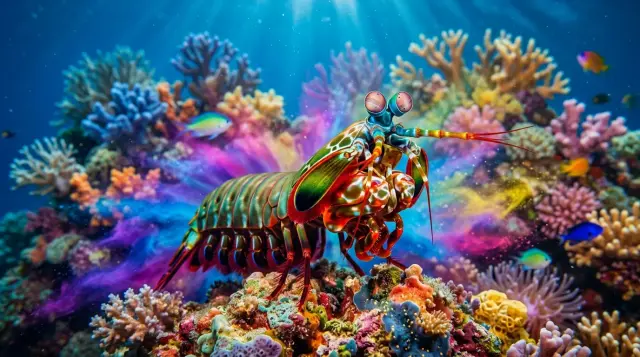
If your eyes are the equivalent of a basic three-color printer, a mantis shrimp's eyes are a 16-channel spectral analyzer. Humans have three types of cone cells: red, green, and blue. We mix those signals to perceive roughly one million colors. Mantis shrimp? They have 16 types of photoreceptor cells, including ones tuned to ultraviolet light wavelengths [2].
Research led by Dr. Justin Marshall at the University of Queensland has shown that mantis shrimp don't just see more colors. They see entirely different categories of light, including UV vision in nature that's completely outside our perceptual range. Their eyes move independently. They can detect polarized light, which lets them see a hidden layer of information in the ocean that's invisible to nearly every other creature.
Now here's where it gets humbling. Despite having all these photoreceptors, studies suggest mantis shrimp aren't necessarily "better" at distinguishing similar shades than we are. Their visual system seems designed for speed: rapid identification of specific wavelengths rather than nuanced color comparison. It's a totally different approach to processing the electromagnetic spectrum in wildlife. Evolution didn't hand them a better version of our eyes. It gave them a completely different operating system.
This kind of thing is exactly why animal facts mind blowing details keep pulling researchers back. It's not just about what animals can do. It's about what those abilities reveal about the energy surrounding all of us. For more on how electromagnetic radiation shapes our world, check out 7 Mind-Blowing Facts About Electromagnetic Radiation: That Will Change How You See the World.
Can Animals Really Sense Earth's Magnetic Field?
Yes. And it's stranger than it sounds. European robins, sea turtles, and even some species of bacteria can detect Earth's magnetic field and use it for navigation. This ability is called magnetoreception, and for years scientists argued about whether it was even real. Now there's solid evidence. A 2018 study published in the journal Nature by a team at the University of Tokyo confirmed the existence of a magnetoreceptive protein called cryptochrome 4 (CRY4) in birds' eyes [3].
Let that sink in. A robin can literally see the magnetic field overlaid on its normal vision, like a heads-up display for navigation. The protein responds to the blue light spectrum and becomes sensitive to magnetic orientation through a quantum mechanical process involving radical pairs. Quantum biology. In a songbird. The more you learn about animal senses beyond human capabilities, the more our own perception feels like watching the world through a keyhole.
Sea turtles take a different approach. According to research from the University of North Carolina, loggerhead turtles imprint on the specific magnetic signature of the beach where they hatch. Decades later, they return to that exact location to nest, using a magnetic map encoded in their biology. The Earth's geomagnetic field literally shapes their entire life cycle.
It makes you wonder what else we're missing. The electromagnetic spectrum is vast, and humans only perceive a tiny sliver of it visually. Plenty of that invisible energy, from radio waves to microwave frequencies, now fills our homes and offices. Understanding how to interact thoughtfully with it is something I think about a lot, and it's one reason I appreciate companies like Proteck'd EMF Protection that take the science of electromagnetic radiation seriously enough to build clothing around it.
Every astonishing animal sense, from a pit viper's heat vision to a platypus's electrical detection, is a reminder that the world is saturated with invisible energy. The only question is how much of it we choose to notice.

How Does the Platypus Hunt Using Electricity?
The platypus is already one of the most bizarre animals on Earth. An egg-laying mammal with a venomous spur, a beaver tail, and a duck bill. But its strangest trick might be electroreception. The platypus bill contains roughly 40,000 electroreceptors that can detect the faint electrical impulses generated by muscle contractions in prey like shrimp and insect larvae [4].
When a platypus hunts, it closes its eyes, ears, and nostrils underwater. Blind. Deaf. Unable to smell. It finds food purely by sensing electrical fields. According to research from the Australian National University, the platypus sweeps its bill back and forth through the water, triangulating the electrical signals of nearby organisms. The sensitivity is staggering: it can detect fields as small as 50 microvolts per centimeter.
Quick Q&A
Q: Is the platypus the only mammal that can sense electrical fields?
A: The platypus and the echidna are the only known mammals with electroreception, though sharks and rays also possess this ability.
Electroreception is a reminder that electrical energy is everywhere in nature: in muscle fibers, in nerve impulses, in the water itself. We live in a world saturated with both natural and artificial electromagnetic fields. If a platypus can detect microvolt signals from a tiny shrimp, it really puts into perspective how much EM radiation our devices pump into our surroundings. Want to see how that connects to the tech you use every day? 12 Fascinating Tech Facts That Sound Too Weird to Be True: The Complete List covers some eye-opening ground.
Why Can Tardigrades Survive Extreme Radiation?
Tardigrades, those microscopic eight-legged creatures sometimes called water bears, are arguably the toughest animals on Earth. They've survived the vacuum of space, temperatures near absolute zero, pressures six times greater than the deepest ocean trench, and radiation doses that would kill a human hundreds of times over. A 2016 study in Nature Communications found that tardigrades produce a unique protein called Dsup (damage suppressor) that literally shields their DNA from radiation damage.
How much radiation can they handle? Tardigrades have survived doses exceeding 5,000 grays. For context, a dose of just 5 grays is lethal for most humans. That's a 1,000-fold difference. Researchers at the University of Tokyo discovered that when they transferred the Dsup protein into human cell cultures, those cells showed roughly 40% less DNA damage from X-ray exposure. The implications for radiation protection in medicine are enormous.
This is one of those astonishing animal biology facts that crosses the line from "cool trivia" into "potentially life-saving science." Understanding how nature already solved the radiation problem could inform everything from cancer treatment to space travel. It's also a powerful reminder that radiation is a constant presence in our environment. Natural sources like UV and cosmic rays. Artificial ones like the EMF from our devices.
For people curious about managing their own exposure to everyday electromagnetic radiation, Learn About EMF Protection is a good starting point. And if you want clothing engineered with shielding in mind, the Faraday Collection takes cues from the same physics that makes radiation such a powerful force in nature.
What Other Animals Have Mind-Blowing Perception?
We've covered heat vision, ultraviolet perception, magnetic navigation, electroreception, and radiation immunity. But the list keeps going, and it keeps getting weirder. Dolphins use echolocation so precise that they can distinguish between objects of different densities from across a pool. According to the Dolphin Research Center in the Florida Keys, dolphins can even detect a coin-sized object buried in sand using only sonar. And they sleep with only half their brain at a time, keeping one eye open to watch for predators. Literally.
Octopuses deserve their own spotlight. They have roughly 500 million neurons, and about two-thirds of those are in their arms, not their brain. Each arm can taste, touch, and make decisions semi-independently. The mimic octopus, found in the Indo-Pacific, can impersonate at least 15 different species, including lionfish, flatfish, and sea snakes, by changing its shape, color, and behavior in real time. Nature's greatest actor, running on a distributed nervous system that neuroscientists are still trying to figure out.
Then there's the peregrine falcon, clocked by National Geographic at over 240 miles per hour in a hunting dive. Or the naked mole rat, which is practically immune to cancer thanks to a molecule called high-molecular-mass hyaluronan, as identified by researchers at the University of Rochester in 2013. Each of these facts represents millions of years of evolution solving a specific problem in a specific environment.
Why does animal facts mind blowing information keep mattering? Because every one of these adaptations teaches us something about the physical forces governing our world. For more on recent discoveries that blur the line between "impossible" and "documented," read 12 Mind-Blowing Facts About Nature: That Science Just Discovered.
How Does All of This Connect to the Invisible Energy Around Us?
Here's the thread that ties everything together. Every single animal ability we've talked about, infrared detection, UV vision, magnetoreception, electroreception, radiation resistance, involves some form of energy that humans can't perceive without technology. We built infrared cameras, UV sensors, and Geiger counters to access what pit vipers, mantis shrimp, and tardigrades just do naturally.
The electromagnetic spectrum doesn't stop being relevant when we put down the nature documentary. Our homes are filled with radio waves from WiFi routers, microwaves from Bluetooth devices, and extremely low frequency fields from power lines. The same invisible energy that animals evolved to master now floods our personal spaces in forms that didn't exist a century ago.
That's not fearmongering. It's context. When you learn that a platypus can detect 50 microvolts from a shrimp, it becomes a lot harder to dismiss the idea that the electromagnetic environment we've built for ourselves might be worth paying attention to. The question isn't whether the energy is there. It's how you choose to engage with it.
Understanding why mind-blowing animal facts matter is really about understanding the invisible forces that shape all life. If that nudges you to think a little more carefully about your own electromagnetic environment, that's a good thing. Whether that means reading the science, adjusting your habits, or exploring options like EMF-shielding clothing, awareness is the first step. The animals figured it out over millions of years. We're just getting started.
Frequently Asked Questions
Q: Why does animal facts mind blowing matter for understanding our world?
These facts matter because they reveal invisible forces, like electromagnetic radiation, magnetic fields, and electrical energy, that are constantly present but undetectable by human senses. Every extraordinary animal ability is evidence of a physical force we tend to ignore. Understanding them shifts how you think about your own environment and the energy moving through it.
Q: Can pit vipers really see in complete darkness?
Yes. Pit vipers detect infrared radiation emitted by warm-blooded animals, allowing them to form thermal images in zero light. Their pit organs are sensitive enough to detect temperature differences as small as 0.003°C, which makes them extremely effective nocturnal hunters.
Q: How many colors can a mantis shrimp see?
Mantis shrimp have 16 types of photoreceptor cells, far more than the 3 in human eyes. They can perceive ultraviolet light and polarized light, giving them access to visual information completely outside our range. That said, research suggests they're optimized for speed of identification rather than fine shade distinction.
Q: How do birds navigate using Earth's magnetic field?
Many migratory birds have a protein called cryptochrome 4 in their eyes that responds to blue light and becomes sensitive to magnetic orientation. This effectively lets them see the magnetic field overlaid on their normal vision, like a built-in compass. European robins are among the best-studied examples.
Q: Can tardigrades survive in space?
They can. Tardigrades have survived the vacuum of space, extreme temperatures, and massive radiation doses. They produce a protein called Dsup that shields their DNA from radiation damage. In lab settings, they've survived radiation levels exceeding 5,000 grays, compared to the 5-gray lethal dose for humans.
Q: What is electroreception and which animals have it?
Electroreception is the ability to detect electrical fields generated by other organisms. Platypuses use roughly 40,000 electroreceptors in their bills to hunt underwater prey. Sharks, rays, and echidnas also have this sense. It allows them to locate prey even when they can't see, hear, or smell it.
Q: Do dolphins really sleep with one eye open?
They do. Dolphins practice unihemispheric slow-wave sleep, meaning one half of their brain rests while the other stays alert. This lets them keep breathing consciously and watch for predators. They alternate which hemisphere is resting throughout a sleep cycle.
Q: What makes the naked mole rat nearly immune to cancer?
Naked mole rats produce an unusually large version of a molecule called hyaluronan, which prevents cells from overcrowding and forming tumors. Researchers at the University of Rochester identified this mechanism in 2013. These rodents can live over 30 years, extraordinarily long for their size, with almost zero incidence of cancer.
Q: How does animal vision relate to the electromagnetic spectrum?
All vision is the detection of electromagnetic radiation at specific wavelengths. Humans see a narrow band called visible light. Many animals see infrared, ultraviolet, or polarized light, accessing broader portions of the spectrum. That means the "visible world" is genuinely different for nearly every species.
Q: Are there any practical applications from studying animal radiation abilities?
Absolutely. The tardigrade's Dsup protein has already been tested in human cell cultures, reducing X-ray DNA damage by about 40%. Mantis shrimp vision has inspired new camera sensor designs. Research into biological magnetoreception is informing navigation technology. Nature's solutions to radiation and energy detection keep translating into real human innovation.
References
- Nature (Springer Nature) – Pit vipers use the TRPA1 protein channel in their pit organs to detect infrared radiation, as identified by researchers at UC San Francisco
- Nature (Springer Nature) – The cryptochrome 4 protein in birds' eyes is magnetically sensitive and enables detection of Earth's magnetic field
- Nature Communications (Springer Nature) – Tardigrades produce the Dsup protein that suppresses DNA damage from radiation, and transfer of this protein to human cells reduced X-ray damage by approximately 40%
- National Institutes of Health (PubMed) – Naked mole rats are resistant to cancer due to high-molecular-mass hyaluronan, as discovered by researchers at the University of Rochester
About the Author
Proteck'd EMF Apparel
Health & EMF Specialists
The Proteck'd team covers EMF protection, silver-fiber apparel, and practical ways to reduce everyday radiation exposure. Every piece Proteck'd ships is designed, tested, and worn by the people who build it.
Get the Free EMF Home Audit Checklist
A room-by-room PDF that walks you through the biggest EMF sources in your house and what to do about each one. No cost, no fluff.
Download the Checklist →✓30-day returns✓Free shipping✓Free returns✓Silver fiber shielding


Leave a comment