


A Low-EMF Bedroom: The Simple Sleep Upgrade

You spent good money on a mattress. Maybe you splurged on blackout curtains or a white noise machine, too. But have you thought about what's invisibly flooding your bedroom every single night? The average sleeping space now contains five to ten wireless-emitting devices, all pumping out electromagnetic radiation while you're trying to recover from the day. Your phone on the nightstand. The WiFi router down the hall. That smart speaker you forgot to unplug. It adds up fast.
Here's the thing: your body does its most important repair work during sleep. Hormone regulation, cellular cleanup, memory consolidation. A growing body of research suggests that electromagnetic fields (EMF) may interfere with some of those processes, particularly melatonin production. That's why more people are exploring solutions like emf shield clothing, bedroom rearrangements, and router timers to cut their exposure during the hours that matter most.
I'm not here to tell you to throw out every gadget you own. That's not realistic. Honestly, it's not even necessary. But a few targeted changes in your bedroom can meaningfully reduce your nighttime EMF exposure. Think of it less like a radical lifestyle overhaul and more like adding one new layer to your sleep hygiene routine.
In this guide, we'll walk through what the science actually says about EMF and sleep, which bedroom sources matter most, and practical steps you can take tonight. We'll also cover how protective fabrics and shielding garments fit into the picture for anyone who wants an extra buffer while they rest.
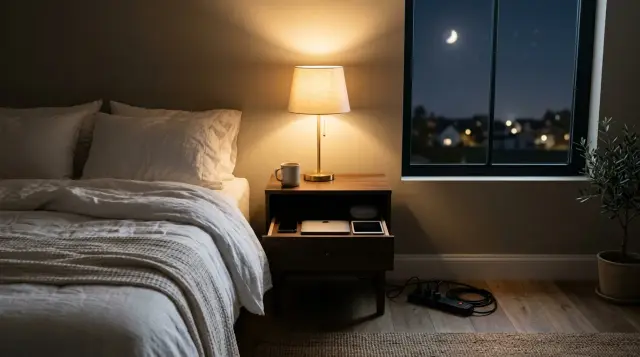
Your body spends seven to nine hours each night repairing itself. Reducing the electromagnetic radiation in your bedroom during those hours isn't paranoia. It's the same logic as choosing clean water and clean air: when you can lower the load, why wouldn't you?
Does EMF Exposure Actually Affect Your Sleep?
Let's start with the question everyone asks first: is there real evidence that electromagnetic radiation disrupts sleep, or is this just internet anxiety? The honest answer is that the science is still evolving. But there are some compelling signals worth paying attention to.
A 2013 meta-analysis by researchers at the University of Melbourne examined multiple studies on RF-EMF exposure and sleep. They found consistent evidence that radiofrequency electromagnetic fields altered EEG (electroencephalogram) brain activity during sleep, particularly affecting sleep spindles, which play a role in memory consolidation [1]. That's not nothing. When your brain's electrical patterns shift during rest, the downstream effects on how refreshed you feel can be real and noticeable.
The World Health Organization's International Agency for Research on Cancer (IARC) classified radiofrequency electromagnetic fields as "possibly carcinogenic to humans" (Group 2B) back in 2011 [2]. That classification is about cancer risk rather than sleep specifically, but it acknowledged that biological effects from RF exposure are plausible enough to warrant caution. And melatonin, the hormone that governs your sleep-wake cycle, is particularly sensitive to environmental signals. Some animal studies have suggested that prolonged EMF exposure can suppress melatonin secretion, though human data remains mixed.
Quick Q&A
Q: Can WiFi signals in your bedroom lower melatonin levels?
A: Some animal studies suggest prolonged RF-EMF exposure may suppress melatonin, though human research is still inconclusive; reducing nighttime exposure is a reasonable precaution based on current evidence.
If you've ever wondered why you can't sleep and whether EMF could be the cause, you're asking a question researchers are actively studying. The precautionary principle makes a lot of sense here. The potential downside of reducing bedroom EMF is zero. The potential upside? Better sleep.
What Are the Biggest EMF Sources in Your Bedroom?
Before you change anything, it helps to know where the electromagnetic radiation in your bedroom is actually coming from. Not all sources are equal. Some are way closer to your body than you'd think.
Your smartphone is the obvious one. Most people charge their phone within arm's reach of their pillow, which means a device actively communicating with cell towers (and often WiFi and Bluetooth simultaneously) sits roughly 12 to 18 inches from your brain for eight hours straight. Then there's your WiFi router. If it's in an adjacent room, or worse, in the bedroom itself, it's broadcasting radiofrequency signals around the clock. A 2015 study published in Electromagnetic Biology and Medicine found that WiFi-frequency radiation (2.4 GHz) could affect oxidative stress markers in exposed organisms [3].
Smart home devices are another culprit people overlook. Smart speakers, baby monitors, Bluetooth alarm clocks, smart plugs. Each one adds to the ambient EM radiation in your room. And don't forget about wiring in the walls. Old or poorly shielded electrical wiring can produce elevated extremely low frequency (ELF) fields, especially near the head of the bed if there's a junction box on the other side of the wall.
Here's a concrete example. A friend of mine bought an EMF meter (a TriField TF2, a popular consumer model) and measured his bedroom. The reading at his pillow was roughly 10 times higher than the reading at the foot of the bed. The reason? His phone, a Bluetooth speaker, and a power strip were all clustered on his nightstand. Moving those three items to the other side of the room cut his pillow-level exposure dramatically. Sometimes the fix really is that simple.
How Do You Create a Low-EMF Bedroom Step by Step?
Alright, let's get practical. You don't need to spend thousands of dollars or gut your walls. Start with the highest-impact changes first, and add more if you want to go deeper. Think of this as a spectrum, not an all-or-nothing commitment.
Step one: distance your devices. Move your phone at least six feet from the bed, or better yet, leave it in another room entirely. If you use it as an alarm, buy a $10 battery-powered alarm clock instead. According to the inverse square law of physics, doubling the distance from an EMF source reduces your exposure by a factor of four. That's a big payoff for something that takes five seconds.
Step two: kill the WiFi at night. A simple outlet timer (about $8 at any hardware store) can automatically shut off your router from, say, 11 p.m. to 6 a.m. You're not using it while you're asleep anyway. If your router is in the bedroom, move it. If it can't be moved, the timer is your best friend. For a more thorough approach, check out this guide on low-EMF home design that covers room-by-room strategies.
Step three: audit your smart devices. Do you really need a smart plug on your bedside lamp? Does the baby monitor need to be WiFi-enabled, or would an audio-only model work just fine? Each device you remove or replace with a non-wireless alternative lowers the ambient electromagnetic field in your sleep space.
Step four: consider your bed's position. If there's an electrical panel, smart meter, or breaker box on the other side of your bedroom wall, move the bed to the opposite wall. Smart meters in particular can emit brief, intense bursts of RF radiation multiple times per minute. The National Institute of Environmental Health Sciences (NIEHS) notes that while individual exposures from smart meters are low, cumulative and chronic proximity matters [4].

Can EMF Shield Clothing Actually Help You Sleep Better?
So here's where things get interesting. You've rearranged your room, set up a router timer, and ditched the bedside phone habit. But what about the electromagnetic radiation you can't easily control? Cell towers, neighbors' WiFi networks, and outdoor sources don't care about your bedtime routine. That's where emf shield clothing enters the picture.
EMF protective clothing works on the same principle as a Faraday cage. Silver or copper threads woven into the fabric create a conductive mesh that reflects and absorbs electromagnetic radiation before it reaches your skin. High-quality silver-fiber garments can block over 99% of RF radiation at frequencies ranging from low MHz up to 10 GHz and beyond, which covers WiFi, Bluetooth, cellular signals, and 5G bands. If you're curious about the mechanics, this breakdown of how Proteck'd builds personal Faraday shielding explains the engineering in plain language.
Wearing a shielding garment to bed might sound unusual. But think about it: you already wear pajamas. Swapping a regular cotton tee for one woven with silver fiber doesn't change your routine at all. It just adds a layer of protection. Proteck'd EMF Protection designs their pieces to feel like normal, comfortable clothing rather than something out of a sci-fi movie, which matters a lot when you're actually trying to fall asleep in them.
Quick Q&A
Q: Does silver-fabric EMF clothing really block radiation while you sleep?
A: Yes, lab-tested silver-fiber fabrics can attenuate over 99% of RF electromagnetic radiation across common wireless frequencies, providing measurable shielding when worn during sleep.
The question people always ask is whether this shielding actually holds up in real-world conditions. Fair question. You can read an honest assessment of whether personal EMF Faraday shields are effective, but the short version is that the physics is sound. Silver is one of the most conductive elements on earth, and its shielding properties are well-documented in materials science literature. The garments won't block 100% of all radiation from every direction, but they meaningfully reduce what reaches the covered areas of your body.
What Should You Wear to Bed for EMF Protection?
If you're going to add EMF protective apparel to your nighttime routine, you want something that actually covers the areas that matter. Your torso houses your heart, lungs, and a large portion of your nervous system. Your head is, well, your brain. So a long-sleeve top and a beanie or cap are probably the two most impactful pieces for sleep.
Proteck'd's Faraday EMF Collection includes options that work well as sleepwear. Their pieces use silver-fiber technology woven directly into soft, breathable fabric, so you're not sleeping in some rigid metallic sheet. I've seen people pair a shielding tee with their regular sleep pants and notice a difference within a week. Is that placebo? Maybe for some. But when you combine it with the environmental changes we talked about earlier, the overall reduction in nighttime EM radiation exposure is measurable.
One practical tip: if you're new to emf shield clothing, start with a single piece and see how you feel over two to three weeks. Track your sleep with a journal (or an app, just put the phone across the room). Note how quickly you fall asleep, how often you wake up, and how rested you feel in the morning. Consistency matters more than perfection here. For more details on what to look for in protective garments, the EMF Protection Benefits page covers the most common questions.
Also, keep in mind that protective fabric works best when it's cared for properly. Silver-fiber garments should be washed gently, ideally by hand or on a delicate cycle, and never with bleach or fabric softener. These chemicals can degrade the conductive fibers over time and reduce shielding effectiveness. Treat them like you'd treat any quality garment and they'll last.
Do EMF Bed Canopies and Blankets Work?
Beyond clothing, some people go further and install EMF shielding canopies over their beds or use silver-threaded blankets. These products work on the same Faraday-cage principle as the clothing, but they aim to shield a larger area around your body.
A shielding canopy drapes over the bed frame and touches the floor on all sides, creating an enclosed space that blocks ambient RF signals. They can be remarkably effective when properly grounded. They're also expensive, though. Often $300 to $800. And they can be tricky to set up correctly. If there are gaps at the bottom or the canopy isn't grounded, its effectiveness drops significantly.
For most people, I think a combination of environmental changes plus EMF protective clothing is a more practical starting point. A canopy makes sense if you live in a high-EMF environment, like an apartment building with dozens of overlapping WiFi networks, or near a cell tower. But if you're in a suburban house and you've already moved devices away and added a router timer, shielding garments fill in the remaining gaps nicely without the hassle of a full canopy installation.
If you want the complete picture of how shielding strategies compare, this complete guide to EMF blocking for better sleep walks through every option from the cheapest to the most comprehensive.
How Can You Measure EMF Levels in Your Bedroom?
You can't manage what you can't measure. If you're serious about creating a low-EMF bedroom, consider picking up an EMF meter. You don't need a $500 professional-grade instrument. The TriField TF2, which costs around $170, measures all three types of EMF (magnetic, electric, and radiofrequency) and is widely recommended by building biologists.
Here's a simple testing protocol. Take readings at pillow height with all devices in their normal positions. Write down the numbers. Then start removing or distancing one device at a time and take a new reading after each change. You'll quickly see which sources contribute the most. Most people are surprised to find that their phone charger cable or a bedside lamp with a dimmer switch produces a stronger local field than they expected.
The Building Biology Institute in the United States publishes exposure guidelines for sleeping areas. They recommend RF power density below 0.1 microwatts per square meter for "no concern" during sleep, and magnetic fields below 0.2 milligauss. These are much stricter than government safety limits, which focus on thermal (heating) effects rather than long-term, low-level exposure. For context, the FCC's general public limit is 1,000 microwatts per square centimeter for the 1.5 GHz to 100 GHz range. That's orders of magnitude higher than what building biologists suggest for sleep environments.
Having actual numbers transforms the process from guesswork into targeted action. You'll know exactly which changes made the biggest difference and where your emf shield clothing or other shielding solutions are still needed.
What About Kids' Bedrooms and Nurseries?
If you're going to prioritize one room in the house, make it the room where a child sleeps. Children's skulls are thinner. Their brains are still developing. Their cells divide more rapidly. All of these factors make them potentially more susceptible to any biological effects of electromagnetic radiation. The American Academy of Pediatrics (AAP) has called for updated EMF safety standards, specifically noting that current FCC guidelines, last meaningfully updated in 1996, don't account for children's unique vulnerability.
In practical terms, that means keeping baby monitors as far from the crib as possible while still being functional. Choose an audio-only monitor over a WiFi-enabled video model if you can. Never place a tablet or phone in or near a crib for white noise. Use a standalone sound machine instead, preferably battery-powered or placed several feet away.
For older kids, the phone-in-the-bedroom battle is familiar to every parent. Consider making the family charging station in the kitchen or living room. No devices in bedrooms after a certain hour. This isn't just an EMF strategy. It's a screen-time strategy that pediatricians recommend for sleep quality regardless of electromagnetic concerns.
Some parents also explore EMF protective garments sized for children, especially for kids who sleep in rooms adjacent to smart meters or in apartment buildings with high ambient RF. It's a growing niche, and the same silver-fiber technology used in adult emf shield clothing is being adapted for smaller sizes.
- Move your phone and wireless devices at least six feet from the bed, or out of the bedroom entirely
- Use an outlet timer to shut off your WiFi router during sleeping hours
- EMF shield clothing with silver fiber can block over 99% of RF radiation covering your torso and head while you sleep
- Measure your bedroom's EMF levels with a consumer meter like the TriField TF2 to identify the highest-exposure spots
- Prioritize children's bedrooms first, as developing bodies may be more susceptible to electromagnetic radiation effects
Frequently Asked Questions
It can. A phone on your nightstand emits RF radiation from cellular, WiFi, and Bluetooth signals continuously. Research from the University of Melbourne found that RF-EMF exposure alters EEG brain activity during sleep [1]. Moving your phone at least six feet away, or into another room entirely, is one of the simplest ways to reduce nighttime exposure.
Most EMF shield clothing is made with silver or copper threads woven into a base fabric like cotton or polyester. Silver is preferred because it's the most electrically conductive element and also naturally antimicrobial. The conductive threads form a mesh that reflects and absorbs electromagnetic radiation, similar to how a Faraday cage works.
Yes, but you need to be gentle with it. Hand washing or a delicate machine cycle works best. Avoid bleach, fabric softener, and high heat in the dryer, since these can damage the conductive silver fibers. Proper care preserves the shielding effectiveness for years.
You can start for almost nothing by moving devices away from the bed and using an $8 outlet timer on your WiFi router. An EMF meter runs around $170. EMF shield clothing ranges from $50 to $150 per piece. A full bed canopy costs $300 to $800. Most people find that the free and low-cost changes make the biggest impact.
The WHO classified RF electromagnetic fields as possibly carcinogenic (Group 2B) in 2011, meaning the evidence warrants attention but isn't conclusive [2]. WiFi operates at 2.4 GHz and 5 GHz, both within the RF spectrum. While individual exposure levels are low, the concern is about chronic, cumulative exposure, especially during sleep when your body is focused on repair.
When properly installed and grounded, EMF shielding canopies can significantly reduce RF radiation around your bed. Gaps at the base or improper grounding reduce their effectiveness, though. For most people, combining device management with EMF protective clothing is more practical and still provides meaningful shielding.
Yes. It's one of the easiest and most impactful changes you can make. A simple outlet timer can automate it so you never have to think about it. You're not using the internet while you sleep, so there's no real downside, and it eliminates a major source of RF radiation in your home during your most restorative hours.
At least six feet is a good general rule. Because of the inverse square law, doubling your distance from an EMF source reduces exposure by roughly 75%. The farther the better. Ideally, devices like phones and tablets should be in a completely different room during sleep.
Potentially, yes. Children have thinner skulls, developing nervous systems, and more rapidly dividing cells, which may make them more susceptible to biological effects. The American Academy of Pediatrics has called for updated FCC safety standards to better account for children's unique physiology.
Some animal studies suggest that prolonged EMF exposure can suppress melatonin secretion, though results in human studies remain mixed. Melatonin peaks between 2 a.m. and 4 a.m., and since it's sensitive to environmental electromagnetic signals, reducing bedroom EMF during sleep is a reasonable precaution.
References
- National Library of Medicine (PubMed) – RF-EMF exposure alters EEG brain activity during sleep, particularly affecting sleep spindles involved in memory consolidation (University of Melbourne meta-analysis, 2013)
- WHO International Agency for Research on Cancer (IARC) – IARC classified radiofrequency electromagnetic fields as possibly carcinogenic to humans (Group 2B) in 2011
- National Library of Medicine (PubMed) – WiFi-frequency radiation (2.4 GHz) may affect oxidative stress markers in biological organisms
- National Institute of Environmental Health Sciences (NIEHS) – NIEHS provides information on EMF exposure from sources including smart meters and notes the relevance of cumulative and chronic proximity to EMF sources
About the Author
Proteck'd EMF Apparel
Health & EMF Specialists
The Proteck'd team covers EMF protection, silver-fiber apparel, and practical ways to reduce everyday radiation exposure. Every piece Proteck'd ships is designed, tested, and worn by the people who build it.
Get the Free EMF Home Audit Checklist
A room-by-room PDF that walks you through the biggest EMF sources in your house and what to do about each one. No cost, no fluff.
Download the Checklist →✓30-day returns✓Free shipping✓Free returns✓Silver fiber shielding


Leave a comment