


EMF Clothing for Better Rest: How It Works

You're lying in bed. Phone on the nightstand. Wi-Fi router humming away downstairs. Maybe a smart speaker glowing on the dresser. You can't see or feel it, but radiofrequency energy is washing over you all night long. And if you've started looking into solutions, you've probably bumped into a question that gives a lot of people pause: is emf radiation protection clothing dangerous? The short answer is no. It isn't.
But I get why you're asking. Anything that claims to "block radiation" sounds like it could be sketchy. Like maybe it involves lead aprons or strange chemicals or something you definitely wouldn't want pressed against your skin for eight hours. The reality is much simpler, and a whole lot more comfortable, than you'd expect.
EMF-shielding garments work by weaving conductive metals, usually silver or copper, directly into soft, wearable fabrics. These metals reflect and absorb electromagnetic radiation before it reaches your body. Silver in particular has been used in medical textiles for decades. It's antimicrobial, biocompatible, and won't irritate your skin [1].
What's actually interesting about these garments isn't the safety question (that one's easy). It's what happens when you reduce your nighttime electromagnetic exposure. That's where the sleep connection comes in, and that's what the rest of this article is really about.
Key Takeaways
Why Does EMF Exposure Affect Sleep in the First Place?
Your body runs on an internal clock called the circadian rhythm, and it's surprisingly sensitive to environmental signals. Light is the big one we all know about. But electromagnetic fields interact with your biology in subtler ways. Research from the National Institute of Environmental Health Sciences (NIEHS) has identified RF radiation as a factor worth studying in relation to sleep disruption and cellular oxidative stress.
Here's a concrete example. A 2013 study published in the International Journal of Environmental Research and Public Health found that subjects exposed to low-frequency electromagnetic fields showed measurably reduced melatonin levels [2]. Melatonin is the hormone that tells your body it's time to sleep. Less of it means lighter sleep, more waking, and that groggy morning feeling no amount of coffee fully fixes.
Think about your bedroom for a second. Your phone, your router, your smart thermostat, maybe a baby monitor. Each device emits RF energy. Individually, the exposure levels stay within FCC guidelines (the SAR limit is 1.6 W/kg for phones). But the cumulative effect of multiple sources running all night long? That's a different conversation entirely. And it's the one researchers are increasingly paying attention to.
Quick Q&A
Q: Can Wi-Fi routers really affect how well you sleep?
A: Yes, routers emit continuous RF radiation, and research suggests cumulative nighttime exposure can suppress melatonin production, which directly affects sleep quality.
For a deeper look at how electromagnetic radiation interacts with your cells, check out What EMF Does at the Cellular Level: Oxidative Stress Explained. It's a surprisingly readable breakdown of the biology involved.
Is EMF Radiation Protection Clothing Safe to Wear All Night?
Let's tackle this one head-on. The concern about whether EMF protection garments are safe usually comes from a misunderstanding about what's actually in them. People hear "metal" and picture something harsh or industrial. But the silver used in shielding fabrics is the same silver that's been used in hospital wound care, surgical textiles, and antimicrobial bedding since the 1990s [1]. It doesn't flake off. It's literally woven into the thread.
According to the FDA, silver-containing textiles have a long track record in medical applications with minimal adverse effects. The amounts used in EMF shielding fabric are small enough to be safe for prolonged skin contact but effective enough to reflect radiofrequency signals. A typical silver-fiber garment can attenuate RF radiation by 30 to 60 dB. In plain English, that means blocking somewhere between 99% and 99.9% of incoming electromagnetic energy.
So when people search "is EMF radiation protection clothing dangerous," they're often mixing up two separate things: the safety of the material itself (silver-threaded fabric, which is well established) and the concept of radiation shielding (which sounds dramatic but is really just physics). You can learn more about the materials and how they're constructed at the EMF Protection Benefits page.
I'll be honest. The biggest complaint I've seen from people who try EMF shielding sleepwear isn't a health concern. It's that they wish they'd tried it sooner. The fabrics are soft, breathable, and don't feel any different from a normal t-shirt. The Faraday EMF Collection from Proteck'd is a good example of how far the design has come. These aren't lab coats. They look and feel like regular clothes.

How Do Silver-Fiber Fabrics Actually Block Electromagnetic Fields?
The science here is actually pretty elegant. Silver is one of the most conductive elements on Earth. When you weave silver fibers into fabric, you create a mesh that acts like a miniature Faraday cage around your body. Incoming RF waves hit the conductive surface and get reflected or absorbed instead of passing through to your skin. Same principle that protects sensitive electronics in military and aerospace applications.
Michael Faraday demonstrated the concept back in 1836, and it's been a cornerstone of electromagnetic shielding ever since. Modern EMF protection garments take his principle and scale it down to something you can throw in your dresser drawer. The effectiveness depends on the density of the silver weave, the quality of the fiber, and how much of your body the garment covers. A well-made shielding shirt, for example, can protect your torso and upper arms from the majority of ambient RF radiation in your bedroom.
Here's something practical to consider. If your phone sits on your nightstand and your router is in the next room, the RF energy hitting your upper body while you sleep is constant. Not intense, but constant. Wearing an RF blocking fabric shirt creates a barrier that dramatically reduces that exposure during your most restorative hours. And unlike turning off every device in your house (which, let's be real, most of us aren't going to do), it's something you can just put on.
Quick Q&A
Q: Does washing silver-fiber fabric reduce its shielding ability?
A: Quality silver-threaded fabrics maintain their shielding effectiveness through dozens of wash cycles when cared for according to the manufacturer's instructions.
If you're curious about how people are incorporating these fabrics into their daily lives (not just sleep), take a look at EMF-Shielding Everyday Wear: Why More People Are Wearing Them.
Your bedroom should be a recovery zone, not a hotspot. Reducing nighttime electromagnetic exposure is one of the simplest, most overlooked upgrades you can make for better sleep quality.
What Does a Low-EMF Sleep Routine Actually Look Like?
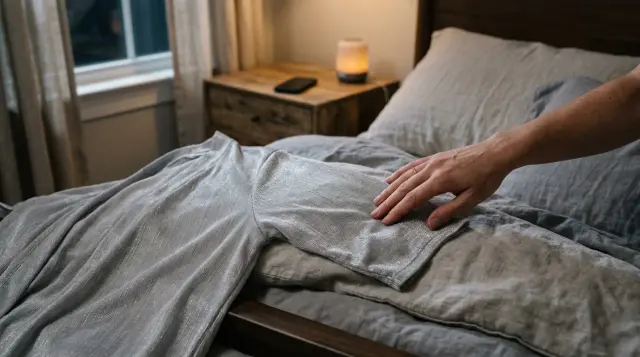
Let me paint a picture. You swap your regular sleep shirt for an EMF shielding one. You move your phone across the room or switch it to airplane mode. You've already set your router on a timer so it shuts off at 11 PM. Your bedroom is dark, cool, and now significantly lower in electromagnetic radiation than it was a month ago. That's it. That's the routine, and it's not complicated.
The clothing piece is interesting because it's the one step that requires zero behavior change beyond getting dressed. You don't have to remember to flip a switch or download an app. A friend of mine who works in tech started wearing a silver-fiber undershirt to bed after reading some of the research on EM radiation and melatonin. He told me he noticed better sleep within the first week. Placebo? Maybe. But three months later he's still wearing it every night, so something's working for him.
For the full breakdown on optimizing your bedroom, I'd recommend reading EMF Blocking for Better Sleep: The Complete Guide and Low-EMF Home Design: A Complete Guide. They cover everything from bed placement to wiring decisions you might not have thought about.
The World Health Organization's International Agency for Research on Cancer (IARC) classified RF electromagnetic fields as Group 2B, meaning "possibly carcinogenic to humans," back in 2011 [3]. That classification alone has motivated a lot of people to reduce their exposure where they can. Sleep takes up roughly a third of your life. It's the easiest place to start.
Should You Be Concerned About EMF Exposure for Your Kids?
This is where things get personal for a lot of parents. Children's skulls are thinner. Their nervous systems are still developing. And they tend to sleep more hours than adults. All of that adds up to greater potential vulnerability to electromagnetic radiation during nighttime hours. A 2012 report from the American Academy of Pediatrics urged the FCC to reassess RF exposure limits, noting that existing standards were based on adult male body models and didn't account for children's unique physiology.
If your kid sleeps with a tablet under the pillow or a baby monitor two feet from their head, the exposure is real and measurable. I'm not trying to scare anyone. But the data suggests that erring on the side of caution makes sense, especially when the solutions are simple. Put some distance between devices and little heads. Switch monitors to low-power mode. Consider EMF protection garments designed for smaller bodies.
For a thorough look at what the research actually says about children and electromagnetic field exposure, read Are Your Kids Getting Too Much EMF?: What the Research Shows. It covers the specific studies, the age-related risk factors, and what practical steps families are taking.
Proteck'd EMF Protection offers options that make it easy to reduce exposure for the whole family without turning your home into some kind of off-grid bunker. That balance between modern life and precaution is exactly where most people want to land.
Does Wearing EMF Clothing Replace Other Sleep Hygiene Practices?
No. And anyone who tells you a single product replaces good sleep habits is selling you something questionable. EMF shielding sleepwear is one layer in a broader approach to better rest. You still need a dark room, a consistent bedtime, limited screen time before sleep, and a mattress that doesn't make your back hate you by morning.
What EMF protection garments do is address a factor that most sleep advice completely ignores: your ambient electromagnetic environment. The National Sleep Foundation's recommendations cover light, noise, temperature, and caffeine. But they don't mention the Wi-Fi signal passing through your body all night. That's a blind spot, and it's one that more people are starting to fill in on their own.
Think of it like air quality. You can have perfect sleep habits, but if your bedroom air is full of allergens, you're still going to wake up congested. Similarly, you can do everything right with your sleep routine and still be bathed in RF energy from dusk to dawn. Addressing that exposure, whether through shielding clothing, device management, or home design changes, adds another dimension to how well you actually recover overnight.
According to the Cleveland Clinic, adults need 7 to 9 hours of quality sleep for proper immune function, memory consolidation, and hormonal balance [4]. "Quality" is the operative word there. It's not just about time in bed. It's about what your body is doing, and what's happening around it, during those hours.
Frequently Asked Questions
Q: Is EMF radiation protection clothing dangerous to wear?
No, it's not. EMF protection clothing uses silver or copper fibers woven into regular fabrics, and silver-based textiles have been safely used in medical settings for over 30 years. There are no known adverse health effects from wearing these garments against your skin, even for extended periods like overnight sleep.
Q: Can EMF clothing actually help you sleep better?
Many users report improved sleep quality after reducing their nighttime electromagnetic exposure. Research has linked RF radiation to suppressed melatonin production, and shielding garments can block 99% or more of ambient RF energy. Individual results vary, but the underlying mechanism is supported by published studies on EMF and circadian rhythm disruption.
Q: What materials are used in EMF shielding clothing?
The most common material is silver fiber woven into fabrics like cotton or polyester blends. Some garments also use copper or stainless steel microfibers. Silver is preferred for its high conductivity, antimicrobial properties, and softness against the skin.
Q: How much EMF does a typical bedroom have at night?
It depends on your devices. A Wi-Fi router emits continuous RF radiation, a smartphone on the nightstand adds more, and smart home devices contribute additional signals. The cumulative exposure in a modern bedroom can be significant, even though each individual device stays within FCC guidelines.
Q: Can you wash EMF protection clothing in a regular washing machine?
Yes, most silver-fiber garments can be machine washed on gentle cycles. Manufacturers typically recommend avoiding bleach and fabric softeners, which can degrade the silver content over time. Following care instructions helps maintain shielding effectiveness through many wash cycles.
Q: Does EMF shielding fabric lose effectiveness over time?
Quality silver-threaded fabrics retain their shielding properties through 50 or more washes when properly cared for. Cheaper products with silver coatings rather than woven-in fibers may degrade faster. Look for garments that specify their shielding effectiveness in decibels (dB) as a reliable quality indicator.
Q: Is it better to turn off Wi-Fi at night or wear EMF clothing?
Both is best. Turning off your router eliminates one major source of RF radiation, while EMF clothing protects against signals from neighbors' networks, cell towers, and devices you can't easily switch off. Using both strategies together gives you the most significant reduction in nighttime exposure.
Q: Are children more affected by EMF exposure during sleep?
Research suggests yes. Children have thinner skulls and developing nervous systems, which may make them more susceptible to RF energy absorption. The American Academy of Pediatrics has recommended reassessing exposure standards for children specifically because current guidelines are based on adult body models.
Q: How is EMF clothing different from a Faraday cage?
EMF clothing uses the same basic principle as a Faraday cage, reflecting electromagnetic energy through conductive material. The difference is coverage. A Faraday cage encloses a space completely, while a garment only shields the body area it covers. A shielding shirt protects your torso but not your head or legs.
Q: Does silver-fiber clothing feel different from regular clothing?
Not really. Modern silver-fiber fabrics are soft, breathable, and blend naturally with cotton or synthetic materials. Most people can't tell the difference by touch. The silver content is microscopic, woven into individual threads rather than applied as a surface layer.
References
- National Institutes of Health (PubMed) – Silver has been safely used in medical textiles, wound dressings, and antimicrobial applications for decades with established biocompatibility.
- International Journal of Environmental Research and Public Health (PubMed) – Low-frequency electromagnetic field exposure has been linked to reduced melatonin production in human subjects.
- IARC / World Health Organization – The IARC classified radiofrequency electromagnetic fields as Group 2B, possibly carcinogenic to humans, in 2011.
- Cleveland Clinic – Adults need 7 to 9 hours of quality sleep for proper immune function, memory consolidation, and hormonal balance.
About the Author
Proteck'd EMF Apparel
Health & EMF Specialists
The Proteck'd team covers EMF protection, silver-fiber apparel, and practical ways to reduce everyday radiation exposure. Every piece Proteck'd ships is designed, tested, and worn by the people who build it.
Get the Free EMF Home Audit Checklist
A room-by-room PDF that walks you through the biggest EMF sources in your house and what to do about each one. No cost, no fluff.
Download the Checklist →✓30-day returns✓Free shipping✓Free returns✓Silver fiber shielding


Leave a comment