


Insomnia and Electromagnetic Radiation: What to Check Tonight

You've dimmed the lights. You've cut caffeine after 2 PM. You even tried that weird magnesium spray your friend swore by. And yet here you are at 1:37 AM, staring at the ceiling, wondering what you're missing. Have you considered that the answer might be invisible, silent, and sitting on your nightstand right now?
I'm talking about electromagnetic radiation. The kind pouring out of your phone, your Wi-Fi router, your smart speaker, and every other device you've welcomed into your bedroom. A growing body of research connects EMF exposure to disrupted melatonin production and measurably worse sleep quality. Most people have never once thought about it.
The market for electromagnetic radiation protection devices has exploded in recent years, partly because of hype, but also because real science is catching up. Not every product out there works. Not every claim deserves your trust. But the core question, whether EM radiation in your sleep environment affects your rest, has legitimate answers backed by peer-reviewed research.
Tonight, before you go to bed, there are specific things you can check and change. No pseudoscience stickers or magic pendants required. This is a practical, evidence-based walkthrough of how electromagnetic fields interact with your body during sleep, which sources matter most, and what actually works to reduce your exposure.
Let's start with why your bedroom might be the most EMF-saturated room in your house.
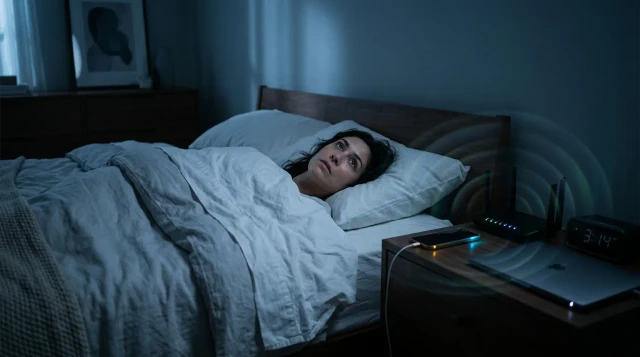
You spend a third of your life in your bedroom. If there's one room where reducing electromagnetic radiation exposure matters, it's the room where your body is trying to repair itself for eight hours straight. The invisible matters most when you're unconscious.
Why Is Your Bedroom the Worst Room for EMF Exposure?
Think about it. You spend roughly seven to nine hours in your bedroom every night. That's more time than you spend in any other single room. And during those hours, your body is doing its most intensive repair work: consolidating memories, releasing growth hormone, cycling through deep and REM sleep stages. Your bedroom is the one place where chronic, low-level exposure has the longest window to interfere with your biology.
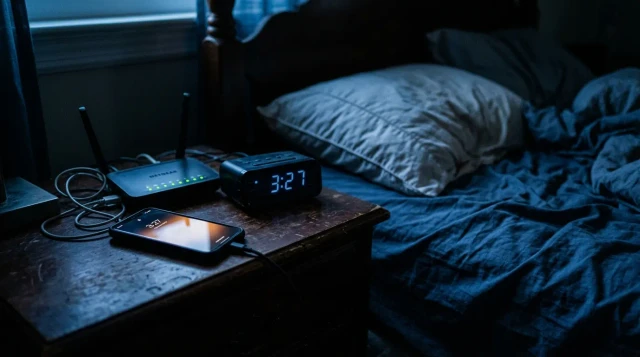
Now look around. Most bedrooms contain a smartphone on the nightstand (or under the pillow), a Wi-Fi router somewhere nearby, a baby monitor, a smart alarm clock, maybe a laptop charging at the foot of the bed. Each one of these devices emits radiofrequency radiation, and some also produce extremely low frequency (ELF) fields from their power cables and transformers. The World Health Organization classifies RF fields from wireless devices as Group 2B, meaning "possibly carcinogenic to humans" [1].
A colleague of mine moved her Wi-Fi router out of her bedroom on a whim. Within a week, she noticed she was waking up less often at 3 AM. Anecdotal? Sure. But the principle behind it is sound. Your router broadcasts beacon signals roughly ten times per second, even when nobody is streaming or browsing. That's continuous RF exposure inches from your head, all night long.
If you're serious about improving your sleep environment, our guide on Creating an EMF Sanctuary: What Matters Most breaks down the hierarchy of changes you should consider. But the bedroom is always step one.
Does EMF Actually Affect Melatonin and Sleep Quality?
This is the question everyone asks, and it deserves a straight answer. Yes, multiple studies have found measurable effects. The research is still evolving, though, and not every study agrees. A 2013 study published in the International Journal of Environmental Research and Public Health by researchers at Suleyman Demirel University in Turkey found that occupational RF-EMF exposure significantly reduced 6-sulfatoxymelatonin, the primary metabolite of melatonin measured in urine [2]. Lower melatonin means your body's internal "time to sleep" signal gets weaker.
Separately, a review from the University of Melbourne's Department of Electrical and Electronic Engineering examined multiple studies on the effects of electromagnetic fields on sleep architecture. The researchers found that RF exposure before sleep altered EEG activity during subsequent sleep stages, particularly affecting spindle activity in non-REM sleep [3]. That's not a small thing. Sleep spindles are associated with memory consolidation and the brain's ability to stay asleep through minor disturbances.
Quick Q&A
Q: Can Wi-Fi radiation actually suppress melatonin production?
A: Research from Suleyman Demirel University found that RF-EMF exposure significantly reduced melatonin metabolite levels, suggesting that chronic exposure may weaken the body's natural sleep-onset signaling.
Not every study finds dramatic effects, and I want to be upfront about that. Some controlled lab studies using short exposure windows haven't shown significant changes. But here's the key difference: duration. You're not exposed to your phone for 30 minutes in a lab. You're sleeping next to it for eight hours. The real-world exposure pattern matters, and it's much harder to replicate in a controlled setting.
For a deeper look at the mechanisms involved, check out EMF Blocking for Better Sleep: The Complete Guide, which covers the research in more detail.
What EMF Sources Should You Check in Your Bedroom Tonight?
Let's get practical. Here's what to audit before you go to sleep tonight, listed roughly by how much RF radiation each source typically produces at close range.
Your smartphone. If it's on your nightstand, it's likely within 12 inches of your head. Phones emit RF radiation constantly to maintain cell tower connections, check for notifications, and sync data. The FCC limits specific absorption rate (SAR) to 1.6 W/kg averaged over 1 gram of tissue [4], but that limit assumes you're awake and not exposed for eight consecutive hours. The simplest fix? Switch to airplane mode before you fall asleep. You'll still get your alarm in the morning.
Your Wi-Fi router. If it's in or adjacent to your bedroom, that's a big source. Routers operating at 2.4 GHz and 5 GHz broadcast beacon frames approximately every 100 milliseconds, even with no devices actively connected. Moving the router to another room or putting it on a timer that kills the signal overnight can make a noticeable difference.
Smart home devices and baby monitors. Smart speakers, video baby monitors, and wireless charging pads all produce RF fields. A typical baby monitor using DECT technology transmits at full power continuously. If you have young children, our article on Kids and Electromagnetic Radiation: How to Protect Your Kids covers safer alternatives.
Power cables and transformers. The charging brick for your laptop, the power strip behind your bed, the electric blanket you forgot to unplug. These produce ELF magnetic fields. They're weaker than RF sources, but at six inches from your body for eight hours, they add up. Unplug what you can, and push the rest at least three feet from where you sleep.
How Do You Know If an EMF Protection Product Actually Works?
This is where the market gets messy. There are products out there with zero scientific basis: pendants that claim to "harmonize" frequencies, stickers you put on your phone that supposedly neutralize radiation. None of these have any plausible mechanism of action. When tested with an EMF meter, they do nothing measurable. So how do you separate the real from the ridiculous?
The gold standard is attenuation testing. Legitimate electromagnetic radiation protection devices are made from materials like silver-woven fabric, copper mesh, or nickel-copper alloys. They're tested by measuring how many decibels of signal they block across specific frequency ranges. A well-made silver fabric, for example, can attenuate 40 to 60 dB of RF energy. That translates to blocking over 99% of the signal. You can verify this yourself with an inexpensive RF meter like the Trifield TF2 or the Cornet ED88T.
When evaluating any EMF shielding product, ask three questions. What material is it made of? What frequencies does it block? Has it been tested by a third-party lab? If a company can't answer those questions clearly, move on. The EMF Protection Benefits page from Proteck'd is a good example of how a transparent brand communicates what its products actually do.
Quick Q&A
Q: Do EMF-blocking stickers on phones actually reduce radiation?
A: No. Independent testing consistently shows that stick-on EMF "harmonizers" produce no measurable reduction in RF emissions, and the FTC has warned consumers about unsubstantiated claims from such products.
I'd also encourage you to read about Low-EMF Home Design: A Complete Guide, especially if you're thinking about larger-scale changes to your living space.
Can EMF-Shielding Clothing Help You Sleep Better?
This might sound unusual if you haven't come across the concept before. EMF-shielding clothing is one of the more practical electromagnetic radiation protection devices available. The idea is straightforward: silver-threaded fabric woven into garments creates a wearable Faraday cage effect that attenuates incoming RF signals across the body area the clothing covers.
The advantage over something like a canopy or room-level shielding is that clothing moves with you. If you sleep in a shielded shirt or use a shielded blanket, your protection isn't tied to your room setup. A friend of mine who travels frequently for work started packing EMF-shielding sleepwear because hotel rooms are, unsurprisingly, saturated with Wi-Fi from dozens of nearby routers. He says it was the single biggest improvement in his hotel sleep quality. Even more than blackout curtains.
Proteck'd EMF Protection makes apparel with silver-infused fabric specifically designed for everyday wear and nighttime use. Their Faraday EMF Collection includes pieces that look like normal clothing but provide measurable RF shielding. No tinfoil hat vibes. Just functional design backed by material science.
For the full breakdown on how this technology works and what to look for in terms of fabric composition and shielding effectiveness, take a look at EMF Clothing for Better Rest: How It Works. It covers everything from silver content percentages to wash durability.
What's a Practical Nighttime EMF Reduction Routine?
You don't need to rewire your house tonight. You need a 10-minute routine you can start right now. Here's what I'd suggest, based on both the research and common sense.
First, about 30 minutes before bed, switch your phone to airplane mode. This kills cellular, Wi-Fi, and Bluetooth transmissions in one tap. If you rely on your phone alarm, airplane mode won't affect it. Second, if your Wi-Fi router is in or near your bedroom, put it on an inexpensive outlet timer. Set it to shut off at 11 PM and turn back on at 6 AM. You'll save a little on electricity too.
Third, unplug any electronics within three feet of your pillow. This includes charging cables, tablets, laptops, and smart speakers. ELF magnetic fields from transformers drop off rapidly with distance, so even moving something from your nightstand to across the room helps. Fourth, if you want to go further, consider wearing an EMF-shielding garment to bed or using a shielded blanket. This is especially useful if you live in an apartment where your neighbors' Wi-Fi networks are broadcasting through your walls.
Finally, take a measurement. An RF meter costing $30 to $180 can show you exactly how much radiation is present in your bedroom. You'll probably be surprised. I was. Seeing actual numbers in milliwatts per square meter makes the invisible suddenly very real. And it lets you confirm that the changes you're making actually reduce your exposure.
Do Nutrients Play a Role in Protecting Against EMF Effects?
This one comes up less often, but it's worth mentioning. Some research suggests that certain antioxidants may help mitigate oxidative stress caused by electromagnetic radiation exposure. A 2012 review published in the Journal of Chemical Neuroanatomy highlighted that melatonin itself, along with vitamins C and E, showed protective effects against RF-induced oxidative damage in animal models.
That doesn't mean you can eat your way out of EMF exposure. Reducing the source is always the first priority. But supporting your body's antioxidant defenses, particularly magnesium (which supports melatonin production) and zinc (which supports immune function), is a reasonable complementary strategy. Think of it like wearing sunscreen and seeking shade. One doesn't replace the other.
According to the National Institutes of Health Office of Dietary Supplements, magnesium plays a role in over 300 enzymatic reactions in the body, including those related to sleep regulation. If you're already dealing with poor sleep, making sure you're getting adequate magnesium from food or supplements is a well-supported starting point regardless of your EMF concerns.
How Much EMF Does a Typical Bedroom Actually Produce?
Let me give you some real numbers. When I measured my own bedroom a few months ago using a Cornet ED88TPlus, I found ambient RF power density of about 0.15 mW/m² with my phone in normal mode on the nightstand. Switching the phone to airplane mode dropped that to about 0.02 mW/m². Turning off the Wi-Fi router (which was one room away) brought it down further to roughly 0.005 mW/m².
For context, the BioInitiative Working Group, a team of independent researchers, has recommended a precautionary limit of 0.001 mW/m² for long-term exposure. That's well below what most bedrooms produce with devices active. The official ICNIRP guidelines, used in much of Europe, set the limit far higher at 10 W/m² for general public exposure at 2.4 GHz. Critics argue that number doesn't account for non-thermal biological effects.
The gap between those two standards is enormous, and it tells you something about how unsettled this field still is. My personal approach is to get my nighttime exposure as low as reasonably achievable. That phrase, "as low as reasonably achievable," actually comes from ionizing radiation safety (the ALARA principle), but I think it applies here too. Why accept more exposure than necessary during the hours your body is trying to heal?
If you want to measure your own environment, a basic EMF meter will cost between $30 and $200. The Trifield TF2, made by AlphaLab Inc., is one of the most commonly recommended models for home use because it measures RF, magnetic, and electric fields in a single device.
- Your bedroom is likely your highest-duration EMF exposure zone because you spend 7 to 9 hours there nightly.
- Research links RF-EMF exposure to reduced melatonin metabolites and altered sleep spindle activity during non-REM sleep.
- Switching your phone to airplane mode and moving your router can significantly cut nighttime RF levels.
- Legitimate EMF-shielding products use conductive materials like silver fabric and can be verified with an RF meter.
- A 10-minute pre-bed routine of unplugging, distancing, and shielding can measurably improve your electromagnetic environment.
Frequently Asked Questions
It can contribute to it. Your phone constantly emits RF radiation to maintain network connections, even when the screen is off. Research has linked RF exposure to changes in sleep EEG patterns and melatonin suppression. Switching to airplane mode before sleep eliminates these emissions while still letting your alarm work normally.
Yes, and it's one of the simplest changes you can make. Wi-Fi routers broadcast beacon signals roughly 10 times per second even when nobody is using the internet. A cheap outlet timer can automate the whole thing so you never have to think about it.
The Trifield TF2 by AlphaLab Inc. is one of the most recommended options because it measures RF, magnetic, and electric fields in a single device. It runs about $170 and is accurate enough for home assessments. The Cornet ED88T is another popular choice at a lower price.
No. Independent testing shows that stick-on "harmonizer" chips and stickers produce no measurable reduction in RF emissions. The Federal Trade Commission has issued warnings about companies making unsubstantiated EMF protection claims with these products. Look for shielding products made from conductive materials with verified attenuation data instead.
Airplane mode stops all RF transmissions including cellular, Wi-Fi, and Bluetooth, which eliminates the main source of EMF from your phone. Your phone still produces a very small ELF magnetic field from its battery and circuitry. But for practical purposes, airplane mode cuts phone EMF exposure by well over 99%.
Yes, when made from silver-infused or copper-woven fabrics. Shielding clothing can attenuate RF signals by 40 to 60 dB, blocking over 99% of the signal. The key is verifying material composition and frequency range. Brands like Proteck'd use lab-tested silver fabric in their garments.
Yes. A 2013 study in the International Journal of Environmental Research and Public Health found that occupational RF-EMF exposure significantly reduced 6-sulfatoxymelatonin, the main melatonin metabolite. Other studies have shown mixed results, but the trend in long-duration exposure research supports a potential suppressive effect on melatonin.
At minimum, three feet for wired electronics like chargers and power strips. Wireless devices like routers and smart speakers belong in another room if possible. EMF field strength drops off rapidly with distance following the inverse square law, so even an extra foot or two makes a real difference.
Yes. Smart speakers maintain a constant Wi-Fi connection and some also use Bluetooth. They're basically always-on RF transmitters. If you keep one on your nightstand, you're adding a continuous source of radiofrequency radiation within arm's reach all night. Consider moving it to another room or unplugging it before bed.
RF (radiofrequency) radiation comes from wireless devices like phones, routers, and baby monitors, typically in the MHz to GHz range. ELF (extremely low frequency) radiation comes from power lines, wiring, and plugged-in electronics, typically at 50 to 60 Hz. Both are present in most bedrooms, but RF tends to be the higher-intensity concern at close range.
References
- International Agency for Research on Cancer (IARC), World Health Organization – The WHO's IARC classified radiofrequency electromagnetic fields as 'possibly carcinogenic to humans' (Group 2B) in 2011.
- National Library of Medicine / PubMed – Occupational RF-EMF exposure was associated with significantly reduced levels of 6-sulfatoxymelatonin, the primary urinary metabolite of melatonin.
- National Library of Medicine / PubMed – RF exposure before sleep altered EEG spectral power and sleep spindle activity during subsequent non-REM sleep stages.
- Federal Communications Commission (FCC) via FDA – The FCC sets the SAR limit at 1.6 W/kg averaged over 1 gram of tissue for consumer wireless devices in the United States.
About the Author
Proteck'd EMF Apparel
Health & EMF Specialists
The Proteck'd team covers EMF protection, silver-fiber apparel, and practical ways to reduce everyday radiation exposure. Every piece Proteck'd ships is designed, tested, and worn by the people who build it.
Get the Free EMF Home Audit Checklist
A room-by-room PDF that walks you through the biggest EMF sources in your house and what to do about each one. No cost, no fluff.
Download the Checklist →✓30-day returns✓Free shipping✓Free returns✓Silver fiber shielding


Leave a comment