


Reducing EMF Exposure: Where to Start

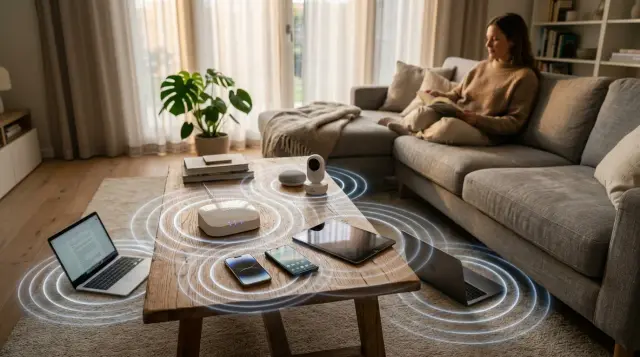
Here's a number worth sitting with: the average American home now has more than 20 devices connected to the internet wirelessly. Routers, phones, tablets, smart speakers, baby monitors, smart thermostats, even light bulbs. Every single one emits electromagnetic radiation. And most of us carry the most powerful transmitter of all, our smartphones, pressed against our bodies for 10 or more hours a day.
If you've been reading about emf shielding and wondering whether it's something you should actually take seriously, you're in good company. Search interest in electromagnetic field protection has surged over the past few years. Some of that's tied to the 5G rollout. Some comes from a growing body of peer-reviewed research. And some of it is just that gut feeling that maybe surrounding ourselves with this much wireless radiation around the clock isn't entirely consequence-free.
The problem? When you start looking into this topic, the information is a mess. You'll find people selling magic stickers that supposedly "harmonize" your phone's radiation (spoiler: they don't do anything measurable) right next to legitimate research from institutions like the National Institutes of Health. Separating fact from marketing fiction takes work.
That's what this guide is for. I'm going to walk you through what EMF exposure actually means in practical terms, which sources in your life matter most, which shielding materials have real science behind them, and where to start making changes that actually move the needle. No fearmongering, no snake oil. Just the stuff that works.
The most effective approach to reducing EMF exposure isn't any single product or strategy. It's a layered combination of distance, behavioral changes, and targeted shielding applied to the specific sources you've actually measured in your own environment.
- Measure before you spend: an EMF meter identifies your actual highest-exposure sources, which are often not the ones you'd guess.
- Distance is the most powerful free tool you have. Doubling your distance from an EMF source cuts exposure to roughly one quarter.
- Legitimate emf shielding products use conductive materials like silver, copper, or nickel and can provide independent lab test data proving their attenuation levels.
- Behavioral changes like using speakerphone, hardwiring internet connections, and enabling airplane mode at night can dramatically reduce daily RF exposure at zero cost.
- EMF protective clothing offers a portable, personal shielding solution for environments you can't control, like offices and apartments.
What Is EMF Exposure and Why Should You Care?
Electromagnetic fields are invisible areas of energy produced by electrically charged objects. They exist on a spectrum. On one end, extremely low frequency (ELF) fields from power lines and household wiring. In the middle, radiofrequency (RF) radiation from cell phones, Wi-Fi, and Bluetooth. On the far end, ionizing radiation like X-rays and gamma rays, which is a completely different conversation.
The everyday exposure most people worry about falls into the RF and ELF categories. These are classified as non-ionizing radiation, meaning they don't carry enough energy to break chemical bonds in DNA the way X-rays do. But that doesn't mean they're biologically inert. In 2011, the International Agency for Research on Cancer (IARC), part of the World Health Organization, classified RF electromagnetic fields as Group 2B, or "possibly carcinogenic to humans" [1]. That classification came partly from studies linking heavy cell phone use to increased glioma risk.
Since then, the research has gotten more interesting, not less. The National Toxicology Program (NTP) completed a major $30 million study in 2018 that found "clear evidence" of heart tumors in male rats exposed to cell phone radiation [2]. Does that mean your iPhone is giving you cancer? Not necessarily. But it does suggest the old line of "non-ionizing radiation can't hurt you" is an oversimplification. For a deeper look at what the peer-reviewed literature actually says, check out this overview of EMF Health Risks: What Peer-Reviewed Science Tells Us.
The practical concern isn't any single device. It's cumulative exposure. The FCC tests phones individually, with the device held at a specified distance from a simulated body. But nobody lives with just one device. You're being exposed to your phone, your neighbor's Wi-Fi, a smart meter on the side of your house, the Bluetooth in your car, and the cell tower two blocks away, all at once. That cumulative picture is what pushes people to start thinking seriously about electromagnetic radiation protection.
Where Does Most of Your Daily EMF Exposure Come From?
Before you spend a dime on emf shielding products, you need to know what you're actually shielding against. The answer varies a lot depending on where you live, what tech you use, and how your home is set up. But some sources are nearly universal.
Your cell phone is usually the single biggest contributor to your RF radiation exposure. Why? Proximity. The FCC limits SAR to 1.6 W/kg averaged over 1 gram of tissue [3], and most phones comply. But that limit was set in 1996, based on thermal effects only, and it assumes a specific usage pattern. Holding your phone against your head for a long call or sleeping with it under your pillow creates sustained exposure the testing protocol wasn't designed to capture.
Wi-Fi routers come in second for most households. A typical dual-band router broadcasting at 2.4 GHz and 5 GHz bathes your living space in RF radiation around the clock. Smart meters installed by utilities can also be significant. According to the California Council on Science and Technology, a smart meter transmits for roughly 45 seconds per day in short bursts, but peak power during those bursts can be quite high.
Quick Q&A
Q: Which household device produces the most personal RF radiation exposure?
A: Your cell phone, because it's typically held against or very close to the body for hours each day, creating much higher localized exposure than a router across the room.
Then there are the sources people forget about. Baby monitors running continuously in a nursery. Bluetooth earbuds transmitting directly into your ear canal. Laptop Wi-Fi cards sitting on your lap near reproductive organs. If you want the full rundown on reducing exposure at home, the guide on Low-EMF Home Design: The Highest-Impact Changes You Can Make is a great place to go deeper.

Does Distance Really Matter More Than Shielding?
Yes. And in many situations, it's not even close. The inverse square law is your best friend here. It says the intensity of electromagnetic radiation decreases proportionally to the square of the distance from the source. In plain English: double your distance and you cut exposure to roughly one quarter. Triple it and you're down to about one ninth.
This is why simply moving your Wi-Fi router from your desk to across the room can make a dramatic difference on an EMF meter. Here's a concrete example. I measured a common Netgear router at about 1.2 mW/m² from 6 inches away. At 6 feet, the reading dropped to around 0.02 mW/m². Same router, same signal strength, completely different exposure.
Practical applications of this principle are everywhere. Use speakerphone or wired headphones instead of holding your phone to your head. Keep your laptop on a desk instead of your lap. Don't sleep with your phone on the nightstand, or at least switch it to airplane mode. These zero-cost moves often reduce your personal exposure more than any product you could buy.
That said, distance has limits. You can't exactly put 10 feet between yourself and your phone while you're using it at work. You can't control the cell tower outside your apartment window. You can't relocate the smart meter that's bolted to the other side of your bedroom wall. That's where targeted EMF blocking materials come in, filling the gap between what distance can accomplish and what your environment forces on you.
What EMF Shielding Materials Actually Work?
This is where things get concrete. Emf shielding works by creating a conductive barrier that reflects or absorbs electromagnetic radiation before it reaches you. The principle goes back to Michael Faraday in the 1830s, when he demonstrated that a conductive enclosure blocks external electric fields. That's still the foundation of every legitimate shielding product on the market today.
Metal-based solutions are the most straightforward. Copper mesh, aluminum foil, and steel enclosures all provide excellent shielding for RF radiation. According to IEEE standards, a properly constructed copper mesh with openings smaller than the wavelength of the target frequency can provide 60 to 80 dB of attenuation. That translates to blocking 99.9% or more of the signal. For reference, cell phone frequencies typically range from about 700 MHz to 2.5 GHz, with 5G bands extending up to 39 GHz in the millimeter wave spectrum.
Fabric-based shielding has gotten surprisingly sophisticated. Silver-threaded textiles can attenuate over 99% of RF radiation in the 30 MHz to 10 GHz range when properly constructed. These fabrics weave conductive silver fibers throughout the textile, creating a flexible Faraday cage effect. The Faraday EMF Collection from Proteck'd EMF Protection uses this approach, incorporating silver-infused fabric into everyday clothing that you'd actually want to wear. No tinfoil hat vibes.
Specialized EMF paints containing carbon and nickel particles can turn walls into shielding barriers when grounded properly. These paints typically provide 30 to 40 dB of attenuation for a single coat. The trade-off: they require professional application and proper grounding to work correctly. You can learn more about integrating these solutions into your living space through this Low-EMF Home Design: A Complete Guide.
How Can You Tell If an EMF Protection Product Is Legitimate?
This is the question that separates informed consumers from easy marks. The EMF protection market is stuffed with products that have zero scientific basis. Stickers, pendants, and "harmonizing" chips that claim to neutralize radiation without any conductive material are, to put it bluntly, nonsense. If a product can't explain its mechanism using basic physics, walk away.
The gold standard for verification is independent lab testing. Legitimate EMF blocking products will have their shielding effectiveness measured in decibels (dB) of attenuation, tested across specific frequency ranges by a third-party lab. Look for test reports from facilities like MET Laboratories or Keystone Compliance. If a company can't produce test data, that tells you everything you need to know.
You can also verify claims yourself with an EMF meter. A good RF meter like the TriField TF2 (around $170) or the Acoustimeter AM-10 (around $350) will let you measure before-and-after readings when you place a shielding product between the source and the sensor. If the readings don't change, the product doesn't work. Simple as that. For more on what to look for in products that deliver real results, check out EMF Protection Benefits.
Quick Q&A
Q: Do EMF stickers or harmonizing chips actually reduce radiation exposure?
A: No. Independent testing consistently shows that adhesive stickers and chip-based products produce no measurable reduction in RF radiation levels compared to baseline readings.
One more thing to watch for: products that claim to block "100% of all EMF." That's physically impossible unless you're inside a completely sealed metal box with no openings. Even the best Faraday cages have some leakage. Honest companies state specific attenuation values at specific frequencies. That kind of transparency is the hallmark of a product worth your money.
Why Are People Choosing EMF Protective Clothing?
Here's what I find compelling about the EMF apparel trend: it solves the proximity problem that distance alone can't fix. You can't always move away from your phone or your colleague's phone or the Wi-Fi access point mounted on the ceiling above your desk. But you can put a conductive barrier between those sources and your body.
EMF protective clothing works the same way any other shielding material does, just woven into fabric you wear. Silver-threaded garments create a partial Faraday cage effect against your skin. A well-constructed EMF shirt covering your torso can significantly reduce the RF radiation reaching your organs during a typical workday spent near wireless devices.
The early versions of this clothing looked, frankly, terrible. Stiff, silver-gray fabric that screamed "I'm worried about radiation." That's changed a lot. Companies like Proteck'd have figured out how to integrate silver fibers into modern cuts and styles that look like regular streetwear. There's a detailed breakdown of Why People Are Switching to EMF Apparel that covers how the category has evolved.
The appeal is strongest for people who can't easily modify their environment. If you rent an apartment, you probably can't paint the walls with shielding paint or rewire for hardwired ethernet. If you work in an office full of wireless devices, you're not going to ask your employer to shut off the Wi-Fi. Wearing shielding fabric is a personal, portable solution that travels with you and doesn't require anyone else's permission.
What's a Practical Step-by-Step Plan for Reducing EMF Exposure?
Let's get specific. If you're just starting to think about wireless radiation exposure reduction, here's the order I'd suggest based on impact per effort.
Step one: measure. Buy or borrow an EMF meter and walk through your home and workspace. You'll be surprised by what you find. That baby monitor might be the hottest source in your house. Your bedroom might be getting hammered by the smart meter on the other side of the wall. You can't fix what you haven't identified. The TriField TF2 reads RF, magnetic, and electric fields all in one unit, making it a solid starting point.
Step two: apply distance and behavioral changes. Move your router out of the bedroom. Switch your phone to airplane mode at night. Use speakerphone or wired headphones for calls. Disable Bluetooth and Wi-Fi on devices when you're not actively using those features. These cost nothing and typically cut your daily exposure by a meaningful amount.
Step three: hardwire what you can. Ethernet adapters for laptops, wired keyboards and mice, even wired security cameras are all available and often perform better than their wireless counterparts. Every device you take off Wi-Fi is one less source of RF in your space. The guide on building an EMF-Safe Home covers this process room by room.
Step four: add targeted shielding. This is where emf shielding products come in. A smart meter guard. Shielding curtains for windows facing cell towers. EMF protective clothing like the pieces in Proteck'd's Faraday EMF Collection for daily wear. The key word is "targeted." You're addressing specific, measured sources of exposure, not trying to block everything everywhere.
Step five: reassess and repeat. Measure again after making changes. See what actually made a difference and what didn't. Your exposure profile will shift over time as you add or remove devices, as your utility installs new equipment, or as new cell towers go up nearby. This isn't a one-and-done project. It's an ongoing practice of awareness.
Do Smart Meters and 5G Towers Change the EMF Shielding Equation?
They do, but maybe not the way you've heard on social media. Smart meters are digital utility meters that communicate usage data wirelessly, typically using RF signals in the 900 MHz or 2.4 GHz bands. According to the Electric Power Research Institute (EPRI), the RF exposure from a smart meter at 3 feet is roughly 1/1000th of the exposure from holding a cell phone to your ear [4]. The catch? Smart meters are on 24/7. If your bedroom wall backs up to one, you're getting that low-level exposure for 8 hours straight while you sleep.
A smart meter shield, basically a Faraday cage that fits over the meter while still allowing it to function, can reduce emissions toward your home by 90 to 95%. These are inexpensive (typically $30 to $80) and easy to install without tools. If your meter sits on a wall adjacent to living or sleeping space, this is probably the highest-value single purchase you can make.
5G is more nuanced. The lower-band 5G frequencies (600 to 900 MHz) behave very similarly to existing 4G signals. The millimeter wave 5G bands (24 to 39 GHz) are higher frequency but much shorter range, and they're mostly deployed in dense urban areas. These higher frequencies are actually easier to block because shorter wavelengths are stopped by thinner shielding materials. Even a quality EMF protective garment handles them well.
The real concern with 5G isn't any single tower being more powerful. It's the density of deployment. Small cells are being installed on utility poles, streetlights, and building facades every few hundred feet in some cities. That means more consistent exposure with fewer natural gaps. This is exactly the scenario where personal electromagnetic radiation protection, whether that's home modifications or wearable shielding, starts to make the most practical sense.
Frequently Asked Questions
Copper and silver top the list for RF radiation shielding, capable of providing 60 dB or more of attenuation when properly constructed. Copper mesh works best for fixed installations like window screens and room enclosures. Silver-threaded fabrics are ideal for wearable applications because they combine high conductivity with flexibility and comfort.
It does. Standard household aluminum foil provides roughly 40 to 60 dB of shielding effectiveness depending on frequency. The problem is that it's impractical for most real-world uses. It tears easily, can't be washed, and creates coverage gaps at seams and edges.
Measure with an EMF meter. The Building Biology Institute recommends sleeping area RF levels below 0.01 mW/m² as ideal. Many bedrooms with nearby routers or smart meters measure 10 to 100 times higher than that. Even an inexpensive RF meter will give you real numbers to work with instead of guessing.
The science is still catching up. The WHO's IARC classified RF radiation as Group 2B (possibly carcinogenic) in 2011, and the NTP's 2018 rat study found evidence of tumor development from RF exposure. Wi-Fi routers emit relatively low power compared to cell phones, but they broadcast continuously. Reducing exposure through distance and shielding is a reasonable precaution while research continues.
Yes, when made with conductive materials like silver fiber. Lab-tested garments can block 99% or more of RF radiation at common wireless frequencies. The fabric must contain actual conductive fibers woven throughout, not just a surface coating that washes off. Always look for products with third-party attenuation test results.
Airplane mode stops RF transmissions including cellular, Wi-Fi, and Bluetooth, which eliminates the primary source of phone-related EMF exposure. The phone still emits very low-level ELF electromagnetic fields from its processor and battery. For sleep purposes, though, airplane mode reduces your phone's EMF output by over 99%.
At least 15 to 20 feet is a reasonable minimum, though further is better. At that distance, RF exposure from a typical home router drops to a small fraction of what it is up close. If your router has to stay in the same room, consider putting it on a timer to shut off during sleeping hours, or switch to a hardwired ethernet setup for the bedroom.
There isn't enough long-term research to say for certain. Lower-band 5G (below 1 GHz) is similar to 4G in frequency and penetration. Millimeter wave 5G (24 to 39 GHz) is higher frequency but doesn't penetrate the body as deeply. The bigger concern with 5G is the density of small cell installations, which increases the consistency of ambient RF exposure in urban areas.
EMF shielding uses conductive materials to physically block or reduce electromagnetic radiation. You can measure its effectiveness in decibels with an EMF meter. EMF harmonizing is a marketing term used by products like stickers and pendants that claim to change the "quality" of radiation without reducing its measurable levels. No peer-reviewed evidence supports harmonizing products producing any measurable effect.
Well-designed shielding phone cases with a conductive flap covering the screen side can reduce RF exposure to the head and body by directing radiation away from you. They use the same Faraday principle as other shielding products. The catch: they have to be used correctly, with the shielding flap between the phone and your body. If the flap is folded behind the phone, it can actually increase emissions toward you.
References
- International Agency for Research on Cancer (WHO/IARC) – IARC classified RF electromagnetic fields as Group 2B, possibly carcinogenic to humans, in 2011
- National Institute of Environmental Health Sciences (NIEHS) – The National Toxicology Program found clear evidence of heart tumors in male rats exposed to cell phone radiofrequency radiation
- U.S. Food and Drug Administration (FDA) – The FCC limits cell phone RF emissions to a specific absorption rate (SAR) of 1.6 W/kg averaged over 1 gram of tissue
- National Institutes of Health (NIH) – NTP studies found that high exposure to radiofrequency radiation was associated with tumor development in rats
About the Author
Proteck'd EMF Apparel
Health & EMF Specialists
The Proteck'd team covers EMF protection, silver-fiber apparel, and practical ways to reduce everyday radiation exposure. Every piece Proteck'd ships is designed, tested, and worn by the people who build it.
Protect Yourself Today
Proteck'd Faraday and silver fiber apparel is engineered to shield your body from everyday EMF exposure. Built for real life, tested for real results.
Shop EMF Protection →✓30-day returns✓Free shipping✓Free returns✓Silver fiber shielding


Hinterlassen Sie einen Kommentar