


The Most Effective Biohacks: Ranked by Evidence

One in three American adults doesn't get enough sleep. Not once in a while. Consistently. And yet there are people dropping hundreds of dollars a month on nootropic stacks, red light panels, and hyperbaric chambers while ignoring the single most powerful performance enhancer their body already has. Sleep optimization isn't sexy. It doesn't come with a subscription box. But it sits at the very top of the evidence pyramid, and there's a good reason for that.
I've spent an embarrassing amount of time reading biohacking forums, trying supplements, tracking HRV data, and testing protocols on myself. Some of it was genuinely useful. A lot of it was expensive placebo. The question I kept circling back to was simple: if I had to rank these interventions by the actual strength of the science behind them, what would the list look like?
That's what this article is. Not a listicle of "cool things to try." It's a ranking of biohacks by the quality and depth of evidence supporting them. We'll cover sleep hygiene, circadian rhythm management, exercise protocols, cold exposure, meditation, gut health, and a few wildcards. Some of them you've heard a thousand times. Some might catch you off guard.
If you've already read our Biohacking: The Honest Guide, consider this the next step. That piece laid the philosophical groundwork. This one gets into specifics, with studies, numbers, and protocols you can actually use starting tonight.
The biggest mistake in biohacking is chasing exotic interventions while ignoring the fundamentals. Sleep, exercise, nutrition, and stress management have more evidence behind them than every supplement and gadget combined. Start boring. Then experiment from a position of strength.
- Sleep optimization is the #1 evidence-based biohack, affecting every biological system from immune function to brain waste clearance.
- Morning bright light exposure and consistent wake times are the two most powerful tools for circadian rhythm management.
- Exercise, even just 22 minutes of moderate activity daily, reduces all-cause mortality by up to 31%.
- Cold exposure has moderate evidence for muscle recovery and alertness but weaker evidence for fat loss and mental health claims.
- Build your protocol in layers: master sleep, exercise, nutrition, and stress management before adding advanced biohacks.
Why Is Sleep Optimization the #1 Ranked Biohack?
Let's just get this out of the way. Nothing else on this list matters if your sleep is broken. Not your supplement stack. Not your cold plunge. Not your fancy meditation app. Sleep optimization earns the top spot because the evidence behind it is enormous, consistent, and spans decades of research across multiple fields.
A 2010 meta-analysis published in the journal Sleep found that adults who consistently get fewer than 7 hours per night face a 13% higher risk of all-cause mortality [1]. Then there's a 2019 study out of Harvard Medical School showing that people with irregular sleep schedules had a 27% higher risk of cardiovascular disease, even after controlling for total sleep duration [2]. Read that again. It's not just about how much you sleep. It's about when.
Your brain has its own waste disposal system called the glymphatic system. Researchers at the University of Rochester discovered in 2013 that this system works about 60% more efficiently during deep sleep than during waking hours [3]. Your brain literally cleans itself of metabolic waste, including amyloid-beta proteins associated with Alzheimer's, while you're unconscious. No supplement replaces that.
Quick Q&A
Q: What makes sleep the most effective biohack?
A: Sleep affects every biological system at once, including immune function, hormone regulation, cognitive performance, and metabolic health. Decades of peer-reviewed evidence support its primacy over any other single intervention.
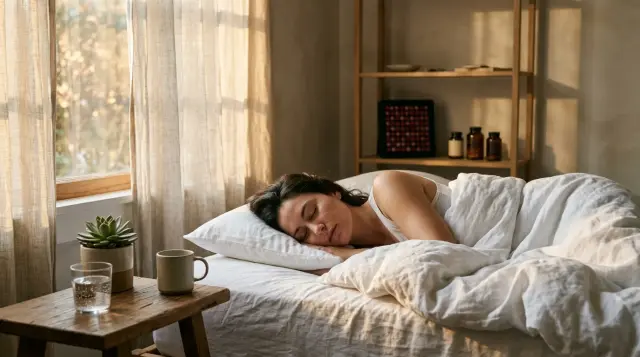
The practical protocols are well established. Keep a consistent wake time, even on weekends. Get bright light exposure within 30 minutes of waking. Keep your bedroom between 65 and 68 degrees Fahrenheit. Cut caffeine by early afternoon. None of this is groundbreaking, but the combined effect is massive. For a full breakdown of actionable steps, check out our post on How to Sleep Better Tonight: The Complete Checklist.
How Does Light Exposure Affect Your Circadian Rhythm?
Your circadian rhythm is a 24-hour internal clock controlled by a tiny cluster of neurons in your hypothalamus called the suprachiasmatic nucleus, or SCN. This clock governs when you feel alert, when you feel drowsy, when your body releases cortisol, and when it ramps up melatonin production. The single most powerful input to this whole system? Light.
Dr. Andrew Huberman at Stanford has popularized the idea of "morning sunlight viewing," and the science backs him up. Research published in the Journal of Clinical Endocrinology & Metabolism shows that exposure to bright light (ideally 10,000 lux or more) in the first 1 to 2 hours after waking helps anchor your circadian clock, improving both sleep onset and sleep quality later that night. Overcast sky? Still works. You're getting far more lux outside on a cloudy day than you are sitting under office fluorescents.
The flip side matters just as much. Blue light exposure after sunset suppresses melatonin production. A 2014 study from Brigham and Women's Hospital found that reading on a light-emitting device before bed delayed melatonin onset by about 1.5 hours compared to reading a printed book. That's not subtle. That's your body thinking it's still afternoon when it should be winding down for nightly recovery.
This is also where your environment comes into play. If you're sleeping near routers, phones, and other electronics, you're not just dealing with light pollution. You're bathing in low-level electromagnetic fields all night. Some people find that reducing nighttime EMF exposure improves their rest quality. Proteck'd's Faraday Health Collection was designed with this in mind, offering EMF-shielding apparel you can wear during sleep or throughout the day. You can learn more about the science behind it on our EMF Health Benefits page.

Does Exercise Really Count as a Biohack?
I know, I know. "Exercise more" feels like the least interesting advice in the world. But if we're ranking interventions by evidence, exercise sits right behind sleep in terms of sheer volume and consistency of research. It's not a biohack in the flashy sense. It's the baseline that makes every other biohack work better.
A landmark 2022 meta-analysis published in the British Journal of Sports Medicine looked at over 196,000 participants and found that even 150 minutes of moderate weekly exercise (that's about 22 minutes a day) reduced all-cause mortality risk by 31% and cardiovascular mortality risk by 29% [4]. These aren't marginal gains. And you don't need to run an ultramarathon. Walking counts. Resistance training counts. Playing with your kids at the park counts.
Here's where it connects to nightly recovery. People who exercise regularly, especially in the morning or early afternoon, tend to fall asleep faster and spend more time in deep sleep stages. A 2011 study from Northwestern University showed that aerobic exercise improved sleep quality in adults with insomnia by a clinically significant margin, comparable to some prescription sleep medications. No side effects. No dependency risk.
The key is consistency, not intensity. You don't need to crush yourself in the gym every day. Three to four sessions per week of moderate effort, mixing cardiovascular work with resistance training, gives you the bulk of the benefit. Do it outside when you can and you're stacking the circadian light exposure benefit on top. Two biohacks for the price of one. For more context on how exercise fits into a broader health strategy, our Getting Better Sleep: What Actually Works guide covers the exercise-sleep connection in more detail.
What Does the Science Say About Cold Exposure?
Cold exposure is one of the trendier biohacks right now, and honestly, the evidence is more mixed than the enthusiasm suggests. That said, it's not all hype. There's real science here. You just have to separate the solid findings from the breathless claims.
The strongest evidence is for post-exercise cold water immersion. That 2022 meta-analysis in the British Journal of Sports Medicine also looked at cold water immersion and found it reduced delayed onset muscle soreness (DOMS) by 11 to 15% compared to passive recovery. If you're an athlete or someone who trains hard, that's meaningful. The sweet spot in most studies is water between 50 and 59 degrees Fahrenheit for 10 to 15 minutes.
The mental health claims are more preliminary but interesting. Dr. Susanna Søberg at the University of Copenhagen published research in 2021 showing that regular cold water exposure increased brown fat activation and improved metabolic markers in a small cohort. Cold exposure also triggers a norepinephrine release, which is why people report feeling alert and focused afterward. But "I feel great after a cold plunge" and "cold plunges cure depression" are two very different statements. The first is well supported. The second needs a lot more data.
Quick Q&A
Q: Is cold exposure a proven biohack?
A: Cold water immersion has moderate evidence for reducing muscle soreness and boosting alertness via norepinephrine release, but claims about fat loss and mental health benefits remain preliminary and need larger clinical trials.
My honest take: cold exposure is a solid mid-tier biohack. If you enjoy it and it makes you feel good, go for it. But don't skip sleep or exercise in favor of buying a $5,000 cold plunge. Priorities matter.
Can Meditation Improve Sleep Quality and Health?
Meditation used to be dismissed as "woo" by the biohacking community. Not anymore. The research has gotten too strong to ignore, particularly around stress reduction, sleep quality, and cognitive function.
A 2015 randomized controlled trial published in JAMA Internal Medicine compared mindfulness meditation to a structured sleep hygiene education program in older adults with moderate sleep disturbance. The meditation group showed significantly greater improvement in sleep quality, daytime fatigue, and depression symptoms. This wasn't some tiny pilot study. It was a well-designed RCT published in one of the most respected medical journals in the world.
The mechanism isn't mysterious. Meditation, particularly mindfulness-based stress reduction (MBSR), lowers cortisol levels and activates the parasympathetic nervous system. Think of it as training your body to downshift. If your nervous system is stuck in fight-or-flight mode all day (and for many of us, it is), you can't expect it to suddenly flip to rest-and-digest the moment your head hits the pillow. Meditation teaches that transition.
You don't need an hour-long practice to see results. Even 10 to 15 minutes of daily meditation has been shown to produce measurable changes in brain structure within eight weeks, according to research from Massachusetts General Hospital and Harvard Medical School. Curious about getting started without the incense and crystals? We put together a practical guide: How to Build a Meditation Practice: Without the Woo.
How Important Is Gut Health for Overall Performance?
The gut microbiome might be the most underrated factor in how you feel day to day. And yes, it affects your sleep too. Research from the University of Tsukuba in Japan, published in 2020, found that gut bacteria influence the production of serotonin, a precursor to melatonin. Disrupt the microbiome, and you can disrupt your circadian rest patterns.
Beyond sleep, your gut influences immune function (roughly 70% of your immune system lives there), mood regulation via the gut-brain axis, nutrient absorption, and inflammation levels. A 2019 review in Nature Reviews Gastroenterology & Hepatology made a compelling case that microbiome diversity is one of the strongest predictors of overall health in large population studies.
So what actually works? Fiber diversity is king. Eating 30 or more different plant foods per week, a target promoted by the American Gut Project led by Dr. Rob Knight at UC San Diego, was associated with significantly greater microbiome diversity compared to eating fewer than 10. Fermented foods help too. Kimchi, sauerkraut, yogurt, kefir. A 2021 Stanford study led by Dr. Justin Sonnenburg found that a high-fermented-food diet increased microbiome diversity and reduced markers of inflammation over a 10-week period.
Skip the expensive probiotic pills until you've nailed the dietary basics. We go deeper on this topic in our Gut Health: The Complete Guide.
Does Reducing EMF Exposure Improve Sleep?
This one's more controversial, and I want to be straightforward about the evidence. There's no large-scale, definitive clinical trial proving that reducing household EMF exposure will transform your sleep. But there is a growing body of smaller studies and a strong biological plausibility argument that makes it worth paying attention to.
A 2013 review published in the International Journal of Environmental Research and Public Health examined the effects of radiofrequency electromagnetic fields on sleep and found that several studies reported changes in sleep architecture, particularly in deep sleep stages, following EMF exposure. The World Health Organization classifies radiofrequency electromagnetic fields as "possibly carcinogenic to humans" (Group 2B). That's admittedly a broad category, but it signals that the scientific community hasn't dismissed the concern.
From a practical standpoint, reducing EMF exposure at night is low-cost and low-risk. Put your phone in airplane mode. Move your router out of the bedroom. If you want to take it a step further, Proteck'd's Women's Wellness Collection and Faraday Health Collection include clothing with silver-fiber technology that provides a physical barrier to electromagnetic radiation. Even if you're skeptical about EMF health effects, removing electronics from your sleep environment also removes light and notification distractions, which we already know impair rest quality.
I think of EMF reduction as a "low downside, potentially meaningful upside" kind of biohack. It's not the foundation of a health protocol (that's sleep, exercise, and nutrition), but it's a reasonable addition to a well-built stack.
What Are the Most Overhyped Biohacks?
Every honest ranking needs a section on what doesn't make the cut. There's a lot of noise out there.
Nootropics are probably the most overhyped category. Outside of caffeine (which genuinely works) and creatine (which has decent evidence for cognitive function in sleep-deprived individuals), most nootropic supplements have thin or conflicting evidence. "Smart drugs" like racetams and modafinil have some research behind them, but the long-term safety profiles are poorly understood, and most studies involve small sample sizes. Piracetam, for instance, was studied extensively in the 1970s and 80s, and results were inconsistent enough that neither the FDA nor the European Medicines Agency approved it as a cognitive enhancer.
IV vitamin drips are another one. Unless you have a diagnosed deficiency or a medical condition that impairs absorption, you're paying $200+ to make expensive urine. A 2020 review in the Journal of General Internal Medicine found no convincing evidence that IV vitamin therapy benefits healthy individuals. Your kidneys just excrete the excess.
Expensive blue-light-blocking glasses? The lenses that cost $15 work just as well as the $300 designer pairs, according to a 2021 Cochrane review that found limited evidence for blue-light glasses improving sleep in general, regardless of price point. If you want to block blue light, your phone's built-in night mode and dimming your house lights costs nothing.
How Should You Build a Biohacking Protocol That Actually Works?
If I had to build a biohacking protocol from scratch with a $0 budget, here's what it would look like. First: fix your sleep. Consistent wake time. Morning light. Cool, dark room. No caffeine after 1 PM. No screens in bed. This alone will change how you feel more than any single supplement or device.
Second: move your body 4 to 5 times per week. Mix resistance training and cardiovascular work. Do it outside when possible. Third: eat a diverse, mostly whole-food diet with plenty of fiber and fermented foods for your gut. Fourth: build a simple meditation or breathwork practice, even just 10 minutes a day.
Once those foundations are solid, and only then, start layering in the more advanced stuff. Cold exposure if you enjoy it. EMF reduction for your sleep environment. Targeted supplementation based on bloodwork, not internet forums. Tracking tools like HRV monitors or continuous glucose monitors if the data motivates you.
The biggest mistake I see people make is chasing the exotic while ignoring the fundamentals. A guy spending $400 a month on peptides and sleeping 5 hours a night is not biohacking. He's just burning money. Start boring. Get the basics dialed in. Then experiment from a position of strength. For a deeper walkthrough of this approach, revisit our Biohacking: The Honest Guide.
Frequently Asked Questions
Sleep optimization, hands down. It affects cognitive function, immune health, metabolic regulation, and longevity all at once. No other single intervention matches its breadth of proven benefits across decades of research.
Most adults need 7 to 9 hours per night, according to the National Sleep Foundation. The CDC reports that about a third of American adults consistently fall short. Individual needs vary slightly, but very few people genuinely function well on less than 7 hours, despite what they might claim.
There's some evidence that cold exposure activates brown fat, which burns calories to generate heat. Dr. Susanna Søberg's 2021 research showed improved metabolic markers in cold water swimmers. However, the caloric effect is modest, and no study has demonstrated clinically significant fat loss from cold exposure alone.
Yes. A 2015 JAMA Internal Medicine study found that mindfulness meditation significantly improved sleep quality and reduced insomnia symptoms in older adults. It works by lowering cortisol and training the parasympathetic nervous system to shift from alertness to rest mode more efficiently.
Melatonin is generally considered safe for short-term use. It's most effective for jet lag and shift work, where your circadian rhythm is misaligned. Most over-the-counter melatonin supplements contain dosages far higher than what the body naturally produces. Starting with 0.3 to 0.5 mg is often more effective than the standard 3 to 10 mg pills.
The evidence is surprisingly weak. A 2021 Cochrane review found limited evidence that blue-light-blocking glasses improve sleep or reduce eye strain. Dimming your house lights and using your device's built-in night mode likely achieves the same effect at no cost.
Several studies have reported changes in sleep architecture, particularly deep sleep stages, following radiofrequency EMF exposure. The evidence isn't conclusive enough for definitive claims, but reducing nighttime EMF exposure is a low-risk step that also removes light and notification distractions from your sleep environment.
IV vitamin drips for healthy individuals, most nootropic supplements beyond caffeine and creatine, and expensive blue-light glasses consistently underperform their marketing. A 2020 review in the Journal of General Internal Medicine found no convincing evidence that IV vitamin therapy benefits people without diagnosed deficiencies.
Your gut bacteria influence serotonin production, which is a precursor to melatonin. Research from the University of Tsukuba found that microbiome disruption can alter sleep patterns. Eating a diverse plant-based diet with fermented foods supports both microbiome health and circadian rhythm regulation.
Get bright light exposure within 30 to 60 minutes of waking. Ideally, go outside. Even on a cloudy day, outdoor light intensity far exceeds indoor lighting. Combine this with a consistent wake time, even on weekends, and you've anchored the two strongest inputs to your body's internal clock.
References
- National Institutes of Health (Sleep journal meta-analysis) – Adults sleeping fewer than 7 hours per night have a 13% higher all-cause mortality risk.
- Harvard Medical School / Journal of the American Heart Association – Irregular sleep schedules increase cardiovascular disease risk by 27% independent of total sleep duration.
- University of Rochester / Science (Glymphatic system study) – The glymphatic system clears brain waste 60% more efficiently during sleep compared to waking hours.
- British Journal of Sports Medicine (Exercise and mortality meta-analysis) – 150 minutes of moderate weekly exercise reduces all-cause mortality risk by approximately 31%.
About the Author
Proteck'd EMF Apparel
Health & EMF Specialists
The Proteck'd team covers EMF protection, silver-fiber apparel, and practical ways to reduce everyday radiation exposure. Every piece Proteck'd ships is designed, tested, and worn by the people who build it.
Protect Yourself Today
Proteck'd Faraday and silver fiber apparel is engineered to shield your body from everyday EMF exposure. Built for real life, tested for real results.
Shop EMF Protection →✓30-day returns✓Free shipping✓Free returns✓Silver fiber shielding


Leave a comment