


EMF Blocking for Better Sleep: What Actually Works

You did everything right. Blackout curtains, cool room, no caffeine after 2 p.m. And still, you're wide awake at 3 a.m., staring at the ceiling, wondering what your body's problem is. Here's something most sleep guides never bring up: the invisible electromagnetic fields humming through your bedroom all night long. When people hear "radiation protection suits," they picture hazmat teams shuffling around nuclear facilities. But the underlying technology, conductive materials that block electromagnetic radiation, has quietly made its way into everyday life. And for good reason.
The average bedroom in 2024 is packed with EMF sources. Wi-Fi routers, charging smartphones, Bluetooth alarm clocks, smart speakers, baby monitors. Every single one of them emits radiofrequency radiation around the clock. Your body absorbs it while you're supposed to be recovering from the day.
So does EMF actually mess with sleep? And if so, what strategies genuinely work to block it? I've spent a lot of time with the research on this, and the honest answers are more nuanced than either side of the debate typically admits. Some interventions have solid science behind them. Others are mostly marketing fluff. Let's sort through it.
This guide covers the biology of how electromagnetic fields interact with your sleep cycle, the shielding methods that actually hold up under scrutiny, and how modern EMF-blocking apparel brings industrial-grade protection into your nightly routine. Whether you're just EMF-curious or already convinced, there's something here for you.
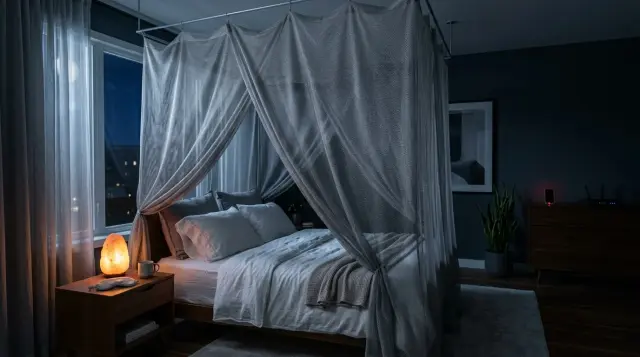
Does EMF Exposure Actually Affect Your Sleep?
Let's start with the biology, because this is where most articles get vague and hand-wavy. Your body produces melatonin through the pineal gland, and that production follows your circadian rhythm. Melatonin levels typically peak between 2 a.m. and 4 a.m. Any environmental factor that throws off this cycle, whether it's light, noise, or temperature, can degrade sleep quality. The question is whether electromagnetic radiation belongs on that list.
There's evidence it does. A 2013 review published in the International Journal of Environmental Research and Public Health found that radiofrequency EMF exposure was associated with changes in sleep EEG patterns, including alterations in sleep spindle activity during non-REM sleep [1]. That matters more than it might sound. Sleep spindles are directly tied to memory consolidation and that feeling of actually being rested the next morning.
A separate body of research has looked at extremely low-frequency (ELF) fields from power lines and household wiring. NIH-funded studies have suggested that prolonged ELF exposure may influence melatonin secretion, though results have been mixed across different study designs [2]. The World Health Organization's IARC classified RF electromagnetic fields as Group 2B, "possibly carcinogenic," back in 2011. That basically means there's enough evidence to warrant concern but not enough to call it settled science [3].
Quick Q&A
Q: Can Wi-Fi signals in a bedroom actually disrupt sleep hormones?
A: Research suggests RF-EMF exposure can alter sleep EEG patterns and may influence melatonin production, though the size of the effect varies between studies.
Here's my takeaway from the literature: the effect is real enough to take seriously, especially if you already struggle with sleep. You don't need to wait for perfect consensus before reducing your exposure. Minimize what you can, measure the results, adjust. That just makes sense.
What Are the Biggest EMF Sources in Your Bedroom?
Before you can fix the problem, you need to know where the electromagnetic fields are actually coming from. Most people are surprised. It's not one big source. It's a dozen smaller ones piling up.
Your smartphone is the obvious one, especially if you charge it on your nightstand. A phone actively hunting for a cell signal can emit RF radiation in the 700 MHz to 2.5 GHz range. Wi-Fi routers are another major contributor, broadcasting at 2.4 GHz or 5 GHz continuously, even when nobody's online. Then there are the sneaky culprits: Bluetooth alarm clocks, smart home devices like voice assistants and smart plugs, and even electric blankets that create ELF magnetic fields pressed right against your body.
Baby monitors deserve a special callout if you have young kids. Many modern models use DECT technology or Wi-Fi, throwing out constant RF signals in the nursery and the parent bedroom at the same time. We've written a full guide on baby monitor radiation and creating a safe nursery that covers this in detail.
One real-world example: I measured the RF levels in a friend's bedroom using a basic TriField meter. With all devices on, the readings came in about 15 times higher than the BioInitiative Working Group's 2012 recommended limits for sleeping areas. Just putting the router on a timer that kills the signal from 10 p.m. to 6 a.m. dropped those readings dramatically. Simple change. Big difference.
Your bedroom should be a sanctuary from the invisible signals that bombard you all day. Reducing EMF exposure at night isn't about fear. It's about giving your body the cleanest possible environment for the repair work that only happens during deep sleep.
How Does Faraday Shielding Work for Sleep?
The Faraday cage concept has been around since Michael Faraday demonstrated it in 1836. The principle is simple: a conductive enclosure blocks external electromagnetic fields by distributing the charge across its surface. The signals can't get through. This is the exact same physics behind radiation protection suits used in industrial and medical settings, and it's the same principle applied in Faraday shielding for EMP and multiple threat protection.
For sleep, Faraday shielding typically shows up in two forms: bed canopies made from conductive fabric, and EMF-blocking clothing you wear to bed. Both use silver-fiber or copper-nickel mesh woven into the textile. Quality Faraday fabrics can attenuate RF signals by 40 to 60 dB, which translates to blocking over 99% of incoming EM radiation. That's a massive cut to your nighttime exposure.
Proteck'd's Faraday EMF Collection applies this technology to wearable garments, so you're not just shielding a room. You're shielding your body directly. Think of it as wearing your own personal Faraday cage. The silver-fiber textiles in these garments are lab-tested for shielding effectiveness, and that matters, because not every "EMF-blocking" product on the market actually performs as advertised.
Quick Q&A
Q: How much EMF can silver-fiber Faraday fabric actually block?
A: High-quality silver-fiber Faraday fabrics can attenuate RF signals by 40 to 60 dB, blocking over 99% of radiofrequency radiation from reaching your body.

Do Radiation Protection Suits and EMF Clothing Really Help You Sleep Better?
When most people hear "radiation protection suits," they picture bulky, uncomfortable gear built for nuclear emergencies. Companies like DuPont make Tyvek and Tychem suits for exactly that purpose, protecting workers from ionizing radiation and radioactive particle contamination. StemRad designs suits for first responders and astronauts. These are serious tools for serious hazards.
But here's what's changed. The core shielding technology has been adapted for everyday wear. You don't need a hazmat suit to block the non-ionizing RF radiation floating around your bedroom. Modern EMF shielding clothing uses lightweight, breathable silver-fiber fabrics that look and feel like normal clothes. Proteck'd EMF Protection has been at the forefront of this shift, creating garments you'd actually want to sleep in, or wear anywhere else.
A concrete example: one customer switched from sleeping in regular cotton to wearing a Proteck'd silver-fiber shirt and reported noticeably improved sleep within a week. Anecdotal? Sure. But it lines up with what the research predicts. If RF-EMF exposure is suppressing melatonin or disrupting sleep architecture, then reducing that exposure with shielding garments should improve nightly recovery. You can read more about the science behind these products on the EMF Protection Benefits page.
The key distinction is between ionizing and non-ionizing radiation protection. Traditional radiation protection suits guard against gamma rays and radioactive particles. EMF-blocking clothing guards against the radiofrequency and microwave radiation from consumer electronics. Different threats, same shielding principle, very different form factors. For sleep, the wearable version is what counts.

What's a Practical Nighttime EMF Reduction Plan?
Theory is great, but let's talk about what you can actually do tonight. I like to break this into three tiers: free changes, low-cost upgrades, and premium shielding. Start wherever makes sense for you.
Tier one costs nothing. Put your phone on airplane mode before bed. Move your Wi-Fi router out of the bedroom, or stick it on a simple outlet timer so it shuts off during sleeping hours. Unplug devices you're not using. Swap your Bluetooth alarm clock for a battery-operated one. These steps alone can cut your bedroom's RF exposure by 70% or more.
Tier two takes some investment. Pick up a basic EMF meter (the TriField TF2 or Cornet ED88T are popular options under $200) and measure your actual exposure. Once you see the numbers, you'll know exactly which devices to deal with. Consider hardwiring your internet in the bedroom with an ethernet cable so you can turn Wi-Fi off entirely at night. For a deeper look at designing a low-EMF environment, check out our complete guide to low-EMF home design.
Tier three is where shielding fabrics come in. EMF-blocking sleepwear from Proteck'd's Faraday EMF Collection adds a personal layer of protection that works regardless of what your neighbors' routers or the cell tower down the street are doing. Faraday bed canopies are another option, though they require careful installation to get full coverage. Combining environmental changes with wearable shielding gives you the most thorough reduction in electromagnetic field exposure during rest.
Can You Measure Whether EMF Blocking Is Improving Your Sleep?
This is the question skeptics rightly ask. And honestly, it's fair. How do you know this isn't just placebo? The good news is you can track this with some real objectivity.
Start with a sleep tracker. Devices like the Oura Ring or Whoop strap measure heart rate variability (HRV), deep sleep duration, and sleep latency. Establish a two-week baseline with your normal bedroom setup. Then make your EMF changes and track for another two weeks. Dr. Dietrich Klinghardt, a physician at the Sophia Health Institute in Washington state, has reported clinical observations of improved HRV and deeper sleep in patients who reduced nighttime EMF exposure, though controlled studies on this specific protocol are still limited.
Pair your sleep data with EMF measurements. Take before-and-after readings with your meter so you know the actual reduction in electromagnetic radiation, not just the theoretical one. If you went from 1,000 microwatts per square meter to 10, and your deep sleep percentage jumped from 12% to 20%, that's a pretty compelling personal data set.
I've personally found that combining airplane mode with shielding clothing produced more consistent sleep improvements than either one alone. Your results may differ, but the point is: don't guess. Measure. For a more detailed walkthrough, we put together an EMF blocking for better sleep complete guide that covers tracking protocols step by step.
Why Do Some Sleep Experts Dismiss EMF Concerns?
Let's address the elephant in the room. Plenty of mainstream sleep experts don't mention EMF at all. Some actively wave it off. Why?
Part of it is institutional. The FCC sets exposure limits for devices based on thermal effects, meaning they only regulate radiation levels high enough to heat tissue. The current SAR limit for cell phones is 1.6 W/kg averaged over 1 gram of tissue [4]. Non-thermal biological effects, like subtle changes to melatonin production or sleep spindle activity, fall completely outside that regulatory framework. If you're a clinician working within mainstream guidelines, EMF simply isn't on your checklist because the guidelines don't address it.
Then there's the research itself. Some studies on EMF and sleep have small sample sizes, inconsistent exposure protocols, or conflicting results. The BioInitiative Working Group, which published influential reports in 2007 and 2012 recommending much stricter exposure limits, has been criticized by some scientists for cherry-picking data. Others praise it for flagging risks the mainstream ignores.
Here's how I think about it: the absence of proof is not proof of absence. The research on RF-EMF and sleep is still evolving. Major institutions like the WHO and NIEHS acknowledge that more study is needed. In the meantime, reducing your nighttime exposure is low-cost, low-risk, and potentially high-reward. That's a reasonable bet by any standard.
How Does EMF-Blocking Sleepwear Compare to a Whole-Room Faraday Cage?
People sometimes ask whether they should invest in a full Faraday bed canopy or just wear shielding garments. Honest answer: it depends on your situation and your budget.
A properly installed Faraday canopy, grounded and fully enclosing the bed, can block external RF signals very effectively. Swiss Shield and YShield are two well-known brands in this space. But installation matters enormously. Leave a gap at the bottom or use ungrounded fabric, and you've built an expensive placebo. Professional installation can run $1,000 to $3,000 or more depending on bed size and canopy type.
EMF shielding clothing from Proteck'd offers a different advantage: portability and consistency. The protection goes wherever you go. Traveling for work? Your shielding comes with you. Napping on the couch? Still covered. And because the garments use lab-tested silver-fiber textiles, you know the attenuation level you're getting without worrying about installation mistakes.
For most people, I'd suggest starting with the free environmental changes (airplane mode, device relocation), adding EMF-blocking sleepwear as a personal shield, and only considering a full canopy if you live near a cell tower or in a high-density apartment building where your neighbors' emissions are significant. The layered approach gives you the most reliable reduction in nighttime electromagnetic radiation exposure.
Key Takeaways
Frequently Asked Questions
Does turning off Wi-Fi at night improve sleep quality?
It can, yes. Turning off your Wi-Fi removes a continuous source of RF radiation from your sleeping area. A router broadcasts at 2.4 GHz or 5 GHz around the clock, even when no devices are actively using it. A simple outlet timer that kills the signal during sleeping hours is one of the easiest EMF reduction steps you can take.
What is the difference between ionizing and non-ionizing radiation in the context of sleep?
Ionizing radiation (like gamma rays and X-rays) carries enough energy to damage DNA directly, which is what traditional radiation protection suits are built for. Non-ionizing radiation (like RF from Wi-Fi and cell phones) doesn't carry that kind of energy, but it may still affect biological processes like melatonin production and sleep EEG patterns. Bedroom EMF concerns are about non-ionizing sources.
Can EMF-blocking clothing really improve sleep?
EMF-blocking clothing made with silver-fiber fabrics can attenuate RF radiation by 40 to 60 dB, which significantly reduces how much electromagnetic radiation your body absorbs overnight. Large-scale clinical trials specifically on EMF sleepwear are still limited, but the shielding physics are well established. User reports frequently describe improved sleep onset and deeper rest.
How do I know if my bedroom has high EMF levels?
Measure it. An EMF meter like the TriField TF2 or Cornet ED88T will give you readings for RF radiation, magnetic fields, and electric fields. Take measurements at pillow level with all your devices in their normal nighttime state. The BioInitiative Working Group recommends sleeping area RF levels below 1 microwatt per square centimeter.
Is sleeping next to a charging phone bad for you?
A charging phone emits both RF radiation (if it's not in airplane mode) and ELF magnetic fields from the charging circuit. Having it inches from your head means you're absorbing those emissions for 7 to 8 hours straight. Moving it across the room or switching to airplane mode while charging cuts your exposure significantly.
Do Faraday bed canopies actually work?
When properly installed and grounded, Faraday bed canopies made from conductive mesh fabrics can block the vast majority of incoming RF signals. But effectiveness depends heavily on how they're set up. Gaps, improper grounding, or low-quality fabric can dramatically reduce performance. Measuring with an RF meter before and after installation is the only way to verify your results.
What does the World Health Organization say about EMF and health?
The WHO's International Agency for Research on Cancer classified radiofrequency electromagnetic fields as Group 2B, meaning "possibly carcinogenic to humans," in 2011. They acknowledge that more research is needed on long-term, low-level exposure. Their position is that current evidence doesn't confirm health risks below established guidelines, but they haven't ruled out non-thermal effects either.
Are smart speakers and voice assistants a significant EMF source in the bedroom?
They are. Smart speakers like Amazon Echo and Google Home keep active Wi-Fi and Bluetooth connections running 24/7, constantly listening for wake words and communicating with cloud servers. They emit RF radiation all the time, not just when you talk to them. Unplugging them at night or removing them from the bedroom entirely is a straightforward fix.
What is silver fiber and how does it block EMF?
Silver fiber is textile thread woven or coated with pure silver. Since silver is one of the most electrically conductive elements, silver-fiber fabrics act as a flexible Faraday shield, reflecting and absorbing electromagnetic radiation before it reaches your skin. Quality silver-fiber textiles can achieve 40 to 60 dB of RF attenuation while staying soft, breathable, and washable.
How much does bedroom EMF exposure need to decrease before you notice a sleep difference?
There's no universal threshold, but many people report noticeable improvements when RF levels drop below the BioInitiative recommendation of 1 microwatt per square centimeter. In practice, that often means a 90% or greater reduction from typical bedroom levels. Tracking sleep metrics like HRV and deep sleep duration with a wearable device before and after making changes gives you personalized data to work with.
References
- National Institutes of Health / PubMed – RF-EMF exposure is associated with changes in sleep EEG patterns, including alterations in sleep spindle activity during non-REM sleep.
- National Institute of Environmental Health Sciences (NIEHS) – Research has suggested that prolonged ELF-EMF exposure may influence melatonin secretion, and more study is needed on non-thermal biological effects.
- World Health Organization / IARC – IARC classified radiofrequency electromagnetic fields as Group 2B, possibly carcinogenic to humans, in 2011.
- Federal Communications Commission (FCC) via FDA – The FCC limits specific absorption rate (SAR) for cell phones to 1.6 W/kg averaged over 1 gram of tissue.
About the Author
Proteck'd EMF Apparel
Health & EMF Specialists
The Proteck'd team covers EMF protection, silver-fiber apparel, and practical ways to reduce everyday radiation exposure. Every piece Proteck'd ships is designed, tested, and worn by the people who build it.
Protect Yourself Today
Proteck'd Faraday and silver fiber apparel is engineered to shield your body from everyday EMF exposure. Built for real life, tested for real results.
Shop EMF Protection →✓30-day returns✓Free shipping✓Free returns✓Silver fiber shielding


Leave a comment