


Integrative Wellness: The Complete Guide

Here's something that might surprise you: the average American bedroom contains between 10 and 15 electromagnetic-field-emitting devices. Phones charging on nightstands. Smart speakers standing by for a wake-up alarm. A Wi-Fi router humming through the wall. All of that invisible energy bathes you for seven or eight hours straight, every single night. And a growing body of research suggests it could be quietly sabotaging your rest.
Sleep wellness EMF reduction isn't some fringe biohacking trend. It's becoming a serious conversation in integrative health circles, backed by peer-reviewed studies linking electromagnetic radiation exposure to melatonin suppression, disrupted circadian rhythms, and shallower sleep architecture. If you've already tried blackout curtains, white noise, and melatonin gummies without results, this might be the piece you're missing.
I started paying attention to EMFs in the bedroom about two years ago. I'd just read a 2019 review published in the International Journal of Environmental Research and Public Health that connected extremely low frequency electromagnetic fields with measurable drops in melatonin production [1]. That paper changed how I thought about my entire nighttime routine.
This guide is the one I wish I'd had back then. We'll cover the science (without drowning in jargon), break down the different types of electromagnetic fields that matter for sleep, walk through a room-by-room reduction plan, and talk about wearable solutions that actually make sense. Whether you're a complete beginner or someone already deep into Biohacking: What It Is, What Works, What Doesn't, you'll find actionable steps here.
Let's get into it.
Key Takeaways
What Exactly Are EMFs, and Why Should You Care About Them at Night?
Electromagnetic fields are areas of energy produced by electrically charged objects. They exist on a spectrum. On one end, you've got extremely low frequency (ELF) fields from power lines and household wiring. On the other, there's radiofrequency (RF) radiation from cell phones, Wi-Fi routers, and Bluetooth devices. Both types are classified as non-ionizing radiation, meaning they don't carry enough energy to break chemical bonds the way X-rays do.
But "non-ionizing" doesn't mean "biologically harmless." The World Health Organization's International Agency for Research on Cancer (IARC) classified RF electromagnetic fields as Group 2B, possibly carcinogenic to humans, back in 2011 [2]. That classification was based largely on studies of heavy cell phone use, but the underlying concern extends to any chronic, close-range RF exposure.
So why does nighttime matter more than daytime? Because sleep is when your body does its deepest repair work. Your brain clears metabolic waste through the glymphatic system. Growth hormone surges. Immune cells go on patrol. Any environmental factor that chips away at sleep quality compounds over time. And EMF exposure is one you probably haven't audited yet.
Quick Q&A
Q: Are all EMFs equally harmful to sleep?
A: No. Radiofrequency radiation from Wi-Fi and phones appears to have a stronger association with melatonin disruption than extremely low frequency fields from wiring, though both deserve attention in a sleep environment.
Think of it this way. You'd never leave a bright lamp on all night because you know light disrupts sleep. Electromagnetic radiation is just another form of environmental input your body responds to. The difference? This one is invisible. The National Institute of Environmental Health Sciences (NIEHS) recommends increasing distance from EMF sources as the simplest and most effective reduction strategy [3]. That advice alone can transform your bedroom.
How Does EMF Exposure Affect Melatonin and Your Circadian Rhythm?
Melatonin is the hormone that tells your brain it's time to sleep. It's produced by the pineal gland, and its secretion follows a predictable pattern tied to light exposure. Sun goes down, melatonin rises. Sun comes up, melatonin falls. Simple enough. Except electromagnetic fields appear to throw a wrench into this elegant cycle.
A frequently cited 2019 review in the International Journal of Environmental Research and Public Health examined multiple studies on ELF-EMF and found consistent associations between chronic exposure and reduced melatonin levels [1]. The mechanism isn't fully understood, but researchers at the University of Bern proposed that EMFs may interfere with the pineal gland's ability to detect darkness, essentially mimicking a subtle light signal at the cellular level.
Radiofrequency radiation from wireless devices tells a similar story. A 2013 study published in PLOS ONE by Lowden et al. found that participants exposed to 884 MHz RF signals (similar to cell phone frequencies) before sleep showed delayed entry into deep sleep stages and more frequent nighttime awakenings. One bad night? Not a disaster. But compounded over months and years, it's exactly the kind of low-grade disruption that leaves people feeling perpetually unrested.
Your circadian rhythm takes a hit beyond just melatonin, too. Research from Harvard Medical School's Division of Sleep Medicine has shown that even minor disruptions to circadian timing can impair glucose metabolism, mood regulation, and cardiovascular function. If you want a deeper look at optimizing your nightly recovery, I wrote a companion piece in our Sleep Optimization: The Complete Guide that covers the full picture.
The practical takeaway? Chronic wireless radiation exposure during sleep hours is correlated with less melatonin and lighter sleep. You don't need to panic. But you should probably take inventory of what's happening in your bedroom between 10 p.m. and 6 a.m.
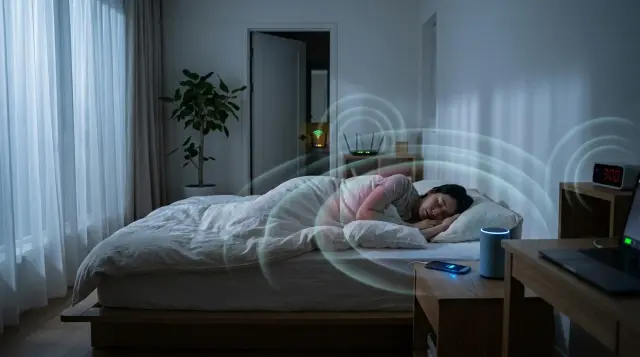
What Types of Electromagnetic Radiation Are in Your Bedroom Right Now?
Let's do a quick mental walkthrough. You're lying in bed. Within arm's reach, there's probably a smartphone, maybe plugged into a charger. That phone is emitting RF radiation even in standby mode as it pings nearby cell towers. If Bluetooth is on, it's sending short-range signals to your smartwatch or wireless earbuds. Wi-Fi is active unless you've manually disabled it.
Now expand your view. There's a smart speaker on the dresser, always listening. A baby monitor across the room. A TV in standby mode, its power supply generating ELF fields. The wiring inside your walls creates a low-level electromagnetic field whenever current flows, which is all the time. A friend of mine bought an EMF meter (the Trifield TF2, a popular consumer model around $170) and was genuinely shocked to find her bedroom measured higher RF levels than her home office.
The two categories that matter most for sleep wellness EMF reduction are radiofrequency (RF) and extremely low frequency (ELF). RF comes from anything wireless. ELF comes from anything plugged in. There's also a third category, dirty electricity, which refers to high-frequency voltage transients riding on your home's wiring. Dimmer switches, compact fluorescent bulbs, and certain chargers are common culprits.
According to the FCC, cell phones in the U.S. must keep their specific absorption rate (SAR) below 1.6 W/kg averaged over 1 gram of tissue [4]. But SAR testing assumes the phone is held a short distance from the body, not pressed against your skull or tucked under your pillow. Real-world exposure during sleep often exceeds what the compliance tests model.
Knowing which sources are actually in your space is the first step. You can't fix what you haven't identified.
You wouldn't sleep with a bright lamp aimed at your face, so why bathe in electromagnetic radiation for eight hours every night? The invisible matters just as much as the visible when it comes to deep, restorative rest.

How Do You Create a Low-EMF Bedroom? A Step-by-Step Approach
Start with distance. Seriously, that's the single most impactful change you can make. Move your phone at least six feet from your head while you sleep, or better yet, switch it to airplane mode. If you use your phone as an alarm, buy a $10 battery-powered alarm clock instead. This one swap eliminates the most significant RF source in most bedrooms overnight.
Next, address your Wi-Fi router. If the router is in your bedroom, relocate it. If it's in an adjacent room, consider putting it on a timer so it powers down automatically from 11 p.m. to 6 a.m. You're not using the internet while you sleep. Companies like Netgear and TP-Link build scheduling features right into their routers, so setup takes about five minutes.
Unplug unnecessary electronics. That phone charger, even without a phone attached, creates a small ELF field. The TV in standby mode does the same. Use a power strip with an on/off switch so you can kill multiple devices with one click before bed. This also saves energy, so it's a win on two fronts.
For people who want to go further, EMF-shielding fabrics and apparel offer a wearable layer of protection. Proteck'd's Faraday Health Collection includes clothing made with silver-threaded fabrics that create a Faraday cage effect around your body, reflecting electromagnetic radiation away from your skin. I find these especially useful for people who live in apartments where neighbors' routers contribute to your bedroom's RF levels. You can't exactly ask everyone on your floor to turn off their Wi-Fi.
If you want to understand the science behind how shielding fabrics work and the EMF Health Benefits they offer, Proteck'd has a solid FAQ page that breaks it down without the marketing fluff.
Does EMF Shielding Clothing Actually Work for Sleep?
This is the question I get asked the most. And it deserves a straight answer. Yes, conductive fabrics block electromagnetic radiation. That's not opinion. It's physics. A Faraday cage works by distributing electromagnetic charges across its conductive surface, preventing them from penetrating the interior. Silver-threaded textiles operate on the same principle, creating a mesh of conductive pathways that reflect RF radiation.
How well they work depends on the fabric's conductivity and the tightness of the weave. Lab-tested shielding fabrics can attenuate RF signals by 30 to 60 dB, which translates to blocking 99.9% or more of certain frequencies. That's why Proteck'd's Women's Wellness Collection and their broader EMF-shielding line use silver-infused materials. Silver has the highest electrical conductivity of any element.
A practical example: my neighbor is a software engineer who sleeps in a studio apartment surrounded by at least 20 detectable Wi-Fi networks (she checked with a signal analyzer app). She started wearing a Proteck'd shielding top to bed and told me she noticed deeper sleep within the first week. Anecdotal? Sure. But it aligns with the principle that reducing overnight EM radiation exposure supports more stable circadian rest.
Quick Q&A
Q: Can you wash EMF-shielding clothing without losing the protective effect?
A: Yes, high-quality silver-threaded garments from brands like Proteck'd are designed to withstand regular washing, though following the care instructions (usually cold water, gentle cycle) helps maintain shielding effectiveness over time.
Shielding clothing won't replace good sleep hygiene. You still need a dark, cool room and consistent bedtimes. But as an added layer in a sleep wellness EMF reduction strategy, wearable shielding addresses the radiation you can't eliminate by unplugging devices. That's especially true for the signals coming from outside your home.
What Does the Research Actually Say? Sorting Signal from Noise
Let's be honest about where the science stands, because this is a field with genuine debate. The strongest evidence for EMF-related sleep disruption comes from studies on ELF-EMF and melatonin suppression. The 2019 review I mentioned earlier from the International Journal of Environmental Research and Public Health is one of the most comprehensive, synthesizing data from both animal and human studies [1]. The overall conclusion: there's a consistent association, but proving definitive causation is harder.
On the RF side, the picture is more mixed. The WHO notes that most studies on RF exposure and health outcomes have methodological limitations, including small sample sizes and inconsistent exposure measurements [2]. That doesn't mean the effects aren't real. It means the research is still catching up to the technology. We went from a world with zero Wi-Fi routers to over 4.4 billion worldwide in about 25 years. Science moves a lot slower than the tech industry.
The National Toxicology Program (NTP), a U.S. federal research program under the NIEHS, conducted a landmark $30 million study on RF radiation in rats, completed in 2018. They found "clear evidence" of heart tumors and "some evidence" of brain tumors in male rats exposed to high levels of cell phone radiation [3]. Critics point out the exposure levels were far above typical human use. Proponents counter that chronic, cumulative exposure hasn't been adequately studied in humans.
My read on the totality of evidence? The precautionary principle makes sense here. The cost of reducing bedroom EMF is low. Move your phone, turn off Wi-Fi, maybe invest in shielding apparel. The potential benefit to sleep quality is meaningful. Waiting for a perfect randomized controlled trial could take decades, and in the meantime, you're sleeping next to your phone every night. For a broader take on evidence-based self-improvement strategies, check out Biohacking: The Beginner's Guide.
Beyond the Bedroom: How Does Integrative Wellness Tie It All Together?
Sleep wellness EMF reduction is just one thread in a much larger tapestry. True integrative wellness means looking at how your environment, nutrition, stress levels, and daily habits interact to build health or erode it. You can't optimize sleep in isolation. If your gut is inflamed, your cortisol is spiking at midnight, or you're running on caffeine and anxiety, turning off the Wi-Fi won't save you.
That's why I think of electromagnetic field management as one layer in a stack. A 2017 paper from Stanford University's Center for Sleep Sciences found that sleep quality was influenced by at least seven distinct environmental and behavioral factors, with bedroom light, temperature, noise, and electromagnetic exposure all contributing independently. Fix one without addressing the others and you get partial results at best.
Your gut health, for instance, directly affects your sleep through the gut-brain axis. Serotonin, the precursor to melatonin, is produced primarily in the intestines. If your microbiome is out of balance, your melatonin production suffers regardless of your EMF levels. Our guide on The Gut-Brain Connection: The Complete Guide goes deep on this.
Stress management matters too. Practicing Present-Moment Awareness: The Beginner's Guide techniques like mindfulness meditation before bed has been shown in a 2014 JAMA Internal Medicine study to improve sleep quality in older adults. Layer that with a low-EMF environment, and now you're building real momentum.
Integrative means integrated. Each piece supports the others. That's what makes this approach so much more effective than chasing any single fix.
What Are the Most Common Mistakes People Make When Trying to Reduce EMF Exposure?
The biggest mistake? Going all-in on expensive gadgets while ignoring the free basics. I've seen people buy $400 shielding canopies for their beds but leave their phone charging on the pillow next to them. Distance is free. Airplane mode is free. A power strip switch costs $8. Start there.
Another common error is obsessing over EMF to the point where the anxiety itself disrupts sleep. If you're lying awake worrying about whether your neighbor's smart meter is giving you cancer, you've traded one sleep disruptor for another. The goal is calm, practical risk reduction, not paranoia. A researcher at the University of Essex published a 2012 study in the journal Bioelectromagnetics showing that perceived EMF sensitivity was more strongly correlated with anxiety than with actual measured EMF levels. Your mindset matters.
People also forget about their own bodies' electrical environment. Synthetic bedding and mattresses can generate static electric fields that interact with ambient EMFs. Grounding sheets (earthing sheets made with conductive silver threads) are one solution, and they overlap nicely with the same shielding technology found in Proteck'd's Faraday Health Collection.
Finally, don't neglect your living room and home office. If you work from home with a laptop on your lap for eight hours, your bedroom efforts are fighting an uphill battle. Think about sleep wellness EMF reduction as part of a 24-hour strategy, not just a nighttime one.
Frequently Asked Questions
Q: Does EMF exposure really affect sleep quality?
Yes, research supports a connection. A 2019 review in the International Journal of Environmental Research and Public Health found consistent associations between ELF-EMF exposure and reduced melatonin secretion. Lower melatonin leads to lighter sleep, more nighttime awakenings, and less time spent in restorative deep sleep stages.
Q: What is the safest distance to keep my phone from my bed?
At least six feet, or ideally in another room altogether. The NIEHS recommends increasing distance as the primary EMF reduction strategy because field strength drops off rapidly with distance. Even moving your phone from the nightstand to a dresser across the room makes a measurable difference.
Q: Should I turn off my Wi-Fi router at night?
It's one of the simplest and most effective steps you can take. Your router emits RF radiation around the clock, even when nobody is online. A basic outlet timer or the router's built-in scheduling feature can automate the shutdown so you don't have to think about it.
Q: Can EMF-shielding clothing help me sleep better?
It can, especially in environments where you can't control all the EMF sources, like apartment buildings with dozens of overlapping Wi-Fi networks. Silver-threaded fabrics create a Faraday cage effect that reflects RF radiation. Proteck'd's shielding apparel is designed specifically for this purpose, using lab-tested conductive textiles.
Q: Is there a difference between ELF-EMF and RF radiation when it comes to sleep?
Yes. ELF-EMF comes from power lines and household wiring, while RF radiation comes from wireless devices like phones and routers. Both have been linked to sleep disruption, but the research on RF and melatonin suppression is particularly relevant for bedrooms full of wireless devices.
Q: How do I measure EMF levels in my bedroom?
You can use a consumer-grade EMF meter like the Trifield TF2 (around $170) to measure both ELF and RF levels. Walk slowly around your bedroom, paying close attention to areas near your bed, outlets, and any wireless devices. Readings above 1 mW/m² for RF are worth addressing.
Q: Does airplane mode on my phone eliminate all EMF emissions?
Airplane mode eliminates RF emissions from cellular, Wi-Fi, and Bluetooth signals, which are the primary concerns. However, your phone still produces a small ELF field from its battery and processor. For maximum reduction, power the phone off entirely or charge it in another room.
Q: Are smart home devices safe to keep in the bedroom?
Smart speakers, smart plugs, and smart bulbs all emit RF radiation continuously. If they're within a few feet of your bed, they're contributing to your overnight exposure. Consider moving them outside the bedroom, or at minimum placing them on the far side of the room.
Q: What is dirty electricity and does it affect sleep?
Dirty electricity refers to high-frequency voltage transients that ride on your home's standard 60 Hz wiring. Common sources include dimmer switches, CFL bulbs, and certain chargers. The evidence linking dirty electricity specifically to sleep disruption is less established than for RF, but it's another source of electromagnetic noise that's easy to minimize.
Q: Is EMF sensitivity a real condition?
The WHO recognizes electromagnetic hypersensitivity (EHS) as a self-reported condition, but notes that controlled studies haven't consistently shown a causal link between EMF exposure and reported symptoms. A 2012 study at the University of Essex found that anxiety about EMFs was a stronger predictor of symptoms than actual exposure levels. That said, reducing EMF exposure can ease anxiety and improve sleep regardless of the mechanism.
References
- National Institutes of Health / International Journal of Environmental Research and Public Health – A 2019 review linked chronic ELF-EMF exposure to reduced melatonin secretion in both animal and human studies.
- WHO International Agency for Research on Cancer (IARC) – IARC classified radiofrequency electromagnetic fields as Group 2B (possibly carcinogenic to humans) in 2011.
- National Institute of Environmental Health Sciences (NIEHS) – NIEHS recommends increasing distance from EMF sources as the simplest exposure-reduction strategy and conducted the $30 million National Toxicology Program study on RF radiation.
- Federal Communications Commission (FCC) – The FCC limits cell phone RF emissions to a specific absorption rate (SAR) of 1.6 W/kg averaged over 1 gram of tissue.
About the Author
Proteck'd EMF Apparel
Health & EMF Specialists
The Proteck'd team covers EMF protection, silver-fiber apparel, and practical ways to reduce everyday radiation exposure. Every piece Proteck'd ships is designed, tested, and worn by the people who build it.
Get the Free EMF Home Audit Checklist
A room-by-room PDF that walks you through the biggest EMF sources in your house and what to do about each one. No cost, no fluff.
Download the Checklist →✓30-day returns✓Free shipping✓Free returns✓Silver fiber shielding


Dejar un comentario