


Whole-Body Health: The Beginner's Guide

Here's a stat that hit me hard: the CDC says one in three American adults don't get enough sleep [1]. Not every once in a while. Regularly. And once I started pulling at that thread, looking at what chronically bad rest actually does to a person, something clicked. Sleep isn't just another health goal on the list. It's the foundation everything else depends on.
That's why any honest conversation about whole-body health has to start with a solid sleep optimization protocol. Not a trendy hack. Not a pile of supplements. A real daily structure grounded in circadian science, one that helps your brain and body do what they already know how to do, as long as you stop getting in the way.
But this guide goes further than sleep alone. Your nightly recovery doesn't exist in a bubble. What you eat, how you move, the light hitting your eyes, the electromagnetic signals pinging around your bedroom at 2 a.m., all of it feeds into the same system. Whole-body health means treating that system as one connected thing, not a scatter of unrelated goals.
So whether you're a total beginner who just wants to stop feeling wrecked by noon, or someone already tracking macros but still waking up foggy, this is for you. We'll cover the science, the practical steps, and the stuff that rarely gets mentioned, like how your gut bacteria might be undermining your deep sleep.
Ready? Let's start where everything starts: with how your body tells time.
What Is a Sleep Optimization Protocol and Why Should Beginners Care?
A sleep optimization protocol is a structured daily plan that uses specific, timed actions to improve how well you sleep, not just how long. Think of it less like a bedtime checklist and more like a 24-hour rhythm that trains your body's internal clock. Dr. Andrew Huberman of Stanford University has been a big voice on this, stressing that what you do at 7 a.m. matters just as much for sleep as what you do at 10 p.m.
The core idea is simple. Your body runs on a circadian rhythm, a roughly 24-hour biological cycle driven by light, temperature, and hormonal signals. When that rhythm is in sync, you fall asleep faster, spend more time in restorative deep sleep and REM, and wake up without an alarm feeling actually rested. When it's off? Everything suffers. Your metabolism. Your mood. Your ability to remember where you put your keys.
For beginners, the best part is that a sleep protocol doesn't require you to buy anything fancy. Research from Harvard Medical School's Division of Sleep Medicine shows the most powerful sleep interventions are behavioral, not pharmaceutical [2]. Sunlight. Consistent timing. Temperature. These are free. They just take some intention.
If you've already explored our Sleep Optimization: The Complete Guide, you'll recognize some of these ideas. This article goes wider, connecting your rest protocol to your overall health picture. Sleep quality is the foundation, but it's not the whole house.
Quick Q&A
Q: What's the difference between sleep quantity and sleep quality?
A: Sleep quantity is total hours in bed; sleep quality measures time in deep sleep and REM stages, sleep efficiency (percentage of time asleep vs. lying awake), and how often you wake during the night.
How Do You Reset Your Circadian Rhythm in the Morning?
If I could tattoo one thing on every beginner's forehead (metaphorically, please), it would be this: get outside in sunlight within 30 minutes of waking up. A 2019 study from Harvard Medical School found that morning light activates melanopsin receptors in the eyes, which fire a direct signal to the suprachiasmatic nucleus, the brain's master clock [2]. This resets your circadian rhythm more powerfully than any supplement can.
You don't need a sunny day. Even overcast skies deliver 10,000 lux or more, which is roughly 50 times brighter than typical indoor lighting. Aim for 10 minutes on a bright day, 20 to 30 minutes when it's cloudy. And no, looking through a window doesn't cut it. Glass filters out too much of the relevant light spectrum.
A concrete example from my own life: I take my coffee outside and just stand there. That's it. No special gear. No sunrise yoga. Just standing in the light like a houseplant. Within about two weeks of doing this consistently, I noticed I was falling asleep faster at night without even trying. That's the circadian reset doing its work.
Another morning tool is delaying caffeine. Dr. Huberman recommends waiting 90 to 120 minutes after waking before your first cup. The reasoning? Adenosine, the molecule that builds sleep pressure, is still clearing from your system in the first hour or so. If you mask it with caffeine too early, you crash harder in the afternoon, which throws off your evening wind-down and your overall nightly recovery. I know. That one stings. But try it for a week and see what happens.
Whole-body health isn't about doing one thing perfectly. It's about connecting sleep, gut health, movement, and environmental awareness into a daily rhythm your body can actually rely on. The people who get lasting results aren't chasing hacks. They're building systems.
What's the Best Bedroom Temperature for Deep Sleep?
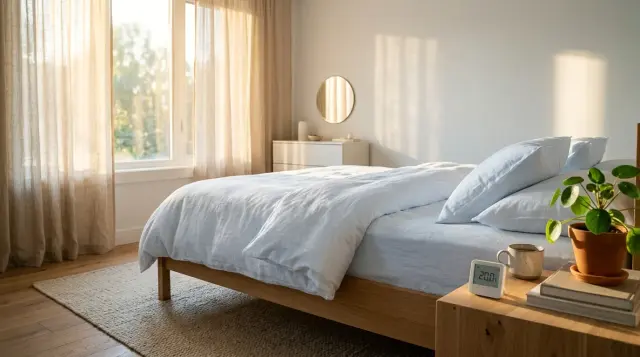
This one surprises a lot of people, and it's backed by hard evidence. Research from Stanford University's Sleep Medicine Center found that the ideal bedroom temperature for maximizing deep sleep is between 65 and 68°F (18 to 20°C). Your core body temperature needs to drop about 2 to 3°F to kick off sleep onset, and a cool room makes that happen naturally.
Think about it. Have you ever tried to fall asleep in a hot room? It's awful. And it's not just discomfort. Your body physically cannot enter slow-wave sleep efficiently when your core temperature is too high. A study published in Sleep Medicine Reviews found that thermal environment was one of the top three predictors of sleep architecture quality, right alongside light exposure and timing consistency.
Some practical tips: if you can't control your thermostat, a fan aimed at your torso works. Cotton or moisture-wicking sleepwear helps. Some people love cooling mattress pads, though they can get pricey. The point is that temperature manipulation is one of the highest-impact, lowest-effort tools in any sleep optimization protocol. Don't sleep on it. (Sorry.)
And your bedroom isn't just about temperature. The electromagnetic signals from your phone, Wi-Fi router, and smart devices are part of the equation too. We wrote more about cutting those exposures in How to Reduce Screen Time: The Method That Works. Proteck'd's Faraday Health Collection also offers EMF-shielding apparel designed to reduce exposure during rest and recovery, which is worth a look if you're serious about optimizing your sleep environment from every angle.
How Does Gut Health Affect Your Sleep Quality?
This is where whole-body health gets genuinely fascinating. Your gut and your brain talk to each other constantly through the gut-brain axis, a network that runs primarily through the vagus nerve. A 2020 review published in Nature Reviews Neuroscience documented that your gut microbiome composition directly influences neurotransmitter production, including serotonin. About 90% of serotonin is actually manufactured in the gut, not the brain [3].
Why does that matter for sleep? Serotonin is the precursor to melatonin, the hormone that governs your sleep-wake cycle. If your gut microbiome is out of balance, your body may not produce melatonin efficiently, no matter how perfect your sleep protocol looks on paper. I've seen people do everything right with light, temperature, and timing, and still struggle with restful sleep, only to discover that their gut health was the missing piece.
A real example: a friend of mine cleaned up her diet, started eating fermented foods like kimchi and kefir, and added a quality probiotic. Within a month, her wearable data showed a 15% increase in deep sleep. She hadn't changed a single other thing about her sleep routine. That's the gut-brain connection at work. For a deeper look, check out The Gut-Brain Connection: The Complete Guide.
The takeaway for beginners: don't ignore what's happening below the neck. Fiber-rich vegetables, fermented foods, and fewer ultra-processed meals can improve your microbiome diversity, which in turn supports better nightly recovery. It really is all connected.
Quick Q&A
Q: Can fixing your gut health actually improve deep sleep?
A: Yes. Because about 90% of the body's serotonin is produced in the gut, and serotonin is converted into melatonin, a healthier gut microbiome can directly support better melatonin production and deeper sleep.
Does EMF Exposure Really Affect Sleep and Recovery?
I get this question a lot, and the honest answer is that the science is still catching up, but there's enough signal (pun very much intended) to take it seriously. A 2020 review by the National Institute of Environmental Health Sciences (NIEHS) noted that radiofrequency electromagnetic fields from devices like cell phones and Wi-Fi routers have been linked to changes in sleep EEG patterns in controlled studies [4]. The biological mechanism isn't fully nailed down, but the observed effects on sleep architecture are real enough to justify precaution.
Here's what we do know. Your body's melatonin production is sensitive to environmental disruption. Blue light gets most of the attention, and deservedly so, but EMF exposure is another factor that some researchers believe can suppress melatonin or alter sleep spindle activity. Even if you're skeptical, reducing EMF in the bedroom is a zero-cost, zero-risk move. Turn off your Wi-Fi router at night. Put your phone in airplane mode. Move devices away from your head.
For people who want to take it further, Proteck'd makes purpose-built EMF-shielding clothing. The Women's Wellness Collection and the broader Faraday Health Collection use silver-infused fabric to block electromagnetic radiation. You can learn more about the science behind it at the EMF Health Benefits page. Will it transform your sleep overnight? Maybe not. But as part of a full sleep optimization protocol, reducing environmental EMF is a logical piece of the puzzle.
What I find persuasive is the precautionary angle. The World Health Organization classifies radiofrequency EMF as "possibly carcinogenic to humans" (Group 2B). You don't need to be an alarmist to decide that reducing exposure during the 7 to 9 hours your body is supposed to be in deep repair mode is just a sensible call.
What Does a 24-Hour Whole-Body Health Routine Actually Look Like?
Let's put it all together. Theory is fine, but I know you want to know what to actually do. Today. Tomorrow. This week. Here's how a full day might look when you build a whole-body wellness routine around circadian science and sleep-centered health.
Morning: Wake at a consistent time (the NIH recommends keeping your wake time within a 30-minute window, even on weekends). Step outside for 10 to 20 minutes of natural light. Drink water before caffeine. Delay coffee for 90 minutes if you can swing it. Move your body. Even a 15-minute walk counts. This builds healthy adenosine pressure, which helps you feel genuinely sleepy later that night.
Afternoon: Eat a lunch rich in fiber and whole foods to support your gut-brain axis. Grab another 10-minute outdoor break if you can, because afternoon light exposure helps stabilize your circadian rhythm even further. Cut off caffeine by 2 p.m. at the latest. According to the American Academy of Sleep Medicine, caffeine has a half-life of about 5 hours. That 3 p.m. espresso? Still 50% active at 8 p.m.
Evening: Dim the lights starting 2 hours before bed. Switch devices to night mode or, better yet, set them down entirely. Keep your bedroom cool, between 65 and 68°F. Consider wearing EMF-shielding sleepwear from Proteck'd. Read a physical book. Try a brief body scan meditation. Even 5 minutes helps activate the parasympathetic nervous system. And for a broader perspective on connecting all these pieces, take a look at Integrative Wellness: The Honest Guide.
Why Do Most Sleep Tips Fail Without a Whole-Body Approach?
I've watched friends buy blackout curtains, pop melatonin pills, download sleep apps, and still wake up feeling demolished. The problem isn't that those things are useless. It's that they treat symptoms without addressing the system. A sleep protocol that ignores your daytime habits, your food, and your environment is like putting premium gas in a car with flat tires.
Research from the Mayo Clinic confirms that sleep disorders frequently show up alongside gastrointestinal issues, metabolic dysfunction, and chronic stress. These aren't coincidences. They're feedback loops. Poor rest raises cortisol. Elevated cortisol damages the gut lining. A compromised gut impairs serotonin production. Less serotonin means less melatonin. Round and round it goes.
The whole-body approach breaks these loops at multiple points at the same time. You fix light exposure and temperature to address the sleep end. You eat real food and add fermented vegetables to address the gut end. You reduce screen time and electromagnetic exposure to address the environmental end. No single fix is magic. But together, they create the conditions for your body to actually heal itself during sleep.
That's the unsexy truth about whole-body health: it's not one big revelation. It's a bunch of small, sensible changes stacked on top of each other. The people who sustain results aren't chasing the next biohack. They're the ones who built a daily rhythm and stuck with it for more than two weeks. If you want to go deeper on reducing one major disruptor, we covered it thoroughly in How to Reduce Screen Time: The Method That Works.
How Can You Track Whether Your Sleep Protocol Is Working?
You can't improve what you don't measure. The good news is that sleep tracking has gotten a lot more approachable. Devices like the Oura Ring, Whoop band, and Apple Watch now measure sleep stages, heart rate variability (HRV), resting heart rate, and blood oxygen levels. The Oura Ring, for instance, gives you a nightly breakdown of how much time you spent in deep sleep versus light sleep versus REM.
So what should you actually look for? According to the National Sleep Foundation, adults should aim for 1.5 to 2 hours of deep sleep per night and roughly 1.5 to 2 hours of REM. Sleep efficiency, the percentage of time in bed that you're actually asleep, should be above 85%. If you're in bed for 9 hours but only sleeping for 6, that's a 66% efficiency rate. That's a red flag.
Here's a practical approach: track for two weeks without changing anything. That's your baseline. Then introduce one change at a time from your sleep optimization protocol. Maybe morning sunlight first, then temperature adjustments, then caffeine timing. Give each change at least 5 to 7 days before you judge its impact. That way you'll know what's actually moving the needle instead of guessing.
I'll be honest. I resisted tracking for a long time because it felt a little obsessive. But when I saw concrete data showing that my deep sleep doubled after I started dimming lights at 8 p.m. and putting my phone in another room, I became a convert. Data removes the guesswork and turns your nightly recovery into something you can actually measure and improve.
Key Takeaways
Frequently Asked Questions
What is a sleep optimization protocol?
It's a structured daily plan that uses timed actions like light exposure, temperature control, caffeine timing, and evening routines to improve sleep quality. Unlike a simple bedtime tip, it covers your full 24-hour cycle. The goal is to sync your habits with your natural circadian rhythm so your body produces melatonin efficiently and spends more time in deep sleep and REM.
How long does it take for a sleep protocol to work?
Most people notice measurable improvements within 7 to 14 days of sticking with it. Circadian rhythm adjustments tend to show results within the first week, especially with morning light exposure. That said, deeper shifts in sleep architecture, like a higher percentage of deep sleep, may take 3 to 4 weeks to settle in according to NIH research.
Do I really need to delay caffeine in the morning?
Sleep researchers like Dr. Andrew Huberman at Stanford strongly recommend it. Adenosine, the chemical that creates sleep pressure, is still clearing from your brain for roughly 90 minutes after you wake up. Drinking caffeine too early masks that adenosine, which can trigger an afternoon crash and make it harder to fall asleep that night.
Can gut health really affect how well I sleep?
Yes, and significantly. About 90% of your body's serotonin is produced in the gut, and serotonin is the precursor to melatonin. Research published in Nature Reviews Neuroscience shows that gut microbiome diversity directly influences neurotransmitter production. Improving your diet with fiber and fermented foods can measurably boost deep sleep over time.
What bedroom temperature is best for deep sleep?
Research from Stanford's Sleep Medicine Center places the sweet spot at 65 to 68°F (18 to 20°C). Your core body temperature needs to drop about 2 to 3 degrees Fahrenheit to trigger sleep onset. A cooler room helps that happen on its own, while a warm room actively prevents your body from entering slow-wave sleep.
Does EMF from phones and Wi-Fi actually disrupt sleep?
The evidence is still developing, but controlled studies reviewed by the NIEHS have observed changes in sleep EEG patterns from radiofrequency electromagnetic fields. Reducing EMF exposure at night, whether by switching to airplane mode or wearing shielding clothing like Proteck'd's Faraday Collection, is a precautionary, zero-risk step consistent with the WHO's Group 2B classification of RF-EMF.
How much deep sleep should I be getting per night?
The National Sleep Foundation recommends 1.5 to 2 hours for adults, which typically makes up about 15 to 25% of total sleep time. If your wearable consistently shows less than an hour, your temperature, timing, or evening light exposure probably needs adjusting. Deep sleep is when your body does its heaviest cellular repair and memory consolidation.
Is it better to optimize sleep or exercise for overall health?
Both matter, but sleep is the foundation. Research from the CDC and the NIH shows that poor sleep undermines the benefits of exercise by raising cortisol, impairing muscle recovery, and reducing insulin sensitivity. You'll get far more from your workouts if your nightly recovery is solid first. Start with sleep, then build movement on top of it.
What's the best way to track sleep quality at home?
Consumer wearables like the Oura Ring, Whoop band, and Apple Watch are the most accessible tools. Focus on three metrics: deep sleep duration, REM sleep duration, and sleep efficiency (shoot for 85% or higher). Track for two weeks without making changes to set a baseline, then introduce one protocol change at a time so you can see what actually makes a difference.
Can I fix my sleep without supplements or medication?
Absolutely. According to Harvard Medical School's Division of Sleep Medicine, the most effective sleep interventions are behavioral, not pharmacological. Morning sunlight, consistent sleep timing, a cool bedroom, and reduced evening screen time consistently outperform supplements in research. Melatonin pills can help with jet lag, but they aren't a long-term fix for chronically poor sleep.
References
- Centers for Disease Control and Prevention – 1 in 3 American adults regularly gets less than the recommended 7 hours of sleep per night.
- Harvard Medical School Division of Sleep Medicine – Morning light exposure activates melanopsin receptors to reset the circadian clock, and the most powerful sleep interventions are behavioral, not pharmaceutical.
- Nature Reviews Neuroscience – Gut microbiome composition directly influences neurotransmitter production including serotonin, which is the precursor to melatonin.
- National Institute of Environmental Health Sciences (NIEHS) – Radiofrequency electromagnetic fields from devices have been associated with changes in sleep EEG patterns in controlled studies.
About the Author
Proteck'd EMF Apparel
Health & EMF Specialists
The Proteck'd team covers EMF protection, silver-fiber apparel, and practical ways to reduce everyday radiation exposure. Every piece Proteck'd ships is designed, tested, and worn by the people who build it.
Protect Yourself Today
Proteck'd Faraday and silver fiber apparel is engineered to shield your body from everyday EMF exposure. Built for real life, tested for real results.
Shop EMF Protection →✓30-day returns✓Free shipping✓Free returns✓Silver fiber shielding


Dejar un comentario