


Electromagnetic Fields and Sleep Quality: What Research Reveals

You turned off the lights. Put the phone on the nightstand. Did the breathing exercises. And you still woke up at 3 a.m. feeling like you hadn't slept at all. Sound familiar? Millions of people chase better sleep through supplements, white noise machines, and blackout curtains. Almost nobody talks about the invisible factor sitting right next to your head: electromagnetic fields. The research on EMF and sleep is actually more interesting, and more unsettling, than most people realize. If you've been shopping for gold polos with performance features or EMF-protective qualities, the connection between what you wear, what surrounds you, and how you sleep is something you'll want to understand.
We live in a soup of electromagnetic radiation. Your WiFi router, your phone charger, your smart thermostat, the cell tower a quarter mile away. None of these existed a hundred years ago. Our biology hasn't had time to catch up. The question researchers keep asking is pretty straightforward: does any of this actually mess with our sleep?
The short answer? The evidence is mounting, and it points in one direction. Multiple studies have linked elevated EMF exposure to measurable changes in melatonin production, brainwave patterns during sleep, and the overall architecture of your nightly rest cycles. Not all the research agrees. The mechanisms are still debated. But there's enough signal in the noise (literally) to take this seriously.
In this piece, I'm going to walk through what the science actually says, separate legitimate findings from fear-mongering, and talk about practical steps you can take. Some of those steps involve your environment. Some involve what you wear to bed. All of them are grounded in real research, not wellness-industry hype.
Key Takeaways
How Do Electromagnetic Fields Actually Affect Your Sleep?
Let's start with the basics. Your body runs on electrical signals. Your heart, your brain, your nervous system. They all rely on tiny bioelectric currents to function. Electromagnetic fields from external sources can, at least theoretically, interact with those signals. The question has always been: at what intensity, and with what consequences?
Research funded by the National Institute of Environmental Health Sciences (NIEHS) shows that extremely low frequency electromagnetic fields (ELF-EMF), the kind produced by power lines and household wiring, influence the pineal gland's production of melatonin [1]. Melatonin is your primary sleep hormone. When it's suppressed, you don't just have trouble falling asleep. You also lose deep sleep stages, the ones where your body does its most important repair work.
A 2019 systematic review published in Environmental Research analyzed data from over a dozen studies and found that ELF-EMF exposure was associated with a roughly 21% reduction in nocturnal melatonin metabolites [2]. That's not a small number. Think about it this way: if someone siphoned 21% of the fuel out of your car every night, you'd notice pretty fast.
Quick Q&A
Q: Does EMF exposure lower melatonin levels?
A: Yes, multiple studies including a 2019 Environmental Research review found that ELF-EMF exposure was linked to a 21% average reduction in nocturnal melatonin metabolites.
Radiofrequency (RF) radiation from cell phones and WiFi routers tells a similar story, though with more nuance. A study from the University of Melbourne found that RF exposure at levels below thermal thresholds still altered electroencephalogram (EEG) patterns during non-REM sleep. Specifically, researchers observed changes in sleep spindle activity, those brief bursts of brain oscillation that help consolidate memory and protect sleep from disruption. Ever wonder why you feel foggy after nights of seemingly adequate rest? Your electromagnetic environment might be part of the picture. For more context on how these exposures affect daily life, check out Living in an EMF World: How to Protect Yourself.
What Devices in Your Bedroom Emit the Most EMF?
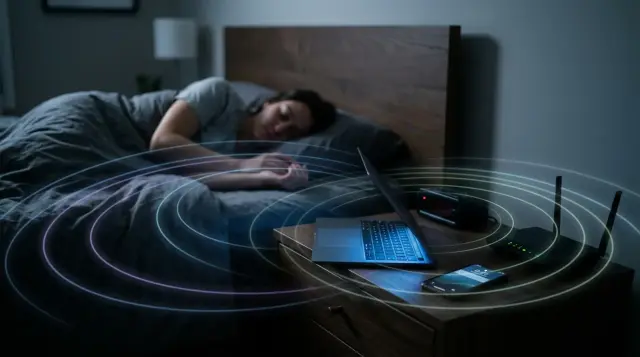
Your bedroom probably has more EM radiation sources than you think. I counted mine once and hit nine before I even got to the outlets behind the headboard. The average American bedroom contains five to ten EMF-emitting devices within six feet of the pillow, according to estimates from building biologists and EMF consultants who measure residential environments for a living.
The biggest offender? Your smartphone. Especially if it's charging on the nightstand while connected to cellular and WiFi networks at the same time. A 2020 measurement study by researchers at the Swiss Federal Institute of Technology (ETH Zurich) found that smartphones in active standby mode emit RF pulses at irregular intervals throughout the night as they communicate with cell towers and download background data. Those pulses measure between 0.1 and 0.5 V/m at a distance of one foot.
WiFi routers come next, and they're often overlooked because they're "in the other room." But walls don't stop radiofrequency radiation. They reduce it, sure. A standard 2.4 GHz router can still produce measurable fields through multiple walls, though. If your router sits on the other side of the wall from your headboard, you're bathing in RF all night. Smart speakers, baby monitors, Bluetooth devices, and even electric blankets all pile on to the total load.
Here's where things get practical. The WHO's International Agency for Research on Cancer (IARC) classified radiofrequency electromagnetic fields as Group 2B, meaning "possibly carcinogenic to humans," back in 2011 [3]. That classification was based primarily on cell phone studies, but the underlying biology applies to any RF source near your body for extended periods. And nothing puts a device near your body for longer than sleeping next to it for eight hours. For a deeper look at reducing these exposures room by room, Low-EMF Home Design: A Complete Guide is a solid resource.
Can What You Wear to Bed Reduce EMF Exposure?
This is where things get interesting for anyone who thinks about what they put on their body. Yes, what you wear can actually make a difference. EMF-shielding fabrics are real, measurable, and increasingly available in everyday clothing. They work by incorporating conductive fibers, typically silver or stainless steel, into the textile weave. The result is a partial Faraday cage effect around your body.
Independent lab testing has shown that silver-threaded fabrics can attenuate up to 99% of RF radiation in the 30 MHz to 10 GHz range. That covers WiFi, Bluetooth, and cellular frequencies. The key factor is the density of the conductive fiber and the completeness of coverage. A shirt covers your torso. Gold polos with silver-fiber construction from brands like Proteck'd EMF Protection offer shielding that looks like something you'd actually want to wear. No tinfoil suit. No bad science fiction movie vibes.
I think this is the part most people get wrong. They hear "EMF-blocking clothing" and picture something bulky or bizarre. But companies like Proteck'd have figured out how to blend shielding technology into gold polos and other styles that look sharp enough for the golf course or the office. Their Faraday EMF Collection uses silver-infused fabrics that you genuinely can't tell apart from regular performance wear by touch or appearance. Wondering if the investment makes sense? EMF-Blocking Clothing: Is It Worth It? breaks down the cost-benefit analysis.
Quick Q&A
Q: Can silver-fiber clothing really block EMF radiation?
A: Yes, lab-tested silver-threaded fabrics can block up to 99% of radiofrequency radiation in the 30 MHz to 10 GHz range, covering WiFi, cellular, and Bluetooth frequencies.
For nighttime use specifically, wearing an EMF-shielding top, whether it's a gold polo style or a sleep-friendly tee, creates a buffer zone around your upper body where organs like the heart and brain are most vulnerable. It won't wipe out all exposure. But it significantly reduces the dose your body absorbs during those critical eight hours of circadian rest.
Your body does its deepest repair work during sleep, and the research increasingly suggests that the electromagnetic fields surrounding your bed may be interfering with that process. Reducing your nighttime EMF exposure is one of the simplest, most overlooked ways to invest in better rest.

Why Do Some Studies on EMF and Sleep Conflict?
If the science were perfectly clear, everyone would already be doing something about it. But EMF research is messy. Honestly, that's one reason I find it so fascinating. Some studies find clear effects on sleep quality. Others find nothing. So what gives?
The biggest issue is dosimetry. That's just a fancy word for how precisely you measure the exposure. According to researchers at the BioInitiative Working Group, many older studies used sham exposure protocols that didn't adequately control for background EMF levels in the lab itself. If your control group is already being exposed to EMF from building wiring and nearby cell towers, your comparison gets muddled. A 2020 commentary in the International Journal of Environmental Research and Public Health specifically called this out as a systemic weakness in the field.
There's also the issue of individual sensitivity. Not everyone responds to electromagnetic radiation the same way. Research from Umeå University in Sweden has documented that some individuals show measurable EEG changes at exposure levels that produce no detectable response in others. This variability makes it hard to produce the kind of clean, universally reproducible results that journal editors love.
Then there's funding bias. A 2007 meta-analysis published in Environmental Health Perspectives found that industry-funded studies were significantly less likely to report biological effects from EMF exposure than independently funded research [4]. That doesn't mean all industry research is wrong. But it does mean you should check who paid for the study before you draw conclusions. The NIEHS and WHO continue to call for more independent research, and for good reason.
Despite these complications, the trend line in the literature is moving toward acknowledgment of non-thermal biological effects. The old argument was simple: if electromagnetic radiation doesn't heat tissue, it can't do anything. That position is getting harder to defend as more evidence accumulates. For families trying to make decisions now rather than waiting for perfect data, Protecting Your Family from 5G Radiation: What Actually Works offers a balanced look at practical options.
What Practical Steps Can You Take Tonight?
You don't need to rip the wiring out of your walls. Start with the easy wins. Move your phone at least six feet from your bed, or better yet, stick it in another room on airplane mode. That single change eliminates one of the largest RF sources in most bedrooms. Instantly. If you use your phone as an alarm, buy a $10 battery-powered alarm clock. Problem solved.
Turn off your WiFi router at night. Most routers have a scheduling feature that lets you set an automatic shutoff from, say, 11 p.m. to 6 a.m. You're not using it while you sleep, so there's literally no downside. If your router doesn't have this feature, a simple outlet timer from any hardware store works just fine.
Think about what you're wearing. This is where gold polos and other EMF-shielding garments from Proteck'd come in. Wearing a silver-fiber top to bed provides passive protection for your torso, heart, and upper organs without requiring any behavior change beyond getting dressed. The EMF Protection Benefits page explains how the shielding technology works in detail, and their designs are comfortable enough to genuinely sleep in.
Consider your bedroom layout, too. Don't place your bed against a wall that has the electrical panel on the other side. Avoid positioning your headboard near a cluster of outlets. Unplug anything you're not actively using. Each of these small adjustments chips away at your cumulative exposure during the hours when your body is supposed to be in deep recovery mode. For a complete framework, EMF Blocking for Better Sleep: The Complete Guide covers everything from bedroom placement to fabric choices.
Does 5G Make the Bedroom EMF Problem Worse?
5G is the elephant in the room, so let's talk about it. Fifth-generation cellular networks use a broader spectrum of frequencies than previous generations, including millimeter waves in the 24 to 100 GHz range. These higher frequencies don't penetrate walls as well as older 4G signals. That means carriers need more small cell antennas, often placed on utility poles in residential neighborhoods. The net result? More sources of RF, closer to homes.
According to the FDA's ongoing review of radiofrequency biological effects, current evidence does not establish that 5G frequencies pose a unique health risk compared to earlier cellular technologies. However, the FDA also acknowledges that long-term exposure data for millimeter-wave frequencies is extremely limited because the technology is so new. We simply don't have 20-year studies yet.
What we do know is that the total electromagnetic load in the average home has jumped dramatically over the past decade. A 2021 measurement survey by the IT'IS Foundation in Zurich documented average residential RF power density increases of 200% to 300% between 2012 and 2021 in urban areas. More sources. Higher aggregate exposure. Your bedroom sits right in the middle of it all.
This is exactly why proactive shielding strategies make sense even if the science on any single frequency isn't conclusive. Gold polos and other EMF-protective clothing from Proteck'd's Faraday EMF Collection address the full RF spectrum, not just one technology. Whether the signal hitting your body is 4G, 5G, WiFi, or Bluetooth, the silver-fiber fabric doesn't care. It attenuates all of them.
How Is EMF Exposure Measured in Sleep Studies?
If you're going to evaluate the research, you need to understand the measurements. EMF exposure in sleep studies is typically quantified in two ways: electric field strength (measured in volts per meter, V/m) and magnetic flux density (measured in microtesla, µT, or milligauss, mG). For radiofrequency specifically, researchers use power density measured in microwatts per square centimeter (µW/cm²).
The International Commission on Non-Ionizing Radiation Protection (ICNIRP), which sets exposure guidelines followed by most countries, recommends a general public limit of 10 W/m² for RF frequencies between 2 and 300 GHz. Building biologists who specialize in healthy homes typically recommend far lower levels for sleeping areas. Often below 0.001 W/m². That's 10,000 times stricter than the ICNIRP guideline.
Why such a massive gap? ICNIRP guidelines are based solely on preventing thermal effects, meaning tissue heating. They don't account for the non-thermal biological effects like melatonin suppression and altered sleep spindle activity that the research we discussed earlier has documented. It's a bit like setting a speed limit based only on whether the car explodes, with zero consideration for fender benders.
For home measurement, you can pick up an EMF meter like the Trifield TF2 (about $180) to get a rough picture of your bedroom's electromagnetic environment. It won't give you lab-grade precision, but it will tell you whether your exposure levels fall in the range where researchers have observed biological effects. A lot of people are genuinely shocked by what they find behind their headboard.
Frequently Asked Questions
Q: Does WiFi affect sleep quality?
Research suggests it can. WiFi routers emit continuous radiofrequency radiation, and studies have shown that RF exposure alters EEG patterns during non-REM sleep. Moving your router farther from the bedroom or turning it off at night is one of the simplest ways to cut this exposure.
Q: How far should my phone be from my bed?
At least six feet, or ideally in another room altogether. RF power density drops off rapidly with distance thanks to the inverse square law, so even a few extra feet makes a real difference in your overnight exposure.
Q: Can EMF-blocking clothing help me sleep better?
Yes. EMF-shielding garments made with silver-threaded fabrics reduce the amount of radiofrequency radiation your body absorbs during sleep. Proteck'd's Faraday Collection includes gold polos and other tops designed for both daytime wear and nighttime protection.
Q: Is 5G more dangerous for sleep than 4G?
There's no conclusive evidence that 5G frequencies are uniquely more harmful than 4G. That said, 5G deployment increases the total number of RF sources near homes because of the need for more small cell antennas. The cumulative effect of more sources is the primary concern.
Q: What is the best EMF meter for home use?
The Trifield TF2 (roughly $180) is a popular consumer-grade option that measures electric fields, magnetic fields, and RF radiation. It won't match lab precision, but it's reliable enough to identify hotspots in your bedroom and guide practical changes.
Q: Does airplane mode on my phone eliminate EMF?
Airplane mode shuts down RF emissions from cellular, WiFi, and Bluetooth radios. The phone still produces a small ELF-EMF from its battery and circuitry, though. It's a major reduction, not absolute zero. Putting it in another room is the most effective step.
Q: How does silver fabric block EMF radiation?
Silver is highly conductive. When woven into fabric, it creates a mesh that reflects and absorbs electromagnetic radiation, the same principle behind a Faraday cage. Lab-tested silver-threaded textiles can attenuate up to 99% of RF in the 30 MHz to 10 GHz range.
Q: Are children more sensitive to EMF during sleep?
Potentially, yes. The WHO notes that children's developing nervous systems may be more susceptible to environmental exposures, including EMF. Their thinner skulls and higher tissue conductivity mean RF radiation penetrates deeper relative to body size. Reducing bedroom EMF is especially worth considering for kids.
Q: Do electric blankets emit harmful EMF?
Electric blankets produce ELF-EMF from their heating elements and wiring, pressed directly against your body for hours. Several building biologists recommend avoiding them entirely, or at minimum preheating the bed and unplugging the blanket before you get in.
Q: What does the WHO say about EMF and health?
The WHO's International Agency for Research on Cancer classified radiofrequency electromagnetic fields as Group 2B (possibly carcinogenic to humans) in 2011. The WHO continues to monitor the research and has called for further studies on long-term and non-thermal biological effects of EMF exposure.
References
- National Institute of Environmental Health Sciences (NIEHS) – NIEHS funds research into EMF biological effects including potential impacts on melatonin production and circadian rhythms
- Environmental Research (via ScienceDirect) – A 2019 systematic review found ELF-EMF exposure was associated with a 21% reduction in nocturnal melatonin metabolites
- IARC / WHO – IARC classified radiofrequency electromagnetic fields as Group 2B (possibly carcinogenic to humans) in 2011
- Environmental Health Perspectives (NIH) – A 2007 meta-analysis found industry-funded EMF studies were significantly less likely to report biological effects than independently funded research
About the Author
Proteck'd EMF Apparel
Health & EMF Specialists
The Proteck'd team covers EMF protection, silver-fiber apparel, and practical ways to reduce everyday radiation exposure. Every piece Proteck'd ships is designed, tested, and worn by the people who build it.
Get the Free EMF Home Audit Checklist
A room-by-room PDF that walks you through the biggest EMF sources in your house and what to do about each one. No cost, no fluff.
Download the Checklist →✓30-day returns✓Free shipping✓Free returns✓Silver fiber shielding


Dejar un comentario