


15 Fascinating Facts About Electromagnetic Radiation: That Will Change How You See the World

Right now, as you read this sentence, billions of invisible waves are passing through your walls, your clothes, and your body. Not science fiction. Just a normal day.
If you've ever gone looking for physics facts mind-blowing enough to drop at a dinner party, you're in the right place. Electromagnetic radiation sounds intimidating until you realize it explains everything from why the sky is blue to why your phone gets warm against your ear. And honestly? The deeper you look, the weirder it gets.
I've spent a lot of time reading through the research on EM radiation. What keeps surprising me is how little most of us know about forces we interact with every single day. We live inside an ocean of electromagnetic fields and barely give it a thought.
So here are 15 facts that range from jaw-dropping to genuinely practical. Some come from quantum mechanics, some from everyday engineering, and a few might change how you think about the gadgets sitting on your nightstand. Let's get into it.
What Exactly Is Electromagnetic Radiation?
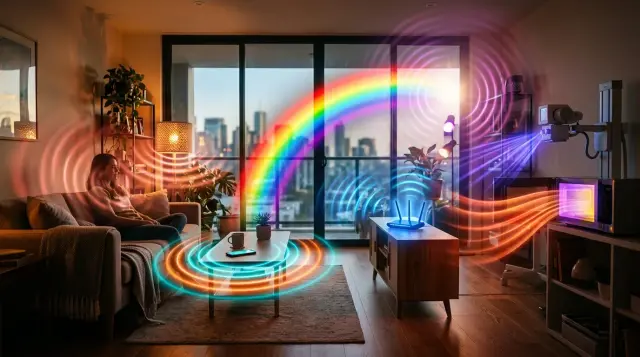
Before we get to the fun stuff, let's nail down the basics. Electromagnetic radiation is energy that travels through space in waves, and it doesn't need a medium to move through. Unlike sound, which requires air or water, EM radiation zips through the vacuum of space without a problem. That's how sunlight reaches us after crossing 93 million miles of absolute nothingness.
The electromagnetic spectrum is enormous. One end has radio waves with wavelengths longer than a football field. The other end has gamma rays with wavelengths smaller than an atom's nucleus. Visible light, that tiny sliver your eyes can actually detect, makes up less than 0.0035% of the entire spectrum according to NASA [1].
Here's the thing that blows people's minds: every single type of electromagnetic radiation, from the radio waves in your car stereo to the X-rays at your dentist's office, travels at exactly the same speed. In a vacuum, that's 299,792,458 meters per second. The only difference between them is wavelength and frequency. That's it. Same fundamental phenomenon, wildly different effects on the world.
Quick Q&A
Q: Do all forms of electromagnetic radiation travel at the same speed?
A: Yes, in a vacuum all electromagnetic radiation travels at the speed of light: 299,792,458 meters per second, regardless of whether it's a radio wave or a gamma ray.
Does Your Microwave Use the Same Radiation as Your WiFi Router?
This one catches people off guard. Your microwave oven and your WiFi router both operate at around 2.4 GHz. They're literally using the same frequency of electromagnetic radiation. The difference? Your microwave pumps out about 1,000 watts of power into a shielded metal box, while your router emits roughly 0.1 watts into the open air.
That power difference is massive, but the underlying physics is identical. Both devices produce non-ionizing radio frequency radiation that excites water molecules. In the microwave, that excitation heats your leftovers. From your router, the signal is so weak it just carries data. Percy Spencer, an engineer at Raytheon, accidentally discovered microwave cooking in 1945 when a radar set melted a chocolate bar in his pocket.
This fact is one of the reasons people start looking into how to reduce their EMF exposure at home. When you realize the same type of radiation cooking your food is also continuously flowing through your living room, it's natural to want to understand the line between harmful and harmless levels. If you're curious about practical steps, you can Learn About EMF Protection and what shielding actually does.
For a deeper look at the science behind electromagnetic fields and your body, check out these 12 Mind-Blowing Facts About Electromagnetic Radiation we covered previously.
You've never truly touched anything in your entire life. What you feel as solidity is electromagnetic repulsion between electron clouds. The universe is stranger, more beautiful, and more interconnected than our everyday senses reveal.
Can Light Really Be a Particle and a Wave at the Same Time?
Yes. And it's arguably the strangest confirmed fact in all of physics. Light behaves as a wave when you're not measuring it and as a particle (called a photon) when you are. This isn't a metaphor. It's been demonstrated in laboratories thousands of times since Thomas Young's famous double-slit experiment in 1801.
In 2012, researchers at the University of Bristol used quantum detectors to observe single photons passing through a double slit. The photons created an interference pattern, behaving like waves, until a detector was placed at the slit to observe them. Then they acted like particles. The act of measurement literally changed the outcome.
This is called wave-particle duality, and it applies to all electromagnetic radiation. Richard Feynman, the Nobel Prize-winning physicist at Caltech, once said this experiment contains "the only mystery" in quantum mechanics. Everything else, he argued, flows from it. If you want more physics facts that make you question reality, we've written about how bizarre the quantum world gets in our post on 12 Fascinating Tech Facts That Sound Too Weird to Be True.

How Fast Does Electromagnetic Radiation Actually Travel?
We mentioned the speed of light earlier, but let's put it in perspective. At 299,792,458 meters per second, light could circle the Earth 7.5 times in a single second. It reaches the Moon in about 1.3 seconds. From the Sun to Earth? About 8 minutes and 20 seconds.
According to Einstein's theory of special relativity, published in 1905, this speed isn't just fast. It's the absolute cosmic speed limit. Nothing with mass can ever reach it. As an object approaches the speed of light, its mass effectively increases toward infinity, requiring infinite energy to push it faster. That's not an engineering limitation. It's a law of physics.
NASA deals with this limit every day. When they communicate with the Mars rovers, signals traveling at light speed still take between 4 and 24 minutes to arrive, depending on where Mars is in its orbit. There's no way to speed that up. No technology will ever fix it. The universe simply has a maximum speed, and electromagnetic radiation is the thing that hits it.
Why Did the WHO Classify RF Radiation as Possibly Carcinogenic?
In 2011, the World Health Organization's International Agency for Research on Cancer (IARC) classified radiofrequency electromagnetic fields as Group 2B, meaning "possibly carcinogenic to humans" [2]. This put RF radiation in the same category as pickled vegetables and talcum powder. Not a definitive danger, but enough evidence to warrant attention.
The classification was based largely on the Interphone study, a multinational research project involving 13 countries. It found a possible link between heavy cell phone use (30 minutes per day over 10 years) and glioma, a type of brain cancer. The results were not conclusive, which is exactly why the classification landed on "possible" rather than "probable" or "confirmed."
Since then, the U.S. National Toxicology Program completed a $30 million study in 2018 that found "clear evidence" of heart tumors in male rats exposed to high levels of RF radiation similar to 2G and 3G cell phone emissions [3]. The debate continues, but the science is getting harder to wave away.
This is one of those areas where practical steps make sense even before all the research is in. Reducing exposure through distance, limiting screen time before bed, or wearing Faraday Collection shielding garments are all straightforward strategies. For more on how your body interacts with these invisible forces, take a look at 10 Mind-Blowing Facts About How Your Body Works.
Is It True That Atoms Never Actually Touch Each Other?
Technically, yes. The atoms in your body, in your chair, in everything you've ever "touched," never make physical contact. What you feel as solid matter is actually electromagnetic repulsion between electron clouds. When you sit in a chair, the electrons in your body and the electrons in the chair push against each other, and that repulsion is what holds you up.
So you've never truly touched anything in your entire life. You're hovering, right now, about an angstrom (one ten-billionth of a meter) above whatever surface you think you're resting on. The feeling of solidity is an electromagnetic illusion.
Rutherford's gold foil experiment at the University of Manchester in 1911 first revealed that atoms are mostly empty space. If an atom were the size of a football stadium, the nucleus would be a marble at the 50-yard line. Everything else is just electric fields. The fact that you feel solid at all tells you just how powerful electromagnetic forces are at close range.
How Much EMF Does Your Phone Actually Emit?
Every cell phone sold in the United States must comply with the FCC's Specific Absorption Rate (SAR) limit of 1.6 watts per kilogram, averaged over 1 gram of tissue [4]. In the European Union, the limit is 2.0 W/kg averaged over 10 grams of tissue. These standards were set in the 1990s and haven't been updated since, despite how dramatically our phone habits have changed.
In 2019, the Chicago Tribune commissioned independent lab testing on popular smartphones and found that several models exceeded FCC SAR limits when tested at 2mm from the body, the distance most people actually hold their phones. The FCC's testing protocol allows phones to be positioned up to 25mm away. That gap between lab conditions and real-world use is something worth knowing about.
Quick Q&A
Q: What is the FCC's SAR limit for cell phones in the United States?
A: The FCC limits cell phone RF emissions to a Specific Absorption Rate (SAR) of 1.6 W/kg averaged over 1 gram of tissue, a standard set in the 1990s.
If you're looking into how to reduce your daily EMF exposure, the simplest step is distance. Using speakerphone or a wired headset dramatically cuts the RF energy reaching your head. And for those who want another layer of protection throughout the day, Proteck'd EMF Protection offers wearable options that incorporate conductive fabrics designed to shield against radio frequency radiation.
Can Particles Really Tunnel Through Solid Walls?
Quantum tunneling sounds like it belongs in a comic book, but it's real and it's happening inside your body right now. In quantum mechanics, particles don't have a fixed position. They exist as probability clouds. And sometimes, that probability extends to the other side of a barrier that classical physics says should be impossible to cross.
The effect is tiny at human scales but enormous at the subatomic level. The Sun depends on it. Inside the Sun's core, hydrogen nuclei don't actually have enough energy to overcome their electromagnetic repulsion and fuse together. Classical physics says fusion shouldn't happen at the Sun's core temperature of about 15 million degrees Celsius. But quantum tunneling lets those protons "cheat" and pass through the energy barrier, enabling the nuclear fusion that powers all life on Earth.
George Gamow first applied quantum tunneling to nuclear physics in 1928 at the University of Göttingen. Without this phenomenon, stars wouldn't shine. You wouldn't be reading this. It's one of those physics facts that amazes you precisely because the universe operates on rules that don't match everyday experience at all.
What Is Quantum Entanglement, and Why Did Einstein Hate It?
Quantum entanglement is what Einstein famously called "spooky action at a distance." When two particles become entangled, measuring one instantly determines the state of the other, no matter how far apart they are. Not "really fast." Instant. Even if they're on opposite sides of the galaxy.
Einstein thought this proved quantum mechanics was incomplete. He co-authored the EPR paradox paper in 1935 with Boris Podolsky and Nathan Rosen, arguing that hidden variables must be explaining the correlation. He was wrong. In 1964, physicist John Bell at CERN developed Bell's theorem, and later experiments, most notably Alain Aspect's tests at the University of Paris-Sud in 1982, confirmed that entanglement is real and no hidden variables can account for it.
In 2022, the Nobel Prize in Physics was awarded to Aspect, John Clauser, and Anton Zeilinger specifically for their experiments establishing the reality of entanglement. It's not a thought experiment anymore. It's the foundation of quantum computing, quantum encryption, and possibly the next generation of communication technology. The universe really is that strange.
Does Distance from a Device Actually Reduce Your EMF Exposure?
Absolutely, and by more than you might expect. Electromagnetic field strength follows the inverse-square law: double your distance from a source, and the intensity drops to one quarter. Triple the distance, it drops to one ninth. This is why the difference between pressing your phone against your head and using speakerphone at arm's length is enormous in terms of RF exposure.
According to the National Institute of Environmental Health Sciences (NIEHS), simple behavioral changes like keeping your phone away from your body, not sleeping with it under your pillow, and using wired earbuds can significantly reduce daily exposure to radio frequency radiation [3].
This is actually one of the most practical how to reduce EMF tips backed by real physics. The math doesn't lie. At 12 inches from your phone versus zero inches, you've reduced your exposure by roughly 99%. That's not marketing. That's the inverse-square law doing its thing. For additional protection, especially if you work near multiple devices all day, EMF-shielding fabrics like those in the Faraday Collection use conductive materials to deflect and absorb radio frequency energy before it reaches your skin.
Why Does Gravity Bend Light If Photons Have No Mass?
This is one of my favorite paradoxes in physics. Photons are massless, yet gravity bends their path. If gravity only pulled on mass, light should travel in perfectly straight lines forever. But it doesn't. Einstein's general theory of relativity, published in 1915, explained why: gravity isn't a force pulling on mass. It's a curvature of spacetime itself.
Light always travels in a straight line through spacetime. But when spacetime is curved by a massive object like a star or a black hole, the "straight line" itself bends. The photon isn't being deflected. The fabric of reality is warped around it.
This was confirmed during the solar eclipse of May 29, 1919, when Arthur Eddington measured starlight bending around the Sun by exactly the amount Einstein predicted. The result made Einstein a worldwide celebrity overnight. Today, astronomers use this gravitational lensing to see galaxies hidden behind other galaxies, bending their light around obstacles like a cosmic magnifying glass.
We've covered more about how EM radiation interacts with the physical world in our post on 7 Mind-Blowing Facts About Electromagnetic Radiation.
Is the Universe Really Expanding Faster Than the Speed of Light?
Yes, and it doesn't violate Einstein's cosmic speed limit. Here's why: relativity says nothing can travel through space faster than light. But space itself can expand at any rate it pleases. And right now, distant galaxies are receding from us faster than 299,792,458 meters per second because the space between us is stretching.
In 1998, two independent research teams, the Supernova Cosmology Project led by Saul Perlmutter at Lawrence Berkeley National Laboratory and the High-z Supernova Search Team led by Brian Schmidt and Adam Riess, discovered that this expansion is actually accelerating. They won the 2011 Nobel Prize in Physics for the discovery. The cause? Something called dark energy, which makes up about 68% of the universe according to NASA's WMAP data. And we have almost no idea what it is.
This means there are galaxies whose light will never reach us, no matter how long we wait. They've crossed what cosmologists call the "cosmic event horizon." The observable universe is getting smaller, even as the total universe gets bigger. Let that sit for a moment.
How Does EMF Shielding Fabric Actually Work?
EMF shielding works on the same principle as a Faraday cage, named after Michael Faraday, who built the first one in 1836. When a conductive material surrounds or covers a space, it redistributes electromagnetic charges across its surface, preventing the fields from passing through. The electromagnetic radiation gets reflected or absorbed instead of reaching whatever's on the other side.
Modern EMF-shielding fabrics weave conductive metals like silver, copper, or nickel into textiles. The effectiveness depends on the conductivity of the metal, the tightness of the weave, and the frequency of the radiation being blocked. Silver-threaded fabrics, for instance, can block upwards of 99% of RF radiation in the WiFi and cellular frequency ranges when properly constructed.
This isn't fringe science. It's applied physics. The same principles protect sensitive electronics in aerospace, medical devices in hospitals, and classified communications in government facilities. If you're looking for everyday wearable options that put these physics principles to work and help you reduce personal EMF exposure, Proteck'd EMF Protection builds this shielding technology into clothing you'd actually want to wear.
What Are Some Practical Ways to Reduce EMF Exposure at Home?
Let's get concrete. If the physics facts above have you thinking more carefully about EM radiation in your own space, here are some steps grounded in actual science. First, distance is your best friend. Keep your WiFi router in a central location rather than right next to where you sleep or work. Even moving it from your desk to across the room makes a measurable difference, thanks to the inverse-square law we talked about earlier.
Second, switch your phone to airplane mode at night. Your phone cycles through connections to cell towers, WiFi, and Bluetooth constantly, even while you sleep. Airplane mode eliminates all RF emissions from the device. Third, use wired internet connections where practical. An Ethernet cable produces zero RF radiation compared to WiFi's continuous 2.4 or 5 GHz broadcast.
Fourth, be mindful of smart home devices. Each one is another source of RF emissions. Smart speakers, smart thermostats, baby monitors, security cameras. They all transmit wirelessly. Audit which ones you actually need and consider wired alternatives. The National Institute of Environmental Health Sciences recommends reducing exposure as a precautionary approach, especially given ongoing research into long-term effects [3].
And fifth, consider what you're wearing. This might sound unusual, but EMF-shielding clothing is built on sound electromagnetic principles. The Faraday Collection uses conductive fabric technology to create a wearable barrier between you and ambient RF radiation. Think of it as the inverse-square law meets your wardrobe.
Why Do These Physics Facts Matter for Everyday Life?
Here's the thing that ties all 15 of these facts together: electromagnetic radiation isn't abstract. It's not locked away in labs and textbooks. It's the light in your kitchen, the signal in your pocket, the warmth from the sun on your face. Understanding how it works isn't just intellectually satisfying. It's practically useful.
When you know that RF exposure follows the inverse-square law, you make different choices about where you put your phone at night. When you understand that wave-particle duality is real, you start to appreciate that the universe operates on principles far stranger than our gut instincts suggest. And when you learn that a $30 million federal study found evidence of biological effects from RF radiation, you take the question of how to reduce exposure more seriously.
Physics isn't just for physicists. These facts affect your health, your technology, and your understanding of reality itself. The electromagnetic spectrum is the stage on which your entire life plays out, and knowing how it works gives you a kind of awareness that most people never bother to acquire.
Key Takeaways
Frequently Asked Questions
What is electromagnetic radiation in simple terms?
Electromagnetic radiation is energy traveling through space as waves of electric and magnetic fields. It includes everything from radio waves and microwaves to visible light, ultraviolet rays, X-rays, and gamma rays. All forms travel at the speed of light but differ in wavelength and frequency.
Is WiFi radiation the same as microwave radiation?
Yes, WiFi routers and microwave ovens both operate at approximately 2.4 GHz, so they use the same frequency of radio wave radiation. The big difference is power output: a microwave oven pushes about 1,000 watts into a shielded cavity, while a router emits roughly 0.1 watts into open air.
Does the WHO consider cell phone radiation dangerous?
The WHO's International Agency for Research on Cancer classified radiofrequency electromagnetic fields as Group 2B, or 'possibly carcinogenic to humans,' in 2011. That's not a definitive danger classification, but it signals enough evidence to warrant further study and precautionary measures.
How can I reduce EMF exposure from my phone?
The most effective step is distance. Use speakerphone or wired earbuds instead of holding the phone against your head. Switch to airplane mode at night, keep the phone off your body when possible, and consider EMF-shielding accessories or clothing for additional protection.
What is the SAR limit for cell phones in the United States?
The FCC limits cell phone Specific Absorption Rate (SAR) to 1.6 watts per kilogram averaged over 1 gram of tissue. This standard was set in the 1990s. The European Union uses a higher limit of 2.0 W/kg averaged over 10 grams.
Does EMF shielding fabric really work?
Yes, it works on the same principle as a Faraday cage. Conductive metals like silver or copper are woven into textile fibers, creating a barrier that reflects or absorbs electromagnetic radiation. High-quality silver-threaded fabrics can block over 99% of RF radiation in common WiFi and cellular frequencies.
How does the inverse-square law apply to EMF exposure?
The inverse-square law means electromagnetic field intensity drops proportionally to the square of the distance from the source. Double your distance from a phone or router, and your exposure drops to one quarter. At 12 inches versus zero inches, exposure falls by roughly 99%.
Can electromagnetic radiation pass through walls?
It depends on the type and frequency. Radio waves and microwaves, including WiFi signals, pass through most walls easily, which is why you get WiFi in other rooms. Higher-frequency radiation like visible light and UV rays are blocked by ordinary walls. X-rays can penetrate soft tissue but are stopped by dense materials like lead.
What is wave-particle duality?
Wave-particle duality is the quantum mechanical principle that electromagnetic radiation behaves as both a wave and a particle. Light creates interference patterns like a wave but hits detectors as individual photons like particles. Thomas Young's double-slit experiment first demonstrated this back in 1801.
Are there any mind-blowing physics facts about how atoms work?
One of the most surprising facts is that atoms are over 99.9% empty space, and the atoms in your body never actually touch anything. What you feel as physical contact is electromagnetic repulsion between electron clouds. Rutherford's 1911 gold foil experiment at the University of Manchester first proved this atomic structure.
References
- International Agency for Research on Cancer (IARC/WHO) – IARC classified radiofrequency electromagnetic fields as Group 2B (possibly carcinogenic to humans) in 2011.
- National Institute of Environmental Health Sciences (NIEHS) – The National Toxicology Program found clear evidence of heart tumors in male rats exposed to high levels of RF radiation, and NIEHS recommends practical steps to reduce cell phone RF exposure.
- Federal Communications Commission (FCC) – The FCC limits cell phone SAR to 1.6 W/kg averaged over 1 gram of tissue.
About the Author
Proteck'd EMF Apparel
Health & EMF Specialists
The Proteck'd team covers EMF protection, silver-fiber apparel, and practical ways to reduce everyday radiation exposure. Every piece Proteck'd ships is designed, tested, and worn by the people who build it.
Protect Yourself Today
Proteck'd Faraday and silver fiber apparel is engineered to shield your body from everyday EMF exposure. Built for real life, tested for real results.
Shop EMF Protection →✓30-day returns✓Free shipping✓Free returns✓Silver fiber shielding


Dejar un comentario